Mobius Digital
Company
4 documents in the library are about Mobius Digital, from writers such as DiGRA, Press Start and University of Melbourne. Each has a summary and key insights with the page they come from.
Connections
Each row is a game or company named alongside Mobius Digital, each column a document, oldest first. A mark means that document names it. Select a row to see those documents.
Documents about Mobius Digital
World Annihilation Operations Database
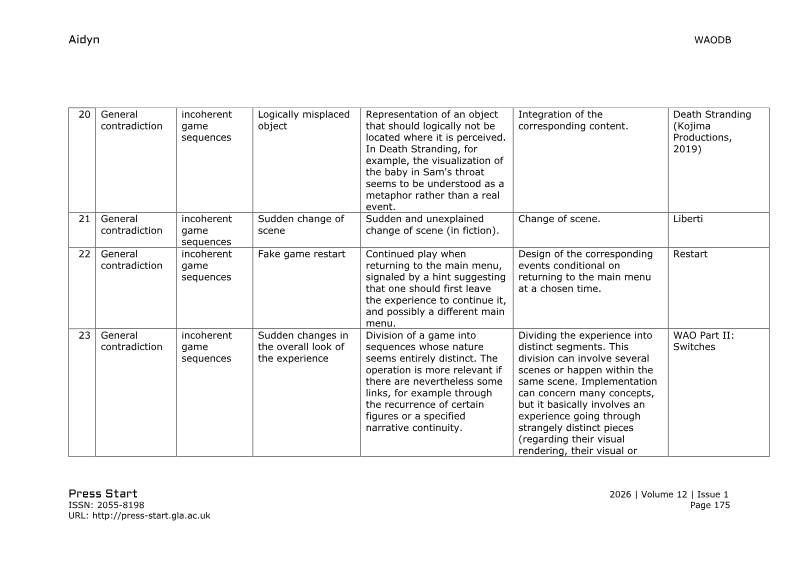
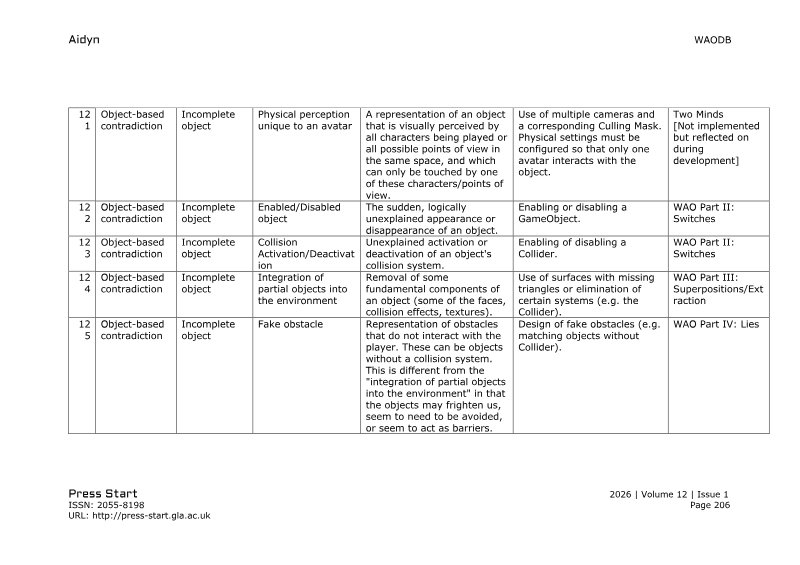
The World Annihilation Operations Database functions as a comprehensive research-creation framework designed to categorize and implement intentional logical contradictions within video game environments.
- The World Annihilation Operations Database (WAODB) provides a structured typology of logical contradictions—such as incoherent physics, spatial discontinuities, and contradictory narrator statements—that developers can intentionally implement as creative design tools.
- Logical contradictions in games can be generated through specific technical operations like using Culling Masks to create objects visible only to specific avatars or employing custom shaders to simulate infinite recursive space.
- The database categorizes contradictions into distinct types, including contradictory indications, sound, spatial composition, object-centered inconsistencies, and multiple/incoherent identities.
The Playful Pleasures of the Videogame Detective Board
This paper, by Cassandra Barkman of the University of Melbourne, examines the detective board as a dual ludic and narrative device in videogames.
- The paper argues that the detective board is both a ludic and narrative device, shaping player behaviour and narrative sensemaking, and reveals a close relationship between videogame narrative design and detective fiction.
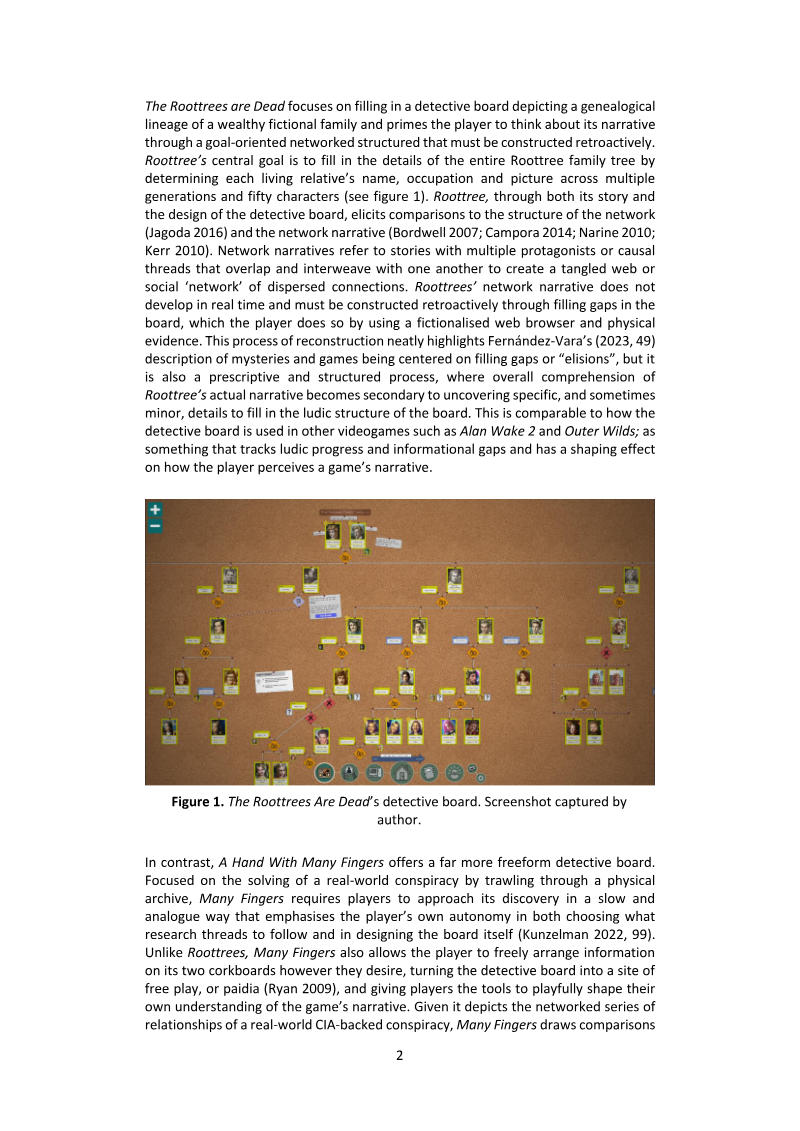
- The Roottrees are Dead uses a structured, goal-driven board: a genealogical network of roughly fifty relatives across several generations that players must reconstruct retroactively by identifying names, occupations, and images.
- The paper contends that the Roottrees board's prescriptive structure can make overall narrative comprehension secondary to uncovering minor details needed to complete the board.
Temporalised Hyperobjects and Affective Play in Outer Wilds
The paper "Temporalised Hyperobjects and Affective Play in Outer Wilds" investigates how the video game Outer Wilds makes vast, incomprehensible cosmic phenomena emotionally accessible through the concept of "temporalised hyperobjects."
- Outer Wilds is analysed through the concept of 'temporalised hyperobjects', using Timothy Morton's idea of phenomena too massively distributed across time and space for human perception to grasp, such as climate change or nuclear radiation.
- Morton's five hyperobject traits (viscosity, nonlocality, temporal undulation, phasing, interobjectivity) are mapped onto three temporal structures in the game: recursive, entropic, and diasporic.
- The game's 22-minute time loop makes 'viscosity' tangible: knowledge persists across loops via the spaceship interface and the Scout Launcher, so repetition becomes cosmological attunement rather than mere constraint.
Fighting Against Return: A Taxonomy of Time Loops in Digital Games
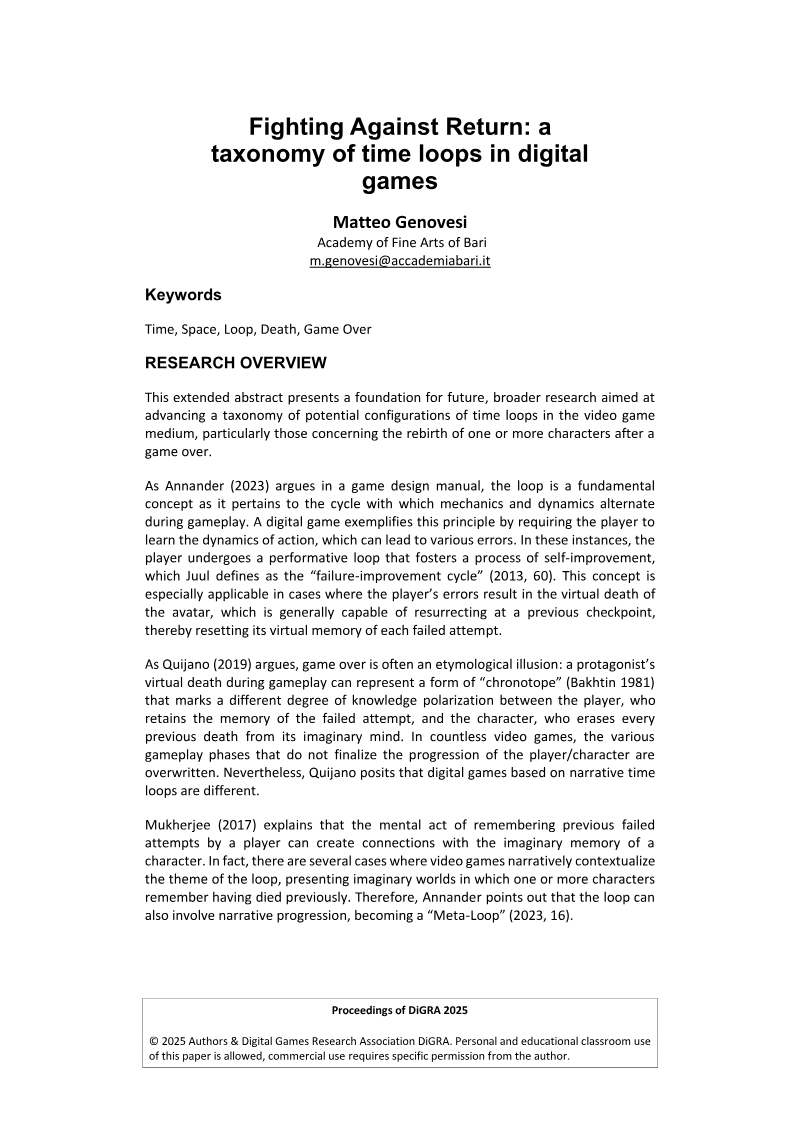
This research outlines a foundational taxonomy for time loops in digital games, specifically focusing on instances where character rebirth occurs after a "game over" state.
- The report proposes a taxonomy of time loop configurations in digital games, focused on how characters are reborn after a game over, and argues that loops are a foundational structure of play.
- It links Juul's 'failure-improvement cycle' to narrative cases where the character forgets previous deaths while the player remembers, and introduces the term 'Meta-Loop' for loops that extend from mechanical repetition into narrative progression.
- The author argues that the implementation of loops is inseparable from the navigable spaces players traverse.
