Adam
Company
Documents about Adam
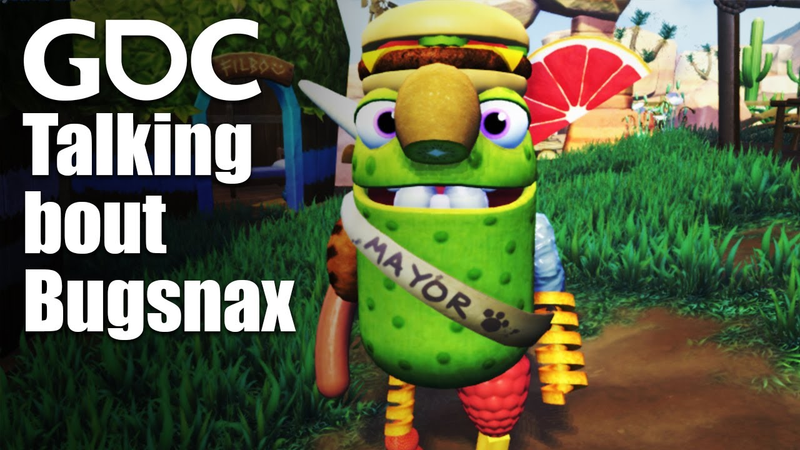
John Murphy, Kevin Zuhn and Adam Saltsman on 'Bugsnax'
The development of Bugsnax represents a deliberate pivot from a systemic, arcade-style prototype toward a character-focused narrative experience.
- The core narrative and mechanical theme of Bugsnax was built on the concept that the creatures are parasitic and harmful, despite the characters' desire to consume them.
- The development team spent the first year of production on a version of the game that was on-rails and featured a strict separation between town-based management and creature hunting, which they ultimately scrapped to allow for free-roaming exploration.
- Young Horses moved away from combat-based mechanics, instead focusing on a systemic approach where the player acts as a journalist and therapist helping Grumpuses resolve personal issues.

GDC Plays Afterparty with game director Adam Hines
Afterparty explores the intersection of comedy and adventure through the journey of two friends navigating Hell to outdrink Satan.
- Night School Studio's Afterparty development process relied on an 1,800-page script, with game director Adam Hines writing 80% to 90% of the content.
- The studio employs a rigorous iterative workflow, conducting two to three rounds of rewrites after initial implementation to ensure gameplay mechanics and dialogue timing function correctly.
- Afterparty incorporates a drinking mechanic that serves as a puzzle-solving system, allowing players to manipulate character personality types to overcome obstacles like bypassing bouncers.
Math for Game Programmers: The Math of Deep Learning
Deep learning functions as a specialized form of differentiable computing, where developers construct large, complex computational graphs to approximate functions that map inputs to outputs.
- Deep learning functions as differentiable computing, utilizing massive computational graphs with billions of parameters to approximate complex functions that map inputs to outputs.
- The primary utility of deep learning is its ability to process high-dimensional data, such as audio, video, and images, to identify complex decision surfaces that traditional rule-based systems cannot.
- Training relies on gradient-based optimization and backpropagation, which use the chain rule to iteratively adjust weights despite the non-convex nature of the problem.

GDC Plays Overland with Finji co-founder Adam Saltsman
Overland serves as a case study in minimalist, turn-based strategy design, prioritizing emotional stakes and tactical vulnerability over the traditional power-fantasy tropes common in the post-apocalyptic genre.
- Overland was designed to evoke player vulnerability and fear rather than the traditional power-fantasy loop found in many post-apocalyptic strategy games.
- The development team prioritized 'proportional warning' for random events, ensuring that players receive a multi-turn heads-up before reinforcements or threats appear on the map.
- Procedural generation in the game utilizes a system of placement masks and 'wild card' modifiers, which act as cascading overrides to determine level layout and resource distribution.
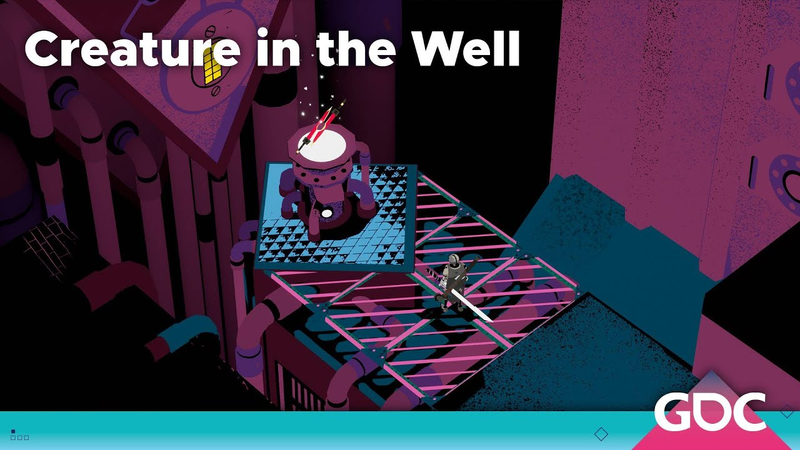
GDC Plays Creature in the Well with Adam Volker
Creature in the Well represents a distinct fusion of genres, blending traditional dungeon crawling with pinball mechanics to create a unique "pinbrawler" experience.
- Flight School Studio created a 'pinbrawler' genre fusion by replacing traditional combat mechanics with pinball-style energy ball launching to power a factory.
- The development team utilized a 70/30 design rule, blending familiar genre tropes with novel mechanics to ensure the game remained intuitive while offering a fresh challenge.
- To maintain mechanical depth and narrative cohesion, the studio rejected procedural generation in favor of a handcrafted, iterative design approach.
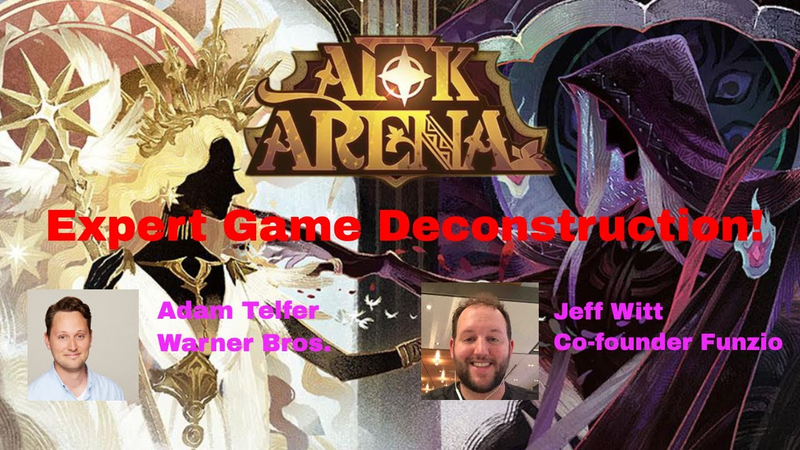
AFK Arena Game Deconstruction | Game Design Analysis with Jeff Witt & Adam Telfer
AFK Arena represents a significant evolution in the mobile RPG landscape, successfully merging traditional collectible character mechanics with the low-friction accessibility of the idle genre.
- AFK Arena achieved 8.7 million downloads and $40 million in net revenue following its late 2018 launch by merging collectible RPG mechanics with idle game accessibility.
- The game utilizes a non-punitive progression system where every hero draw contributes to long-term growth, effectively eliminating the need for repetitive grinding.
- Designers implemented a stat-check approach across modes like the Arcane Labyrinth and Peaks of Time to incentivize the cultivation of deep, specialized rosters across six distinct factions.
Deus Ex: Human Revolution - How Games Explore Hard Real World Questions - Extra Credits
Deus Ex: Human Revolution serves as a compelling case study for how interactive media can explore complex philosophical and societal questions.
- Deus Ex: Human Revolution uses its cyberpunk setting to examine the societal implications of transhumanism and the ethical costs of replacing biological evolution with technological augmentation.
- The game functions as a parable for modern wealth inequality, highlighting the growing divide between those with access to life-altering technology and those left behind.
- By mirroring real-world disparities in education and economic opportunity, the narrative forces players to confront the consequences of a future where technological access determines social status.