Spiel|Formen
50 reports, presentations and talks by Spiel|Formen in the Game Industry Library, the newest “Herausforderungen beim Erhalt Software-basierter Kunst: ZKM Karlsruhe” (2023).
Documents
Herausforderungen beim Erhalt Software-basierter Kunst: ZKM Karlsruhe
The preservation of software-based art presents significant technical and logistical challenges due to the inherent fragility of electronic hardware and the rapid obsolescence of digital technologies.
- The ZKM Karlsruhe manages one of the world's largest media art collections, comprising approximately 10,000 works, of which about 220 are software-based.
- Preserving software-based art requires active maintenance, repair, and emulation rather than passive storage, as hardware components inevitably degrade over time.
- The ZKM employs a conservation strategy that prioritizes minimal code intervention and the preservation of the original socio-technological ecosystem.
Technologische Krisenerfahrung: Krisen im digitalen Spiel zwischen Bewältigungsstrategie und Metalepse
Digital games serve as a unique medium for navigating both concrete and fantastic crises, ranging from pandemic simulations to post-apocalyptic scenarios.
- Digital games serve as a coping mechanism for real-world crises, as evidenced by the surge in popularity of titles like 'Plague Inc.' during global epidemics and pandemics.
- The 'crash' or technical failure of a game acts as a metalepsis, forcing players to confront the hidden, fallible nature of the complex digital technologies they rely on.
- Post-apocalyptic narratives in games, such as the 'Fallout' series, function as a form of technology criticism by reflecting societal anxieties about systemic collapse and the destructive potential of scientific progress.
Technisierung des Menschlichen: Disruptionen naturalisierter Spielbegriffe
The rise of digital gaming during the 1980s precipitated a fundamental crisis in anthropocentric definitions of play, challenging the long-held assumption that play is an inherently irrational, human-centric constant.
- During the 1980s in West Germany, a pervasive cultural anxiety emerged regarding computer games, driven by the fear that digital interaction would diminish human empathy and lead to social disorientation.
- Early computer science critics, such as Joseph Weizenbaum in his 1977 work 'Die Macht der Computer und die Ohnmacht der Vernunft', argued that computerization fostered a formalist reduction of human experience and irrational thought.
- Academic discourse in the 1980s often framed the computer as a threat to human uniqueness, with researchers like Volpert (1987) predicting that computers would force life into a rigid 'telematics corner' by the year 2000.
SimCities und Simkrisen: Keynote at the International City Gaming Conference 2017
The SimCity series functions as a manifestation of capitalist realism, promoting a normative, growth-oriented ideology that obscures the complex social realities of urban life.
Provozierte Unruhe: Von Störungen und Entstörungen in Among Us
The social dynamics of digital gaming rely on a fragile, often invisible infrastructure of cooperation and mutual trust.
- Intentional disruptions of game rules, known as 'breachings,' serve as a research method to reveal the invisible social infrastructures and trust-based expectations that govern online gaming.
- In an observed session of Among Us, a player's deliberate 'trolling' forced the group to engage in 'entstörung' (restoration) processes, demonstrating that cooperation is not just a prerequisite but a continuous, active negotiation.
- The study highlights that trust in online gaming is a complex socio-technical arrangement involving the game platform, individual player behaviors, and the specific context of the gaming environment.
Mit klingendem Spiel: Musikalische Inszenierung von Krise und Eskalation in Videospielen
Video games function as sophisticated rhetorical environments where music serves as a primary mechanism for staging and communicating crises.
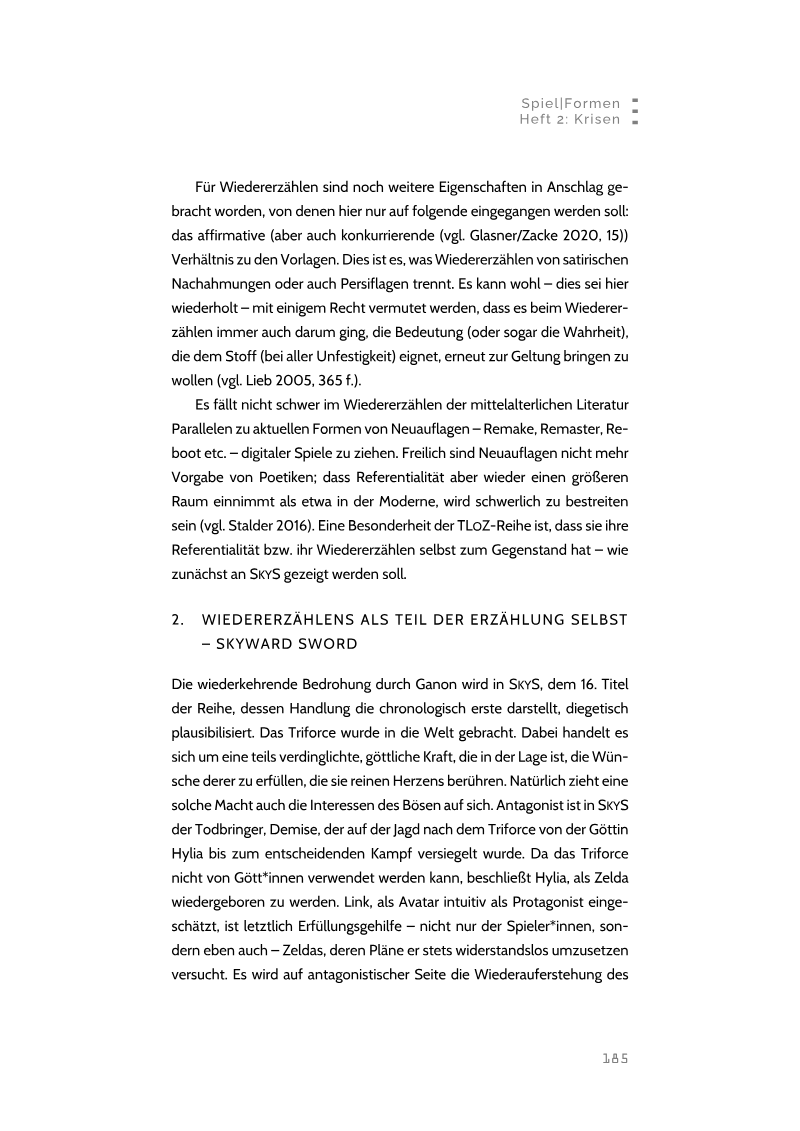
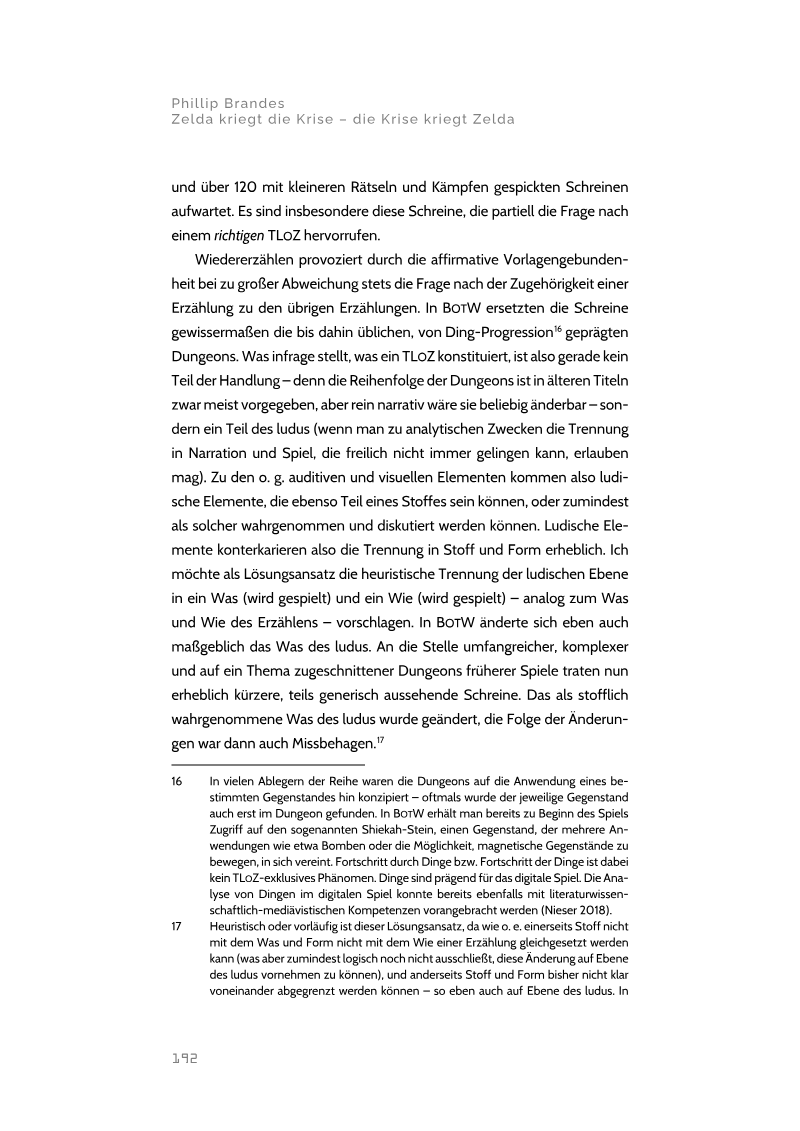
Zelda kriegt die Krise – Die Krise kriegt Zelda: Ein Beitrag zu Wiedererzählen, Stoff und Form
The Legend of Zelda series functions as a complex, modular network where narrative and ludic elements converge to create a persistent state of crisis.
- The Legend of Zelda series is fundamentally built on the concept of crisis, which serves as the primary narrative catalyst and aligns with the structural patterns of pre-modern literature where familiar material is repeatedly updated.
- The series functions through a cyclical, non-linear narrative where Ganon is a recurring, predictable threat rather than a one-time event, mirroring the way medieval epics were retold and reinterpreted over time.
- The distinction between 'Stoff' (content/subject matter) and 'Form' (the way of telling/playing) is increasingly blurred in modern game design, as ludic elements like weapon durability in Breath of the Wild impact both mechanics and the core narrative identity.
Losing the Game: How Blockchain and NFT Technology Turns Games Into Work
The integration of blockchain technology and non-fungible tokens (NFTs) into the gaming industry represents a regressive shift that transforms play into precarious labor.
- Play-to-earn (P2E) models, exemplified by Axie Infinity, function as a form of 'click-work colonialism' where middle-class investors from industrial nations profit from the labor of workers in low-income countries.
- Blockchain gaming represents a qualitative shift beyond traditional free-to-play monetization by exploiting players' fears of social decline and their desire for economic advancement in an era of polycrisis.
- The P2E model relies on a capitalist-worker dichotomy that strips games of their ludic value, effectively turning leisure into menial, precarious labor.
Lyonel Feininger's Locomotives and Trains: Experiencing Materials and Colors Through Toys as Learning Materials at the Bauhaus
This analysis examines the intersection of artistic design, industrial production, and pedagogical theory through the lens of Lyonel Feininger’s toy train designs and their role within the Bauhaus movement.
- Lyonel Feininger, a master at the Bauhaus, designed 'block trains' and miniature wooden buildings that served as both artistic sculptures and experimental learning materials for children.
- Feininger’s toy designs prioritized artistic abstraction over mechanical realism, exemplified by his patented train design that featured sliding rollers rather than functional wheels.
- The Bauhaus approach to toy design aimed to move beyond traditional pedagogical constraints, viewing play as an open-ended opportunity for children to engage in combination, reduction, and abstraction.
Papercrafting Utopia: Gaming Literacies from Bauhaus to Nintendo Labo
The Bauhaus movement’s pedagogical emphasis on material experimentation and constructive thinking finds a modern successor in Nintendo Labo.
- Nintendo Labo, launched in April 2018, serves as a modern pedagogical tool that bridges analog cardboard construction with digital gameplay through physical interfaces like the fishing rod's nylon thread.
- The design philosophy of Nintendo Labo mirrors Bauhaus 'Vorkurs' principles by emphasizing material experimentation, radical simplification, and the 'learning by doing' methodology championed by figures like László Moholy-Nagy.
- Nintendo Labo’s 'Toy-Con Garage' provides a rudimentary programming environment that allows users to move beyond pre-designed models to create custom inventions using 'if-then' logic.
Video Game Modding and Money: From Precarious Playbor to Reimbursed Labor of Love
The video game modding landscape is currently defined by a fundamental tension between the traditional ethos of a labor of love and the growing pressure to professionalize and monetize creative output.
- Modding is a massive, decentralized industry, with NexusMods alone hosting over 358,000 files for 1,600 games, resulting in more than 5.5 billion total downloads as of February 2022.
- The relationship between modders and developers is characterized by 'precarious playbour,' where hobbyists provide value-enhancing labor that often goes uncompensated, despite the industry frequently benefiting from their contributions.
- Attempts to formalize paid modding, such as the 2015 Steam Workshop initiative for 'The Elder Scrolls V: Skyrim,' failed due to community backlash regarding quality concerns, plagiarism, and the perceived corruption of a 'labor of love' culture.
Steam and the Platformization of Virtual Goods: An Analysis of the Weapon Skin Economy in Counter-Strike: Global Offensive
The weapon skin economy within Counter-Strike: Global Offensive serves as a definitive case study for the platformization of contemporary gaming.
- Valve’s Steam platform functions as a centralized infrastructure that commodifies user labor and play by integrating modding, content distribution, and a virtual goods marketplace into a single ecosystem.
- The weapon skin economy in Counter-Strike: Global Offensive exemplifies a 'virtual gig economy' where an anonymous, decentralized group of creators produces content for a platform owner that maintains asymmetric power and control.
- External gambling markets utilizing CS:GO skins reached significant scale, with an estimated 3 million people wagering $2.3 billion worth of skins on esports matches in 2015 alone.
Do you work at Spiel|Formen? Get a free report of how these documents are read and cited here.