Spiel|Formen
50 reports, presentations and talks by Spiel|Formen in the Game Industry Library, the newest “Misgendered by the Hobgoblin?: Queere Repräsentation im zeitgenössischen RPG Baldur's Gate 3” (2024).
Documents
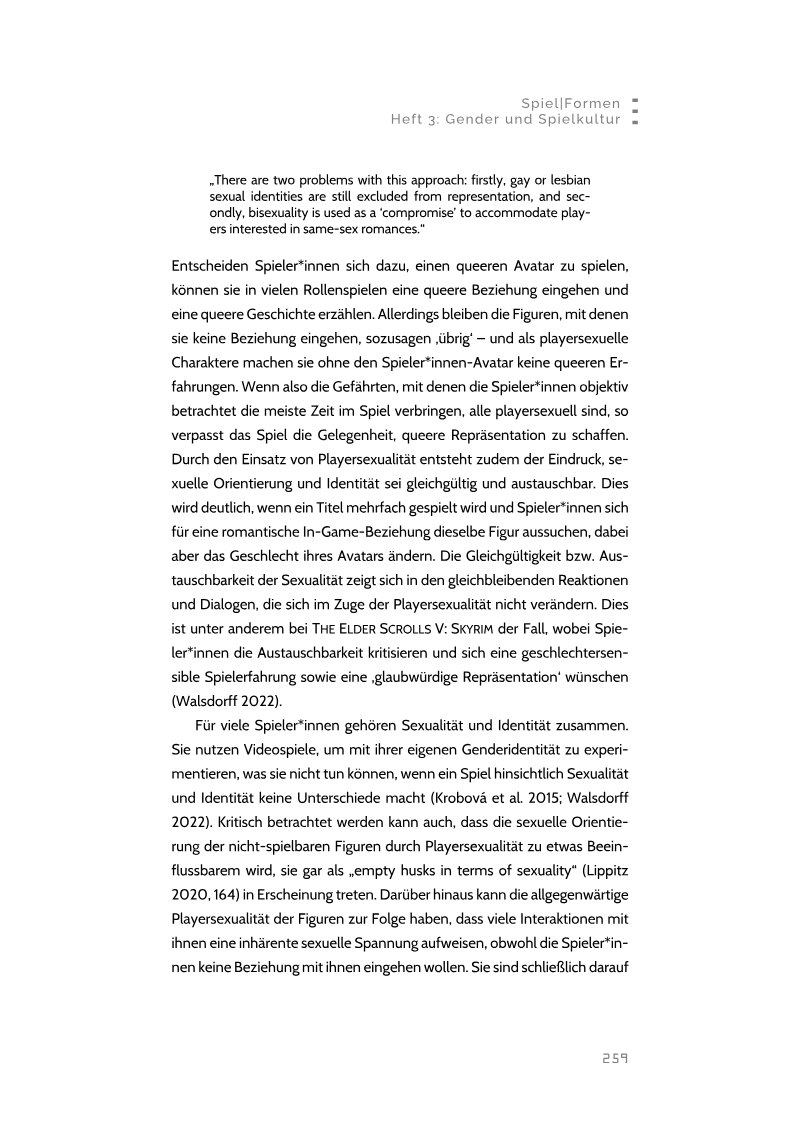
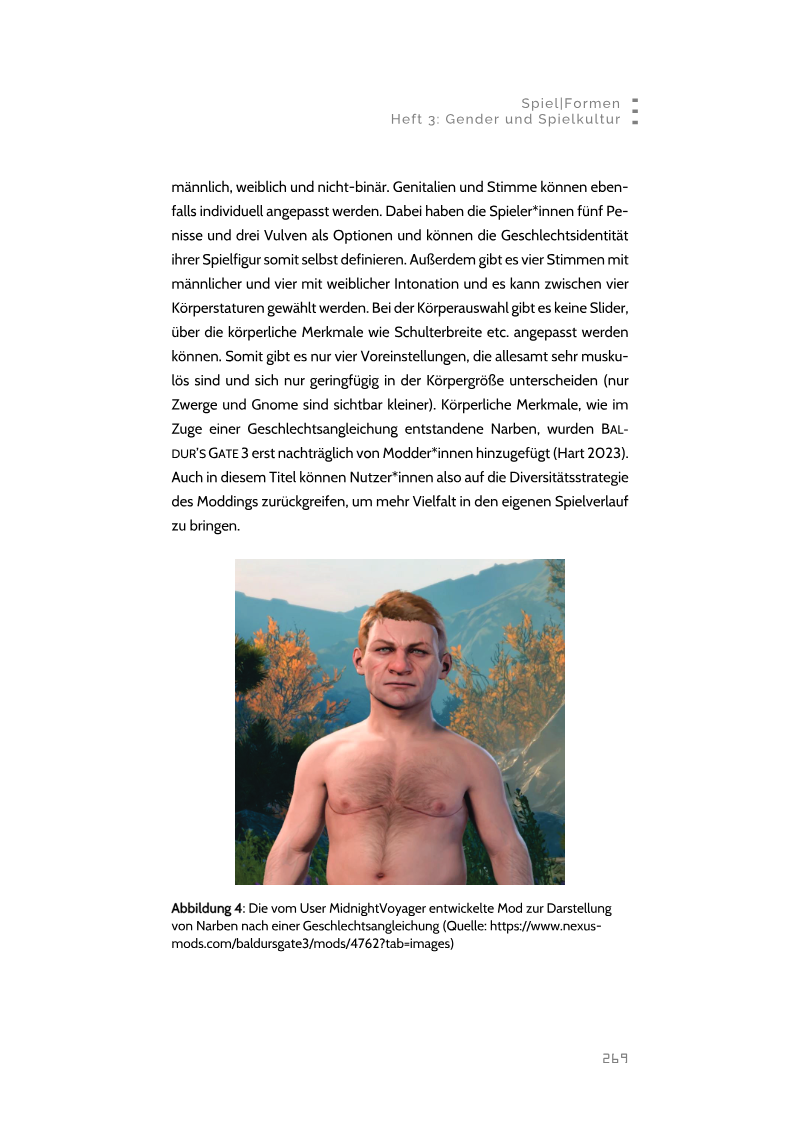
Misgendered by the Hobgoblin?: Queere Repräsentation im zeitgenössischen RPG Baldur's Gate 3
Contemporary role-playing games are undergoing a significant shift in how they handle LGBTQ+ narratives, moving away from historical industry tropes like queerbaiting and heteronormative defaults toward more explicit inclusion.
- Baldur's Gate 3, released in 2023, reached the Steam Top 10 with peak concurrent player counts of up to 800,000, serving as a primary case study for contemporary queer representation in RPGs.
- The game relies heavily on 'playersexuality,' a mechanic where NPC romantic interests are fluid and adapt to the player's avatar gender, often rendering queer identities invisible unless the player actively pursues them.
- While the game features explicit queer relationships, such as the lesbian romance between Dame Aylin and Isobel, many other queer-coded interactions remain optional, hidden, or subject to 'Schrödinger's Sexuality,' where orientation is only defined by player interaction.
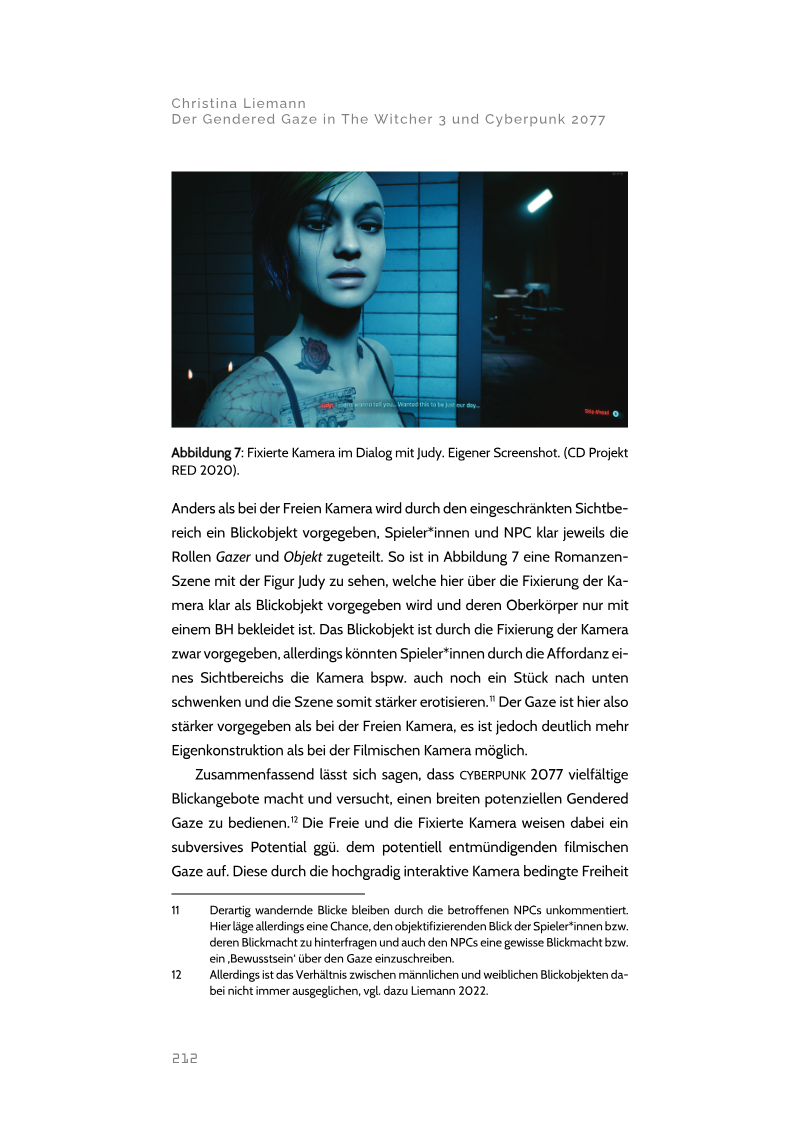
Der Gendered Gaze in The Witcher 3 und Cyberpunk 2077: Eine vergleichende Analyse
The gendered gaze in contemporary video games is fundamentally constructed through the interplay of interactive mechanics, camera positioning, and narrative design.
- The 'Critical Gazing' methodology demonstrates that the gendered gaze in video games is constructed through the interplay of camera mechanics, available objects of interest, and player interaction, rather than being solely predefined as in film.
- Cyberpunk 2077 (2020) utilizes highly interactive, homodiegetic camera mechanics that allow players to subvert the traditional male gaze by choosing what to observe, whereas The Witcher 3 (2015) employs restrictive, heterodiegetic camera types that enforce a predefined perspective.
- In The Witcher 3, the camera frequently acts as a mediator for the protagonist Geralt’s perspective, explicitly directing the player's view toward eroticized female bodies during dialogue and gameplay sequences.
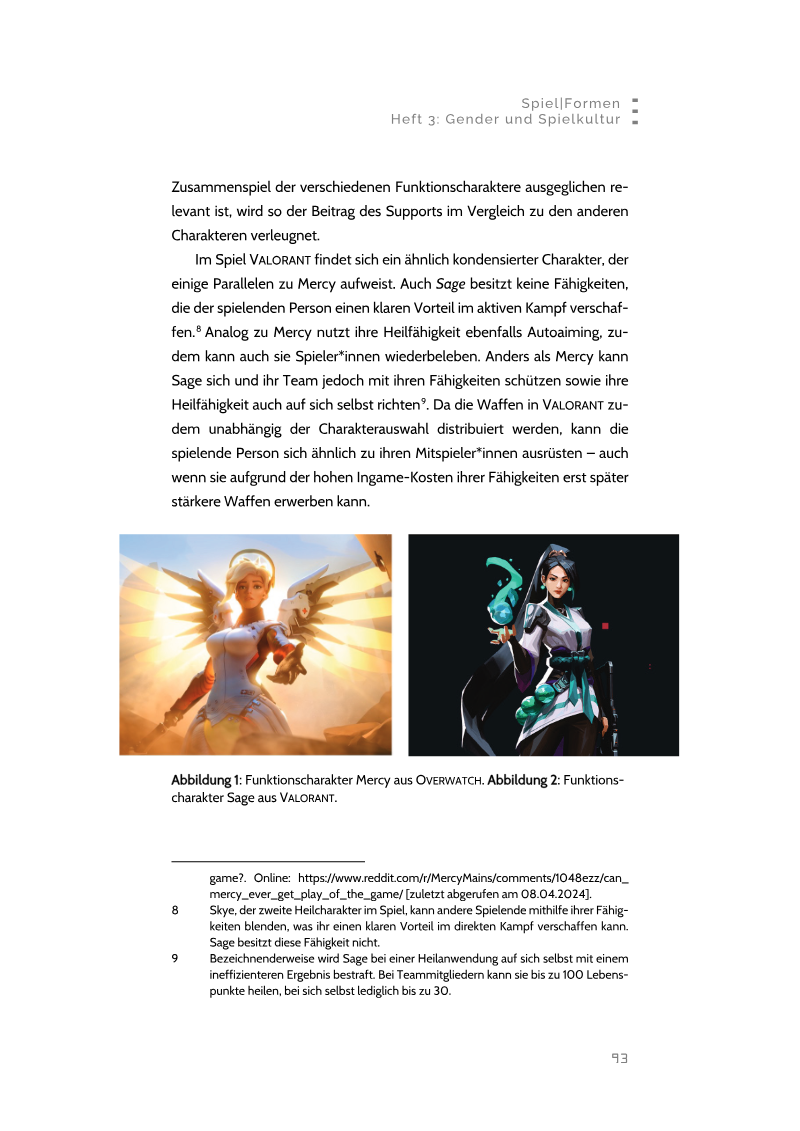
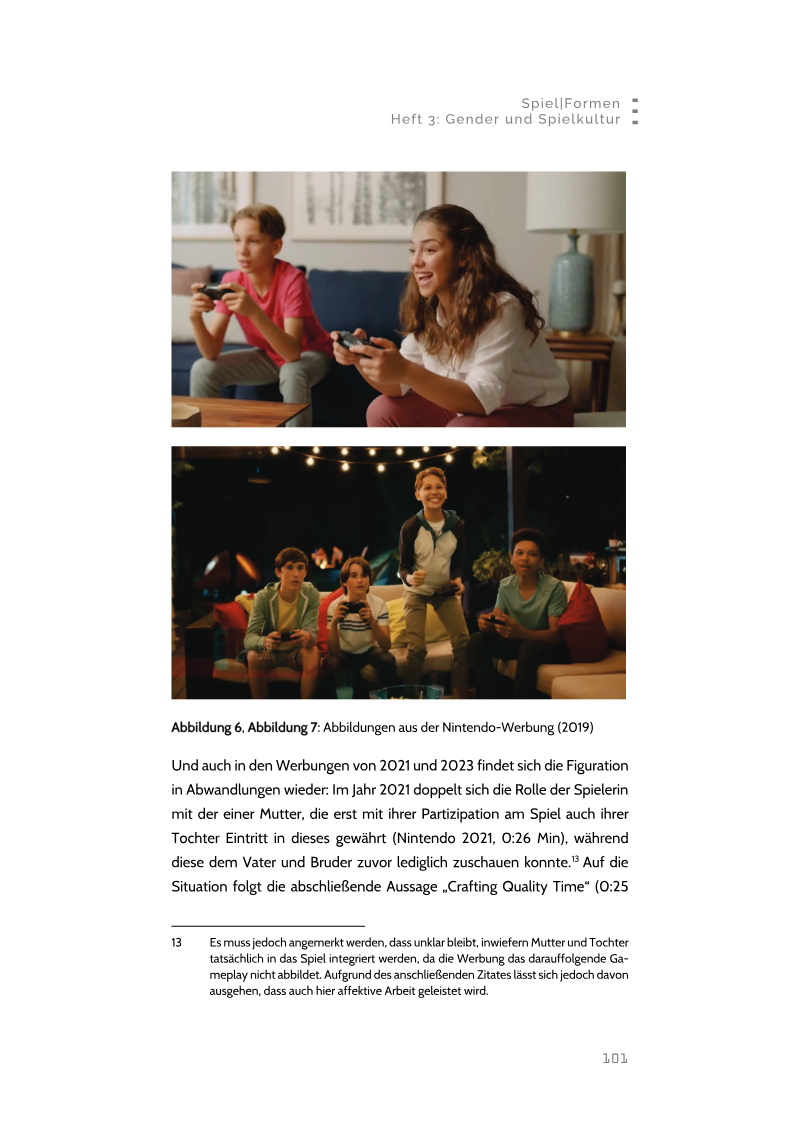
You Should've Been Mercy: The Discursive Representation of Women as Players
Gaming culture frequently marginalizes female participants by reinforcing gendered hierarchies that frame women as secondary facilitators rather than independent, skilled competitors.
- In male-coded gaming environments, female players are frequently relegated to the 'Mitspielerin' (co-player) role, a discursive figure that prioritizes affective care work over active, competitive participation.
- Support characters like Mercy in 'Overwatch' and Sage in 'VALORANT' reinforce gendered stereotypes by framing healing as a 'motherly' or 'divine' duty rather than a strategic skill.
- The 'Mitspielerin' role functions as a mechanism to limit female agency, often stripping players of recognition for their contributions while forcing them to facilitate the 'heroic' moments of male teammates.
Interview mit Nina Kiel: Einblicke in die Arbeit als Head of Diversity & Inclusion bei Flying Sheep Studios
The provided interview explores the role and implementation of Diversity, Equity, and Inclusion (DEI) initiatives within the German video game industry, specifically focusing on the experiences of a dedicated DEI lead at a mid-sized studio.
Für manche Frauen ist ein Vater mehr als genug: Ein Beitrag zum Erzählen von Geschlecht in Ghost of Tsushima
Ghost of Tsushima functions as a critical case study in how modern digital narratives negotiate the intersection of historical myth-making and gendered power dynamics.
- Ghost of Tsushima (Sucker Punch, 2020) utilizes female characters like Yuna, Lady Adachi, and Tomoe primarily as narrative tools to facilitate protagonist Jin Sakai’s internal conflict regarding his identity as a samurai and a man.
- While the game avoids sexualizing female characters and grants them significant agency, it relies on pejorative tropes—such as the 'vengeful widow' or the 'thief'—to define their roles within the patriarchal, pseudo-historical setting.
- The game’s narrative structure consistently undermines the effectiveness of female-coded 'non-samurai' tactics by having male authority figures, such as Lord Shimura and Sensei Ishikawa, repeatedly frame these methods as dishonorable or deviant.
Lara Croft: Modell, Medium, Cyberheldin
Lara Croft represents a transformative cultural phenomenon that transcends her origins as a digital protagonist to function as a universal media icon.
- Lara Croft emerged as a 'cultural icon' and universal medium by transcending the gaming market to appear in mainstream media, including Playboy, Spiegel, and Stern, and serving as a brand ambassador for companies like Sony and various consumer goods.
- The character's success was intrinsically linked to the 1994 launch of 32-bit platforms like the Sony PlayStation, which sold over 80 million units by the end of 2000 and revolutionized gaming through superior 3D graphics.
- Lara Croft functions as a 'virtual machine' that bridges the gap between hardware and user, effectively neutralizing gender differences for the player while simultaneously reinforcing traditional, hierarchical gender dualisms.
(Un-)Sicht- und Spielbarkeiten der Game Culture: Zum kritischen Umgang mit Repräsentation(en)
Game culture remains fundamentally shaped by a hegemonic, cis-male normative identity that frequently relegates minoritized subject positions to superficial or conditional roles.
- The game industry often treats diversity as a 'ready-made solution' for inclusion, but this frequently results in 'conditional recognition' where non-hegemonic identities are only accepted if they do not challenge the existing heteronormative status quo.
- Major industry players including Ubisoft, Nintendo, Sony Interactive Entertainment, Microsoft Xbox, and Electronic Arts utilize diversity and inclusion marketing to project an image of progress, yet these corporate strategies often fail to address deeper systemic biases.
- In titles like Metroid, the potential for non-binary representation is undermined by 'conditional recognition,' such as the reward system that forces the protagonist Samus Aran into a sexualized, gendered reveal at the end of the game.
Das Metagame der Männlichkeit: Geschlecht als die Bedingung der Möglichkeit des Spielens
Masculinity functions as a foundational metagame that dictates the cultural conditions under which play is defined and experienced.
„Andererseits sind die Mädchen sehr diskret“: Strip-Poker-Rezensionen in frühen Spielemagazinen
Between 1984 and 1994, German-language gaming magazines played a pivotal role in constructing a male-dominated, cis-heteronormative culture within the emerging digital entertainment industry.
Das Geschlecht der Medien: Methodologische Überlegungen zu einer Medienwissenschaft
This analysis examines the methodological foundations of media studies, specifically critiquing how traditional media theory has historically relied on binary, gendered, and apocalyptic metaphors.
- Media studies must address the dual nature of media as both 'useful tools' for communication and independent 'actors' that shape content and perception, often creating a 'vexierbild' (puzzle picture) effect where the medium disappears when the content is focused upon.
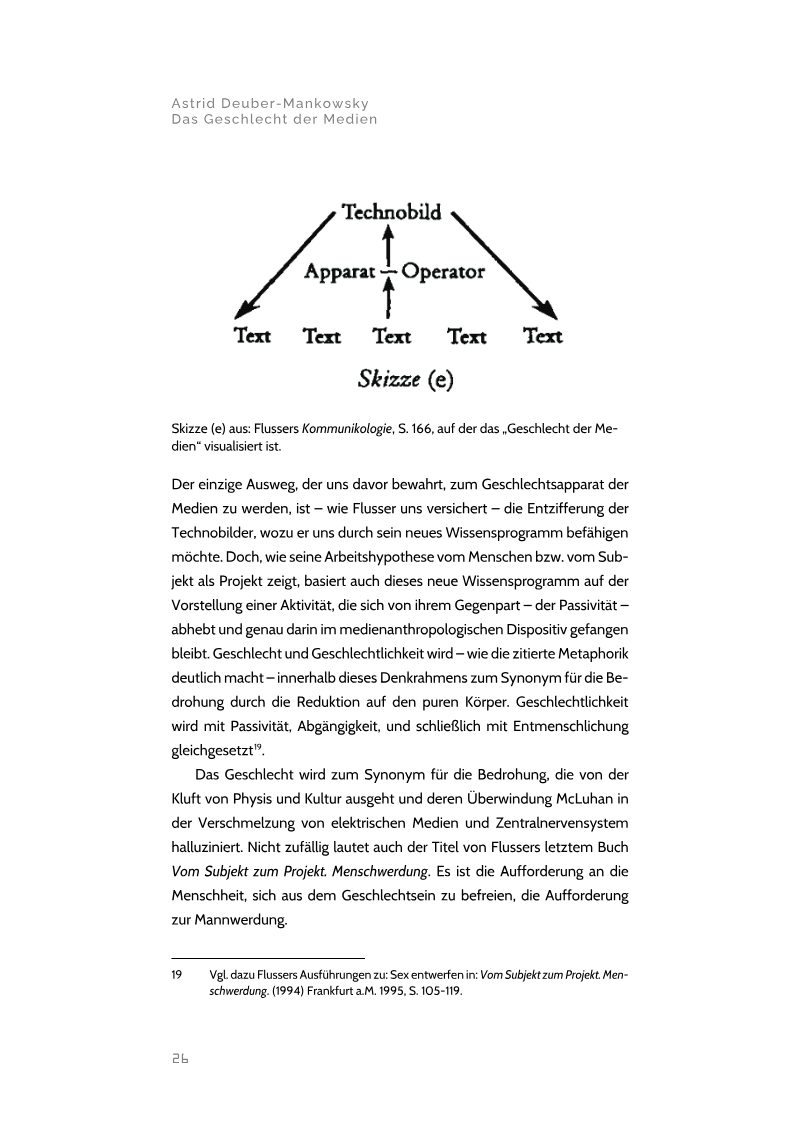
- Traditional media theory often relies on a binary, gender-hierarchical framework where 'masculine' activity is associated with control and 'feminine' passivity is linked to the threat of technological dehumanization.
- Prominent media theorists like Marshall McLuhan and Vilém Flusser utilize apocalyptic metaphors, framing the integration of humans and technology as either a loss of agency or a mystical 'short-circuiting' of the nervous system.
Krypto/Spiel/Krise: Wie Blockchain-Technologie und NFTs Spiele zu Arbeit werden lassen
The integration of blockchain technology and non-fungible tokens (NFTs) into the gaming industry represents a regressive shift that transforms play into precarious labor.
- Blockchain-based 'play-to-earn' models, exemplified by Axie Infinity, function as pyramid schemes that lack intrinsic value and rely solely on the continuous influx of new capital from speculative investors.
- The play-to-earn ecosystem typically exploits a labor dichotomy where investors from industrialized nations profit from the labor of 'click-workers' in low-income countries, effectively turning play into monotonous, low-wage work.
- The gaming industry’s push into NFTs and blockchain is an extension of aggressive monetization strategies seen in free-to-play games, where companies prioritize profit extraction over gameplay, as evidenced by character upgrades in Diablo Immortal costing up to $500,000.
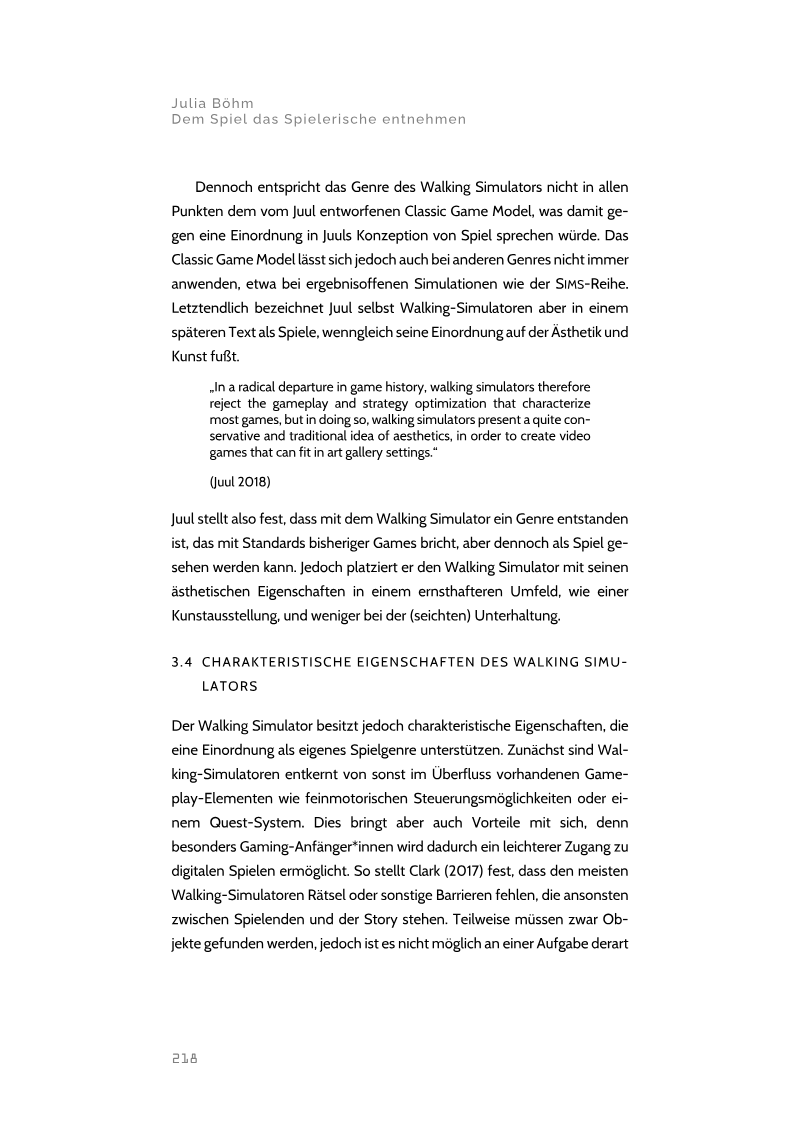
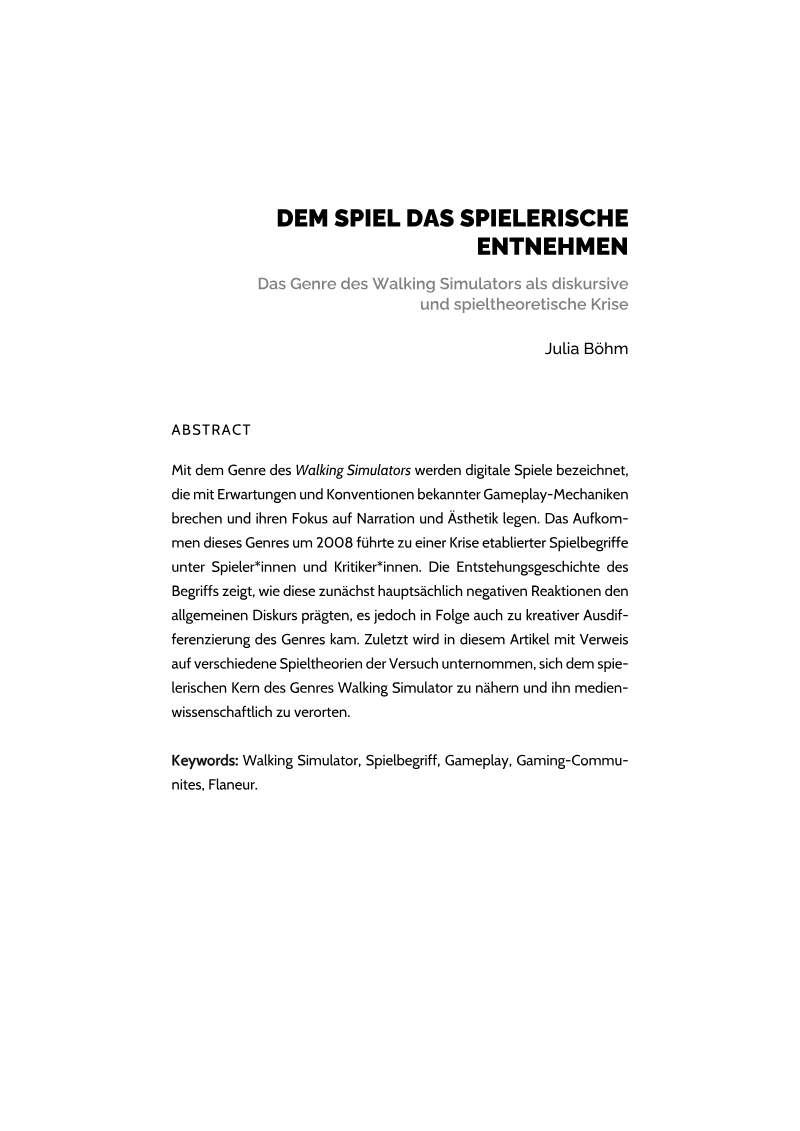
Dem Spiel das Spielerische entnehmen: Das Genre des Walking Simulators als diskursive und spieltheoretische Krise
The emergence of the walking simulator genre since 2008 represents a significant discursive and theoretical crisis within the video game industry.
- The 'Walking Simulator' genre emerged around 2008 as a disruptive category that challenged established gaming conventions by prioritizing aesthetics and narrative over traditional competitive mechanics.
- Early reception of the genre was characterized by intense backlash from gaming communities, with titles like 'Dear Esther' (2012) and Tale of Tales' 'The Path' (2009) being dismissed by critics as 'not games' due to their lack of challenge and action.
- The term 'Walking Simulator' originated as a pejorative label to describe titles perceived as boring or lazy, though it eventually became the industry-standard nomenclature despite academic efforts to introduce more neutral terms like 'First Person Walker' or 'Ambient Action Game'.
Do you work at Spiel|Formen? Get a free report of how these documents are read and cited here.