Spiel|Formen
50 reports, presentations and talks by Spiel|Formen in the Game Industry Library, the newest “Game | Play | Ability: Ein Laborbericht zu alternativen Spielweisen” (2025).
Documents
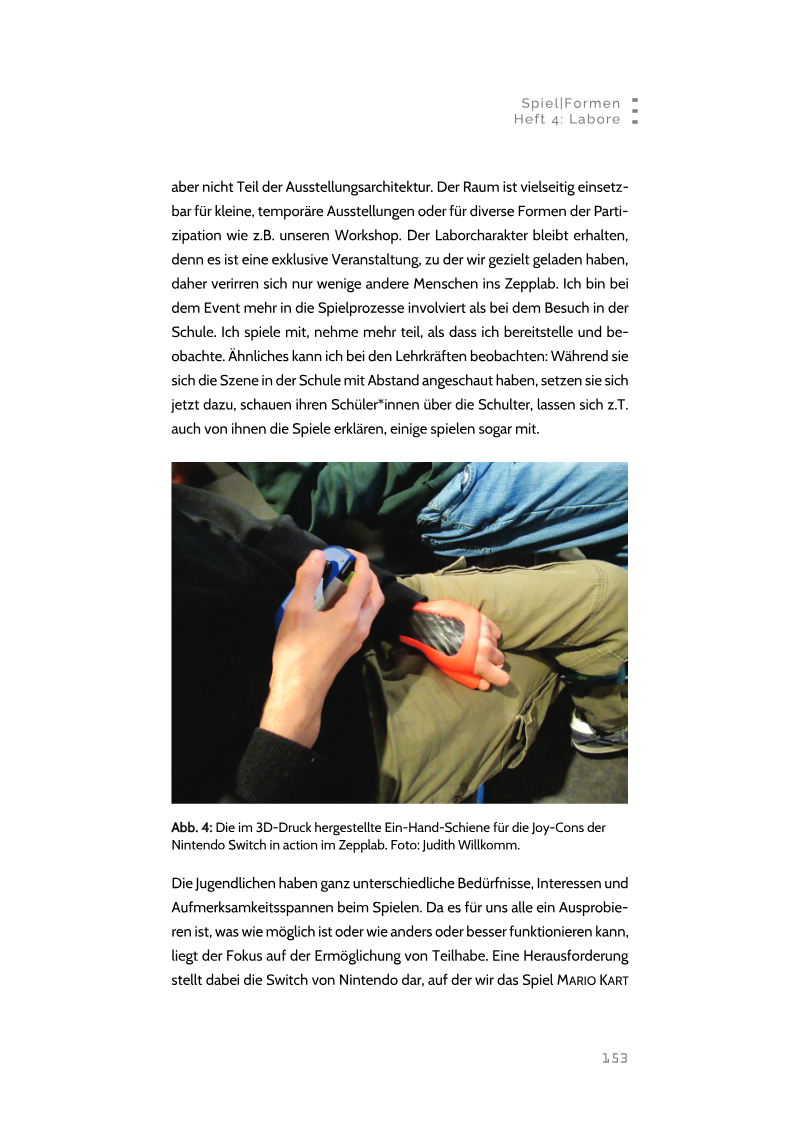
Game | Play | Ability: Ein Laborbericht zu alternativen Spielweisen
Game | Play | Ability investigates the intersection of accessible hardware design and inclusive gaming cultures within university-based laboratory environments.
- The project shifts the focus from creating specialized therapeutic games for people with disabilities to enabling participation in mainstream gaming communities to foster social connection.
- Researchers utilized the Xbox Adaptive Controller and custom button configurations to transform inaccessible games into inclusive, shared player experiences.
- Field experiments at a special education center demonstrated that collaborative input methods—where multiple users operate different buttons simultaneously—create new, experimental forms of gameplay.
Warum und wozu braucht man 50 Jahre alte Computer?: Retro Computing Lab an der Uni Würzburg
The Retro Computing Lab at the University of Würzburg serves as a research and educational facility dedicated to the study of historical digital culture.
- The Retro Computing Lab at the University of Würzburg preserves digital history by maintaining approximately 20 original vintage computer and console systems, rather than relying on emulators.
- The lab emphasizes that modern digital culture is rooted in historical techno-social transformations that began in the 1970s and 1980s, necessitating the study of original hardware to understand the evolution of software and interface design.
- Operational challenges include the degradation of cathode-ray tube (CRT) monitors, the need for analog-to-digital converters, and the difficulty of reading legacy storage media like 3.5-inch, 5.25-inch, and 3-inch disks or audio cassettes.
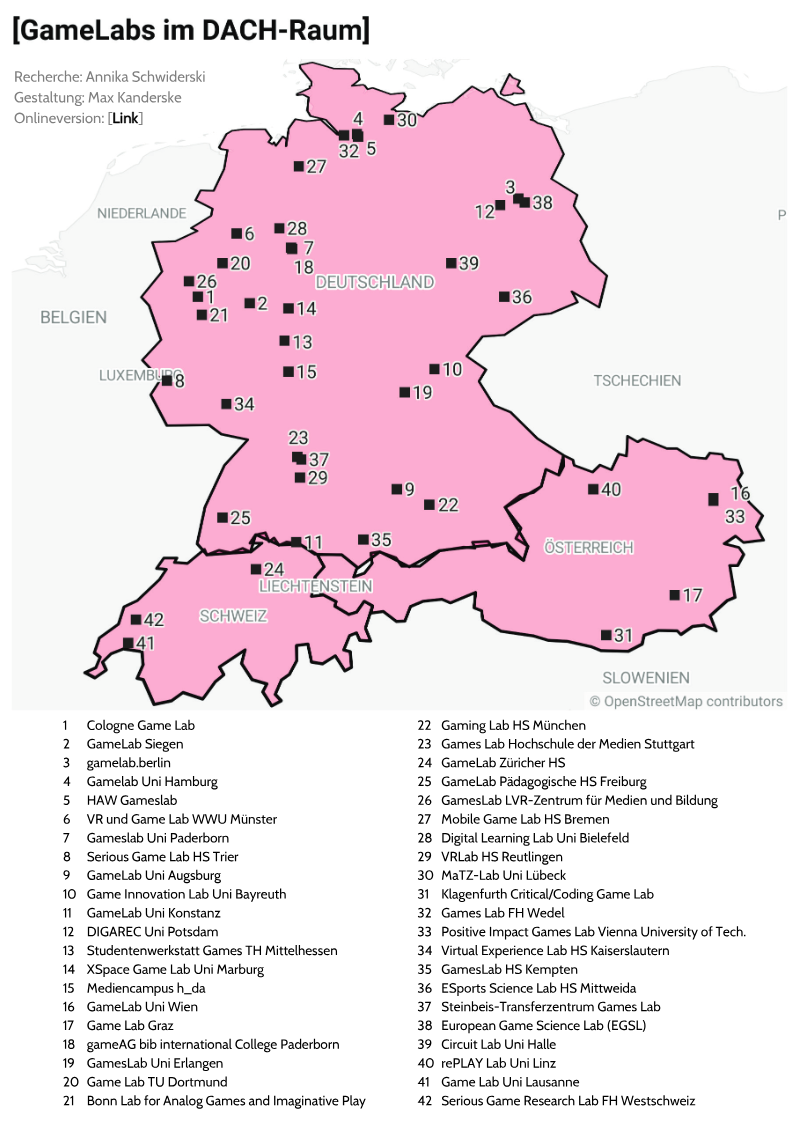
Game Labs im DACH-Raum
The landscape of game-focused research and development facilities across the DACH region—Germany, Austria, and Switzerland—is characterized by a dense network of forty specialized laboratories integrated into academic and vocational institutions.
- The DACH region (Germany, Austria, Switzerland) hosts a network of at least 40 specialized game laboratories integrated into universities and research institutions.
- Game labs are widely distributed across the region, with significant concentrations in major academic hubs including Cologne, Berlin, Hamburg, Munich, Stuttgart, Vienna, and Zurich.
- The labs focus on diverse specializations, ranging from serious games and virtual reality (VR) to esports science, mobile gaming, and critical coding.
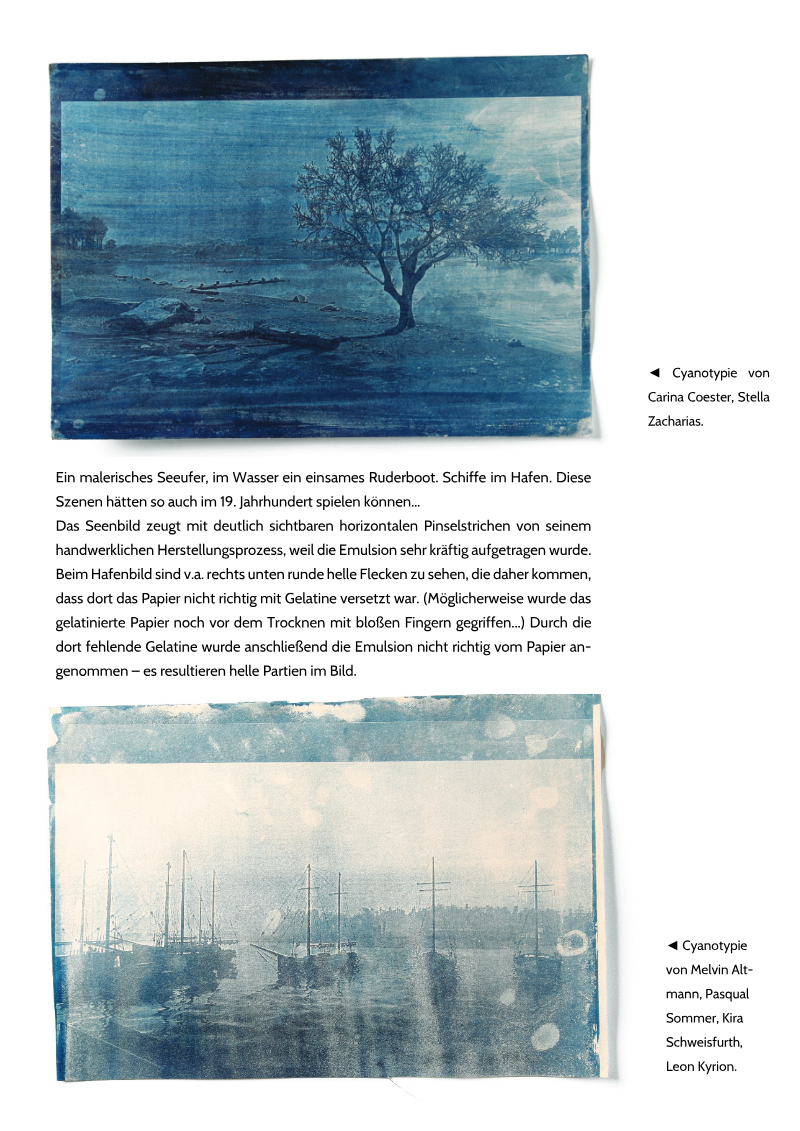
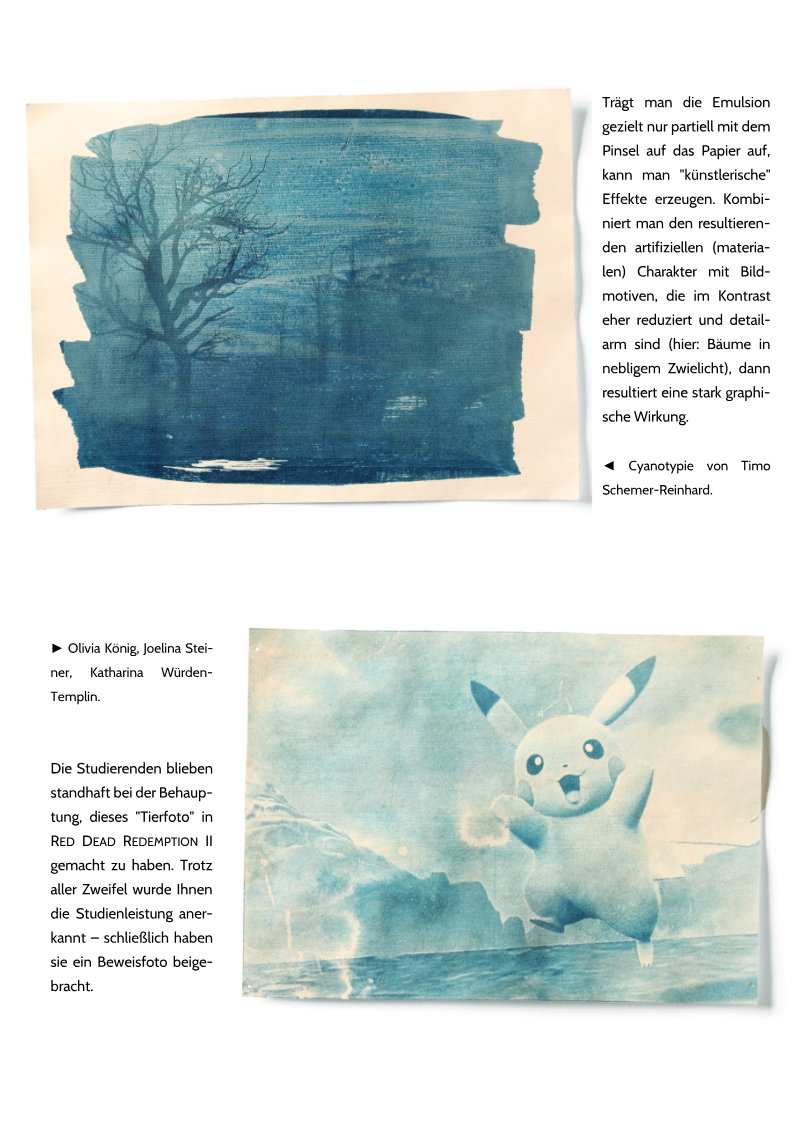
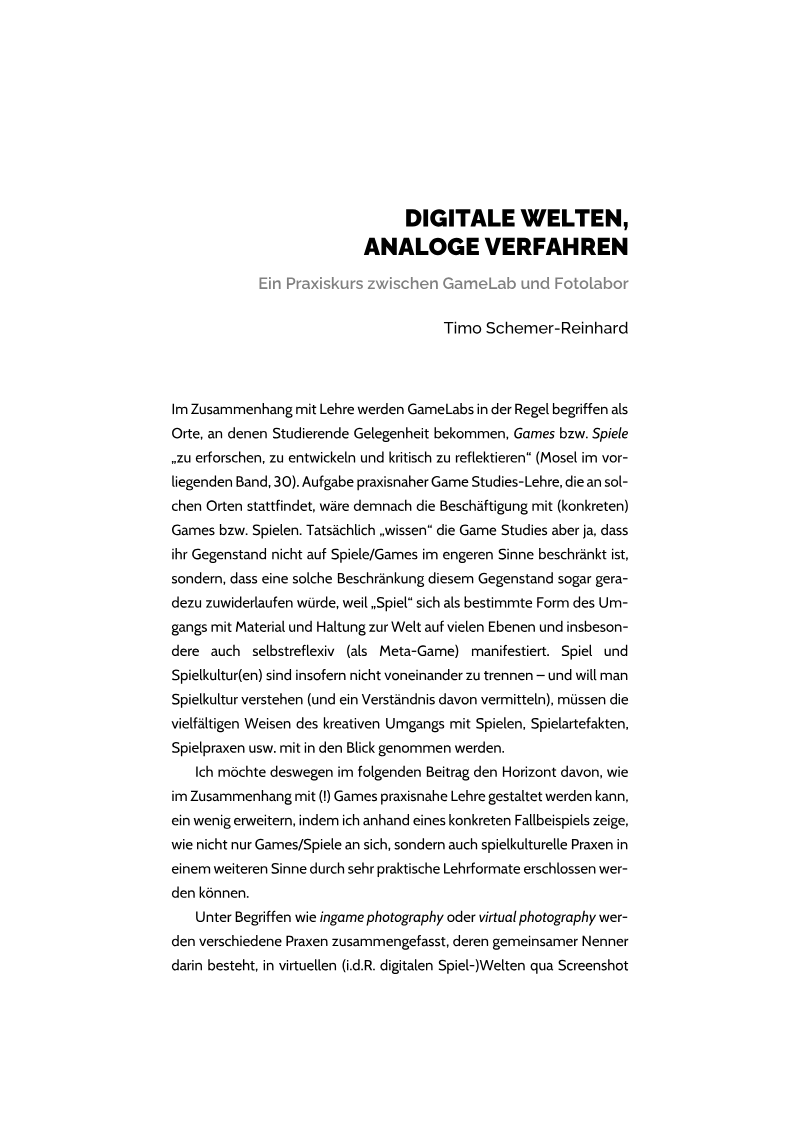
Digitale Welten, Analoge Verfahren: Ein Praxiskurs zwischen GameLab und Fotolabor
This pedagogical project explores the intersection of digital game culture and historical analog photography, specifically through the practice of virtual photography.
- Combining virtual photography from games like Red Dead Redemption II with the 19th-century cyanotype process creates physical artifacts that bridge digital aesthetics with historical materiality.
- The cyanotype process, developed by John Herschel in 1842, is a non-toxic, iron-based photographic technique that serves as an accessible pedagogical tool for exploring game culture and image production.
- Virtual photography challenges traditional definitions of the medium by creating images independent of real-world referents, yet these images often mimic the technical characteristics of historical photography to achieve perceived authenticity.
Gamelab ohne Hardware: Mittelalterimaginationen spielen
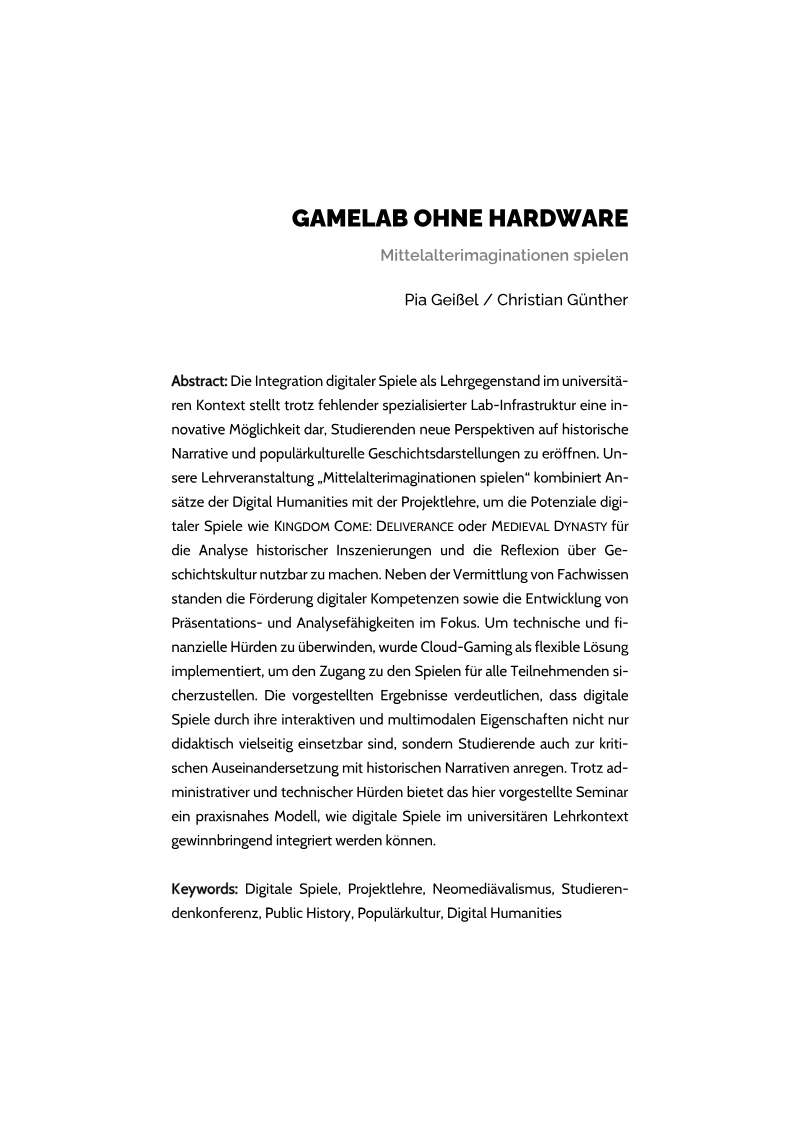
Integrating digital games into university curricula offers a robust framework for analyzing historical narratives and fostering digital literacy, even when institutional resources are constrained.
- Digital games serve as effective pedagogical tools for analyzing historical narratives and cultural representations, even in university environments lacking dedicated hardware infrastructure.
- Cloud-gaming services like NVIDIA GeForce NOW and Shadow were implemented as flexible solutions to overcome technical and financial barriers, allowing students to access hardware-intensive titles like Kingdom Come: Deliverance.
- The seminar 'Mittelalterimaginationen spielen' attracted 30 students, reaching maximum capacity within two days and demonstrating high demand for game-based learning regardless of the participants' prior gaming experience.
Ein experimentelles kulturwissenschaftliches Labor für das analoge imaginative Spiel: Konzept, Aufbau und Praxis des Bonn Lab for Analog Games and Imaginative Play
The Bonn Lab for Analog Games and Imaginative Play (LAGIP) functions as an interdisciplinary research and teaching hub at the University of Bonn, dedicated to the rigorous study of analog gaming as a cultural technique.
GamesLab und VR Lab zwischen studentischer Partizipation und Freelabor
The GamesLab and VR Lab at the University of Paderborn function as interdisciplinary hubs for the production, evaluation, and research of digital games and virtual reality applications.
- The GamesLab at the University of Paderborn, established in 2011, relies on a 'bottom-up' participatory culture where students manage workshops and course content, creating a dependency on unpaid or precarious labor to maintain operations.
- The laboratory structure functions through an intergenerational 'peer learning' model where experienced students mentor lower-semester participants, effectively bridging the gap between academic instruction and technical production.
- The VR Lab, established as part of the 'VR@UPB' project, operates under a 'top-down' model that currently lacks a long-term, sustainable funding structure beyond the project's initial lifecycle.
Wissenschaftskommunikation als medienästhetische Praxis: Zur Formatentwicklung im 'spielenden' Labor
Science communication is undergoing a significant evolution through the integration of humanities-based game laboratories, which function as hybrid environments for both academic inquiry and aesthetic practice.
- The 'playing lab' functions as a hybrid research environment where five interdependent practices—documenting, researching, playing, negotiating, and producing—converge to foster innovation.
- Geisteswissenschaftliche (humanities) research in this lab model utilizes 'Artistic Research' to move beyond traditional analysis, employing 'fore-search' to generate new ideas through aesthetic exploration.
- The development of a board game serves as a primary case study for science communication, demonstrating how game mechanics can effectively structure complex epistemological spaces into manageable, rule-based frameworks.
Spiel und Klasse: Das Game Lab als sozialer Faktor
The establishment of the Game Lab at the TU Dortmund in April 2024 serves as a case study for addressing the socio-economic barriers inherent in academic game studies.
- The Game Lab at TU Dortmund, established in April 2024, functions primarily as a low-threshold infrastructure to provide students with access to expensive hardware and software, addressing socioeconomic barriers to media participation.
- The lab was founded by Professor Sascha Pöhlmann using non-earmarked discretionary funding from his professorship, highlighting the structural difficulty of establishing such facilities without dedicated start-up budgets.
- A core mission of the lab is to support teacher training, as current curricula require digital media literacy that is not adequately addressed in existing pedagogical programs.
Signals & Noises: Das Signallabor an der Humboldt-Universität 2012-2022
The Signallabor at the Humboldt-Universität zu Berlin served as a critical nexus for media archaeology, technical research, and public engagement between 2012 and 2022.
- Between 2012 and 2022, the Signallabor at Humboldt-Universität Berlin curated a collection of over 300 media-historical objects, including 4-, 8-, and 16-bit computers, early game consoles, and analog computing equipment.
- The laboratory functioned as a hybrid space for academic research and a retro-hackerspace, facilitating collaborations between media studies students and the local Berlin hacker community to repair and maintain historical hardware.
- Hands-on engagement with game technology, such as programming in assembly language or developing AI opponents for classic games like Pong, served as a didactic strategy to lower barriers for non-technical students to engage with STEM subjects.
Guck mal, wir sind schwanger! Avatare, Gender & Identitätsprozesse
The relationship between players and their digital avatars is defined by fluid identity processes, where the use of personal pronouns serves as a primary indicator of psychological integration.
- Let's players frequently use the inclusive pronoun 'we' to describe their avatar's experiences, indicating a strong psychological identification and a blurring of boundaries between the player's self and the in-game character.
- The use of personal pronouns serves as a primary indicator of identity processes, with shifts between 'I' and 'we' reflecting varying degrees of inclusion, self-representation, and distance from the avatar.
- Moral and value-based disagreements with an avatar's actions or narrative choices are more significant drivers of player-avatar distancing than the gender of the avatar itself.
Gaming Regional und Fair: Praktische Einblicke in lokale Initiativen als diverse Potenzialträger
Regional esports initiatives and community-oriented associations serve as vital alternatives to the often-toxic environments found in online gaming by providing physical spaces that prioritize inclusive, value-driven cultures.
- Regional, community-based e-sports initiatives are emerging as a counter-model to toxic online gaming environments by providing supervised, value-oriented 'safe spaces' for players.
- The professionalization of the German e-sports ecosystem is increasingly driven by the formation of state-level associations, such as those in Schleswig-Holstein and North Rhine-Westphalia, which provide structured training and infrastructure.
- Public funding is essential for the sustainability of amateur e-sports, yet only a few German states, including Schleswig-Holstein, North Rhine-Westphalia, and Saxony-Anhalt, currently provide financial support for e-sports-related training and education.
Do you work at Spiel|Formen? Get a free report of how these documents are read and cited here.