Spiel|Formen
50 reports, presentations and talks by Spiel|Formen in the Game Industry Library, the newest “On the Reification of Game Culture Using the Example of Sharing: How Multiple Social Practices Have Turned Into a Single Button” (2022).
Documents
On the Reification of Game Culture Using the Example of Sharing: How Multiple Social Practices Have Turned Into a Single Button
The introduction of the dedicated share button on the PlayStation 4 controller in 2013 serves as a definitive case study in the reification of digital social practices.
- The introduction of the dedicated 'Share' button on the 2013 PlayStation 4 DualShock 4 controller represents the culmination of a long-term industry shift toward reifying complex social practices into a single, standardized interface element.
- Technical buttons function as 'gestalt' units that trigger complex, multi-step processes—such as 'booting' a PC or sharing media—which have become culturally established as singular, recognizable actions.
- Digital sharing integrates three distinct social modes: the distribution of divisible goods, the creation of community through shared ideational goods, and the communication of internal states to build intimacy.
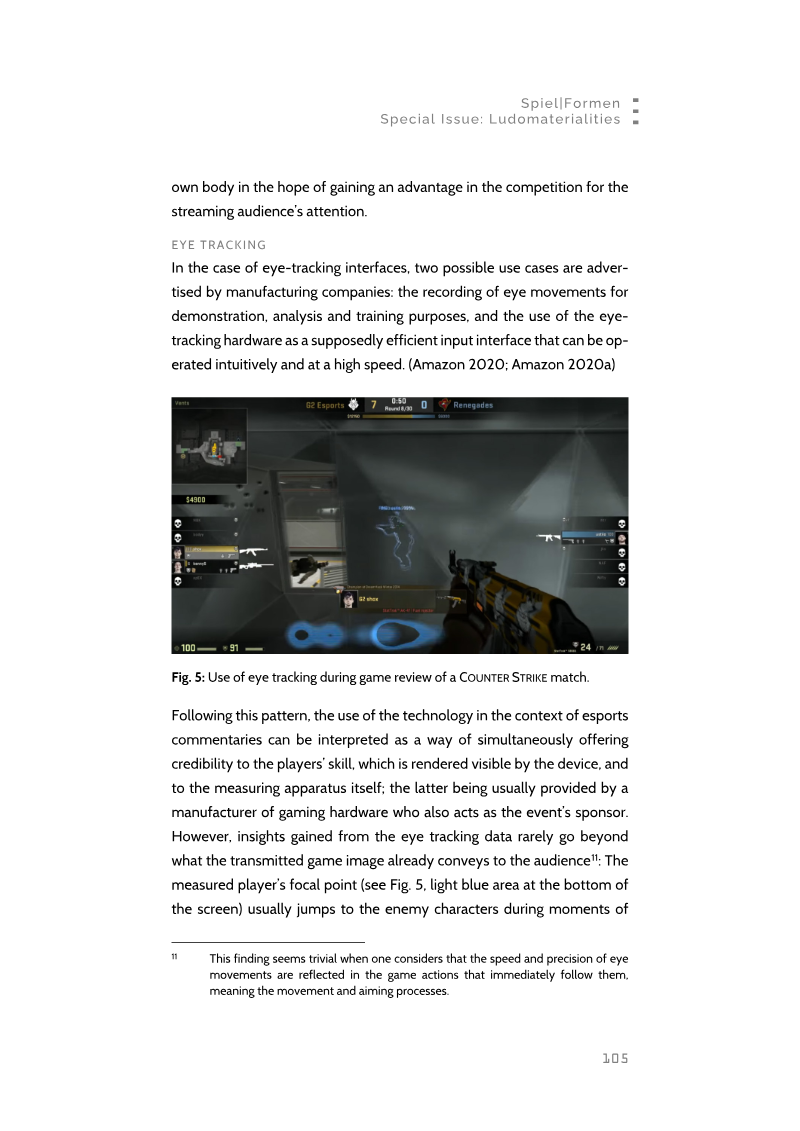
Playful Metadata: Between Performance Careers and Affect Modulation
The rise of playful metadata represents a fundamental shift in contemporary gaming, where self-tracking hardware and software transform ephemeral leisure activities into quantifiable performance metrics.
- Players and developers increasingly use 'playful metadata'—data generated within games—to quantify performance, modulate player affect, and define success parameters beyond the game's original design.
- Speedrunning communities utilize split-timing software to canonize optimal routes, transforming gameplay into a measurable performance career that relies on shared, community-validated data.
- Competitive gaming platforms and developers aggregate player data to provide automated statistical tracking, which functions as a form of surveillance capitalism that shapes player behavior and perceived skill.
Materialities of the Mise-en-Game: Playing with Cineludic Forms
The concept of mise-en-game serves as a critical framework for understanding the intersection of cinematic mise-en-scène and ludic structures, challenging the notion that digital media has rendered analog artifacts obsolete.
- The concept of 'mise-en-game' adapts film theory's 'mise-en-scène' to describe how physical and digital game environments create transmedia connections between cinematic tropes and player interaction.
- Arcade gaming serves as a foundational 'cineludic' experience, with modern open-world titles like the Grand Theft Auto and Yakuza series (since 1997 and 2005) actively remediating the arcade hall as a playable, nostalgic space within their virtual environments.
- Board game adaptations of films, such as the 2019 JAWS game or the 1982 E.T. game, demonstrate that successful transmedia translation depends on aligning game mechanics with the source material's genre, rather than simply applying a cinematic theme as a superficial 'giftwrapping'.
Playing with Light: On the Materialities of Video Game Spaces
This analysis explores the ontological and material role of light in video games, positing that light serves as the fundamental constituent of the digital play experience.
Dice, Cards and Boards: Material Elements of Games and the Play-Form
Play-forms represent the fundamental building blocks of analog gaming, functioning as stable, recognizable material elements that define the core mechanics and player experiences across diverse cultural contexts.
- Games are defined by 'play-forms'—stable, recognizable, and functional material objects like dice, cards, and boards that possess inherent affordances for specific types of interaction.
- Dice games center on the tension of randomness and the 'adumbration' of objects, where the physical act of rolling creates a delay and a moment of surprise that serves as the game's primary attraction.
- Card games are defined by hierarchical symbols and values that facilitate imperfect information, requiring players to deduce hidden configurations through skill and combination rather than pure chance.
Paper and Polygon: Theming and Materiality in Game Studies and Game Design
The analysis challenges the long-standing academic assertion that digital games are inherently "themable"—the idea that a game’s rule system is independent of its representation and that themes can be swapped without altering the gameplay.
Was bisher geschah: TYRANNYS 'Conquest Mode' als Beispiel für metaleptisch-narrative Einflussmöglichkeiten
The analysis explores the concept of narrative metalepsis—the transgression between distinct narrative levels—within the context of digital role-playing games, specifically focusing on the 2016 title Tyranny by Obsidian Entertainment.
- The 2016 RPG 'Tyranny' by Obsidian Entertainment introduces a 'Conquest Mode' that allows players to define their avatar's actions during a three-year military campaign preceding the main game, fundamentally shaping the world's political state and the protagonist's reputation.
- In narratological terms, player interaction in video games functions as a 'metalepsis,' a transgression between the extradiegetical level (the player) and the diegetical level (the game world).
- The 'Conquest Mode' serves as a sophisticated form of 'descending metalepsis,' where player decisions made before the game starts create a flexible narrative foundation that dictates how NPCs react and how specific locations are controlled.
Auswählen, Gestalten, Individualisieren: Avataraktualisierungen als Anfänge des Computerspiels
Avatar creation serves as a critical threshold space where players transition from the extradiegetic menu into the diegetic game world.
- The avatar serves as both a functional tool for interaction and a narratively integrated figure, possessing both instrumental and fictional agency within the game world.
- Avatar creation acts as a 'threshold' experience at the beginning of a game, allowing players to transition from a transcendent entity to a concrete, material presence in the game space.
- Customization options range from ludically irrelevant cosmetic choices, such as in LEFT 4 DEAD 2 (2009), to ludically significant parameters that affect gameplay, as seen in VIRTUA TENNIS 4 (2011).
The Evolution of the Introductory Section: An Analysis Based on Three Long-Standing Video Game Series
The evolution of introductory sections in video games serves as a critical lens for understanding the shifting relationship between ludic mechanics, narrative structure, and designer assumptions regarding player expertise.

Der Zusammenhang von Anfängen und Serialität in Computerspielen: Wie die konzeptionelle Serialität von Computerspielen Erwartungshaltungen gegenüber ihren Anfängen determiniert
The inherent seriality of video games fundamentally shapes player expectations, positioning the beginning of a game as the most critical juncture for establishing both familiarity and innovation.
- Seriality in video games functions as a framework of 'varying repetition,' where players' expectations are shaped by the balance between familiar structures and new, modified elements.
- Expectations for a game are often established long before the actual start, driven by prior experiences with previous entries in a series or genre.
- The 'Zelda' series, specifically 'Breath of the Wild,' demonstrates how radical changes to gameplay—such as non-linear exploration and freedom in dungeon order—can coexist with established core narrative goals to manage player expectations.
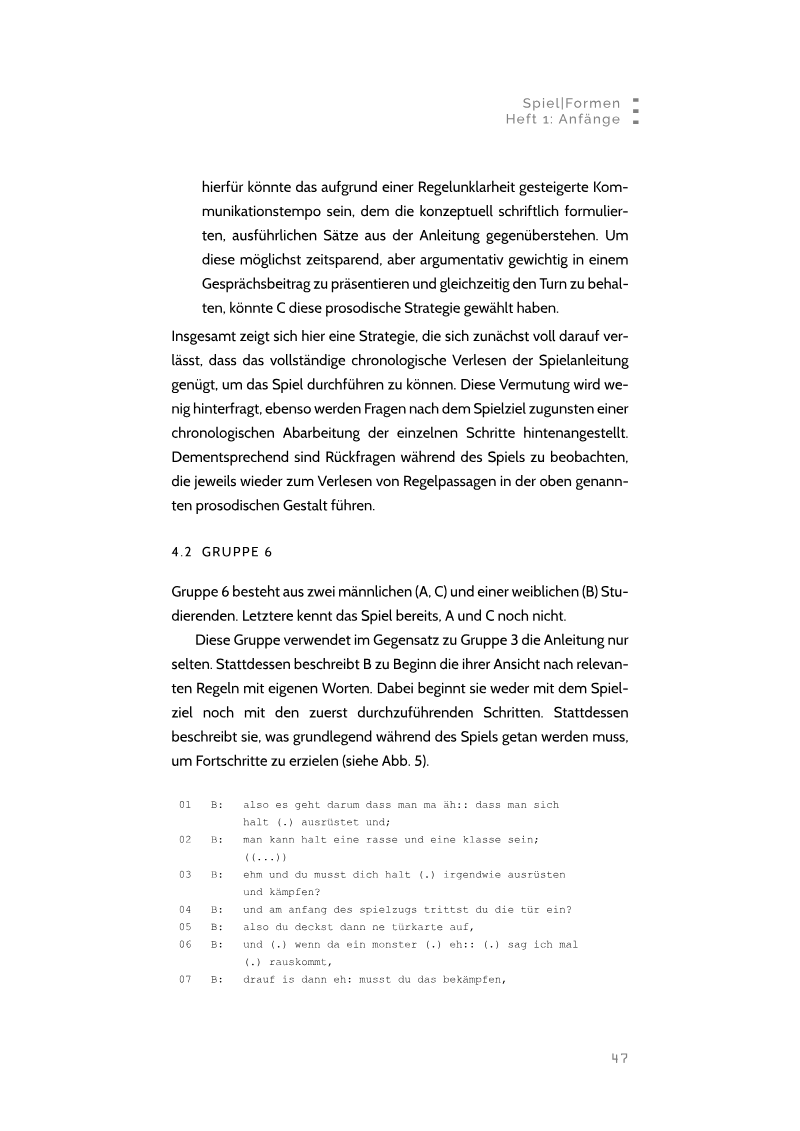
Regel(er)klärungen in Gesellschaftsspielen: Eine gesprächsanalytische Perspektive
Modern board games increasingly demand complex communication strategies as players navigate the collaborative construction of fictional worlds alongside intricate mechanical frameworks.
- Modern board games have become increasingly complex, requiring significant player effort to learn and often featuring detailed, multi-page narrative texts to guide collaborative storytelling.
- The Ravensburger publishing house released 30 game titles in 2018, of which 20 were categorized as games with fictional scenarios, reflecting a broader industry trend toward high-immersion, rule-heavy designs.
- Rule-learning in groups is often inefficient, characterized by a lack of explicit feedback or evaluation, and players frequently struggle to recall rules they have just read aloud from the manual.
Wissenschaft und Computerspielforschung: Bereits gemachte und noch mögliche Anfänge
The intersection of Game Studies and Science and Technology Studies reveals that video games function as powerful, under-researched mediums for both public engagement and the critique of academic structures.
- Serious games like Foldit (University of Washington, 2008) and Eterna (Stanford/Carnegie Mellon, 2010) have transformed research by enabling amateur players to contribute to complex scientific tasks like protein folding and RNA design.
- The integration of game design into education, such as the 'Scalable Game Design Switzerland' initiative, teaches students computational thinking patterns that are essential for navigating complex STEM simulations.
- Digital games frequently rely on the 'mad scientist' archetype to drive narratives, with characters like Dr. Suchong in BioShock (2K Games, 2007) and Dr. Stanislaus Braun in Fallout (Interplay, 1997) serving as prominent examples.
Do you work at Spiel|Formen? Get a free report of how these documents are read and cited here.