
Replay. The Polish Journal of Game Studies
Open-access game studies journal published by Lodz University Press, in English and Polish.
Documents
Putting the "Pocket" in Pocket Monsters: The Game Boy's Technical and Ludic Impacts on Pokémon Red and Blue
https://doi.org/10.18778/2391-8551.13.06 Putting the "Pocket" in Pocket Technical and Ludic Impacts on When Pokémon Red and Blue (Game Freak, 1998) arrived in North America and Europe, Pokémon fever swept across the (gaming) world.
- Game Freak utilized a technique called 'memory banking' to divide the 373 kB of data in Pokémon Red and Blue into 44 separate banks, allowing the game to function within the Game Boy’s 32 kB hardware read limit.
- The inclusion of the secret Pokémon Mew was only possible because developers removed debug features at the end of development, freeing up 300 bytes of space on the nearly full game cartridge.
- The technical limitations of the Game Boy and the lack of official information created a 'knowledge-seeker' culture where players relied on rumors and glitches, such as the MissingNo. anomaly, to navigate and master the game.
Reaganoludography: The 1980s Japanese Digital Games in the Service of the United States
https://doi.org/10.18778/2391-8551.13.03 Reaganoludography: The 1980s Japanese Digital Games in the Service of the United States This article examines the phenomenon in the 1980s Japanese gaming industry, labeled "Reaganoludography" due to its strong reliance on themes directly borrowed from American action cinema, known in…



Tworzenie „przestrzeni dyskomfortu” jako narzędzie zarządzania afektywnego: przypadek marki Pokémon
https://doi.org/10.18778/2391-8551.13.02 Tworzenie "przestrzeni dyskomfortu" jako narzędzie zarządzania afektywnego: W artykule stawiamy tezę, że marka Pokémon zarządza emocjami konsumentów tworząc specyficzną "przestrzeń dyskomfortu", w obrębie której przenikają się mecha- nizmy rynkowe i społeczne.
- The Pokémon Company (TPC) maintains long-term consumer loyalty by creating a 'space of discomfort,' a strategic balance between emotional security (nostalgia) and intentional tension (uncertainty, risk, and criticism).
- Analysis of 6,473 YouTube comments reveals that TPC manages consumer affect through five primary mechanisms: acting as an affective influence tool, playing with expectations, gamifying risk, competing over meanings, and facilitating controlled criticism.
- Intentional friction—such as low drop rates for rare items or controversial game balance changes—does not drive fans away; instead, it triggers cognitive dissonance and rationalization, which paradoxically deepens emotional investment.
Post-cyfrowość współczesnych polskich gier komputerowych: Zarys zagadnień
https://doi.org/10.18778/2391-8551.13.01 Artykuł koncentruje się na zagadnieniu post-cyfrowości, ukazując je jako zjawisko kulturowe, które redefiniuje relacje między cyfrowością i analogowością oraz odwo- łuje się do zjawisk charakterystycznych dla wczesnego etapu rozwoju mediów i kultury gier cyfrowych.
- Post-digital aesthetics in Polish game development involve a deliberate hybridization of digital and analog media, moving beyond simple retro-style graphics to challenge the 'new media' ideology of seamless, flawless technology.
- Games like 'SuperHot' (2016) exemplify post-digital strategies by rejecting standard 3D textures in favor of low-poly, white-model aesthetics and tactical, time-manipulation mechanics that subvert traditional FPS conventions.
- Polish titles such as 'The Invincible' (11 bit studios, 2023) and 'Observer' utilize retro-futuristic design and analog-style interfaces—such as manual window cranks and monochrome displays—to create a sense of tangible, historical materiality within a digital space.
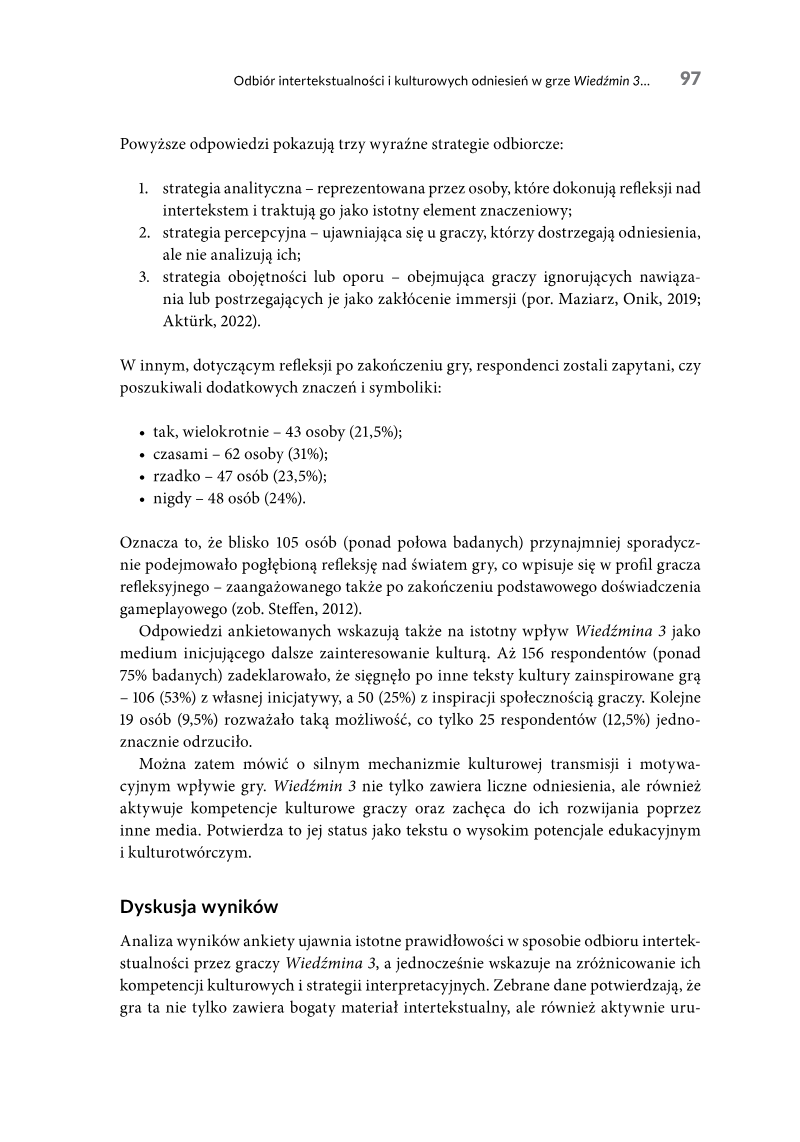
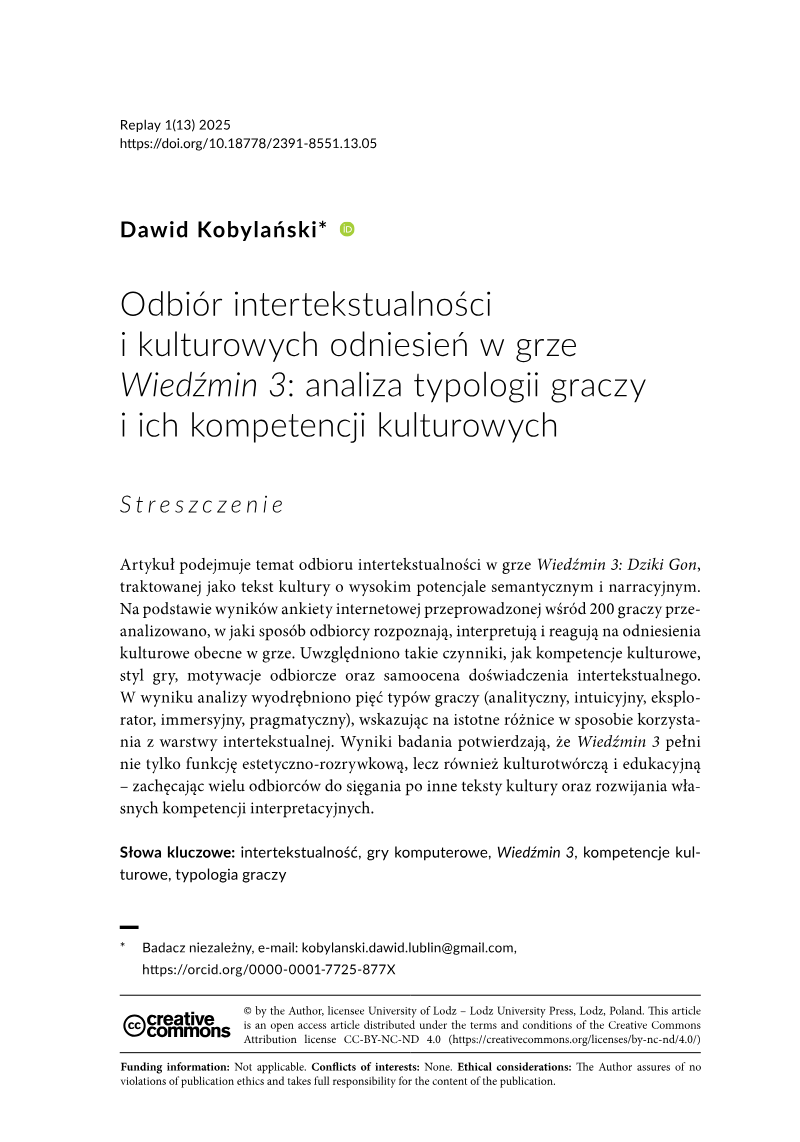
Reception of Intertextuality and Cultural References in The Witcher 3: Analysis of Player Typologies
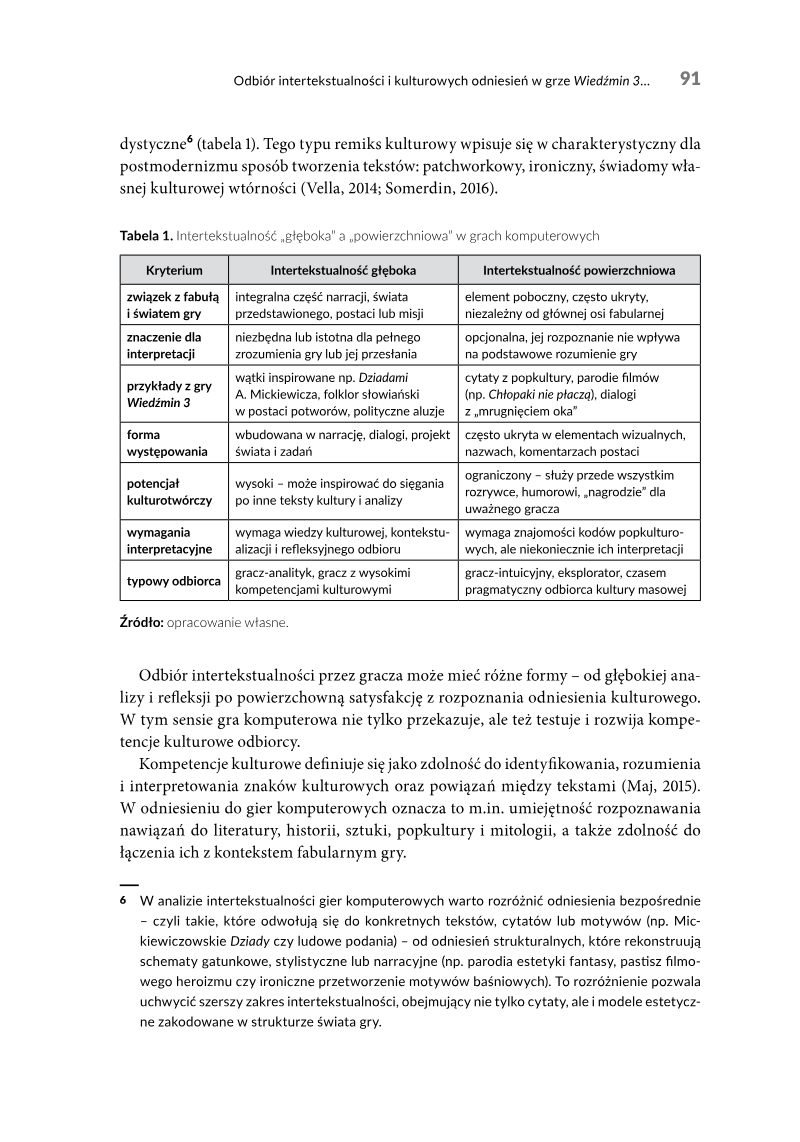
https://doi.org/10.18778/2391-8551.13.05 i kulturowych odniesień w grze Wiedźmin 3: analiza typologii graczy Artykuł podejmuje temat odbioru intertekstualności w grze Wiedźmin 3: Dziki Gon, traktowanej jako tekst kultury o wysokim potencjale semantycznym i narracyjnym.
- Over 81% of players confirm that The Witcher 3 functions as an intertextual cultural text, with 75% of respondents reporting that the game inspired them to explore other cultural works.
- Player engagement with intertextuality is categorized into five distinct typologies: analytical, intuitive, explorer, immersive, and pragmatic.
- Over 90% of the 200 surveyed players entered the game with prior knowledge of Andrzej Sapkowski’s literary series, which significantly enhanced their ability to recognize and interpret cultural references.
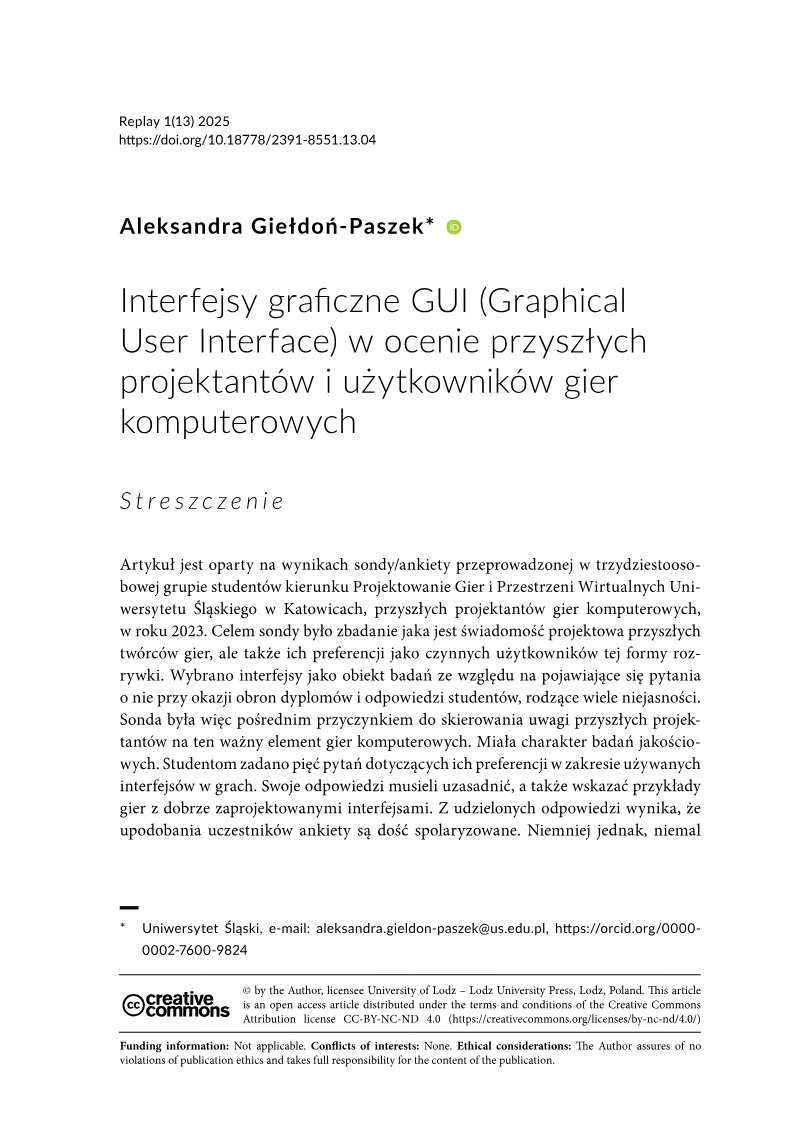
Graphical User Interfaces (GUI) in the Assessment of Future Game Designers and Users
https://doi.org/10.18778/2391-8551.13.04 Interfejsy graficzne GUI (Graphical User Interface) w ocenie przyszłych projektantów i użytkowników gier Artykuł jest oparty na wynikach sondy/ankiety przeprowadzonej w trzydziestooso- bowej grupie studentów kierunku Projektowanie Gier i Przestrzeni Wirtualnych Uni- wersytetu Śląskiego w…
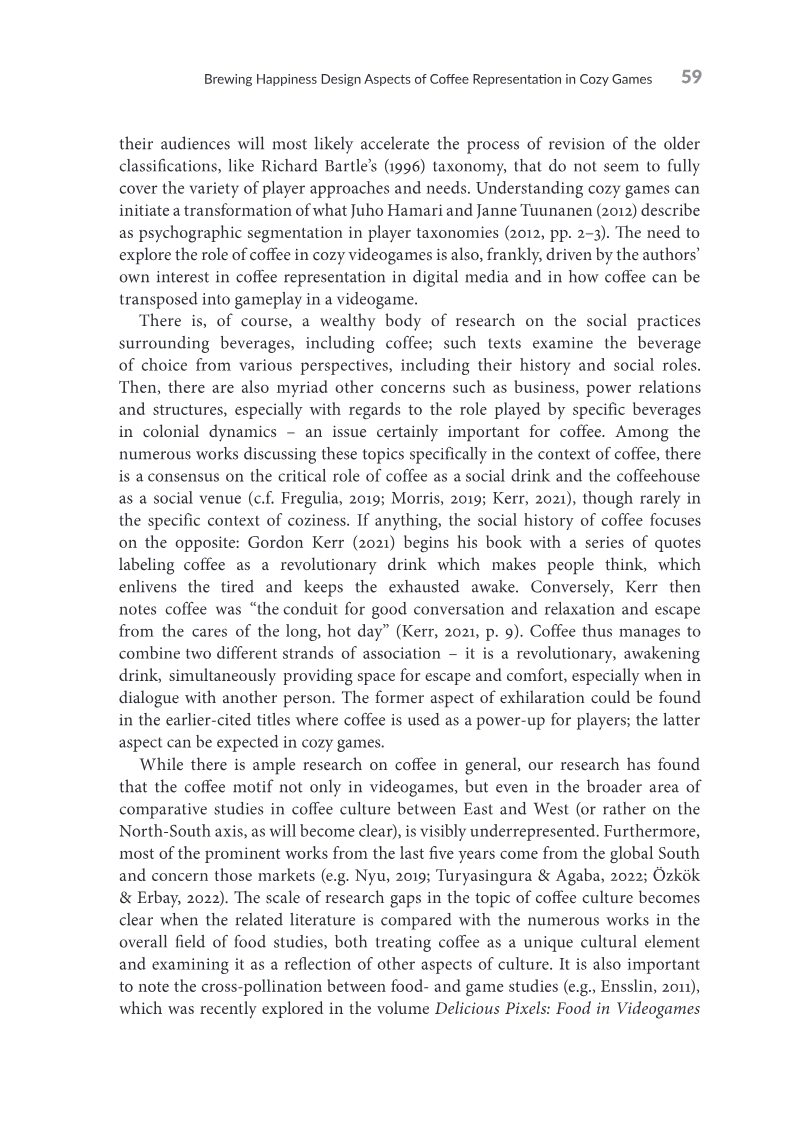
Brewing Happiness: Design Aspects of Coffee Representation in Cozy Games
https://doi.org/10.18778/2391-8551.12.05 Brewing Happiness Design Aspects of Coffee Representation in Cozy Games This paper examines the way coffee is represented and used in cozy games.
- Coffee is a significant contributor to the 'cozy' genre, functioning as a key tool to amplify feelings of safety, abundance, and comfort through aesthetic, narrative, and mechanical design.
- While coffee is a recurring motif in gaming history dating back to the 1980s, its implementation in cozy games specifically emphasizes social interaction and relaxation rather than the 'power-up' or 'energy-boost' mechanics found in earlier titles.
- A quantitative analysis of Steam and GOG platforms reveals that coffee-related games represent a niche market, accounting for approximately 0.51% of titles on Steam and 0.275% on GOG.
Beyond Aesthetics: Players, Player-Characters and Interactivity-as-Demand in Cozy Games
https://doi.org/10.18778/2391-8551.12.04 Player-Characters and Interactivity-as- Cozy games are often defined by their soft visual design, ambient audio, and low risk gameplay that addresses a range of themes from casual to meaningful.
- Cozy games are defined by a design philosophy of 'safety, abundance, and softness,' which intentionally minimizes risk, time-based pressure, and cognitive load to foster a relaxing play space.
- Unlike traditional games that rely on a balance of skill and challenge to create 'flow,' cozy games achieve engagement through low-demand, soothing aesthetics and accessible control schemes.
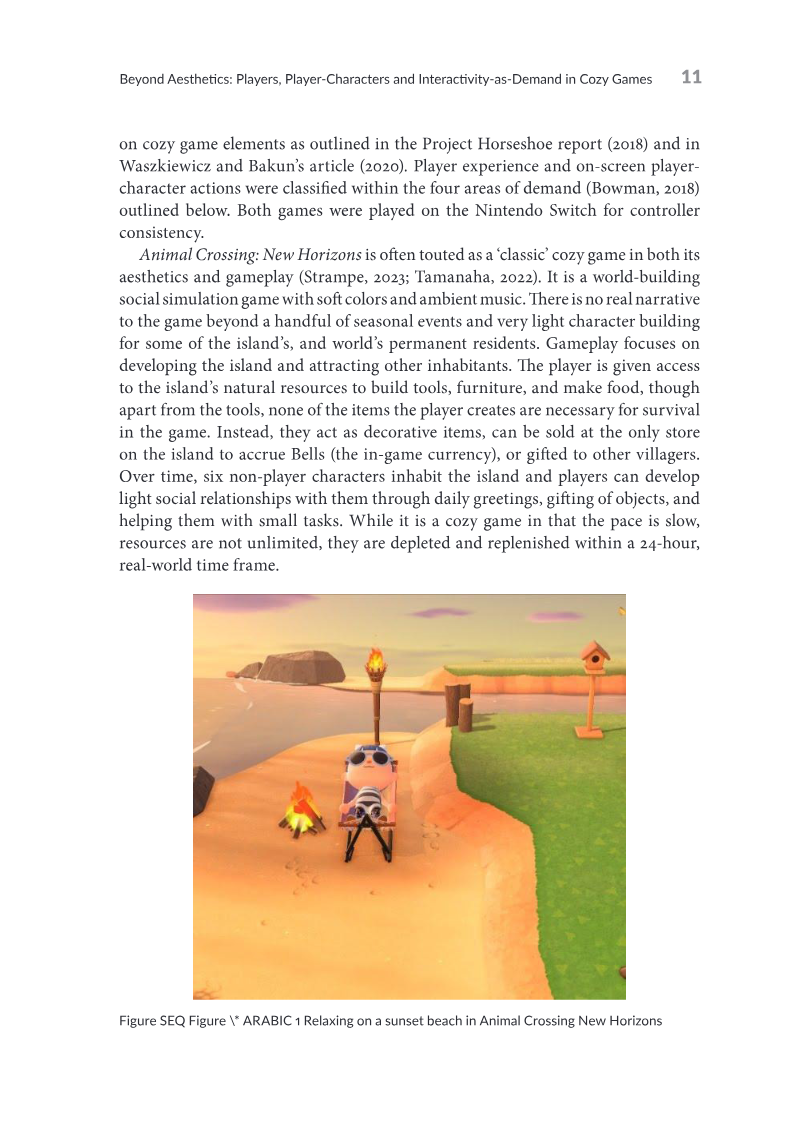
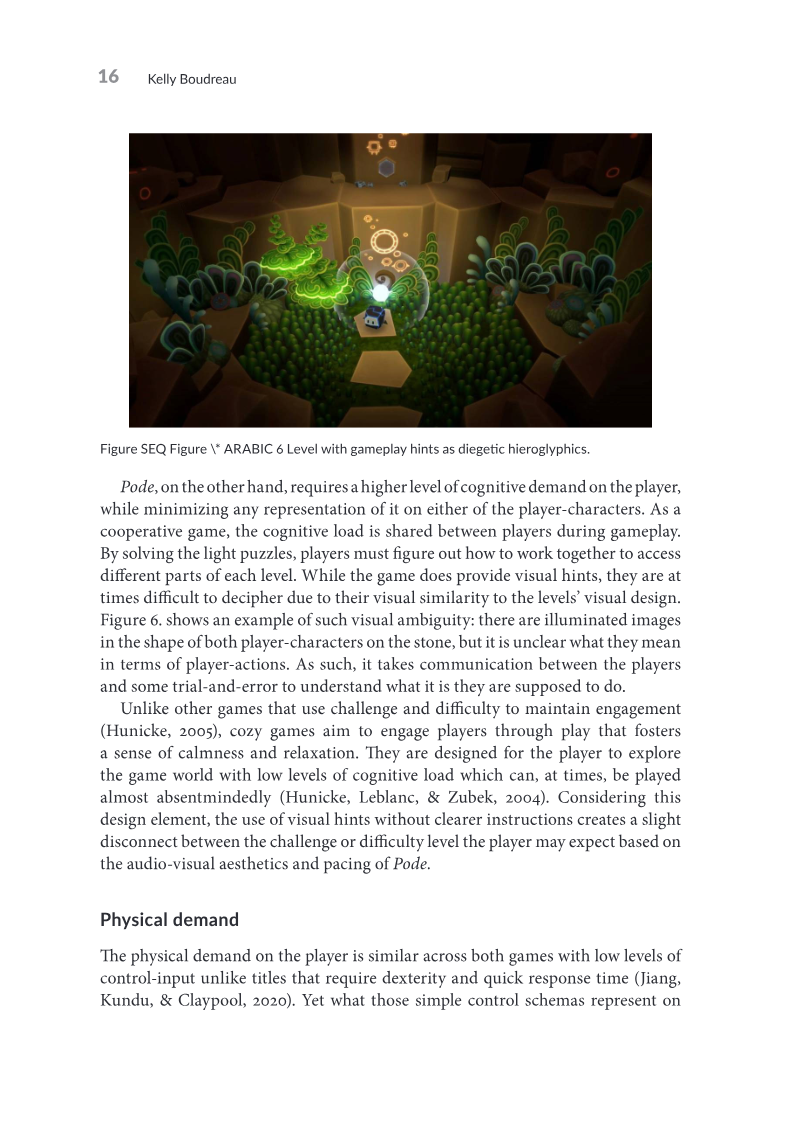
- Analysis of Animal Crossing: New Horizons (2020) and Pode (2018) reveals that even when in-game characters face tasks, these representations are designed to avoid increasing the actual cognitive, physical, or emotional burden on the player.
Looking for Cosy in All the Wrong Places: Cosiness and Tamed Sublime of No Man's Sky
https://doi.org/10.18778/2391-8551.12.03 Looking for Cosy in All the Wrong Places.
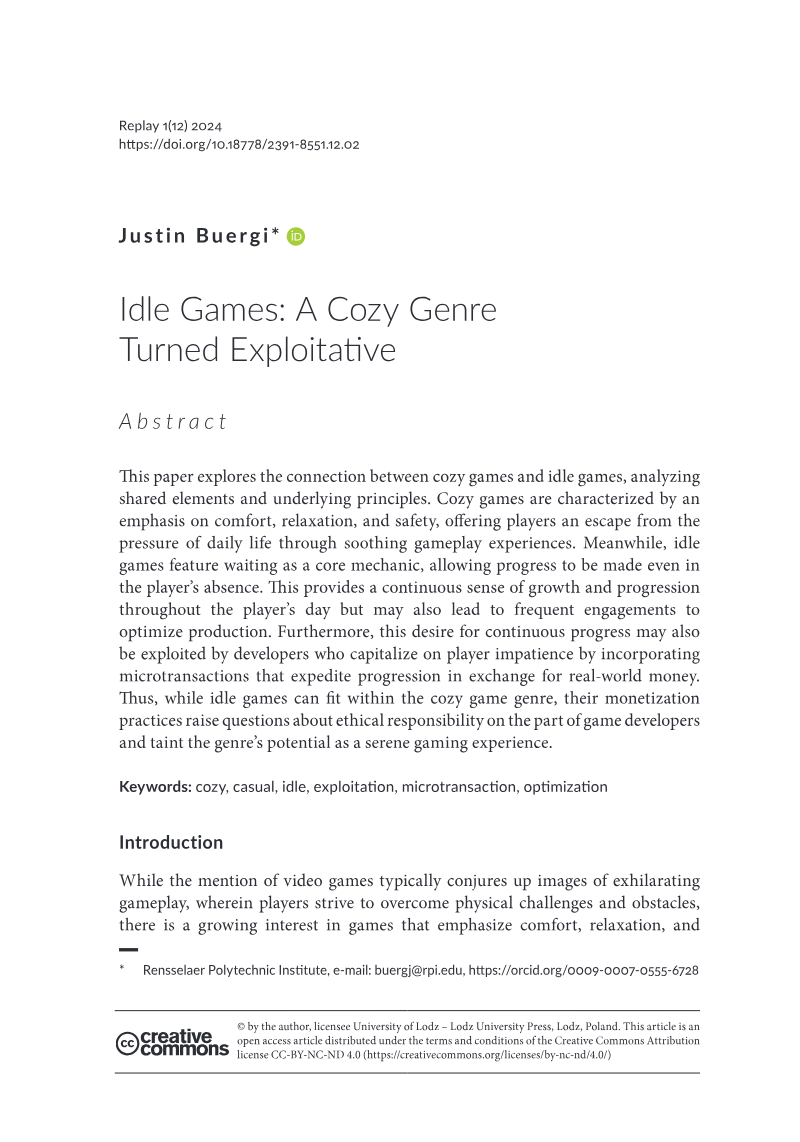
Idle Games: A Cozy Genre Turned Exploitative
https://doi.org/10.18778/2391-8551.12.02 This paper explores the connection between cozy games and idle games, analyzing shared elements and underlying principles.
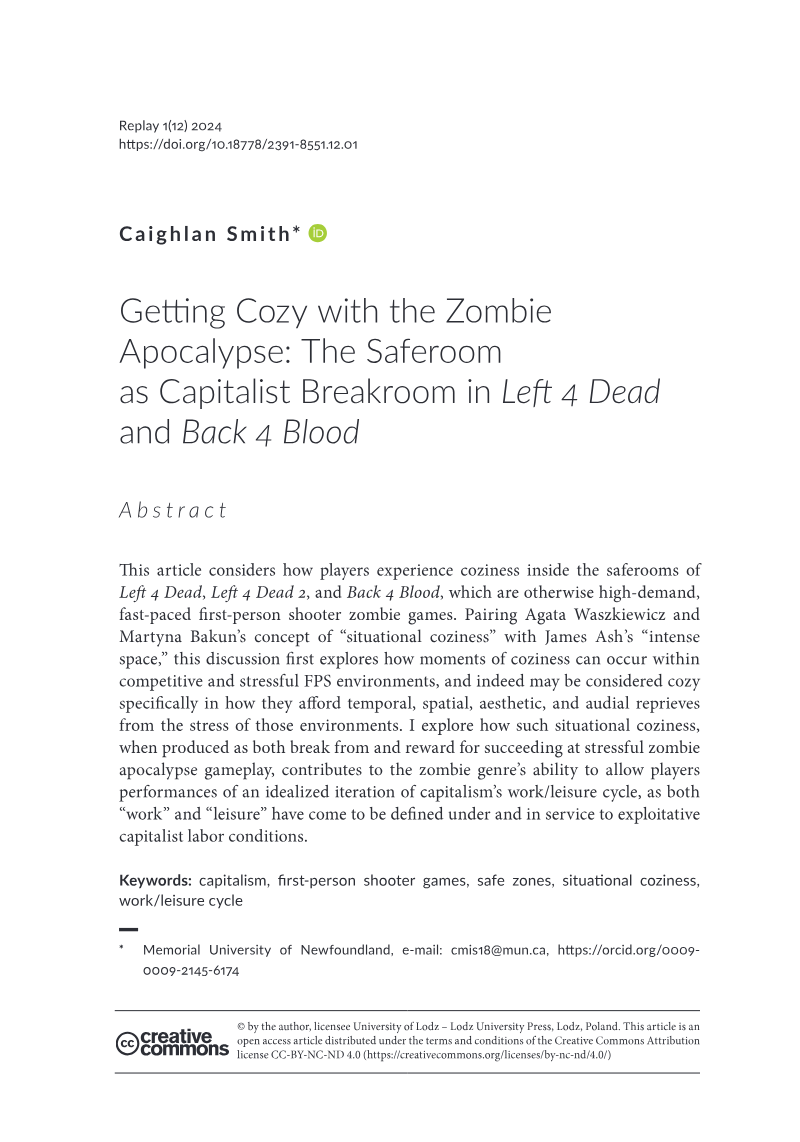
Getting Cozy with the Zombie Apocalypse: The Saferoom as Capitalist Breakroom in Left 4 Dead and Back 4 Blood
https://doi.org/10.18778/2391-8551.12.01 Getting Cozy with the Zombie Apocalypse: The Saferoom as Capitalist Breakroom in Left 4 Dead and Back 4 Blood This article considers how players experience coziness inside the saferooms of Left 4 Dead, Left 4 Dead 2, and Back 4 Blood, which are otherwise high-demand, fast-paced…
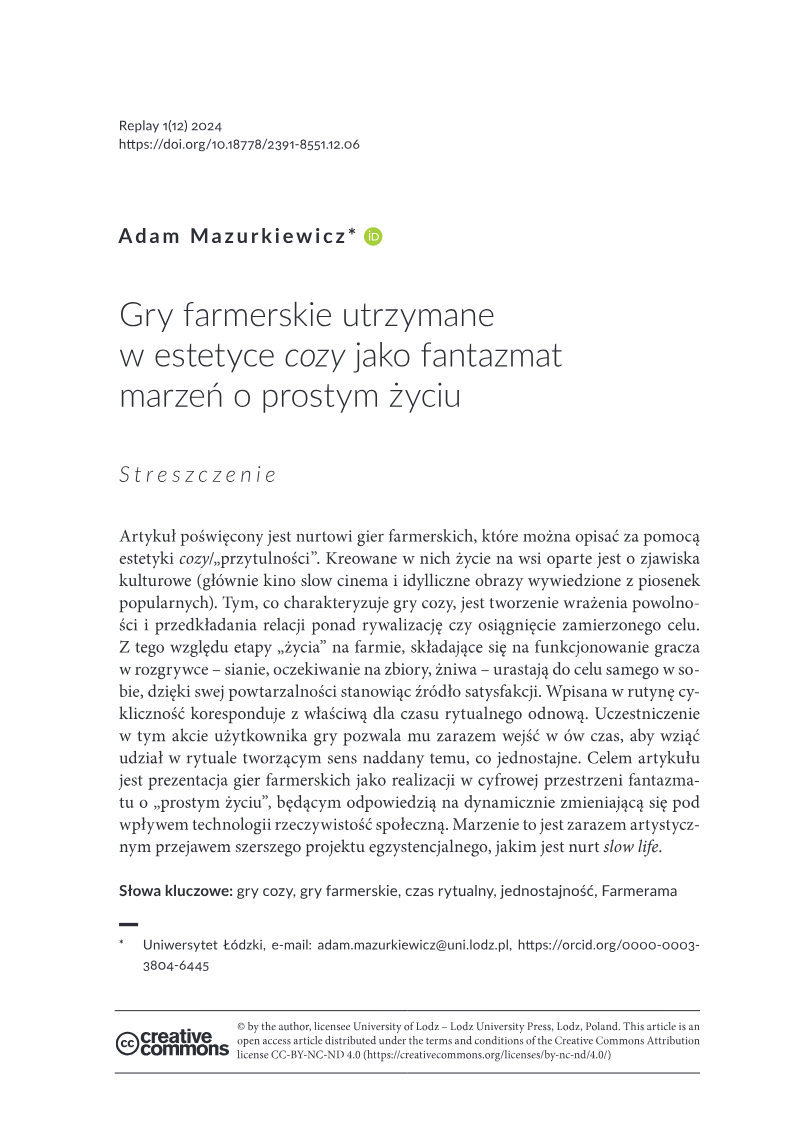
Farming Games in the Cozy Aesthetic as a Phantasm of Dreams of a Simple Life
https://doi.org/10.18778/2391-8551.12.06 w estetyce cozy jako fantazmat Artykuł poświęcony jest nurtowi gier farmerskich, które można opisać za pomocą estetyki cozy/"przytulności".
- Cozy farming games function as a digital 'phantasm' of a simple life, serving as an existential response to the stress and rapid technological changes of modern society.
- The core appeal of the genre lies in the ritualization of repetitive tasks like planting and harvesting, which provides players with a sense of security, predictability, and meditative satisfaction.
- Cozy games prioritize cooperation and the 'gift economy' over competition, often removing mandatory objectives to allow players to engage with the game at their own pace.
Do you work at Replay. The Polish Journal of Game Studies? Get a free report of how these documents are read and cited here.