
Press Start
Open-access student and early-career game studies journal hosted by the University of Glasgow.
Documents
Being Anal About the Rules: How Digital Media and Gamification Redefined MSM Culture
This analysis explores the intersection of game studies and queer culture, specifically examining how geolocation-based mobile applications have transformed the sexual practices of men who have sex with men (MSM).
- Between 1993 and 2002, the percentage of young men arranging their first sexual encounter online surged from 2.6% to 61%.
- Participation in traditional physical cruising and cottaging spaces declined by a factor of eight as digital platforms became the primary venue for MSM interaction.
- Geolocation-based hook-up applications function as gamified environments that have replaced historical, clandestine physical 'erotic oases' with augmented-reality platforms.
Game Movement as Enactive Focalization
Enactive focalization serves as a critical theoretical framework for understanding how movement dynamics function as a primary vehicle for narrative sense-making in digital games.
- Movement dynamics function as a primary vehicle for narrative sense-making, acting as a continuous feedback loop between player action and the gamespace rather than a separate visual perspective.
- Environmental storytelling is fundamentally constructed through the harmonic alignment of movement physics and spatial progression, as evidenced by case studies like Journey and QuiVr.
- Narrative depth is often enhanced by imposing movement constraints and physical limitations on player agency, rather than providing total omnipotence.
Queer Gamer Assemblages and the Affective Elements of Digital Games
Queer gamers engage with digital environments as socio-technological assemblages, where the boundaries between player, hardware, and software dissolve into a singular, embodied experience.
- Queer gamers experience video games as 'socio-technological assemblages,' where identity and sociality are enacted through the physical and emotional connection between the player's body and game technology.
- Games facilitate 'worldmaking' for queer players through three primary mechanisms: atmospheric 'worlding' (immersion in landscapes and soundscapes), specific game mechanics, and narrative storytelling.
- Game mechanics can provide unique opportunities for empathy and perspective-taking, such as the Xbox version of 'Bully,' which required players to kiss a male character to achieve 100% completion, forcing a temporary embodiment of a bisexual experience.
Shrieking, Biting, and Licking: The Monstrous-Feminine in Video Games
Video games frequently frame the empowered female body as an abject, threatening entity, perpetuating a long-standing cultural tradition that equates female autonomy with monstrosity.
- Video games, specifically the God of War and The Witcher series, frequently frame female autonomy as a form of monstrosity that must be neutralized to restore male-centered order.
- Female antagonists in these titles are consistently depicted as grotesque, deceptive, and inherently evil to serve as embodiments of patriarchal anxieties regarding female sexuality.
- Design choices such as fanged mouths, shrieks, and phallic tongues are used to weaponize the female body and represent existential threats like castration and disease.
Desperately Trying to Mediate Immediacy: A discussion of lived experiences in esports
Esports functions as a critical site for understanding the intersection of digital mediatization and the human body, challenging the tendency of contemporary discourse to prioritize abstract meaning over physical, lived experience.
- Esports functions as an experience economy where participants and spectators prioritize raw, immediate moments of intensity over traditional narrative framing.
- The core challenge in digital play is the mediation of immediacy, defined by the tension between the desire to analyze experiences and the practice of suspending sense-making.
- Esports serves as a microcosm for broader human engagement with a digitized world, as digital layers are increasingly superimposed onto daily physical reality.
Bloodborne, and the New Frontier of the Gothic
Bloodborne represents a significant evolution in the Gothic genre, successfully bridging the gap between traditional literary conventions and interactive digital media.
- Bloodborne evolves the Gothic genre by shifting it from passive literary observation to a participatory, player-driven experience.
- The game utilizes the 'insight' mechanic to mechanically integrate the psychological toll of player actions into the core gameplay loop.
- The narrative structure transitions from traditional Gothic horror into Lovecraftian weird fiction, emphasizing the corruptive nature of forbidden knowledge.
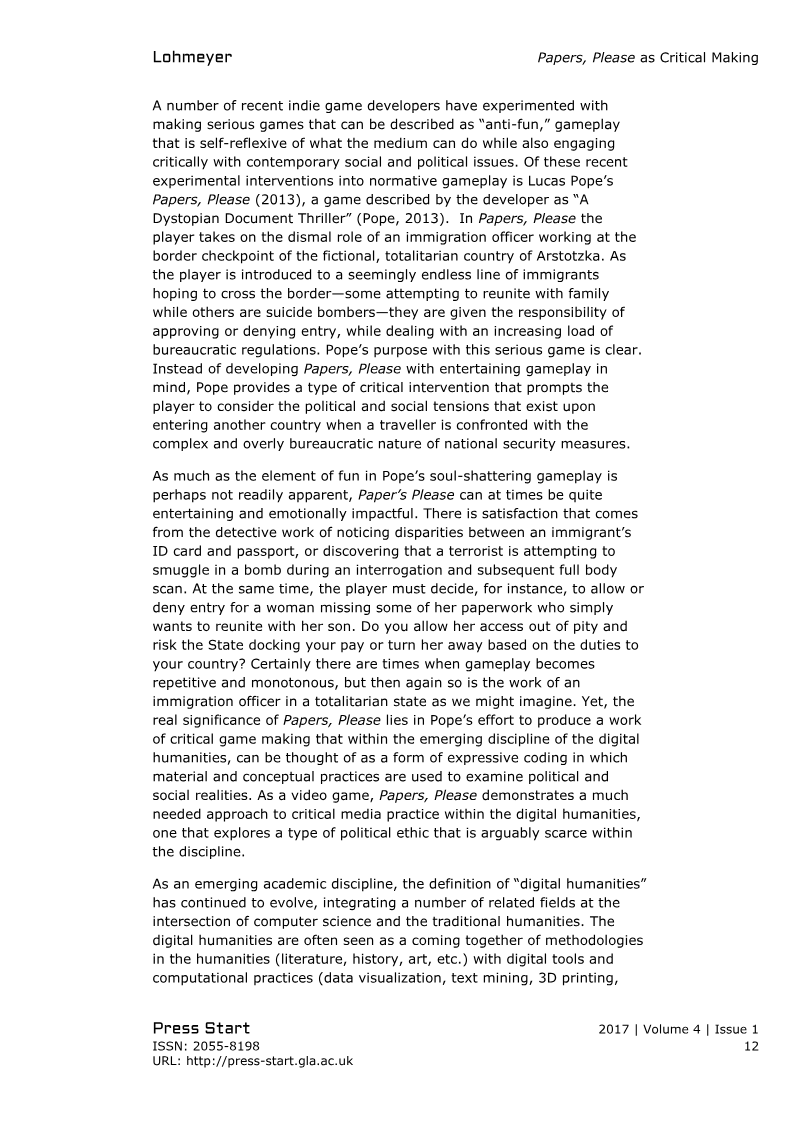
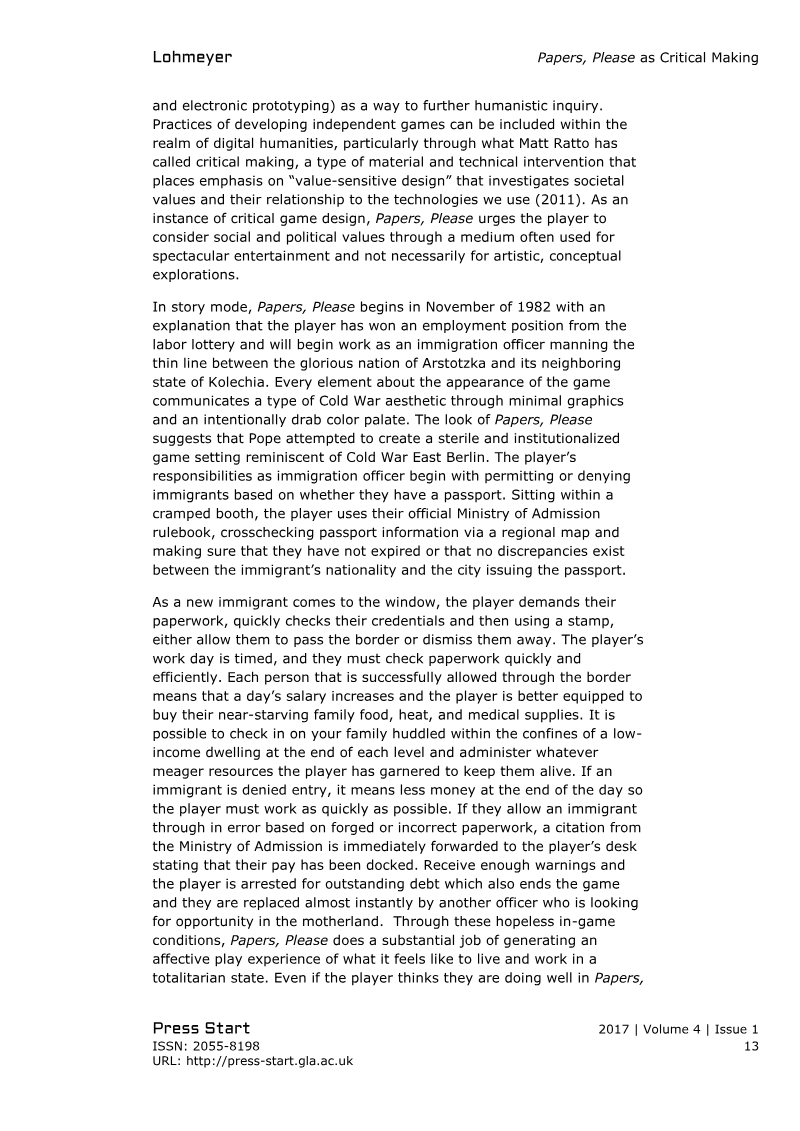
Papers, Please as Critical Making: A Review
Papers, Please serves as a primary case study for the concept of critical making within the digital humanities.
- Lucas Pope’s 2013 game Papers, Please serves as a primary example of 'critical making' within the digital humanities, using game design to force players to confront the bureaucratic and moral realities of a totalitarian state.
- The game functions as an 'anti-fun' intervention that prioritizes political and social reflection over traditional entertainment, requiring players to balance the survival of their in-game family against the ethical implications of enforcing oppressive border policies.
- By simulating the repetitive, high-pressure environment of an immigration checkpoint, the game creates an affective experience that highlights the tension between state-mandated security measures and individual human rights.
The Design Process of a Board Game for Exploring the Territories of the United States
The design and development of an educational board game centered on United States geography serves as a practical exploration of how mechanic-driven systems can facilitate spatial learning.
- Iterative design and structured focus group testing are essential for balancing game complexity with educational objectives in geography-based board games.
- Developmental testing across four rounds with 12 participants identified and resolved specific mechanical issues, including turn-order imbalances, board clarity, and player movement stagnation.
- The integration of hidden goals and the 'BlueStar' power-up system was critical for increasing player engagement and strategic depth.
Pokémon is Evolving!: An investigation into the development of the Pokémon community
The Pokémon franchise sustains its enduring market dominance by balancing a consistent core gameplay loop with strategic multi-media integration.
- Pokémon’s market dominance relies on a symbiotic relationship between developer-led initiatives and a self-sustaining fan community that creates its own engagement platforms.
- The franchise successfully bridges traditional gaming and experimental titles by leveraging a broad multi-media ecosystem, with the anime acting as a critical driver for overcoming skepticism toward new gameplay directions.
- Pokémon GO serves as a definitive case study for evolving the brand’s core identity to capture new audiences while maintaining the loyalty of the established player base.
Playing Producer: An alternative perspective on video games as film
This analysis proposes a new framework for understanding the relationship between video games and cinema by shifting the focus from narrative and formal characteristics to the role of the player as a producer.
- The player-as-producer framework resolves the narrative paradox by shifting focus from fixed storytelling to the player's role in creative processes like casting, cinematography, and script management.
- Players exercise agency within a predetermined narrative by utilizing game mechanics for non-narrative tasks such as character customization, relationship management, and tactical combat choreography.
- The 2009 role-playing game Dragon Age: Origins serves as a primary case study demonstrating how players act as directors by manipulating camera perspectives and stylistic elements.
Player Perspectives: What It Means to Be a Gamer
The identity of the modern gamer is a fluid, individualized construct that defies traditional industry categorizations.
- Traditional industry categorizations like 'hardcore' or 'casual' are obsolete because modern gaming identity is a fluid, individualized construct.
- Gaming identity is shaped by the intersection of daily routines, social contexts, and the negotiation between professional obligations and leisure time.
- A more accurate analytical framework prioritizes a player's level of engagement, time commitment, and the personal value attributed to digital interactions over genre or platform labels.
Streaming Video Games: Copyright Infringement or Protected Speech?
The rapid expansion of video game streaming as a dominant economic and cultural force has created a significant legal friction point within the European Union.
- Under EU copyright law, video game streams likely constitute an infringement of the developer's exclusive right to communicate their work to the public.
- Game developers are increasingly asserting copyright control to demand revenue shares or restrict the context in which their games are broadcast, as seen with Nintendo's content restrictions and Riot Games' shutdown of the 'spectatefaker' stream.
- The author argues that freedom of expression should be leveraged to protect streamers from developer overreach, particularly for 'variety streamers' whose content relies on original commentary and interaction rather than just gameplay.
Do you work at Press Start? Get a free report of how these documents are read and cited here.