
Press Start
Open-access student and early-career game studies journal hosted by the University of Glasgow.
Documents
Domesticating the First-Person Shooter: The Emergent Challenge of Gone Home’s Homely Chronotope
The emergence of the walking simulator genre, exemplified by the title Gone Home, represents a fundamental challenge to the traditional, agonistic paradigms that have long defined the video game industry.



Guiding with a Soft Touch: Directing Players in Nonlinear Levels Without UI
Effective player navigation in large-scale, nonlinear 3D environments relies on the strategic integration of embedded environmental design rather than traditional user interface elements.
From Zelda to Stanley: Comparing the Integrative Complexity of Six Video Game Genres
The narrative complexity of video games is often assumed to be higher in genres that prioritize storytelling over mechanical challenge, such as walking simulators.
From Walking Simulator to Ambience Action Game: A Philosophical Approach to a Misunderstood Genre
The term walking simulator often carries a derogatory connotation that fails to capture the sophisticated design intent behind atmospheric, narrative-driven titles.
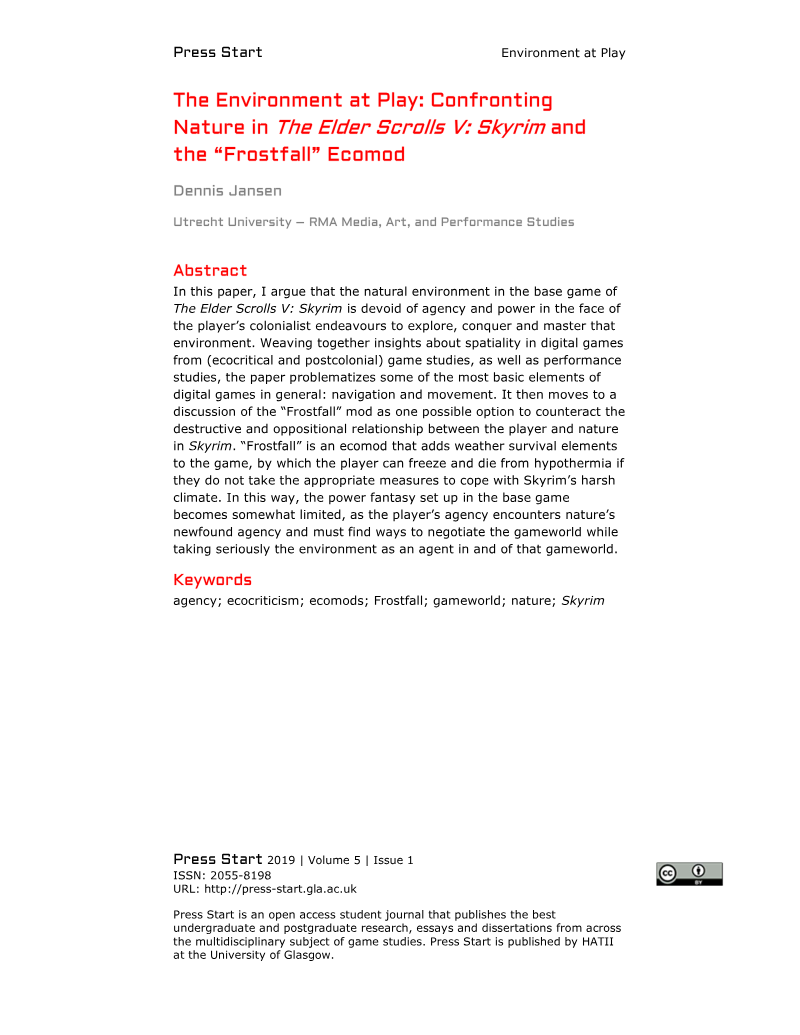
The Environment at Play: Confronting Nature in The Elder Scrolls V: Skyrim and the Frostfall Ecomod
The Elder Scrolls V: Skyrim functions primarily as a colonialist power fantasy, where the natural environment is reduced to a passive, static backdrop designed for player conquest and resource extraction.
Silent Halls: P.T., Freud, and Psychological Horror
The playable teaser P.T. (2014) serves as a seminal case study for the efficacy of psychological horror within video games.
- The 2014 playable teaser P.T. by Kojima Productions and Konami established a new benchmark for psychological horror by eschewing traditional jump scares and combat in favor of the psychoanalytical concept of 'the uncanny.'
- The core of P.T.'s design is a single, looping L-shaped hallway that forces players to repeatedly navigate a mundane, domestic environment that undergoes subtle, unsettling changes with each iteration.
- The game leverages Sigmund Freud’s theory of the 'unheimlich' (the uncanny), which posits that horror is most effective when a familiar, domestic space is disrupted to create a sense of discomfort and doubt.

Aya of the Beholder: An Examination of the Construction of Real-World Locations in Parasite Eve
Video games construct virtual environments not as literal simulations of physical geography, but as curated spaces designed to evoke a specific sense of place through semiotic shorthand.
- Video game environments do not require one-to-one physical accuracy to successfully evoke a real-world location, as players use semiotic shorthand to bridge the gap between virtual spaces and actual places.
- In Square's 1998 title Parasite Eve, Manhattan is represented through an abstract overworld map that intentionally excludes or minimizes major areas like Harlem and Times Square while highlighting specific landmarks like the World Trade Center.
- Game developers prioritize 'gamic action' and player experience over geographical realism, often compressing distances or altering layouts to accommodate gameplay mechanics, such as the proximity of the Central Park Zoo to the Bandshell in Parasite Eve.
The Burden of Queer Love
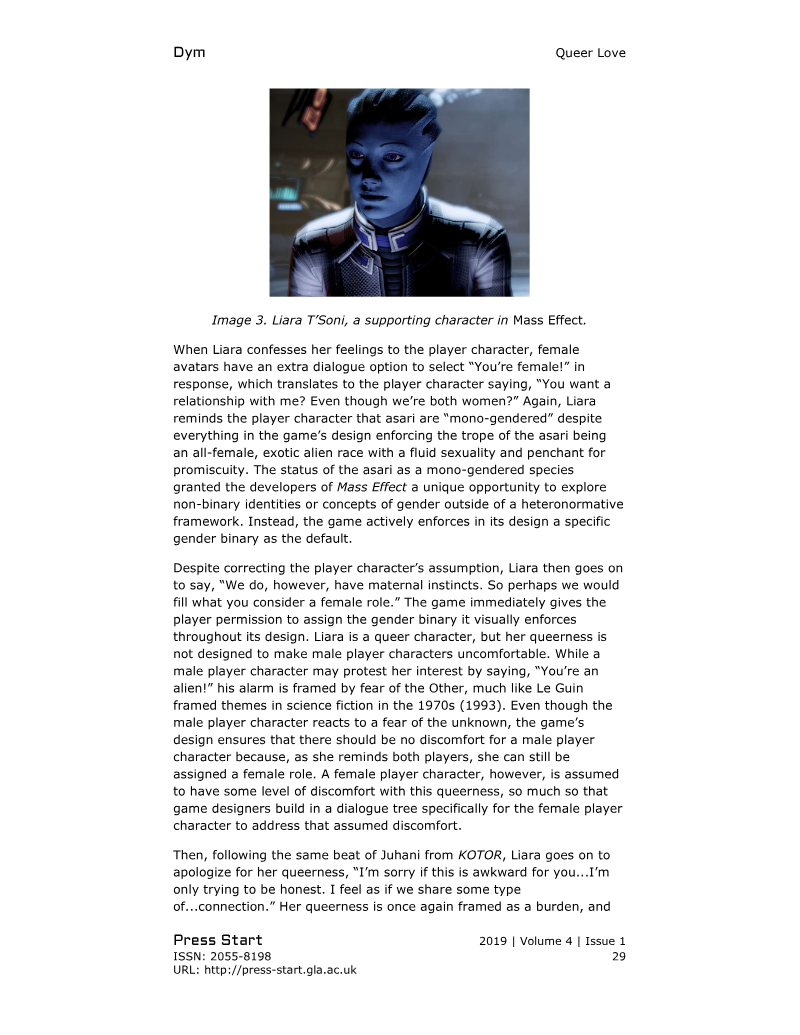
The video game industry, particularly within the output of major developers like BioWare, maintains a persistent heterocentric and hypermasculine status quo that systematically marginalizes LGBTQ+ players.
- Major developers like BioWare prioritize a heterocentric and hypermasculine status quo, treating LGBTQ+ romantic subplots as secondary, optional deviations rather than integral narrative components.
- Foundational titles including Knights of the Old Republic, Jade Empire, and Mass Effect systematically relegate queer romance to non-essential side characters or lock it behind restrictive dialogue gates.
- Industry design patterns, such as the use of recycled animations and rigid gender-role enforcement, force queer players to navigate narratives that frame non-heteronormative identities as inherently subordinate or shameful.
"Hey! Listen!": Video Game Dialogue, Integrative Complexity and the Perception of Quality
Video game quality, as measured by industry recognition through the Spike Video Game Awards, exhibits a distinct inverse relationship with the linguistic complexity of in-game dialogue.
- Award-winning video games exhibit an inverse relationship between critical acclaim and the linguistic complexity of their dialogue.
- Titles that achieve recognition at the Spike Video Game Awards consistently utilize lower levels of integrative and dialectical complexity than their non-winning counterparts.
- The statistical correlation between simplified, accessible dialogue and award success is most pronounced within the shooter genre.
And How Does That Make You Feel? A Psychological Approach to a Classic Game Studies Debate
The debate surrounding the influence of violent video games on human behavior remains a contentious issue in media studies, yet empirical evidence increasingly points toward internal psychological factors rather than external media consumption.
- Individual personality traits, specifically the Dark Triad (narcissism, Machiavellianism, and psychopathy), are the sole significant predictors of aggressive behavior, rather than media consumption.
- Empirical research involving 36 participants found no statistically significant link between violent game content and increased post-gameplay aggression.
- Camera perspectives used during gameplay have no measurable impact on aggressive behavioral outcomes.
Ideology in BioShock: A Critical Analysis
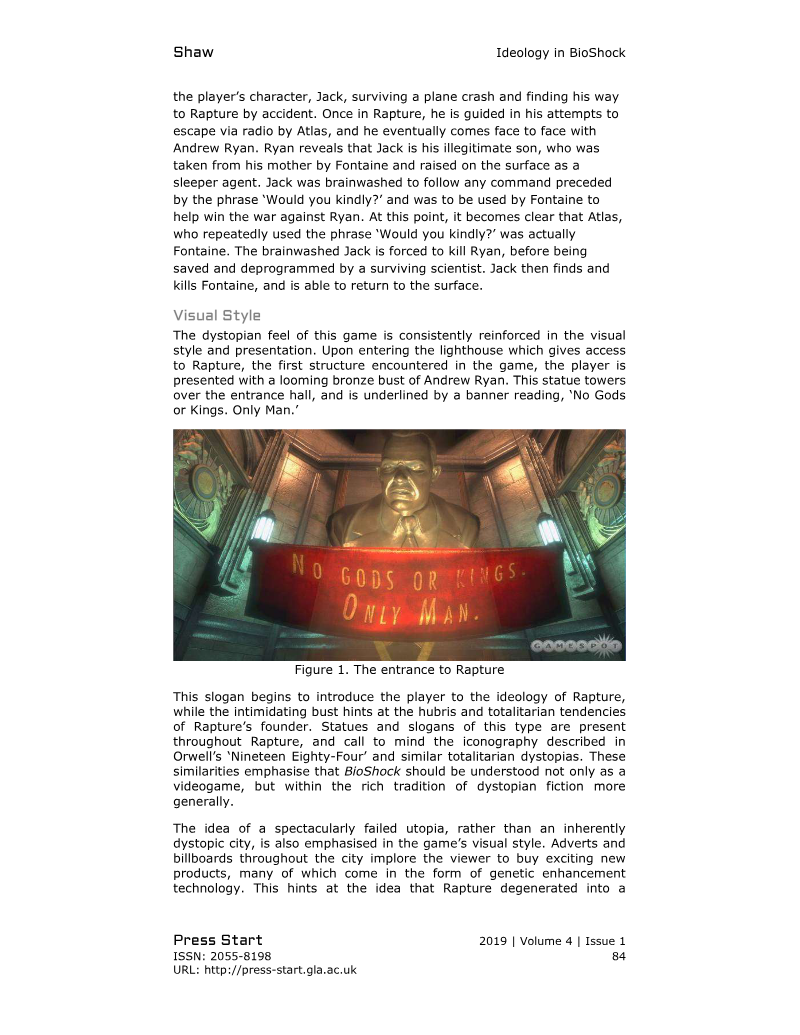
The BioShock series serves as a significant case study in how interactive media can engage with complex political philosophy.
- The BioShock series functions as a critique of extreme, unquestioning ideological adherence rather than a targeted attack on any single political philosophy like Objectivism or Collectivism.
- The games utilize 'procedural rhetoric'—the practice of authoring arguments through gameplay processes—to demonstrate the dangers of ideologies, such as using garish vending machines to highlight the absurdity of extreme libertarianism.
- The series illustrates the 'Horseshoe theory' of politics by showing that both the libertarian Objectivism of Andrew Ryan and the collectivist utilitarianism of Sofia Lamb lead to identical outcomes of totalitarianism and societal collapse.
frictiOns: A Case Study on Experimental Film and Smartphone Culture
The experimental film project frictiOns serves as a critical case study examining the intersection of smartphone culture, digital interface design, and the blurring boundaries between information, entertainment, and labor.
- Modern smartphones function as 'operational' tools that coerce users into a state of perpetual, active performance, effectively erasing the boundary between private life and public interaction.
- The 'all-in-one' design philosophy of devices like the iPhone mirrors the formal conventions of first-person shooter games by demanding constant, productive user interaction.
- Corporate design strategies utilize soft power to position the user as a player within a game-like apparatus, enforcing a hegemonic imperative to remain constantly connected and content-generative.
Do you work at Press Start? Get a free report of how these documents are read and cited here.