
International Journal of Serious Games
Open-access peer-reviewed journal of the Serious Games Society on the design, use and assessment of serious games.
Documents


Playing to Investigate the Relationship Between Achievement and the Perception of Learning
This research examines the relationship between gameplay achievement, student enjoyment, and the perceived effectiveness of learning within the context of serious games.
- Student enjoyment is the primary driver of perceived learning effectiveness in serious games, showing a strong, statistically significant correlation.
- There is no statistically significant link between a student’s final point scores and their perception of having learned the subject matter.
- While game achievement correlates with enjoyment, the relationship is notably weaker than the link between enjoyment and perceived learning.



Overview and Comparative Analysis of Game Engines for Desktop and Mobile Devices
Selecting an appropriate game engine for cross-platform development requires a nuanced understanding of the trade-offs between technical complexity, graphical fidelity, and ease of use.
- Unity and Unreal Engine 4 are the industry-standard solutions for high-fidelity, cross-platform development across desktop, Android, and iOS.
- Unity is the optimal choice for projects requiring rapid iteration, user-friendly workflows, and optimized mobile compression.
- Unreal Engine 4 is the preferred platform for projects prioritizing advanced graphical performance and sophisticated visual scripting, despite a steeper technical learning curve.


Exploring the Impact of Freeform Gameplay on Players' Experience: An Experiment with Maze Games at Varying Levels of Freedom of Movement
Digital gameplay exists on a spectrum ranging from rigid, rule-bound structures to open-ended, freeform environments.
- Player satisfaction and replay intent are directly correlated with the level of movement autonomy provided in digital games.
- An experiment with 71 primary school children confirms that maximizing freeform elements significantly increases user engagement.
- Total lack of structure can lead to aimless play and reduced efficiency, necessitating an intermediate balance between agency and constraints.

Lessons Learned from Two Usability Studies of a Digital Skiing Game with Elderly People
Digital games serve as effective, accessible tools for promoting physical activity among elderly populations, provided that design strategies prioritize safety and ease of use.
- Digital games are effective tools for promoting physical activity among the elderly, provided designs prioritize safety and ease of use.
- Successful adoption requires controller-free interaction models, clear visual and voice-based instructions, and the removal of elements that cause motion sickness or physical risk.
- Cultural background influences perception, with Japanese seniors viewing digital games as a primary exercise substitute, while Finnish seniors view them as a secondary option for when traditional exercise is inaccessible.

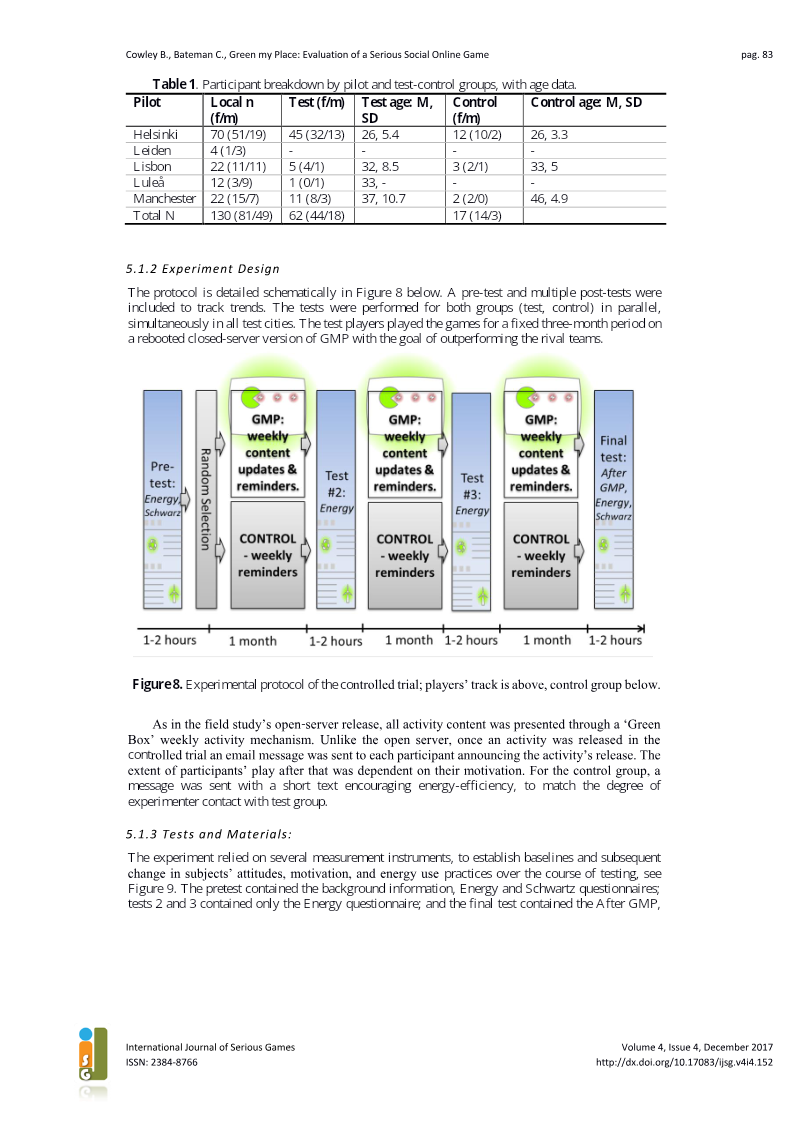

Green My Place: Evaluation of a Serious Social Online Game Designed to Promote Energy Efficient Behaviour Change
Green My Place functions as a serious social online game designed to foster energy-efficient behavior by integrating real-time building sensor data with competitive, team-based mechanics.
- The Green My Place pilot program achieved measurable energy savings ranging from 7% to 30% across five test buildings over a one-year period.
- There is a strong correlation between participation in mini-games and the consumption of educational content, indicating that even low-level interaction drives tangible environmental outcomes.
- Significant behavioral change in energy consumption does not require deep or sustained player immersion in the game platform.
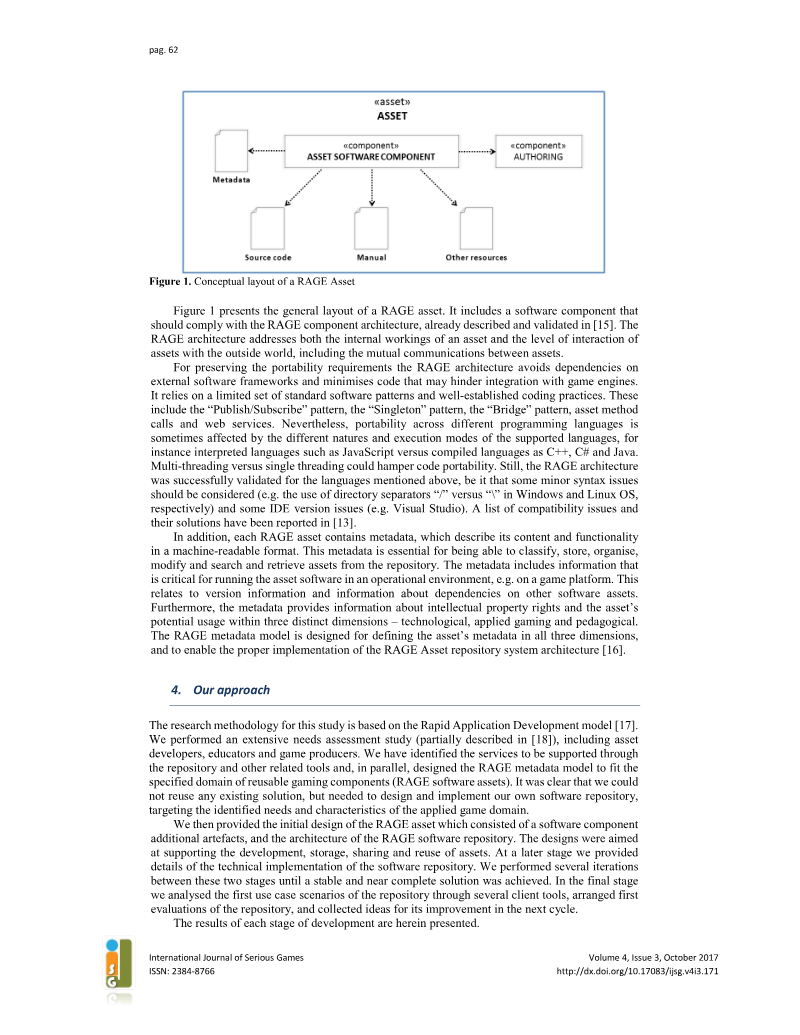

The RAGE Game Software Components Repository: Supporting Applied Game Development
The RAGE project establishes a centralized infrastructure designed to address the persistent fragmentation within the applied games industry.
- The RAGE project provides a centralized repository of reusable software components specifically designed to reduce development costs and technical barriers in the applied games industry.
- The architecture prioritizes interoperability across diverse game engines and programming languages, distinguishing it from general-purpose asset stores.
- The system utilizes a three-tier architecture—client, service, and data store—integrated with Fedora, Sesame, and Solr to manage the full lifecycle of software assets.



EscapED: A Framework for Creating Educational Escape Rooms and Interactive Games
The escapED framework establishes a structured methodology for integrating non-digital, human-centered escape rooms into higher education curricula.
- The escapED framework provides a structured, six-step methodology for designing educational escape rooms based on participants, objectives, theme, puzzles, equipment, and evaluation.
- The framework prioritizes non-digital, physical, and team-based environments to foster soft skills like leadership, communication, and collaborative problem-solving.
- Pilot studies using the Balanced Measure of Psychological Needs scale confirm that these interactive, narrative-driven experiences consistently increase student motivation and engagement.
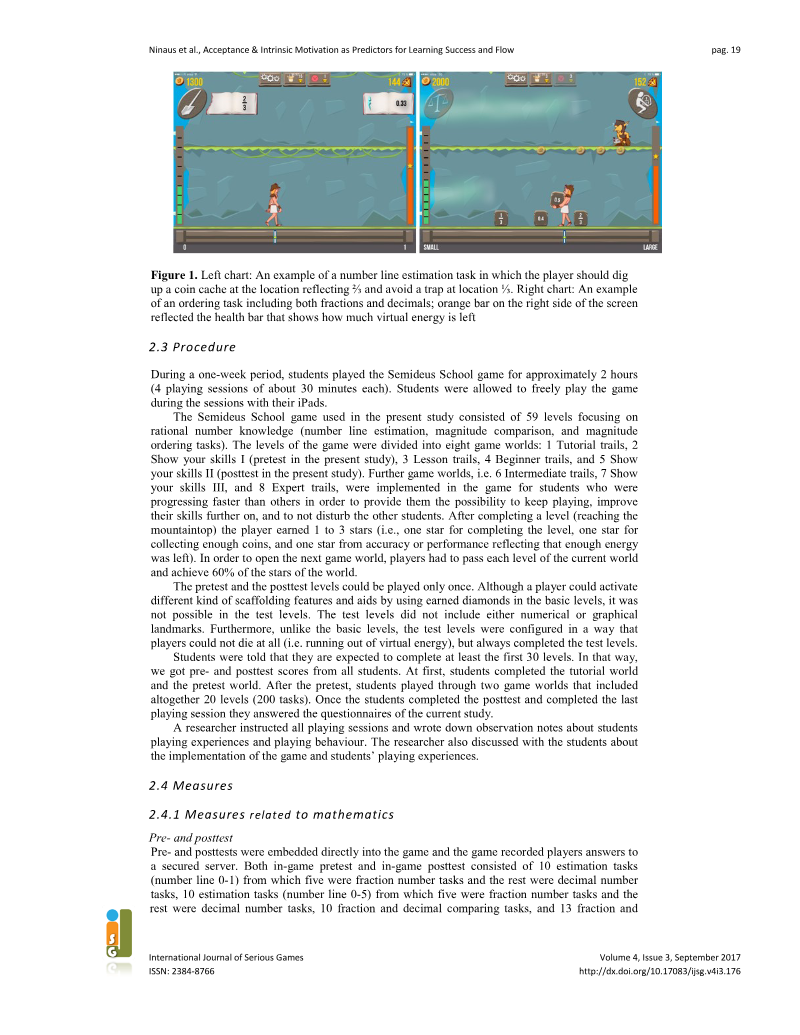

Acceptance of Game-Based Learning and Intrinsic Motivation as Predictors for Learning Success and Flow Experience
Game-based learning serves as a potent pedagogical tool for improving rational number proficiency among sixth-grade students.
- A multiple regression analysis of the Semideus game-based training explained 61% of the variation in student learning success, with an adjusted R² of 0.47 indicating a medium-sized effect.
- Students' learning success in rational number tasks is significantly predicted by their intrinsic motivation (math interest and self-efficacy) and their acceptance of the game as a learning tool.
- Perceived flow experience during gameplay is directly influenced by a player's math interest and their perception of the game's usefulness and ease of use.
Connected Gaming: An Inclusive Perspective for Serious Gaming
Connected gaming represents a pedagogical framework that synthesizes instructionist game-playing with constructionist game-making to foster a more comprehensive educational environment.
- Connected gaming integrates 'instructionist' approaches (playing educational games) with 'constructionist' approaches (students designing and building their own games) to maximize learning outcomes.
- Minecraft serves as a primary model for this convergence, having sold over 100 million copies and demonstrating how sandbox environments allow users to transition seamlessly from playing to building and coding.
- The shift toward constructionist gaming is driven by a growing DIY culture, an industry-wide push for computational thinking, and the need to broaden participation in computing.



Does Feedback Design Matter? A Neurofeedback Study Comparing Immersive Virtual Reality and Traditional Training Screens in Elderly
Immersive virtual reality environments offer a transformative approach to neurofeedback training by providing intuitive, high-fidelity feedback designed to enhance user engagement and performance.
- In healthy older individuals, 3D virtual reality (VR) neurofeedback significantly outperformed traditional 2D bar-based feedback in training performance, showing a statistically significant linear increase in Upper Alpha (UA) power.
- 3D VR feedback improved user experience for healthy seniors by increasing mastery confidence and reducing feelings of incompetence, whereas stroke patients in previous studies reported higher anxiety and lower confidence with the same 3D interface.
- The 3D VR feedback design, which utilized a semi-transparent stereoscopic human body, did not induce cyber sickness symptoms and maintained EEG data quality comparable to traditional 2D methods.



A Proposed Framework for the Collection of Health-Related Data from Serious Games and Apps
Serious games for health represent a significant opportunity to improve patient outcomes, yet the lack of standardized data collection remains a primary barrier to their clinical adoption.
- Serious Games for Health (SGFH) currently produce proprietary, non-standardized data that cannot be integrated into clinical workflows or Electronic Health Records (EHRs), creating significant barriers for physician adoption and patient treatment monitoring.
- The proposed framework aims to bridge the gap between game data and clinical systems by utilizing standardized interfaces such as HL7 FHIR to ensure health data is semantically rich and interoperable with Hospital Information Systems (HIS).
- A central component of the framework is a Decision Support System (DSS) that processes both game-proprietary metrics and medical data to generate actionable health recommendations for patients and clinicians.


Prime Example Ingress: Reframing the Pervasive Game Design Framework (PGDF)
The Pervasive Game Design Framework (PGDF) serves as a critical mechanism for enhancing the efficacy of immersive educational games by leveraging design principles derived from real-world, location-based gaming.
- The Pervasive Game Design Framework (PGDF) was developed to provide a methodology for creating immersive educational games and gamified learning paths, using Ingress as a primary case study.
- A survey of 133 long-term Ingress players revealed that the primary motivation for ending a game session is the requirement of real-life activities (mean score 4.0), followed by the completion of in-game goals (mean score 3.7).
- Ingress players are highly motivated by social interaction, community identification, and the opportunity to meet diverse people, with socializing and new acquaintances ranking among the top cited benefits.