1 free read left. Create a free account for unlimited reading + AI research.
Create free accountWhitepaper International Journal of Serious Games
1 free read left. Create a free account for unlimited reading + AI research.
Create free accountWhitepaperInternational Journal of Serious Games
The Semideus training program, a digital intervention, leads to measurable gains in mathematical knowledge.
Game-based learning serves as a potent pedagogical tool for improving rational number proficiency among sixth-grade students. By utilizing the training program Semideus, research confirms that digital interventions lead to measurable gains in mathematical knowledge, with the most significant improvements observed in students who begin with lower baseline proficiency. These findings suggest that serious games are uniquely positioned to bridge achievement gaps by providing an engaging environment that supports learners who may struggle with traditional instructional methods.
The success of these educational interventions relies heavily on the intersection of technology acceptance and intrinsic motivation. Learning outcomes are primarily driven by a student’s perception of the tool’s usefulness and ease of use, alongside their personal math self-efficacy. Simultaneously, the psychological state of flow—characterized by deep immersion and focus—is fostered when students perceive the game as both functional and relevant to their interests. Consequently, math interest acts as a critical catalyst for maintaining engagement throughout the learning process.
Ultimately, the integration of pedagogical principles with user-centered design is essential for optimizing educational outcomes in digital environments. By aligning game mechanics with the psychological drivers of motivation and technology acceptance, developers can create experiences that not only teach complex concepts but also sustain student interest. These insights underscore the necessity of designing serious games that prioritize both the cognitive demands of the curriculum and the affective needs of the learner, ensuring that technology serves as an effective bridge to academic success.
International Journal of Serious Games · 2023
International Journal of Serious Games · 2022
International Journal of Serious Games · 2020
International Journal of Serious Games · 2020
International Journal of Serious Games · 2020
International Journal of Serious Games · 2020
International Journal of Serious Games · 2020
International Journal of Serious Games · 2020
International Journal of Serious Games · 2020

International Journal of Serious Games · 2020

International Journal of Serious Games · 2020
Air Force Institute of Technology · 2020
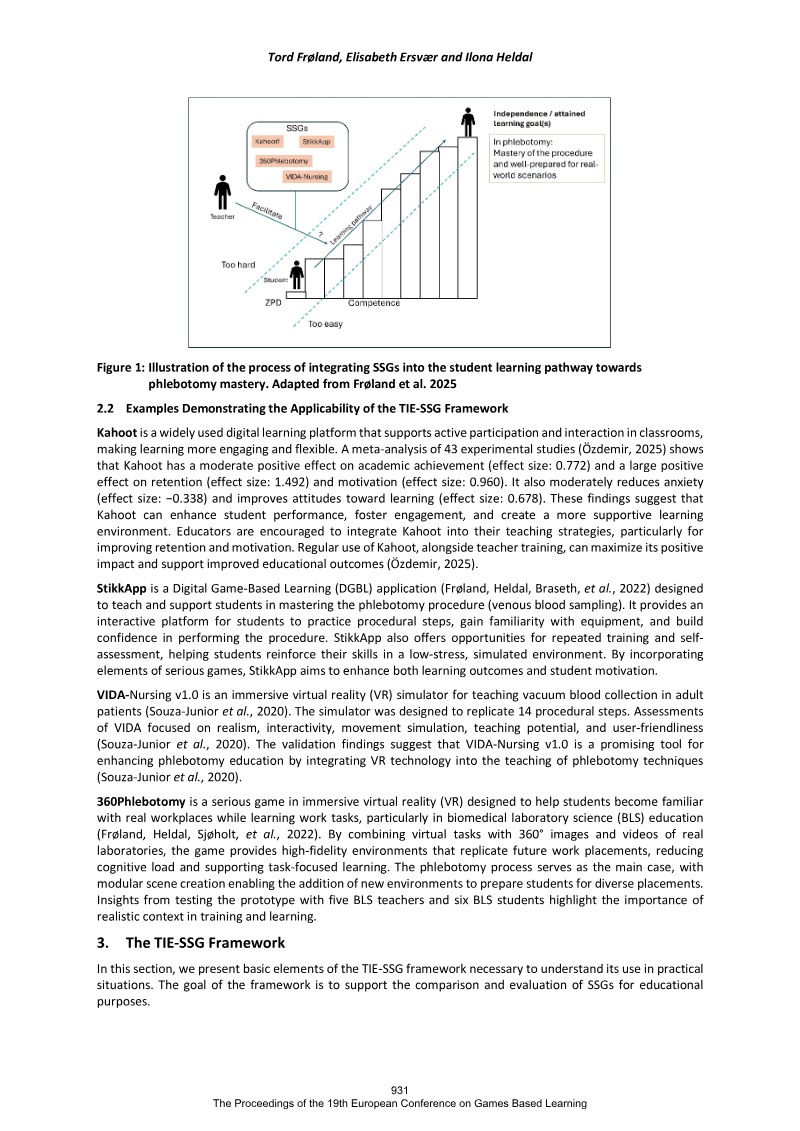
Western Norway University of Applied Sciences · 2025
European Conference on Games Based Learning (ECGBL) · 2025
European Conference on Games Based Learning (ECGBL) · 2022