GameRefinery
Research36 documents
Documents

Report24 pages
In-Game Events Snapshot: November 2021
In-game events have become a cornerstone of mobile game monetization and player retention, with 90% of the top 100 grossing mobile titles utilizing seasonal events. This analysis examines the strategic implementation of these live operations across major global markets, including the US, China, and Japan, focusing on data from late 2020 through late 2021.
The findings indicate that seasonal events are highly effective at re-engaging existing players and acquiring new ones. In the US, developers primarily leverage public holidays like Christmas and Halloween, while Asian markets utilize region-specific occasions such as China’s Qixi Festival and Japan’s Sakura season. Successful implementations often combine UI changes with playable content, such as the tower defense mode in Genshin Impact’s Lantern Rite event, which drove daily revenue from $200,000 to over $1.25 million. Revenue is typically generated through time-limited skins, themed currencies, and special gacha mechanics.
Promotional collaborations with external brands represent a significant growth area, appearing in 42% of the top 100 US iOS games—a steady increase since 2017. This trend is even more pronounced in Asia, where 51% of top Chinese games and 62% of top Japanese games feature collaborations. These partnerships extend beyond gaming IPs to include non-gaming brands like KFC or virtual influencers like Kizuna AI. The latter’s partnership with Sky: Children of the Light demonstrated the power of niche fanbases, pushing the game to over $1 million in daily revenue through a single $20 accessory kit.
Methodologically, the insights are derived from GameRefinery’s proprietary three-layered taxonomy, which categorizes games by category, genre, and subgenre. The data highlights that while events are ubiquitous among top-tier titles, they remain underutilized by lower-ranking games, serving as a key differentiator for market leaders across the casual, mid-core, and casino segments.
- Seasonal in-game events are a standard industry practice, utilized by 90% of the top 100 grossing mobile titles to drive player retention and monetization.
- External brand collaborations are a major growth area, appearing in 42% of top US iOS games, 51% of top Chinese games, and 62% of top Japanese games.
- Strategic event implementation can drive massive revenue spikes, such as Genshin Impact’s Lantern Rite event increasing daily revenue from $200,000 to over $1.25 million.
- Niche influencer partnerships can be highly lucrative, evidenced by a single $20 accessory kit in Sky: Children of the Light pushing daily revenue past $1 million.
- Successful events frequently combine UI overhauls with new playable content, leveraging time-limited skins, themed currencies, and special gacha mechanics to monetize.
+1
GameRefineryNov 2021
Report16 pages
Strategy Genre Snapshot 2021
The strategy genre remains a cornerstone of the mobile gaming market, currently ranking as the third-largest genre in the United States on iOS with a 17% revenue market share. The landscape is heavily dominated by the 4X strategy subgenre, which accounts for 20 of the top 25 grossing strategy titles. While the market is crowded with aging titles, recent growth is driven by genre-blending, where developers integrate mechanics from other categories—such as merge, match-3, or RPG elements—to broaden player appeal.
Market analysis reveals that 4X strategy games rely on three primary pillars: long-term power progression through permanent boosts and deep economies, complex live operations featuring recurring events, and robust social frameworks centered on competition and collaboration. High-performing examples include State of Survival, which reached the top of the 4X subgenre through massive IP collaborations, and Top War, which successfully scaled using merge mechanics. Conversely, the MOBA subgenre continues to face challenges in the U.S. market; despite a strong launch, League of Legends: Wild Rift struggled to maintain its top-grossing position, leaving the subgenre's future performance to newer entries like Pokémon UNITE.
Player motivation data, derived from a survey of over 7,000 respondents across English-speaking Western territories, indicates that strategy players are primarily driven by strategic planning, resource optimization, and social competition. Successful titles capitalize on these drivers by offering deep technology trees, competitive guild mechanics, and diverse PvP modes. While Supercell remains the only major player finding significant success outside the 4X subgenre with titles like Clash of Clans, the broader trend suggests that sustained revenue in this space requires a sophisticated mix of deep monetization loops and constant feature innovation.
- The 4X subgenre dominates the U.S. mobile strategy market, accounting for 20 of the top 25 grossing titles within a genre that holds a 17% total iOS revenue share.
- Successful strategy titles are increasingly driven by genre-blending, integrating mechanics like merge, match-3, or RPG elements to expand their player base beyond traditional core audiences.
- High-performing 4X games rely on three core pillars: long-term power progression through deep economies, complex live operations with recurring events, and social frameworks built on competition and collaboration.
- Player motivation data from over 7,000 Western respondents confirms that strategic planning, resource optimization, and social competition are the primary drivers for engagement in the genre.
- While Supercell remains a notable exception with Clash of Clans, the broader strategy market is currently defined by aging titles that require constant feature innovation and deep monetization loops to maintain revenue.
GameRefineryOct 2021
Report22 pages
Shooter Genre Snapshot: September 2021
Shooter Genre Snapshot – September 2021 (GameRefinery)
1. Market Overview | Metric | Insight | |--------|----------| | Genre rank (US iOS) | 6th largest mobile genre, ~6 % of total iOS revenue. | | Revenue share | The “Big Three” – Call of Duty: Mobile, PUBG Mobile, and Garena Free Fire – generate > 84 % of shooter revenue. | | Impact of Fortnite removal | Apple‑Epic lawsuit (Fortnite removed Aug 2020) erased a game that once held ~30 % of the shooter market on iOS. | | Growth leader | Garena Free Fire doubled its iOS revenue in 2021, climbing from ~10 % to ~30 % market share and now rivals CoD Mobile for the top spot (Q2 2021). | | New‑entry stagnation | No shooter launched in the last 2 years cracked the top‑grossing 200; only Bullet Echo (May 2020) entered the top‑500. |
2. Top‑Performing Titles (US iOS – Q2 2021)
| Rank | Game | Publisher | Sub‑genre | Share | |------|------|-----------|-----------|-------| | 1 | Garena Free Fire – 4th Anniversary | Garena International | Battle‑Royale | 28.56 % | | 2 | Call of Duty: Mobile | Activision | Classic FPS/TPS | 28.17 % | | 3 | PUBG Mobile – Ignition | Tencent | Battle‑Royale | 26.55 % | | 4 | War Robots | Pixonic | Tactical Shooter | 3.5 % | | 5 | Sniper 3D | Fun Games | Sniper | 3.5 % | | 6 | Pixel Gun 3D | Cubic Games | Classic FPS/TPS | 2.12 % | | 7 | War Machines: Tank | Fun Games | Tactical Shooter | 1.9 % | | 8 | Zooba: Zoo Battle Royale | Wildlife Studios | Battle‑Royale | 1.88 % | | 9 | World of Tanks Blitz | Wargaming | Tactical Shooter | 1.61 % | | 10| Tacticool | – | – | ~1 % |
Key takeaway: The top three dominate ~83 % of the genre’s revenue; the rest of the field is highly fragmented.
3. Why the “Big Three” Stay on Top
| Driver | How It’s Implemented | |--------|----------------------| | Battle Pass | Seasonal “free + paid” tracks that reward playtime, cosmetics, and progression. | | Limited‑time Gachas | Time‑bound loot‑box style draws with increasing price/odds, often tied to events or milestones. | | Live Events & New Modes | Frequent, high‑visibility updates (e.g
- The shooter genre on US iOS is highly concentrated, with the 'Big Three'—Garena Free Fire, Call of Duty: Mobile, and PUBG Mobile—collectively generating over 84% of total genre revenue.
- Garena Free Fire experienced significant growth in 2021, doubling its iOS revenue and capturing approximately 30% of the market share to rival Call of Duty: Mobile for the top position as of Q2 2021.
- The shooter genre accounts for roughly 6% of total US iOS revenue, currently ranking as the platform's 6th largest mobile genre.
- The removal of Fortnite from the App Store in August 2020 eliminated a title that previously commanded approximately 30% of the iOS shooter market.
- New-entry performance is stagnant, as no new shooter titles launched in the two years prior to September 2021 have cracked the top 200 grossing list.
+1
GameRefinerySept 2021
Report19 pages
RPG Genre Snapshot
Role-playing games represent a significant pillar of the mobile gaming market, currently holding a 14% revenue share on the US iOS platform. While established titles like Raid: Shadow Legends and Marvel Strike Force maintain their positions at the top of the charts, the genre is undergoing a fundamental shift in subgenre dominance. Historically led by turn-based titles, the market is increasingly defined by high-production action RPGs. This transition is primarily driven by the massive success of Genshin Impact, which alone accounts for 10% of the total RPG market share, and the more recent launch of My Hero Academia: The Strongest Hero.
Analysis of these market leaders reveals a trend toward open-world experiences, narrative depth, and console-quality production values. While both leading titles utilize action-based combat and anime art styles, they cater to different player motivations. Genshin Impact focuses on single-player exploration and skill-based mechanics, whereas My Hero Academia emphasizes social and competitive elements through synchronous and asynchronous PvP. Despite these innovations in gameplay, the genre remains anchored by character collection and gacha-based monetization.
Revenue performance in the sector is heavily dictated by live operations and content updates. Data indicates that the most significant revenue spikes occur during limited-time events, particularly those introducing new characters via "banner gachas" or step-up mechanics. Furthermore, collaboration events with external intellectual properties, such as the crossover between The Seven Deadly Sins: Grand Cross and Stranger Things, have proven highly effective at engaging audiences. These findings, derived from GameRefinery’s proprietary SaaS dashboard and genre taxonomy, cover the US iOS market over a twelve-month period ending in mid-2021.
- RPG titles account for 14% of the total revenue share on the US iOS mobile gaming market.
- Genshin Impact alone captures 10% of the total RPG market share, signaling a shift from turn-based titles toward high-production action RPGs.
- Market leaders are increasingly defined by console-quality production values, open-world environments, and narrative-heavy gameplay.
- Revenue performance is primarily driven by live operations, specifically limited-time events, new character 'banner gacha' releases, and external IP collaborations.
- While action-based combat and anime aesthetics are common, top titles differentiate by focusing on either single-player exploration or competitive PvP elements.
+1
GameRefineryJun 2021
Report19 pages
RPG Genre Snapshot Report June 2021
Role-playing games (RPGs) represent a cornerstone of the mobile gaming market, accounting for approximately 14% of total revenue on the US iOS platform as of mid-2021. While the genre has long been dominated by established turn-based titles like Raid: Shadow Legends and Marvel Strike Force, recent market data indicates a significant shift toward Action RPGs. This transition is driven primarily by high-production, open-world titles that bridge the gap between mobile and console-quality experiences.
The primary catalyst for this shift is Genshin Impact, which alone commands over 10% of the RPG market share. Alongside the more recent launch of My Hero Academia (MHA): The Strongest Hero, these titles emphasize narrative depth, exploration, and high-fidelity graphics. While both utilize an anime art style, they cater to different player motivations: Genshin Impact focuses on single-player exploration and skill-based combat, whereas MHA integrates more competitive social elements, including synchronous and asynchronous PvP.
Monetization within the genre remains heavily reliant on character collection mechanics and sophisticated gacha systems. Analysis of top-performing updates shows that revenue spikes are most frequently tied to limited-time "banner" gachas and IP collaboration events, such as the crossover between The Seven Deadly Sins: Grand Cross and Stranger Things. These events often introduce bespoke gameplay modes, such as tower defense or unique PvE challenges, to maintain engagement.
The findings are based on GameRefinery’s proprietary three-layered taxonomy and a motivation framework derived from a survey of over 7000 mobile gamers across English-speaking Western markets. The data specifically covers the US iOS market for the 12-month period leading up to June 2021, highlighting a clear evolution from traditional turn-based mechanics toward immersive, open-world action experiences.
- As of mid-2021, RPGs account for approximately 14% of total revenue on the US iOS mobile gaming platform.
- The RPG market is shifting from traditional turn-based titles toward high-fidelity, open-world Action RPGs that offer console-quality experiences.
- Genshin Impact is the primary driver of the genre's evolution, currently commanding over 10% of the total RPG market share.
- Top-performing RPGs increasingly differentiate themselves through specific player motivations, such as Genshin Impact’s focus on single-player exploration versus My Hero Academia’s emphasis on competitive PvP.
- Revenue growth in the genre is primarily driven by limited-time 'banner' gacha systems and IP collaboration events, such as the crossover between The Seven Deadly Sins: Grand Cross and Stranger Things.
+1
GameRefineryJun 2021
Report20 pages
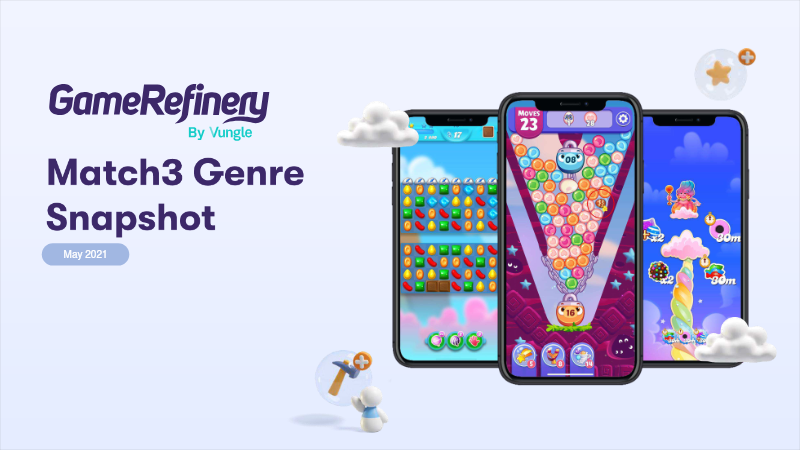
Match3 Genre Snapshot: US iOS (May 2021)
The Match3 subgenre represents the largest individual segment of the US iOS mobile gaming market, accounting for approximately 16% of total market revenue as of May 2021. While the category has long been dominated by established titles that have maintained chart positions for years, recent market shifts indicate a move away from traditional swapping mechanics. Notably, none of the new Match3 titles entering the top 500 grossing rankings over the last 18 months utilize standard swapping gameplay, signaling a diversification in core mechanics and the rising importance of meta-layers.
Meta-elements, particularly those focused on decoration and customization, have become essential components for modern success in the genre. Successful megahits like Royal Match and Project Makeover demonstrate the effectiveness of combining core puzzle gameplay with deep progression systems and sophisticated monetization strategies. Data indicates that recurring live events, special event rewards, and limited-time in-app purchase offers have the highest impact on revenue. Furthermore, social features such as guild mechanics and "send/ask help" systems are increasingly vital for driving engagement and retention.
Player motivation analysis, based on a survey of over 7,000 mobile gamers across English-speaking Western markets, reveals distinct psychological drivers within the genre. While "Thinking and Solving" remains the primary driver for traditional titles like Candy Crush Saga, newer successful entries increasingly lean into "Customization and Decoration" and "Role-playing and Emotions." This shift reflects a broader industry trend where loss aversion mechanics and social competition are leveraged to enhance the player experience and maximize lifetime value in a highly competitive landscape.
- As of May 2021, the Match3 subgenre accounts for approximately 16% of total US iOS mobile gaming revenue.
- No new Match3 titles entering the top 500 grossing rankings over the last 18 months utilize standard swapping mechanics, indicating a shift toward gameplay diversification.
- Modern Match3 success is increasingly driven by meta-layers, specifically decoration and customization features seen in titles like Royal Match and Project Makeover.
- Revenue performance in the genre is most heavily influenced by recurring live events, special event rewards, and limited-time in-app purchase offers.
- Social features, including guild mechanics and help-request systems, are now essential for maintaining player engagement and retention.
+5
GameRefineryMay 2021
Report21 pages
Market Snapshot: Q1 2021 US, China & Japan
The mobile gaming market in the first quarter of 2021 demonstrated regional divergence in genre performance, with the United States remaining relatively stable while China and Japan experienced notable shifts in market share. In the US, simulation games continued to grow, and Roblox Corporation solidified its position as the top-grossing publisher. Conversely, Japan saw a decline in RPG market share alongside a significant rise in sports titles, driven by the breakout success of Cygames’ Uma Musume Pretty Derby. China’s market moved away from traditional RPG and strategy dominance, favoring a surge in shooter games.
Data analysis reveals distinct trends in monetization and feature implementation across these regions. Collectible albums have become a staple in the US, utilized by over 70% of top-grossing games. In Japan, battle pass mechanics are gaining traction, appearing in over 25% of top-grossing titles. Meanwhile, Chinese developers have doubled the year-over-year utilization of special gacha mechanics, which now appear in 30% of top-grossing games. Social features, particularly guild mechanics and co-op modes, remain essential for retention across puzzle, RPG, and strategy genres.
The analysis utilizes a proprietary genre taxonomy and a motivation framework to categorize player archetypes. In the US market, the top 200 grossing games primarily appeal to five distinct archetypes, with a rising trend toward the Skill Master archetype, indicating an increased consumer appetite for competitive gameplay that rewards reflexes and skill. These findings are based on iOS market performance data, publisher share metrics, and an evaluation of soft-launch titles, providing a comprehensive view of the mobile landscape during the transition from late 2020 to early 2021.
- In Q1 2021, mobile gaming genre preferences diverged globally: US markets favored simulation games, Japan saw a shift from RPGs to sports titles led by Cygames’ Uma Musume Pretty Derby, and China moved toward shooter games.
- Roblox Corporation established itself as the top-grossing publisher in the US market during Q1 2021.
- Monetization strategies varied by region, with collectible albums appearing in over 70% of top-grossing US games, battle passes in over 25% of top-grossing Japanese titles, and special gacha mechanics in 30% of top-grossing Chinese games.
- Chinese developers doubled their year-over-year utilization of special gacha mechanics in top-grossing titles.
- US mobile gaming trends indicate a rising consumer appetite for the 'Skill Master' archetype, reflecting a growing preference for competitive gameplay that rewards reflexes and skill.
+2
GameRefineryApr 2021
Report21 pages
Casino Snapshot Report: Market, Features & Updates, Motivations (March 2021)
This analysis examines the state of the mobile Casino game category in the United States during the fourth quarter of 2020. Utilizing a proprietary three-layered taxonomy and data from the GameRefinery SaaS platform, the findings highlight that Casino games represent the second-largest revenue-generating category on iOS in the US, accounting for 17.2% of total mobile game revenue. The research identifies three primary subgenres—Slots, Poker/Cards, and Bingo—and evaluates their market share, competitive landscapes, and player motivations.
The data reveals that Slots is the dominant subgenre, responsible for 80% of the category's revenue. Unlike Poker and Bingo, which are characterized by "king of the hill" titles like World Series of Poker and Bingo Blitz, the Slots market is highly competitive with no single dominant leader. Market share is distributed relatively evenly among the top five titles, including Slotomania and DoubleDown Casino. The study notes that the Casino market is mature, with most top-grossing titles having maintained their positions for several years, making it difficult for new challengers to break into the top charts.
Methodology involves a survey of over 7,000 mobile gamers across English-speaking Western markets to identify key motivational drivers. Findings indicate that Casino players are primarily driven by excitement, competition, and treasure collection. Consequently, top-performing games increasingly adopt "meta" features from other genres to drive engagement. Key differentiating features include collectible albums, guild mechanics for social play, and "Piggy Bank" monetization systems. For instance, 60% of top-tier Casino games utilize collectible mechanics compared to only 36% of the broader category, illustrating a clear correlation between complex progression features and commercial success.
- The mobile Casino category is the second-largest revenue generator on US iOS, capturing 17.2% of total mobile game revenue as of Q4 2020.
- Slots dominate the category with 80% of total revenue, characterized by a highly competitive landscape where market share is evenly distributed among top titles like Slotomania and DoubleDown Casino.
- In contrast to the fragmented Slots market, the Poker and Bingo subgenres are dominated by single 'king of the hill' titles such as World Series of Poker and Bingo Blitz.
- The Casino market is highly mature, with top-grossing titles maintaining their positions for years, creating a high barrier to entry for new challengers.
- Top-performing Casino games are increasingly integrating meta-features from other genres, such as guild mechanics and collectible albums, to drive player engagement.
+1
GameRefineryMar 2021
Report22 pages
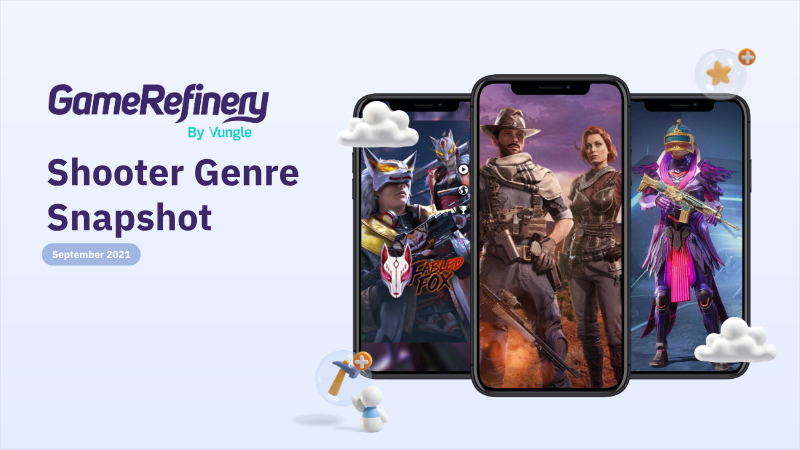
Shooter Genre Snapshot: September 2021
The mobile shooter genre currently occupies a significant position in the US iOS market, ranking as the sixth-largest genre and accounting for approximately 6% of total market revenue. The landscape is characterized by high market concentration, with over 84% of revenue generated by the "Big Three" titles: Call of Duty: Mobile, PUBG Mobile, and Garena Free Fire. The removal of Fortnite from the App Store in August 2020 served as a major catalyst for market consolidation, allowing these remaining leaders to capture significant additional market share. Garena Free Fire has demonstrated the most aggressive growth, more than doubling its revenue over the past year to reach parity with its primary competitors.
Despite the genre's financial success, the market has entered a period of stagnation regarding new entrants. No new shooter games released within the last two years have successfully broken into the top 200 grossing charts, and only one title, Bullet Echo, has entered the top 500 since May 2020. This lack of new competition is expected to be challenged soon, as several high-profile titles—including mobile adaptations of Valorant, Apex Legends, and Battlefield—are currently in development. These upcoming releases aim to leverage established intellectual properties to disrupt the current hierarchy.
Successful shooter titles rely on a consistent, high-frequency content cadence to maintain engagement and monetization. Core monetization strategies center on cosmetic economies, utilizing Battle Pass systems and limited-time gacha mechanics. Player motivation analysis indicates that the genre is driven primarily by mastery, competition, and excitement, with top games utilizing social features like guilds and collection systems to deepen player retention. Future growth in the sector will likely depend on whether new titles can successfully implement these proven engagement loops while introducing enough differentiation to attract players from the established incumbents.
- The US mobile shooter market is highly concentrated, with Call of Duty: Mobile, PUBG Mobile, and Garena Free Fire generating over 84% of total genre revenue.
- Garena Free Fire has achieved significant market growth, more than doubling its revenue over the past year to reach parity with its primary competitors.
- The mobile shooter genre currently ranks as the sixth-largest in the US iOS market, accounting for approximately 6% of total market revenue.
- Market entry for new titles has stalled, as no shooter released in the last two years has reached the top 200 grossing charts, and only one has entered the top 500 since May 2020.
- The removal of Fortnite from the App Store in August 2020 acted as a catalyst for market consolidation, allowing the remaining top-tier titles to capture increased market share.
+1
GameRefineryJan 2021

Report24 pages
In-Game Events Snapshot
The snapshot presents a comprehensive overview of in‑game event strategies across the global mobile gaming market, focusing on seasonal and promotional collaboration events. It establishes that 90 % of the top‑grossing 100 mobile titles deploy seasonal events, while 40 % of US iOS top‑100 games feature brand collaborations. These events are highlighted as key drivers for player re‑engagement, new user acquisition, and revenue spikes, with examples such as Sky: Children of the Light’s Kizuna AI partnership and Genshin Impact’s Lantern Rite event, which each generated multi‑million daily revenue surges.
The report details the taxonomy of events—UI changes, limited‑time offers, playable content, and special bundles—and identifies profitable revenue streams: time‑limited skins, character drops, themed currency, and gacha mechanics. Seasonal calendars list major holidays (Christmas, Lunar New Year, Halloween) and region‑specific observances (Double Five in China, Sakura season in Japan), underscoring the importance of cultural relevance.
Geographic scope covers North America, China, and Japan, with data on event adoption rates: 51 % of Chinese top‑100 games and 62 % of Japanese top‑100 games use promotional collaborations, compared to 42 % in the US. Methodology relies on GameRefinery’s SaaS platform, aggregating revenue and event data from thousands of titles.
Key conclusions emphasize that events remain a differentiator for high‑performing games, offering scalable monetization and cross‑brand synergy. The snapshot recommends that developers evaluate event fit against audience demographics, content alignment, and potential for brand partnership to maximize engagement and revenue.
- Seasonal events are a standard industry practice, utilized by 90% of the top-grossing 100 mobile games to drive player re-engagement and revenue spikes.
- Brand collaborations are a significant growth lever, appearing in 62% of top-100 games in Japan, 51% in China, and 42% in the US.
- High-profile collaborations, such as Sky: Children of the Light’s Kizuna AI partnership and Genshin Impact’s Lantern Rite, have demonstrated the ability to generate multi-million dollar daily revenue surges.
- Successful event monetization relies on a mix of time-limited skins, character drops, themed currency, and gacha mechanics.
- Event strategies must prioritize cultural relevance, with top-performing titles aligning content with region-specific observances like China’s Double Five or Japan’s Sakura season.
GameRefineryJan 2021
Report20 pages
Market Snapshot: Q2 2021 US, China & Japan
The mobile gaming market in the second quarter of 2021 experienced notable shifts in genre performance and publisher dominance across the United States, China, and Japan. The primary objective is to provide a comparative analysis of these regional markets, highlighting evolving trends in genre market share, publisher success, and the increasing importance of live-service feature updates. The analysis utilizes a proprietary taxonomy and motivation framework, supported by a survey of over 7,000 mobile gamers in English-speaking western countries, to categorize games and identify player archetypes.
Key findings indicate that the United States saw a decline in the Puzzle genre’s market share, while the Strategy genre experienced significant growth. In Japan, the Sports genre continued to gain momentum, largely driven by the success of titles like Umamusume Pretty Derby, while RPGs faced a decline. China exhibited a trend reversal from the previous quarter, with RPG and Strategy genres regaining market share at the expense of Shooters. Publisher performance was marked by strong results from Supercell in the US and Cygames in Japan, while Leiting Games nearly doubled its market share in China.
A critical trend identified is the 37% year-over-year increase in feature updates, with Strategy games leading this surge at 208%. Developers are increasingly prioritizing engagement through non-recurring live events and limited in-app purchase offers, which saw frequency increases of 143% and 122%, respectively. These features are becoming essential for retention and monetization across major genres. Furthermore, player motivation data reveals that games appealing to fast-paced action and competitive play continue to dominate the top-grossing charts in the US, with specific archetypes like King of the Hill and Skill Master remaining highly relevant.
- Live-service feature updates increased by 37% year-over-year, with Strategy games leading the surge at 208% growth.
- Engagement tactics are shifting toward non-recurring live events and limited-time in-app purchase offers, which saw frequency increases of 143% and 122% respectively.
- In the US, the Strategy genre grew while the Puzzle genre declined, with Supercell emerging as a top-performing publisher.
- China experienced a market reversal in Q2 2021 as RPG and Strategy genres regained share from Shooters, while Leiting Games nearly doubled its market share.
- Japan’s market saw the Sports genre gain momentum behind the success of Umamusume Pretty Derby, while RPGs faced a decline and Cygames maintained strong publisher performance.
+3
GameRefineryJan 2021
Report20 pages
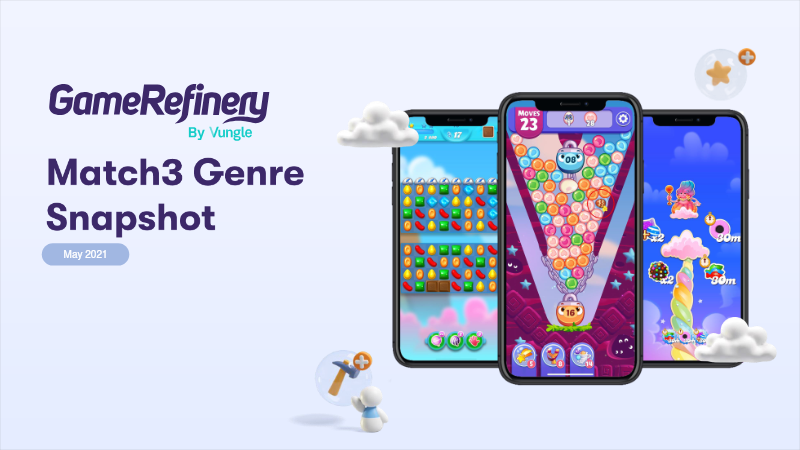
Match3 Genre Snapshot Report May 2021 (2021)
The Match3 subgenre represents the largest segment of the US iOS mobile gaming market, accounting for approximately 16% of total revenue as of mid-2021. While established titles have dominated the charts for years, the landscape is evolving through the integration of complex meta-layers and sophisticated monetization strategies. Notably, every new Match3 title that entered the top 500 grossing rankings between late 2019 and early 2021 utilized traditional swapping mechanics, signaling a preference for familiar core gameplay enhanced by modern secondary features.
Meta-elements, particularly customization and decoration, have become essential components of modern Match3 success. Recent megahits like Royal Match and Project Makeover demonstrate this trend by blending core puzzle mechanics with narrative progression and aesthetic choices. Beyond gameplay, monetization has shifted toward loss aversion mechanics and diverse live operations. Data indicates that recurring live events, special event rewards, and limited-time in-app purchase offers have the highest impact on revenue. Social features, including guild mechanics and "send/ask help" systems, further bolster engagement and retention within the subgenre.
Player motivation analysis, based on a survey of over 7,000 mobile gamers across major English-speaking markets, reveals distinct psychological drivers. While traditional titles like Candy Crush Saga rely heavily on the "Thinking & Solving" and "Completing Milestones" drivers, the broader Match3 market is increasingly leaning into "Customization & Decoration." This shift highlights a move away from pure puzzle-solving toward a more expressive and multi-layered player experience. The findings suggest that future growth in the category depends on balancing core puzzle mastery with social competition and deep meta-progression.
- As of mid-2021, the Match3 subgenre is the largest segment of the US iOS mobile gaming market, generating approximately 16% of total revenue.
- Every new Match3 title that entered the top 500 grossing rankings between late 2019 and early 2021 retained traditional swapping mechanics, confirming that core gameplay innovation is less critical than secondary feature integration.
- Success in the modern market is driven by meta-layers like customization and decoration, as evidenced by the performance of titles such as Royal Match and Project Makeover.
- Revenue optimization in the subgenre is currently driven by loss aversion mechanics, recurring live events, special event rewards, and limited-time in-app purchase offers.
- Player motivation has shifted from pure puzzle-solving toward expressive experiences, with 'Customization & Decoration' now serving as a primary psychological driver alongside traditional 'Thinking & Solving' and 'Completing Milestones' goals.
+2
GameRefineryJan 2021