GameRefinery
Research36 documents
Documents
Report10 pages
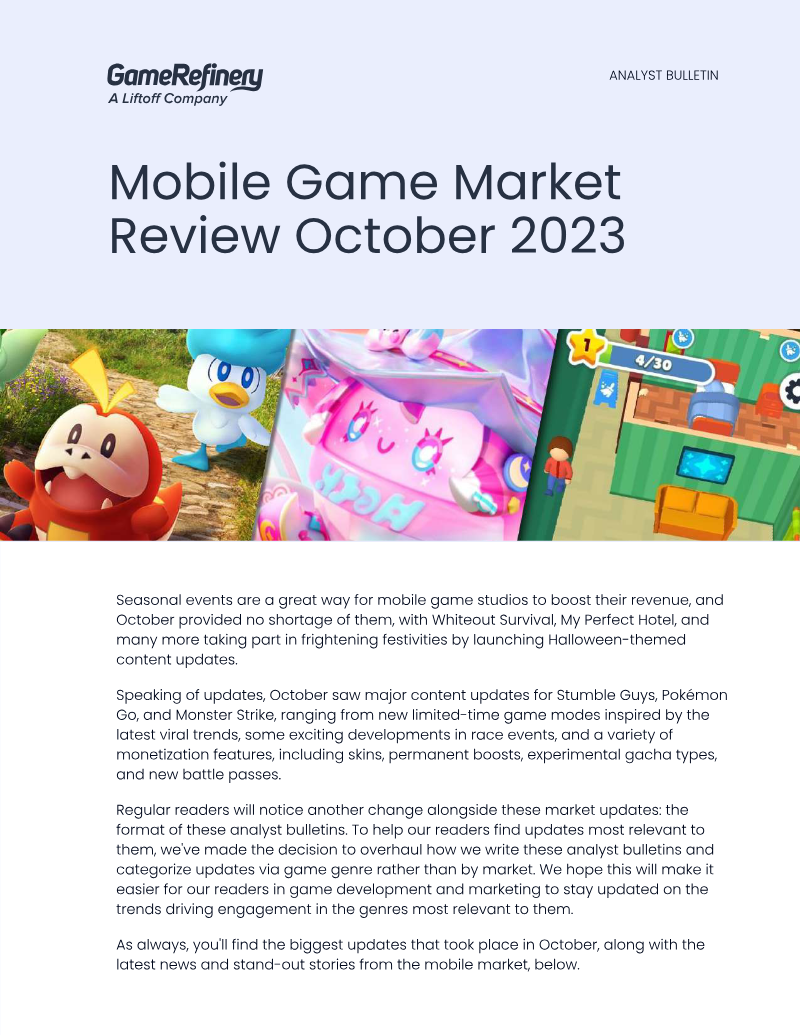
Mobile Game Market Review October 2023
The mobile gaming market in October 2023 was characterized by a heavy reliance on seasonal Halloween content and innovative social features to drive monetization and engagement. Analysis of the period reveals that major titles across the casual and midcore segments utilized limited-time events, crossover collaborations, and experimental gacha mechanics to bolster revenue. Geographically, the review focuses on major global markets, specifically the United States, Japan, and China, highlighting how regional preferences dictate event structures, such as the prevalence of social multi-gachas and location-based business discounts in the Japanese market.
In the casual segment, developers increasingly integrated social and competitive mechanics to maintain player interest. Notable examples include Pokémon Go’s introduction of a four-player party system and Eggy Party’s "Pedestrian Street" mode, which emphasizes social hangouts over core gameplay. Data indicates that titles like My Perfect Hotel successfully improved revenue trends by balancing download fluctuations with permanent boost systems and specialized battle passes. Furthermore, the market saw the rise of "challenging" platforming content in the party royale genre, drawing inspiration from viral PC trends to test player perseverance.
The midcore sector demonstrated the power of long-term live operations and high-profile collaborations. Monster Strike’s 10th-anniversary celebrations in Japan utilized celebrity partnerships and anime crossovers to maintain its top-tier status. Simultaneously, new entries such as Dungeon Hunter 6 and Reverse: 1999 achieved significant chart positions shortly after launch, with the latter reaching the top 100 in both the US and Japan. The findings suggest a market shift toward hybrid gameplay—such as combining merge mechanics with match-3 puzzles—and the successful localization of high-performing Chinese extraction shooters for Western audiences. Overall, the data underscores that consistent content overhauls and the strategic timing of feature updates remain the primary drivers for scaling performance in a competitive mobile landscape.
- Live operations and seasonal content, particularly Halloween-themed events and crossover collaborations, were the primary drivers for revenue and engagement across casual and midcore mobile titles in October 2023.
- Casual games are increasingly integrating social and competitive features to sustain retention, exemplified by Pokémon Go’s four-player party system and Eggy Party’s social-focused 'Pedestrian Street' mode.
- The midcore sector continues to rely on long-term live service strategies, evidenced by Monster Strike maintaining top-tier status in Japan through its 10th-anniversary celebrity and anime collaborations.
- New market entrants like Reverse: 1999 demonstrated strong global appeal by reaching the top 100 charts in both the US and Japan shortly after its launch.
- Monetization strategies in the casual segment are shifting toward permanent boost systems and specialized battle passes, as seen in the revenue stabilization of My Perfect Hotel.
+1
GameRefineryApr 2023
Report25 pages
The Rise of Midcore Mobile Games Snapshot Report July 2022
The midcore mobile gaming sector is experiencing a significant shift as AAA developers and high-fidelity titles increasingly challenge the historical dominance of casual and hyper-casual games. Analysis of the US iOS market between Q1 2021 and Q1 2022 reveals that midcore was the only category to achieve revenue growth, currently accounting for 36.73% of total mobile game revenue. This trend is further evidenced by the fact that nine midcore titles released in the past year remain in the top 200 grossing chart, compared to only three casual titles.
The success of these games, such as Diablo Immortal, Genshin Impact, and Apex Legends Mobile, is attributed to three essential design pillars: sophisticated control systems, diversified monetization, and high content cadence. Top-performing midcore games differentiate themselves by offering precise, console-like manual controls and minimizing reliance on autoplay. Furthermore, they utilize complex monetization strategies; 75% of top-grossing midcore games employ Battle Pass systems, and over 63% feature five or more distinct gacha mechanics.
Live operations and player engagement are equally critical, with 100% of top-tier midcore games utilizing recurring live events. A notable 80% of these titles implement special event-specific currencies to manage game economies and drive temporary sinks. Additionally, a burgeoning trend involves publishers establishing external web stores to bypass standard app store commission fees. Data for this analysis was sourced from the GameRefinery SaaS platform, focusing on feature adoption and revenue performance within the US iOS market to identify the specific mechanics that separate market leaders from the broader competitive field.
- Midcore mobile games were the only category to achieve revenue growth in the US iOS market between Q1 2021 and Q1 2022, now capturing 36.73% of total mobile gaming revenue.
- New midcore titles are outperforming casual games in long-term retention, with nine midcore releases from the past year remaining in the top 200 grossing chart compared to only three casual titles.
- Top-performing midcore titles like Diablo Immortal, Genshin Impact, and Apex Legends Mobile prioritize console-like manual controls over autoplay mechanics to drive engagement.
- Monetization in the sector is highly complex, with 75% of top-grossing midcore games utilizing Battle Pass systems and over 63% incorporating five or more distinct gacha mechanics.
- Live operations are universal among top-tier midcore games, with 100% employing recurring live events and 80% using event-specific currencies to manage game economies.
+1
GameRefineryJul 2022
Report25 pages
The Rise of Midcore Mobile Games Snapshot Report
The midcore mobile gaming sector is experiencing a significant shift as AAA developers successfully port major PC and console franchises to mobile devices. Between Q1 2021 and Q1 2022, midcore games represented the only category to see market share growth, accounting for nearly 37% of US iOS mobile game revenue. This trend is further evidenced by the fact that nine midcore titles released in the past year remain in the top-200 grossing charts in the US, compared to only three casual titles.
The success of these high-performing midcore games is attributed to three essential design pillars: sophisticated control systems, diversified monetization, and high content cadence. Leading titles like Diablo Immortal and Genshin Impact have moved away from traditional mobile autoplay mechanics, instead favoring precision-based manual controls and immersive storytelling that mirror premium console experiences. These games effectively cater to player motivations centered on mastery and the adrenaline rush of reaction-based skills.
Monetization strategies in the midcore space have become increasingly complex. Top-performing games are significantly more likely to utilize Battle Passes, with 75% of the top 20% grossing midcore games employing the feature compared to just 25% of lower-ranking titles. Furthermore, gacha systems remain a dominant revenue driver; over 65% of top midcore games feature more than five different gachas. To maximize margins, a emerging trend shows publishers establishing external web stores to bypass standard app store commission fees.
Finally, maintaining a massive content cadence is critical for retention. Approximately 80% of top midcore games utilize special live event currencies to create temporary economic sinks and drive daily engagement. By combining frequent limited-time events with a steady stream of cosmetic updates and new gameplay modes, successful developers ensure long-term player interest in an increasingly competitive AAA mobile landscape.
- Midcore games were the only mobile category to see market share growth between Q1 2021 and Q1 2022, capturing nearly 37% of US iOS mobile game revenue.
- Successful midcore titles are increasingly adopting high-cadence content strategies, with 80% of top-performing games using special live event currencies to drive daily engagement.
- Battle Passes are a primary monetization driver for top-tier midcore games, utilized by 75% of the top 20% grossing titles compared to only 25% of lower-ranking games.
- Leading titles like Genshin Impact and Diablo Immortal are shifting away from mobile autoplay mechanics in favor of precision-based manual controls and immersive storytelling to mirror console experiences.
- Gacha systems remain a dominant revenue source, with over 65% of top midcore games featuring more than five distinct gacha mechanics.
+1
GameRefineryJul 2022
Report25 pages
The Rise of Midcore Mobile Games
This analysis explores the significant growth and evolving landscape of midcore mobile games, particularly in the United States market as of mid-2022. While casual and hyper-casual titles historically dominated the mobile space, midcore games—often high-quality AAA experiences ported from PC and console franchises—are increasingly capturing market share. Data indicates that midcore titles accounted for nearly 37% of US iOS mobile game revenue in Q1 2022, representing the only category to see year-over-year growth during that period.
The findings highlight a clear performance gap between top-tier midcore games and their competitors. In a 365-day sample, nine midcore titles maintained positions in the top-200 grossing US charts, compared to only three casual titles. Success in this segment is driven by three primary pillars: sophisticated control systems that emulate the precision of console gaming, massive content cadence through live events, and diversified monetization strategies. Notably, 75% of top-grossing midcore games utilize Battle Passes, and over 65% feature five or more distinct gacha mechanics.
The scope of the research focuses on the US iOS market, utilizing a proprietary three-layered taxonomy to analyze genre-specific trends. Key case studies include Diablo Immortal, Apex Legends Mobile, and Genshin Impact, which are cited for their ability to balance core gameplay depth with mobile-specific monetization. Additionally, the analysis identifies an emerging trend of publishers implementing external web stores to bypass traditional app store commission fees. The methodology relies on data-driven analysis from the GameRefinery SaaS platform, incorporating feature-level comparisons and revenue tracking to distinguish the design elements that define market leaders.
- Midcore mobile games accounted for 37% of US iOS mobile game revenue in Q1 2022 and were the only category to experience year-over-year growth.
- Top-tier midcore titles demonstrate superior retention, with nine midcore games maintaining top-200 grossing positions over a 365-day period compared to only three casual titles.
- Monetization in top-grossing midcore titles is heavily standardized, with 75% of games utilizing Battle Passes and over 65% incorporating five or more distinct gacha mechanics.
- Success in the midcore segment is driven by a combination of console-quality control systems, high-frequency content updates via live events, and diversified monetization.
- Major titles such as Diablo Immortal, Apex Legends Mobile, and Genshin Impact serve as benchmarks for balancing core gameplay depth with mobile-specific monetization.
+1
GameRefineryJul 2022

Report35 pages
Innovative Monetization Features Snapshot Report June 2022
The mobile gaming landscape in mid-2022 is defined by the maturation and diversification of Battle Passes and gacha mechanics, which serve as the primary drivers for revenue in top-grossing titles. Battle Passes have evolved into sophisticated retention tools, appearing in 60% of high-performing games and incorporating social elements like guild-wide rewards and cooperative progression. Gacha mechanics remain even more pervasive, integrated into 93% of top titles in Japan and 75% of the top 20% grossing games in the United States. To maintain player trust and engagement, these systems increasingly feature transparency-focused innovations such as "pity" mechanics, player-selected prize pools, and social "joint-pull" events.
Monetization strategies are shifting away from direct gameplay boosters toward meta-layer engagement, focusing on narrative depth and cosmetic customization. Successful developers utilize psychological triggers like urgency and exclusivity through "Mystery Shops" and randomized discount events. For instance, mechanics that allow players to manipulate bundle contents or discount rates increase perceived agency, while quantity-based limitations create social pressure to purchase. These tactics are particularly effective when combined with hybrid monetization models, such as ad-supported tracks that convert non-paying users into the ecosystem.
Data indicates a clear correlation between sophisticated in-app purchase structures and market success. Progressive reward systems, which grant bonuses based on cumulative spending thresholds, are utilized by 23% of the top 20% grossing US iOS games, a significantly higher adoption rate than the 9% seen in lower-performing titles. By prioritizing player agency and social integration over simple transactional offers, developers are able to drive higher conversion rates and long-term player loyalty across diverse global markets and genres.
- Gacha mechanics are the dominant revenue driver, integrated into 93% of top-grossing Japanese titles and 75% of the top 20% of US-grossing games.
- Battle Passes have matured into primary retention tools, appearing in 60% of high-performing games and increasingly incorporating social and cooperative progression features.
- Progressive reward systems, which grant bonuses based on cumulative spending, are utilized by 23% of top-performing US iOS games compared to only 9% of lower-performing titles.
- Developers are shifting monetization focus toward meta-layer engagement, such as narrative depth and cosmetic customization, rather than direct gameplay boosters.
- To maintain player trust, developers are increasingly implementing transparency-focused gacha features, including 'pity' mechanics, player-selected prize pools, and joint-pull events.
+1
GameRefineryJun 2022

Report35 pages
Innovative Monetization Features Snapshot Report
Modern mobile game monetization is increasingly defined by the integration of sophisticated Battle Pass systems and gacha mechanics, which serve as the primary drivers for the industry's highest-grossing titles. Gacha mechanics are nearly universal among top-tier games, appearing in 93% of the top 20% grossing titles, while Battle Passes are utilized by 60% of this same demographic. These tools have evolved from simple transactional models into complex systems that leverage social cooperation, urgency, and psychological progression. Innovations such as auto-renewing subscriptions, social gifting within guilds, and "pity" systems for gacha pools have become standard practices to ensure transparency and maintain long-term player engagement without compromising core gameplay balance.
The geographic focus remains centered on the United States mobile market, where 75% of top-grossing games now employ gacha mechanics. A significant shift is occurring in the nature of in-app purchases, moving away from direct gameplay boosters toward meta-layer content such as narrative elements and collectibles. Furthermore, progressive reward systems—which provide escalating gifts based on cumulative spending—have seen a steady two-year increase in adoption. These systems are highly correlated with financial success, as they are nearly three times more likely to be found in top-performing iOS games than in lower-grossing titles.
Ultimately, the most successful monetization strategies rely on emotional triggers and social integration rather than isolated transactions. Features like randomized "Mystery Shops" and quantity-limited community offers create a sense of scarcity and collective participation. Developers who find success in this landscape are those who look across diverse genres to adapt innovative features like piggy bank integrations and co-op progression tracks. By focusing on these sophisticated meta-layer incentives, studios can drive both retention and revenue while fostering a more committed player base.
- Gacha mechanics are the industry standard, appearing in 93% of the top 20% grossing mobile titles, while Battle Passes are utilized by 60% of that same demographic.
- In the U.S. mobile market, 75% of top-grossing games now incorporate gacha mechanics.
- Progressive reward systems, which offer escalating gifts based on cumulative spending, are nearly three times more likely to be found in top-performing iOS games than in lower-grossing titles.
- Monetization strategies are shifting away from direct gameplay boosters toward meta-layer content, such as narrative elements and collectibles.
- Industry-standard retention tools now include auto-renewing subscriptions, social gifting within guilds, and 'pity' systems for gacha pools.
+1
GameRefineryJun 2022
Report33 pages
Casual Gaming Trends Snapshot Report March 2022
This analysis examines the evolving landscape of the casual mobile gaming market as of March 2022, focusing primarily on the United States iOS market. The central thesis posits that the casual sector has become increasingly competitive, forcing developers to move beyond simple core gameplay by integrating sophisticated meta-elements, hybrid mechanics, and social features to maintain chart positions and drive player retention.
Key findings indicate a massive shift in the Match3 genre, where the presence of meta-elements in top-100 grossing games rose from under 10% six years ago to 70% by early 2022. Renovation and construction mechanics have emerged as the dominant trend; notably, every top-100 grossing casual game released in the two years preceding the report utilizes renovation elements. Construction features specifically appeared in 49% of top Match3 games, a significant increase from 7% in 2016. These elements are prized for providing visual progression and satisfying psychological "completionist" motivations without disrupting core game balance.
The scope of the research covers the casual genre hierarchy—including subgenres like Match3, Solitaire, and Time Management—with a specific focus on top-grossing titles on the US iOS platform. Data points highlight the stability of the top three casual games between Q4 2020 and Q4 2021, while noting that newer titles like Royal Match and Project Makeover successfully captured market share by leveraging episodic design and deep customization.
Methodologically, the insights are derived from the GameRefinery SaaS platform, utilizing a proprietary three-layered taxonomy (Category, Genre, Subgenre) developed with industry experts. The analysis concludes that successful casual games are increasingly adopting midcore-inspired features, such as social hangouts, competitive tournaments, and diverse minigames, to broaden their motivational appeal and create new monetization sinks in a post-IDFA marketing environment.
- By early 2022, 70% of top-100 grossing Match3 games incorporated meta-elements, a massive increase from less than 10% six years prior.
- Renovation and construction mechanics have become industry standard, appearing in every top-100 grossing casual game released between 2020 and 2022.
- The integration of construction features in top Match3 games surged to 49% in 2022, up from just 7% in 2016.
- Newer titles like Royal Match and Project Makeover successfully disrupted the market by utilizing episodic design and deep customization to challenge established top-grossing games.
- Casual games are increasingly adopting midcore features—such as social hangouts, competitive tournaments, and minigames—to drive retention and monetization in a post-IDFA environment.
+2
GameRefineryMar 2022
Report33 pages
Casual Gaming Trends Snapshot Report
The casual gaming landscape is undergoing a significant transformation driven by the rise of hybrid designs that blend core puzzle mechanics with complex meta-layers. This shift is most evident in the Match3 genre, where 70% of the top-grossing titles now incorporate elements such as renovation, collectibles, or RPG mechanics to enhance long-term engagement and monetization. Data indicates a dramatic pivot in player preferences over the last six years, with construction mechanics in top Match3 games surging from 7% to 49%. Currently, every top-100 casual game released within the past two years utilizes renovation elements, highlighting their role in providing visual progression and psychological satisfaction.
Beyond permanent gameplay features, developers are increasingly leveraging renovation and construction layers within limited-time events across diverse genres, including card games and puzzle RPGs. This strategy allows studios to introduce new monetization sinks and broaden motivational appeal without disrupting core gameplay balance. Furthermore, the industry is moving toward a model of digital togetherness by integrating social and competitive features into traditionally solitary experiences. Features such as guilds, chat functions, and communal hangout areas are becoming standard tools for improving player retention and fostering cooperative environments.
Competitive elements have emerged as a primary differentiator between market leaders and lower-performing titles. Top-tier games like Candy Crush Saga are successfully attracting players motivated by rivalry through the integration of leaderboards and head-to-head challenges. While the highest-grossing titles in the casual segment have aggressively adopted these social and competitive frameworks to distinguish themselves in a saturated market, underperforming titles have been slower to adapt. This evolution reflects a broader industry trend toward multifaceted gaming experiences that prioritize social connectivity and diverse motivational drivers to maintain a dominant market position.
- Every top-100 casual game released in the last two years now incorporates renovation elements to drive visual progression and player satisfaction.
- The integration of construction mechanics in top Match3 games has surged from 7% to 49% over the past six years.
- 70% of top-grossing Match3 titles currently utilize hybrid designs that blend core puzzle mechanics with complex meta-layers like RPG elements or collectibles.
- Developers are increasingly deploying renovation and construction layers within limited-time events across genres like card games and puzzle RPGs to create new monetization opportunities.
- Competitive features such as leaderboards and head-to-head challenges, exemplified by Candy Crush Saga, are now primary differentiators between market leaders and lower-performing titles.
+1
GameRefineryMar 2022
Report31 pages
Motivations and Demographics Snapshot Report: The Motivations Driving Top Mobile Games, February 2022
The mobile gaming landscape in the United States is defined by a complex interplay between player demographics and a diverse set of motivational drivers. Analysis of the top 200 grossing titles as of early 2022 reveals that while certain motivations like excitement and thrill are universal, their execution is highly demographic-specific. Younger male audiences gravitate toward high-sensomotoric challenges such as Battle Royales, whereas players aged 45 and older seek similar thrills through low-sensomotoric experiences like Slots. A significant shift in the casual market is also evident, as every top-grossing casual game released between 2020 and 2022 has integrated renovation and customization elements to broaden appeal and foster player expression.
Gender and age remain primary indicators of genre preference and monetization behavior. Thinking and solving motivations, prevalent in Match3 and Hidden Object games, attract a 63% female audience that frequently monetizes through level retries. Conversely, strategic planning and mastery drivers are dominated by male players, who make up 76% to 84% of the audience in 4X strategy and synchronous PvP titles. However, these gender lines blur in specific sub-genres; for instance, while men dominate resource optimization in strategy games, women represent 61% of the audience for similar mechanics within the Tycoon and Crafting categories.
The integration of secondary motivational drivers has become a standard industry practice to enhance retention and engagement. Collection mechanics have permeated nearly all genres, with Slots and character-driven RPGs leading the trend. Social drivers are increasingly facilitated through non-competitive co-op and guild systems, particularly among men aged 25 to 44, while exploration is driven by live events and sandbox elements. Ultimately, the most successful mobile titles are those that layer multiple drivers—such as milestone completion, skill improvement, and social interaction—to appeal to the nuanced psychological profiles of their target demographics.
- Gender and age are primary indicators of genre preference, with women comprising 63% of the audience for Match3 and Hidden Object games, while men make up 76% to 84% of the audience in 4X strategy and synchronous PvP titles.
- Every top-grossing casual game released between 2020 and 2022 has integrated renovation and customization elements to increase player expression and broaden market appeal.
- Motivational drivers are demographic-specific; younger males prefer high-sensomotoric challenges like Battle Royales, while players aged 45 and older seek similar thrills through low-sensomotoric experiences like Slots.
- Gender-based genre preferences are not absolute, as evidenced by women representing 61% of the audience for resource optimization mechanics within Tycoon and Crafting categories.
- Secondary engagement drivers such as collection mechanics have become industry-standard, with Slots and character-driven RPGs leading the trend to improve retention.
+2
GameRefineryFeb 2022
Report31 pages
Motivations and Demographics Snapshot Report
The mobile gaming landscape in the United States is defined by a complex interplay between game mechanics and player psychology, categorized through a framework of twelve distinct motivational drivers. Analysis of the top 200 grossing titles reveals that while broad categories like Excitement and Thrill account for nearly a quarter of the market, the specific implementation of these drivers varies significantly across demographic lines. Younger male audiences typically engage with high-action PvP environments to satisfy mastery and competition, whereas players aged 45 and older gravitate toward progressive jackpots in social slots.
A significant shift in the casual gaming sector demonstrates the universal appeal of renovation and customization mechanics. Every top-100 grossing casual title released within the last two years has integrated renovation elements, signaling that Expression—the desire to customize and decorate—has become a fundamental requirement for modern engagement. This trend is particularly pronounced among female players, who show a strong preference for tycoon games and creative customization, while male players remain more focused on role-playing elements and reaction-based skill mastery.
Strategic drivers such as Management and Exploration show varying levels of market penetration. While Exploration is widely utilized through gacha mechanics and sandbox discovery, Management remains a specialized niche dominated by 4X strategy titles, which account for 70% of that segment. These findings underscore the necessity for developers to align specific gameplay features with the nuanced motivational profiles of their target age and gender groups to achieve commercial success in the competitive US mobile market.
- Renovation and customization mechanics are now a fundamental requirement for casual gaming, appearing in 100% of the top-100 grossing casual titles released in the last two years.
- Motivational drivers for US mobile gaming are highly demographic-specific, with younger males prioritizing mastery and competition in PvP, while players aged 45 and older favor social slots.
- The 'Expression' driver, centered on customization and decoration, is a primary engagement factor particularly among female players who show a strong preference for tycoon and creative titles.
- Excitement and Thrill-based mechanics account for nearly 25% of the market across the top 200 grossing titles.
- The Management genre is a specialized niche in the US market, with 4X strategy titles currently controlling 70% of that segment.
+1
GameRefineryFeb 2022
Report34 pages
2022 Casual Gaming Report
The 2022 Casual Gaming Report demonstrates that mobile gaming dominates the global market, accounting for more than sixty percent of total industry revenue. Despite this dominance, overall user spend declined in the first quarter of 2022 after reaching a pandemic‑era peak of $22.6 billion, indicating a shift in consumer behavior and heightened competition for monetization.
Key performance metrics reveal that the average cost per install (CPI) rose to $1.10, with iOS users costing $2.27 and Android users $0.75. Return on ad spend (ROAS) remained stable, with 7‑day and 30‑day figures at 7.31 % and 17.81 %, respectively; lifestyle titles delivered the highest 30‑day ROAS at 22.56 %. Regional analysis shows that Asia-Pacific and Latin America offer the most cost‑effective acquisition opportunities, each maintaining CPIs below $1 while delivering ROAS comparable to other markets. Conversely, North America remains the most expensive segment with a CPI of $3.32.
The report underscores that creative content is the pivotal factor in successful user acquisition, as it effectively communicates value and propels users through the funnel. Liftoff’s GameRefinery platform, backed by a dataset of 76.1 billion impressions, 3.4 billion clicks, and 58.5 million installs from May 2021 to May 2022, provides developers and publishers with granular insights into pre‑production and LiveOps performance drivers. These findings collectively inform strategic decisions across acquisition, creative development, and regional targeting for casual game stakeholders worldwide.
- Mobile gaming accounts for over 60% of total industry revenue, though Q1 2022 saw a decline in user spend following a pandemic-era peak of $22.6 billion.
- The average cost per install (CPI) is $1.10, with a significant disparity between iOS ($2.27) and Android ($0.75).
- North America is the most expensive market for user acquisition with a CPI of $3.32, while Asia-Pacific and Latin America offer more cost-effective opportunities with CPIs below $1.
- Return on ad spend (ROAS) remains stable at 7.31% for 7-day and 17.81% for 30-day periods, with lifestyle titles peaking at 22.56% for 30-day ROAS.
- Creative content is identified as the primary driver for successful user acquisition and funnel progression.
GameRefineryJan 2022
Report34 pages
Casual Gaming Apps Report 2022
The mobile gaming landscape entered a period of transition in early 2022, marked by the first year-over-year decline in global spending during the first quarter. Despite this contraction, mobile gaming remains the dominant force in the industry, commanding over 60% of the total market share. Analysis of performance metrics from May 2021 to May 2022 reveals an average cost per install (CPI) of $1.10 and a Day 30 return on ad spend (ROAS) of 17.81%. Lifestyle games emerged as a particularly lucrative segment, generating the highest returns for developers despite carrying higher-than-average acquisition costs.
Platform and regional disparities significantly influence user acquisition strategies. Android remains the more cost-effective platform with an average CPI of $0.75, which is less than half of the $2.27 required on iOS. Notably, both platforms maintain comparable ROAS at the Day 7 and Day 30 marks, suggesting that Android offers superior efficiency for many casual titles. Geographically, North America represents the most expensive market with a CPI of $3.32, while the LATAM and APAC regions provide the most affordable entry points. However, lower acquisition costs in LATAM are often offset by lower overall returns compared to more established markets.
To maintain long-term player investment and monetization, top-grossing casual games increasingly utilize hybrid mechanics. By blending core puzzle or rhythm gameplay with secondary layers like interior design or social competition, developers are successfully extending player lifecycles. These findings, derived from an extensive dataset of 76.1 billion impressions and 58.5 million installs, underscore a shift toward sophisticated, multi-layered game design as a primary driver for growth in an increasingly competitive and price-sensitive mobile environment.
- Mobile gaming maintains over 60% of the total industry market share despite experiencing its first year-over-year global spending decline in Q1 2022.
- Android is significantly more cost-effective for user acquisition than iOS, with an average CPI of $0.75 compared to $2.27, while both platforms deliver comparable Day 30 ROAS.
- Lifestyle games are the most lucrative segment for developers, yielding the highest returns despite carrying higher-than-average acquisition costs.
- North America is the most expensive market for user acquisition with a $3.32 CPI, whereas LATAM and APAC offer lower entry costs but typically provide lower overall returns.
- Top-grossing casual titles are increasingly utilizing hybrid mechanics—blending core gameplay with secondary layers like interior design or social competition—to extend player lifecycles.
+1
GameRefineryJan 2022