
Game Developers Conference
Game Developers Conference (GDC, now the GDC Festival of Gaming) is the professional event for the games industry. It publishes recorded talks and interviews, annual industry survey reports such as the State of the Game Industry, and news articles.
Documents
Level Design Workshop: The Illusion of Choice
This presentation explores the psychological and biological mechanisms behind player choice, arguing that effective level design relies on creating an "illusion of choice" rather than providing unlimited options.
- The Paradox of Choice demonstrates that while autonomy is essential, excessive options overwhelm the player's brain, making them happier and more focused when choices are constrained.
- The availability heuristic dictates that players prefer familiar elements, meaning designers can influence player behavior by using recognizable patterns, colors, or architectural cues to guide navigation.
- The sunk cost fallacy causes players to remain committed to a chosen path or strategy even when a better alternative exists, as the brain becomes psychologically invested in the initial decision.

GDC Plays IGF Nominee Eliza with Matthew S. Burns
Eliza serves as a critical examination of the intersection between mental health and automated technology, specifically critiquing how modern corporations gamify human interaction.
- Eliza critiques the intersection of mental health and automated technology by highlighting how corporate reliance on metrics and AI-driven interfaces often prioritizes efficiency over genuine therapeutic outcomes.
- The game intentionally rejects branching paths and complex moral systems in favor of a linear, character-driven narrative to maintain focus on emotional introspection rather than mechanical complexity.
- To prevent scope creep and ensure narrative cohesion, the development team finalized the entire script before beginning production.
Plot and Parcel: Procedural Level Design in XCOM 2
The transition to a procedural level design architecture in XCOM 2 represents a strategic shift toward modularity to address the high labor costs and limited replayability associated with handcrafted environments.
- Firaxis transitioned XCOM 2 to a procedural level system using 'Plots' (the map layout), 'Parcels' (the building blocks), and 'PCPs' (Procedural Content Parcels) to eliminate environment art as a production bottleneck.
- To ensure consistent gameplay and movement, the team adopted a 'base 8' grid system for all assets and a 'one-wide rule,' which mandates two empty tiles between object clusters to prevent camera blocking and ensure freedom of movement.
- The team implemented a biome-swapping system that allowed temperate maps to be converted into arid or tundra versions on-the-fly, reducing the required maintenance of unique map files by two-thirds.

Community Marketing and Management at Your Best and Worst Times
Community marketing functions as a strategic pillar for growth by leveraging deep insights into player language, shared narratives, and specific motivations.
- When managing a crisis like the 2017 Europa Universalis 4 review bombing, companies should transparently admit mistakes, offer compensation, and communicate changes early to rebuild trust.
- Effective community marketing requires adopting the 'language' of the target audience, which includes not just spoken words but also images, music, memes, and specific community-driven inside jokes.
- When marketing a game with a clear competitor, such as Cities: Skylines versus SimCity, focus on the unique value proposition of your own product rather than merely attacking the competitor's failures, which can foster a toxic community environment.
Diversity and Inclusion Starter Kit
This presentation outlines a framework for establishing sustainable Diversity and Inclusion (D&I) initiatives within small to medium-sized game development studios.
- Avalanche Studios New York achieved a near-doubling of female hires and a significant increase in the representation of people of color between 2016 and 2018 by implementing a long-term, incremental D&I strategy.
- Successful D&I initiatives require a dual-track approach that simultaneously fosters an inclusive internal culture and implements structured improvements to recruitment processes.
- Studios can improve recruitment outcomes by training interviewers to mitigate bias, adopting gender-neutral job descriptions, and expanding outreach to diverse professional and academic organizations.
Applying Level Design to Dialogue in Subsurface Circular
Narrative design in Subsurface Circular functions by applying traditional level design principles to dialogue systems, effectively transforming static text trees into exploratory environments.
- Subsurface Circular treats dialogue topics as inventory items, using them as keys to unlock narrative progression in a manner analogous to spatial traversal in level design.
- The development team utilized a node-based, dungeon-like dialogue structure rather than complex branching paths to facilitate a rapid, iterative production pipeline.
- The game integrates quest-giving, objective tracking, and world-building directly into the dialogue system to bridge the gap between interactive fiction and traditional gameplay.
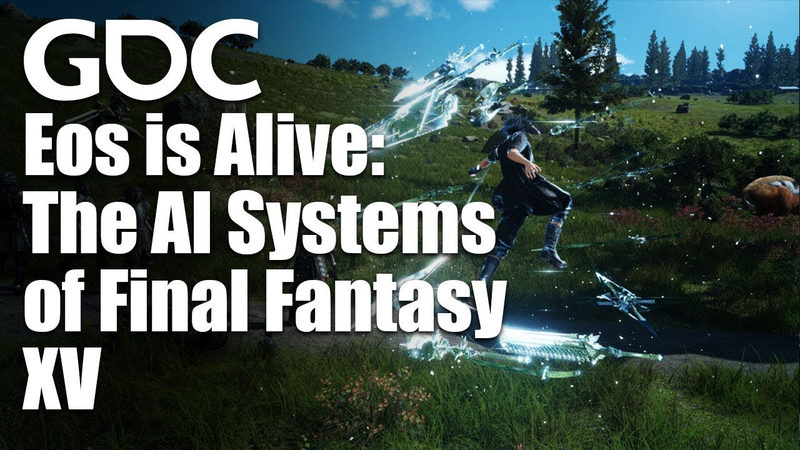
Eos is Alive: The AI Systems of Final Fantasy XV
Final Fantasy XV utilizes a sophisticated, multi-layered artificial intelligence architecture designed to create a cohesive, autonomous, and reactive open-world experience.
- Final Fantasy XV utilizes a three-tiered AI architecture consisting of a Meta AI (director), Character AI (individual intelligence), and Navigation AI (spatial positioning) to manage game progress and NPC behavior.
- The Character AI system employs a hierarchical 'AI Graph' that nests state machines within behavior trees, allowing game designers to create complex, scalable decision-making structures without deep programming knowledge.
- To maximize efficiency and reuse, the system uses an 'overriding' function that allows designers to customize specific common logic states for individual monsters or characters without rebuilding entire AI graphs.
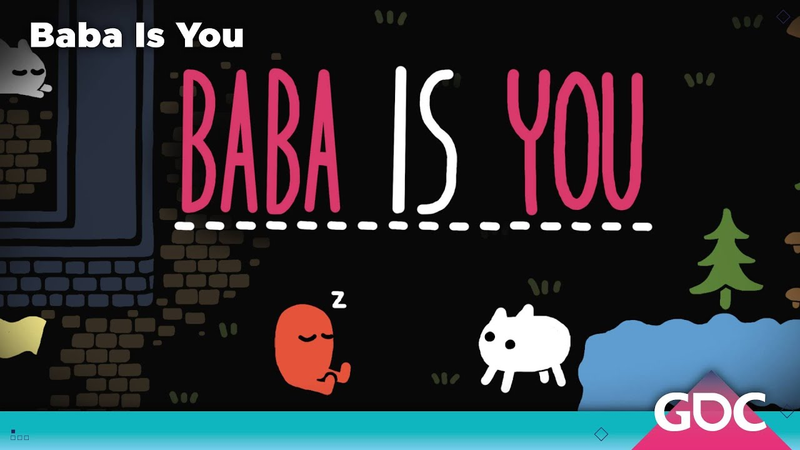
GDC Plays GDCA Nominee Baba Is You with Arvi Teikari
Baba Is You represents a significant achievement in puzzle game design, centered on a rule-manipulation mechanic that allows players to redefine the logic of the game world at runtime.
- Baba Is You utilizes a rule-manipulation mechanic that allows players to redefine game logic at runtime, creating deep, emergent gameplay from a 2017 Nordic Game Jam prototype.
- The game balances high-level complexity with accessibility by implementing a progression structure that permits players to bypass difficult levels, preventing frustration.
- The technical architecture combines the Multimedia Fusion 2 engine with Lua scripting, demonstrating how creators can leverage accessible, no-code tools to bypass traditional programming barriers.
Integrating Narrative into Game Design: A Portal Post-Mortem
The development of Portal serves as a case study in how resource constraints and iterative design can foster innovative narrative integration.
- Integrating narrative directly into gameplay mechanics, such as using a disembodied AI voice to avoid character animation burdens, minimizes the gap between exposition and player action.
- Rapid prototyping and aggressive playtesting are essential for identifying and removing content that disrupts pacing or fails to resonate with the player experience.
- Emotional anchors, such as the Weighted Companion Cube, can effectively guide player behavior and increase narrative stakes without requiring complex mechanical systems.
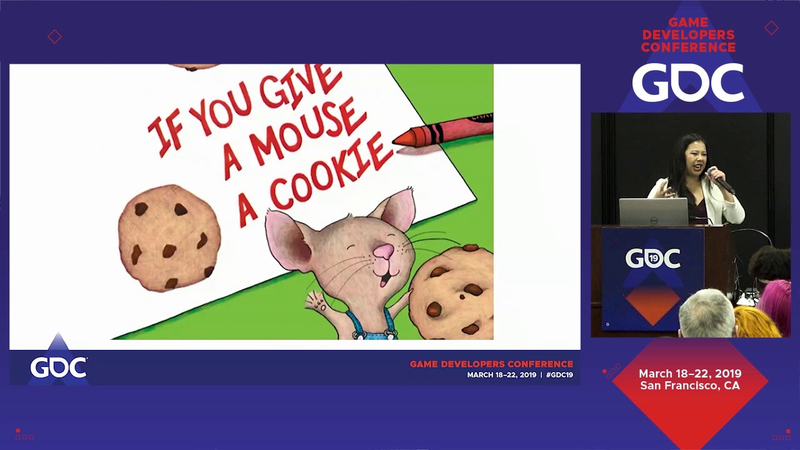
Frag You, Pay Me: Getting Started with Salary Negotiation
Salary negotiation serves as a fundamental career competency, yet professionals in the game industry frequently undervalue their labor due to the pervasive "dream job" narrative.
- The 'dream job' narrative in the game industry often leads professionals to undervalue their labor, resulting in systemic pay inequality and significant lifetime earnings losses.
- Candidates should reframe salary negotiation as a proactive career-shaping tool rather than a hostile confrontation to overcome self-limiting beliefs like imposter syndrome.
- Hiring managers are highly motivated to fill vacancies to mitigate operational risk, which provides candidates with essential leverage to advocate for fair compensation.
Game Discoverability Day: Free vs. Paid: Discoverability for Smaller Mobile Games
This analysis examines the discoverability and commercial viability of small-scale mobile games, contrasting the experiences of a solo developer navigating both paid and free-to-play (F2P) models.
- The mobile gaming market has shifted heavily toward free-to-play (F2P) models, relegating paid games to a niche status with significantly lower revenue ceilings.
- Paid games require consistent platform featuring to remain commercially viable, as they lack the long-term revenue potential of F2P titles.
- F2P games demand a complex, data-driven infrastructure including real-time stat tracking, ad integration, and sophisticated in-app purchase design.
Line Wobbler & Beasts of Balance: Two Routes to Custom Hardware Goodness
The creation of custom hardware games represents a burgeoning intersection of digital design and physical engineering, offering developers a unique path to differentiate their work in a crowded market.
- Custom hardware games differentiate products in crowded markets by bridging digital design with physical engineering through microcontrollers and 3D printing.
- Transitioning from prototypes to commercial products requires shifting from improvised testing to professional-grade manufacturing standards to ensure durability and scalability.
- Commercial success depends on navigating complex supply chains, where minor manufacturing details like material coatings can significantly alter profit margins.