
Game Developers Conference
Game Developers Conference (GDC, now the GDC Festival of Gaming) is the professional event for the games industry. It publishes recorded talks and interviews, annual industry survey reports such as the State of the Game Industry, and news articles.
Documents
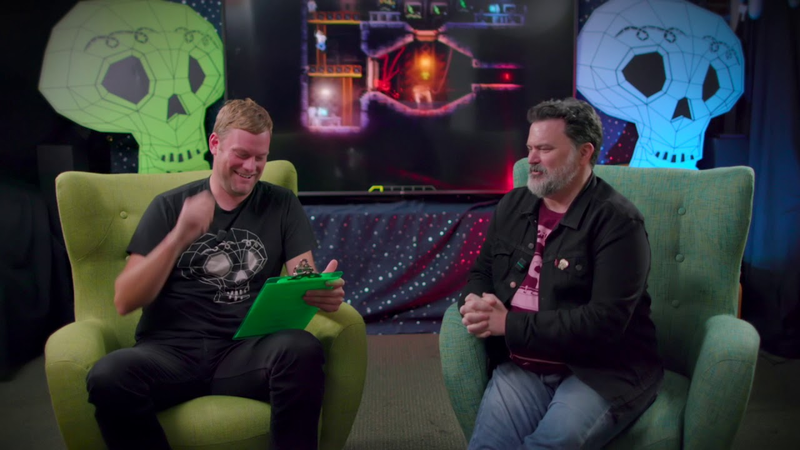
Day of the Devs: GDC Edition Direct
The independent gaming sector maintains its momentum through curated digital showcases that provide essential visibility for developers in the absence of traditional industry gatherings.
- Digital showcases like Day of the Devs have become the primary mechanism for independent developers to gain market visibility and bridge the gap between creative vision and audience reach.
- The indie sector is successfully sustaining its ecosystem by prioritizing creative autonomy and niche storytelling, as evidenced by the broad range of titles featured in recent showcases.
- Featured gameplay experiences span a diverse spectrum, including high-difficulty reflex games like Disc Room, physics-based co-op titles like Heavenly Bodies, and meditative VR adventures like Paper Beast.
Forgiveness Mechanics: Reading Minds for Responsive Gameplay
Forgiveness mechanics are essential design tools that ensure game controls feel responsive by anticipating and accommodating player inconsistencies.
- Forgiveness mechanics shift the burden of performance from the player to the game's logic by anticipating intent, ensuring controls feel responsive despite human error.
- Spatial forgiveness improves fluid movement by dynamically adjusting hitboxes, such as pinching collision volumes for tight gaps or extending them for positive items to reward near-misses.
- Late-input forgiveness techniques like the 'coyote jump' provide a brief temporal window to execute actions after leaving a platform, while 'cable stretching' maintains connections beyond original ranges.
Storytelling with Verbs: Integrating Gameplay and Narrative
Narrative design functions most effectively when treated as a core component of game design, where gameplay mechanics—or "verbs"—serve as the primary building blocks for storytelling.
- Gameplay mechanics, or 'verbs,' should serve as the primary building blocks for storytelling to ensure that the player's physical actions and the narrative arc remain cohesive.
- Integrating narrative design as a core component of game design from the start of pre-production prevents ludonarrative dissonance and streamlines the development process.
- Designers should define characterization and world stakes by analyzing the implications of player actions, such as how 'defend' implies survival while 'attack' implies aggression.
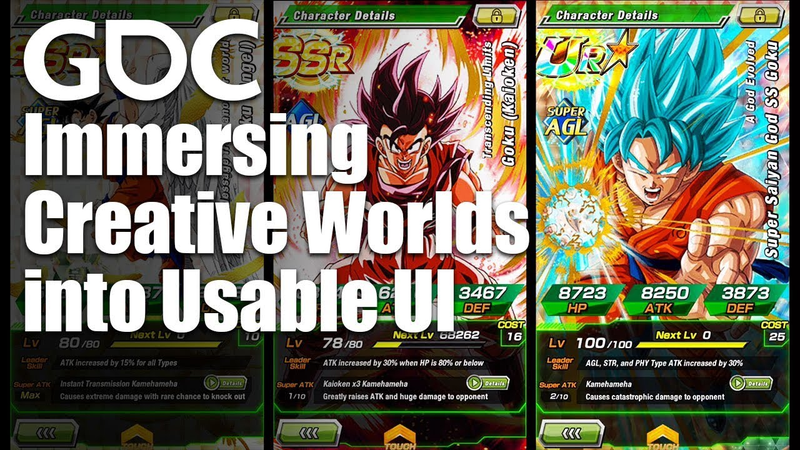
Immersing a Creative World into a Usable UI
Effective user interface design in gaming hinges on the delicate equilibrium between narrative immersion and functional clarity.
- Effective UI design requires balancing narrative immersion with functional clarity by ensuring visual elements like typography and iconography act as extensions of the game world.
- Designers should follow a three-phase process of research, exploration, and iteration to maintain an intuitive interface that reinforces the game's aesthetic identity.
- The choice between diegetic UI, which exists within the game environment, and non-diegetic UI, which is often better for managing high cognitive loads in complex games, is a fundamental strategic decision.
How Sound Tells the Story of Night in the Woods
The sound design for the 2017 narrative-driven game Night in the Woods serves as a primary vehicle for storytelling, atmosphere, and character development.
- To create a sense of 'living' environments, use randomized procedural sound triggers for repetitive actions and ambient elements like wind, birds, and townspeople, varying intervals between 1 and 300 seconds to avoid predictable patterns.
- Integrate sound effects directly into the musical score by aligning their BPM with the game's soundtrack, as demonstrated by syncing train pass-by sounds with the music in Night in the Woods.
- Use diegetic audio cues, such as the sound of a record player needle after music fades, to signal shifts in emotional tone and create uncomfortable or serious atmospheres.
Empires to Ages: Storytelling Lessons Learned in 14 Years at BioWare
Narrative design in large-scale game development requires a fundamental shift from purely creative writing toward a focus on production logistics, cross-disciplinary collaboration, and adaptive project management.
- Build trust with the development team by being transparent and vulnerable, actively inviting feedback from other disciplines to remove the 'ivory tower' stigma often associated with narrative designers.
- Implement a 'ditto' feedback system during peer reviews where participants cannot repeat previous notes, allowing the team to quickly identify consensus on what is working and what is failing.
- Account for production volatility by assuming at least 25% of your schedule will be lost to rewrites, staff turnover, or unforeseen issues, and increase this buffer to 50% for games with a tightly enmeshed critical path.
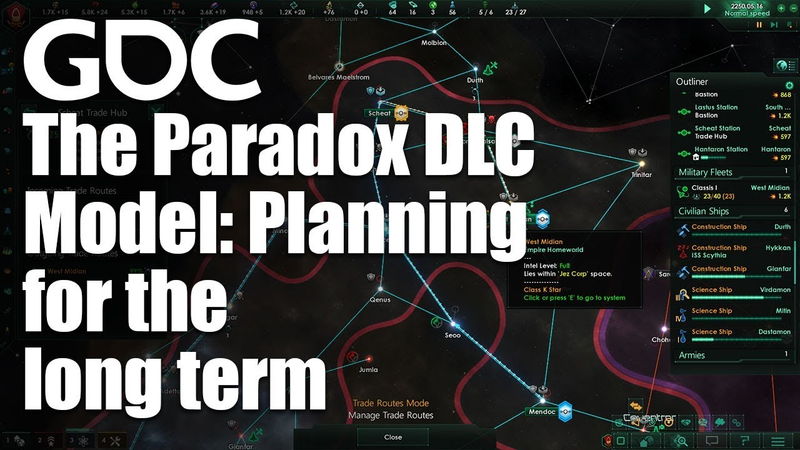
The Paradox DLC Model: Planning for the Long Term
Paradox Interactive achieves long-term commercial success by prioritizing a marathon-oriented business model centered on niche, infinitely replayable strategy titles.
- Paradox Interactive utilizes a modular DLC framework instead of serial expansion cycles to maintain long-term game relevance and generate consistent, multi-year revenue streams.
- The company prioritizes deep, system-driven gameplay and community-driven modding over high-fidelity graphics to ensure high player retention in niche strategy titles.
- Paid content is designed to be atomic, standalone, and additive to enhance the player experience without fragmenting the community or disrupting existing mechanics.

The 2019 Indie Soapbox
The independent game development landscape requires a fundamental shift toward sustainable labor practices, ethical design, and a rejection of market-driven homogenization.
- Independent studios must adopt sustainable production models that replace 'death march' work cultures with well-defined deadlines and creative constraints to prevent burnout.
- Developers should reject addiction-based mechanics and dark patterns in favor of design practices that prioritize player respect and long-term engagement.
- Financial equity requires the implementation of royalty structures that ensure all project contributors share directly in the commercial success of their work.
Balancing the Economy for Albion Online
Albion Online operates as a sandbox MMORPG defined by a fully player-driven economy where every piece of equipment is crafted by the community.
- Economy balance in a player-driven MMO is defined as the macro-scale management of all extrinsic reward systems, which function as the primary incentive structure directing player behavior.
- To prevent wealth disparity and provide long-term progression, Albion Online utilizes a tiered equipment system where T4 gear is common and accessible, while T8 gear is rare and serves as a high-end wealth sink.
- The development team establishes price channels for resources by implementing a transmutation system, allowing players to convert silver into higher-tier resources at fixed rates to create a floor and ceiling for market prices.
To Err is to Play: Human Error and Game Design
Human error serves as a fundamental element in game design, functioning as both a source of intentional challenge and a hurdle to player engagement.
- Designers should categorize player mistakes into skill, rule, and knowledge-based levels to strategically manipulate game difficulty and decision-making.
- Unintended player errors often stem from cognitive biases like overconfidence, salience, and the availability heuristic, which lead to inefficient strategies or misunderstandings of game logic.
- To minimize frustration, developers must implement interface consistency, clear visual cues, and robust feedback loops that effectively distinguish essential information from environmental noise.
Same Game, Different Sound
Musical composition for video games functions as a critical narrative and atmospheric tool, where the choice of score fundamentally alters player perception of identical gameplay.
- Adaptive, modular scoring is essential to prevent listener fatigue, utilizing middleware like Wwise or FMOD to dynamically adjust music based on combat intensity and environmental changes.
- Successful game audio requires strategic frequency management, such as prioritizing lower-register melodies and rhythmic foundations to prevent auditory clutter when balanced against dense sound effects.
- Effective game scoring relies on early, proactive collaboration between audio directors and composers to align emotional goals with technical planning before implementation.
Board Game Design Day: Why Indirect or Zero Player Interaction Can Be Great
Board game design functions most effectively when designers view player interaction as a flexible spectrum rather than a mandatory requirement for conflict.
- Player interaction should be treated as a flexible spectrum rather than a mandatory requirement for conflict, allowing designers to prioritize strategic planning and personal agency.
- Games with indirect or zero-player interaction offer superior scalability and facilitate simultaneous play compared to traditional direct-conflict mechanics.
- Designers should categorize mechanics into three scales—personal (individual impact), global (shared game state), and adjacent (direct opponent influence)—to maintain ludonarrative harmony.