
DiGRA
The Digital Games Research Association: the international association of academics and professionals who study digital games. Its Digital Library holds the proceedings of the DiGRA conferences since 2002.
Documents
That Dragon, Cancer: Contemplating Life and Death in a Medium That Has Frequently Trivialized Both
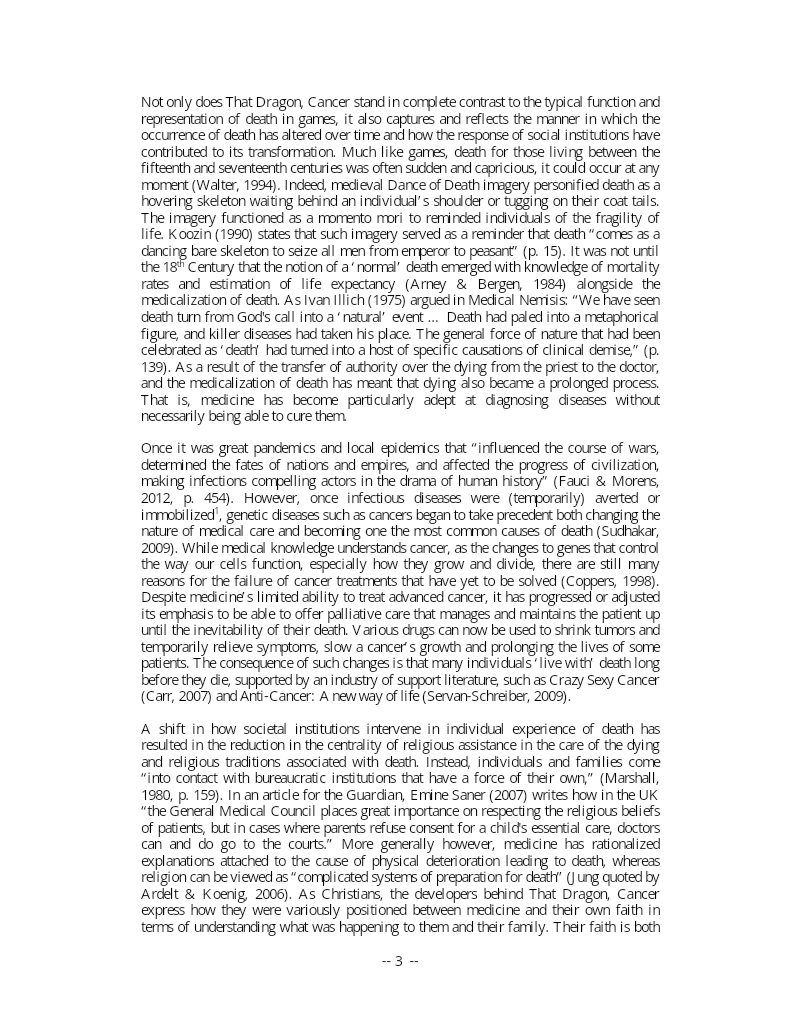
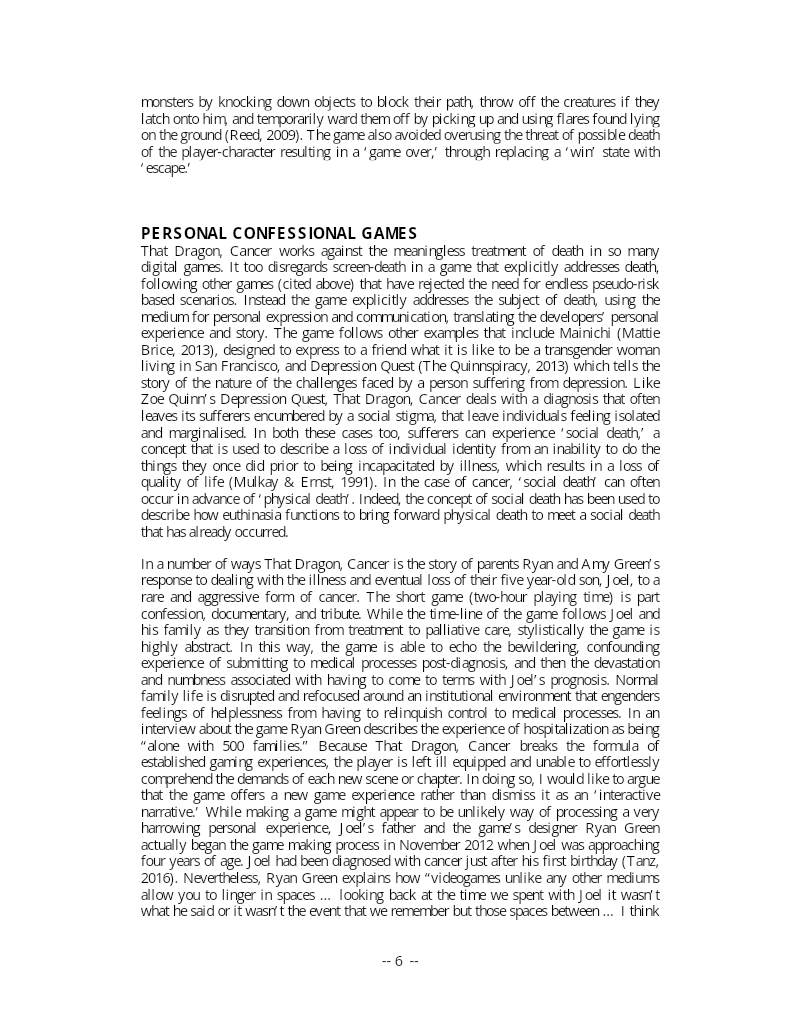
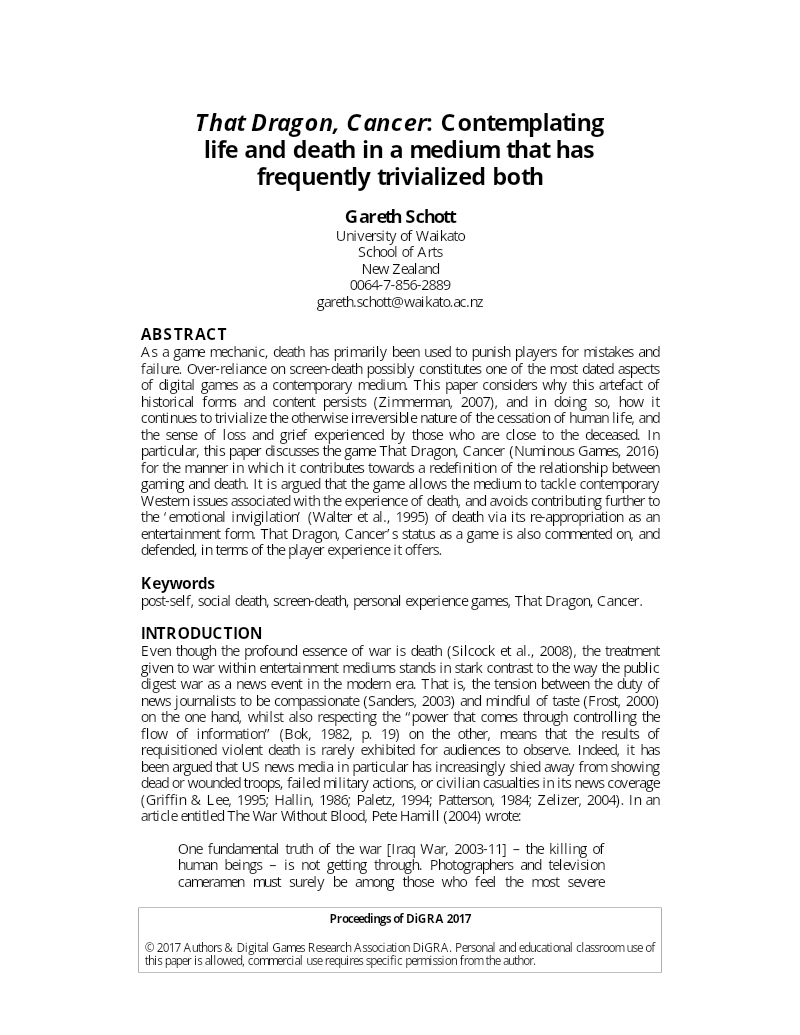
Gareth Schott's analysis examines how video games have typically handled death, most often as a punitive game mechanic such as the screen-death "game over," which arguably trivializes the irreversibility of mortality and bereavement.
- Games have typically treated death as a punitive mechanic, such as the screen-death 'game over,' which arguably trivializes the irreversibility of mortality and bereavement.
- Schott argues that games can engage death seriously by grounding it in lived experience rather than presenting it as a consequence of player failure.
- That Dragon, Cancer (2016), an autobiographical game of roughly two hours about the Green family's loss of their five-year-old son Joel to cancer, conveys grief and medical helplessness through abstraction, shifting player perspectives, and the absence of a win state.
Fictionalism and Videogame Aggression
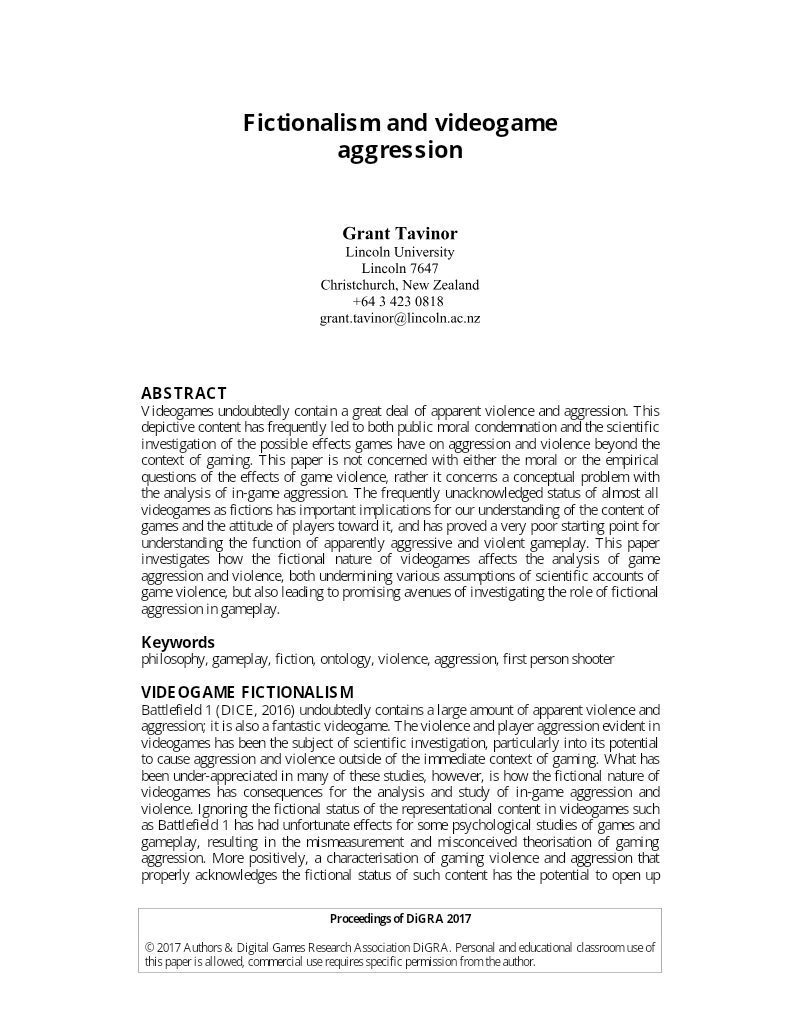
Tavinor's paper, "Fictionalism and Videogame Aggression," argues that videogames are fictions and that recognizing this status exposes serious conceptual weaknesses in psychological research on game-based aggression.
- Tavinor argues that videogames are fictions, so standard definitions of aggression (intentional harm to a real individual who wishes to avoid it) cannot literally apply to in-game violence, since players harm no real people and fictional characters cannot be genuinely harmed.
- The paper uses the 2007 Anderson, Gentile, and Buckley study, which reported that players of violent games delivered more high-intensity noise blasts, to illustrate how conflating fictional violence with real aggression can undermine the conclusions of such experiments.
- The paper's most sustained critique targets the General Aggression Model of Anderson and Bushman, which it claims treats fictional violence in titles like Battlefield 1 as genuine aggression while overlooking that players are mainly engaged in ludic activities such as competition and cooperation.

Digitising Diplomacy: Grand Strategy Video Games as an Introductory Tool for Learning Diplomacy and International Relations
Rhett Loban's paper argues that grand strategy video games, particularly titles such as Europa Universalis IV, Stellaris, and Hearts of Iron IV, can serve as accessible introductory tools for teaching diplomacy and International Relations (IR).
- Only about 27 percent of IR educators report using digital games in teaching, compared with 56 percent who use non-digital resources, revealing a notable gap in higher education.
- Rhett Loban argues that grand strategy games such as Europa Universalis IV, Stellaris, and Hearts of Iron IV can serve as accessible introductory tools for teaching diplomacy and International Relations.
- These games model IR concepts both explicitly, through diplomatic action interfaces, opinion modifiers, and war declarations, and in more complex ways, through balance-of-power coalitions, alliance systems, and democratic peace dynamics reflected in AI behaviour.
Virtual Reality Is 'Finally Here': A Qualitative Exploration of Formal Determinants of Player Experience in VR
This paper offers a qualitative exploration of how virtual reality shapes player experience, arguing that VR is a renaissance of immersive technology whose capacity to affect beliefs, emotions, and behaviour warrants serious scholarly attention from game studies.
- The paper argues VR is a renaissance of immersive technology whose capacity to affect beliefs, emotions, and behaviour merits serious scholarly attention from game studies.
- Its central thesis is that VR uniquely elicits self-directed "I emotions", whereas screen-based games typically elicit threats concerning story (F emotions) or gameplay (G emotions).
- Based on a qualitative content analysis of 124 immersive environments drawn from clinical and experimental VR research, the authors identify recurring threat stimuli: looming threats, heights, hostile agents, and enclosed spaces.
Tell-A-Dyrham-Tale: A Storytelling Board Game
Tell-A-Dyrham-Tale is a card-based storytelling board game designed to explore whether games can serve as a practical tool for co-creating historical narratives about Dyrham Park, a late 17th-century National Trust country house near Bristol and Bath.
- Tell-A-Dyrham-Tale is a card-based storytelling board game built as groundwork for an Augmented Reality visitor experience at Dyrham Park, a late 17th-century National Trust house near Bristol and Bath, centred on William Blathwayt's bookcase.
- The project aims to involve ordinary visitors in co-creating the historical narratives told about the site, rather than relying solely on curatorial selection.
- The game runs in three phases: an auction where players buy cards with silver and gold coins, a tale phase where purchased cards are woven into a story, and a voting phase where the best narrative wins a tile.
The Challenges of Using Commercial-Off-the-Shelf Narrative Games in History Classrooms
This paper examines the practical and pedagogical challenges of bringing commercial, off-the-shelf narrative games into secondary history classrooms.
- Historical narrative games present history as dynamic and multi-perspectival rather than as a fixed sequence of events, making them usable as texts for students to critique and interpret, provided educators anticipate significant classroom obstacles.
- The most significant early finding concerned usability rather than content: students struggled with The Last Express's constant-rate time mechanic, which required players to be in the right place at the right time, and many grew frustrated when they could not progress or overhear conversations.
- Classroom constraints limited play in the three two-day tests with ninth-grade World History students at a vocational school, including 40-minute class periods, the inability to preload save points, and classroom noise that hindered audio comprehension.
OFabulis and Versailles 1685: A Comparative Study of the Creation Process Behind Video Games on Historical Monuments
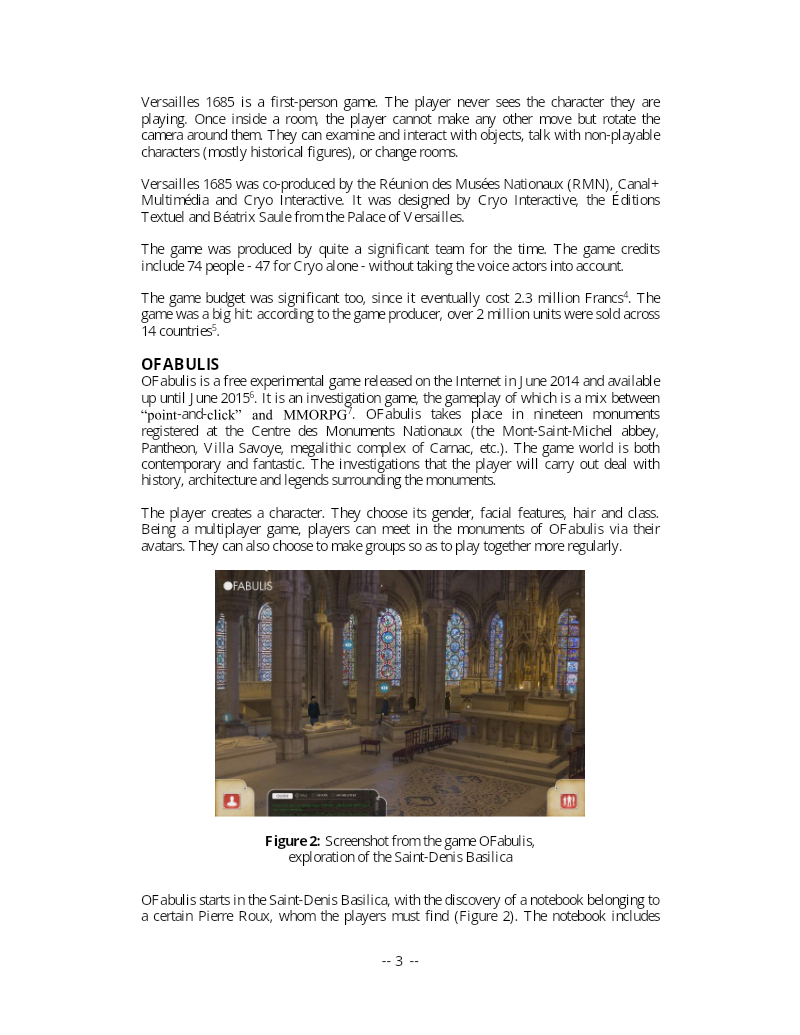
This paper by Edwige Lelièvre compares the creation processes of two point-and-click investigation games set in historical monuments: Versailles 1685, released by Cryo Interactive in 1996, and OFabulis, a free experimental multiplayer game released online in 2014 covering nineteen monuments managed by the Centre des Monuments…
- The paper argues that heritage games share three inherent traits: cultural institutions participate in design from the outset, the scenario must negotiate a compromise between history and fiction, and multimedia systems are built around limited gameplay and realistic rendering to showcase monuments.
- The study compares Versailles 1685 (Cryo Interactive, 1996), which used the Omni 3D system to let players explore fully rendered reconstructions of 1685 Versailles, with OFabulis (free experimental multiplayer game, online in 2014), covering nineteen monuments managed by the Centre des Monuments Nationaux.
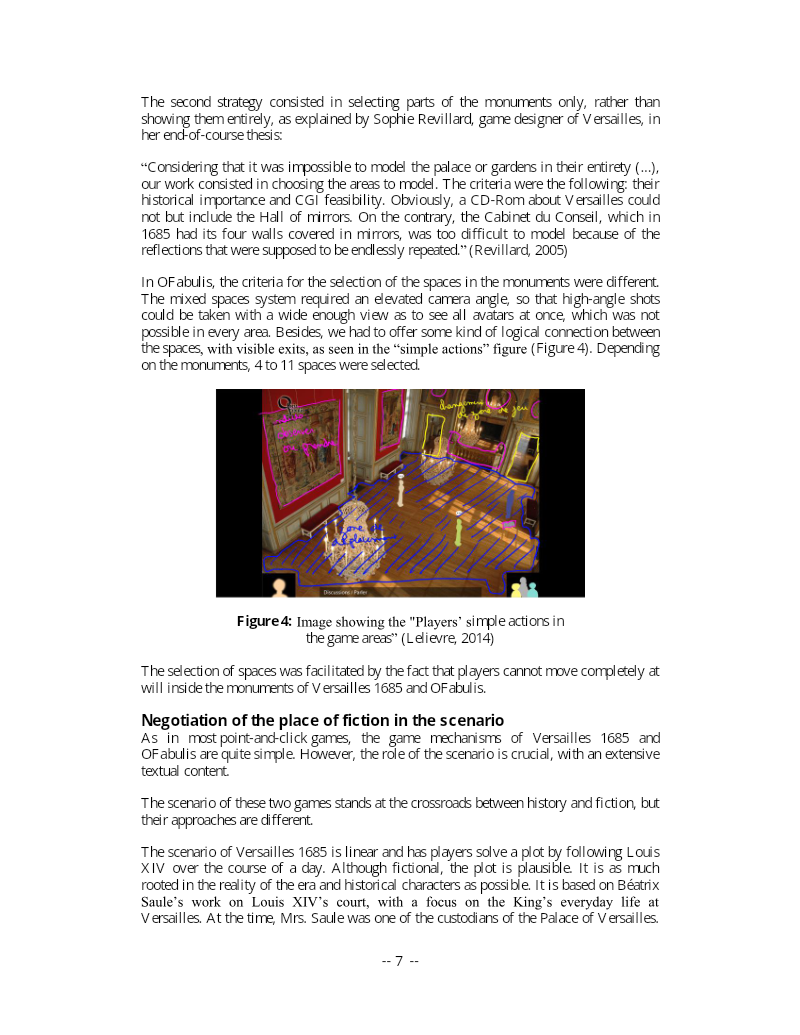
- OFabulis combined photographs, 3D avatars, and filmed agents into "mixed spaces" that could run on modest hardware, while Versailles 1685 relied on fully rendered 3D reconstructions.
Archaeological Storytelling in Games
This paper proposes archaeological storytelling as a distinct narrative technique for games, in which the player must study material culture within a game world and interpret artefacts to build an understanding of that world's history.
- Archaeological storytelling is proposed as a distinct narrative technique in which players must study in-game material culture and interpret artefacts to reconstruct a world's history, distinct from both archaeogaming and existing environmental storytelling.
- The authors argue that games should avoid a single authoritative interpretation and instead offer multiple, possibly contradictory histories, drawing on museum practice around active object interpretation and the principle of multi-vocality.
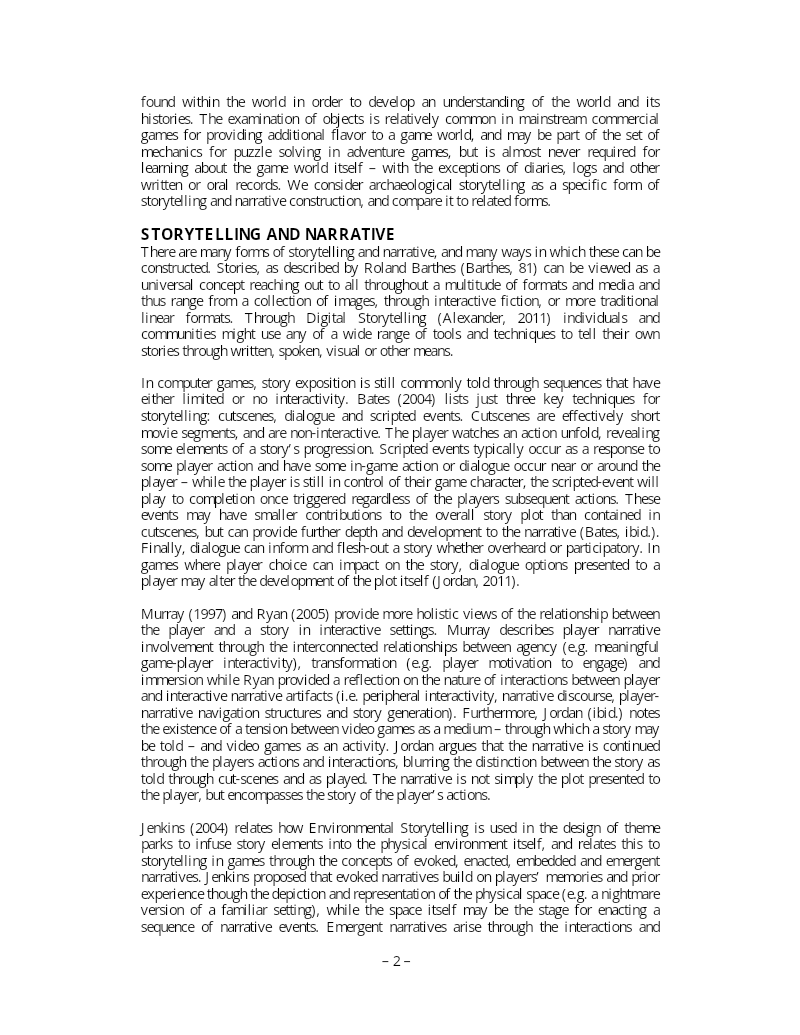
- Popular titles such as Tomb Raider and Uncharted treat artefacts as optional collectibles with little bearing on the main narrative, and often reduce the archaeological past to a surrogate history of social elites.
History, Biography and Empathy in Inkle's '80 Days'
Inkle's 80 Days, a digital gamebook adapting Jules Verne's novel into a steampunk science-fiction setting, offers players an unusual relationship to history.
- The report argues that 80 Days, Inkle's steampunk adaptation of Jules Verne's novel, layers real nineteenth-century history beneath a fictional world to foreground minority perspectives.
- Its central claim is a divided structure: the player-character Passepartout is a detached witness to large events that rarely affect his journey, while non-player characters actively shape and reshape history, often through resistance and revolt.
- Historical references in the game are brief, episodic, and optional, with no in-game supplementary resources, so players must consult outside sources such as the Internet to learn more.
The Fortress of Monemvasia as Playground for a Location Based Game
This paper reports an ongoing study of "If … in Monemvasia," a location-based multiplayer mobile game deployed at the medieval fortress town of Monemvasia in southeastern Greece.
- The location-based game "If … in Monemvasia" has been integrated into an Environmental Education Center's program since February 2016, and in its first three months was played 18 times by 343 secondary-level pupils, averaging 19 per session.
- Players form four teams of three to five and move through the medieval town to match seventeen role-playing missions, framed around Siege, Rebuilding, and Everyday Life, to landmarks revealed through GPS "hot zones" on Android tablets, earning points only for correct associations.
- The design treats historical concepts such as repeated invasions, multicultural architecture, limited space, and reliance on rainwater as lenses for observing the environment rather than facts to memorize, with the authors arguing that linking historical analysis to physical exploration fosters historical thinking.
Playing with Herstory: Representing Femininity in Historical Video Games
This paper by Elisabeta Toma and Cosima Rughiniș proposes a set of six indicators for systematically examining how feminine characters are represented in historical video games, which the authors argue has received far less critical attention than historical texts and films.
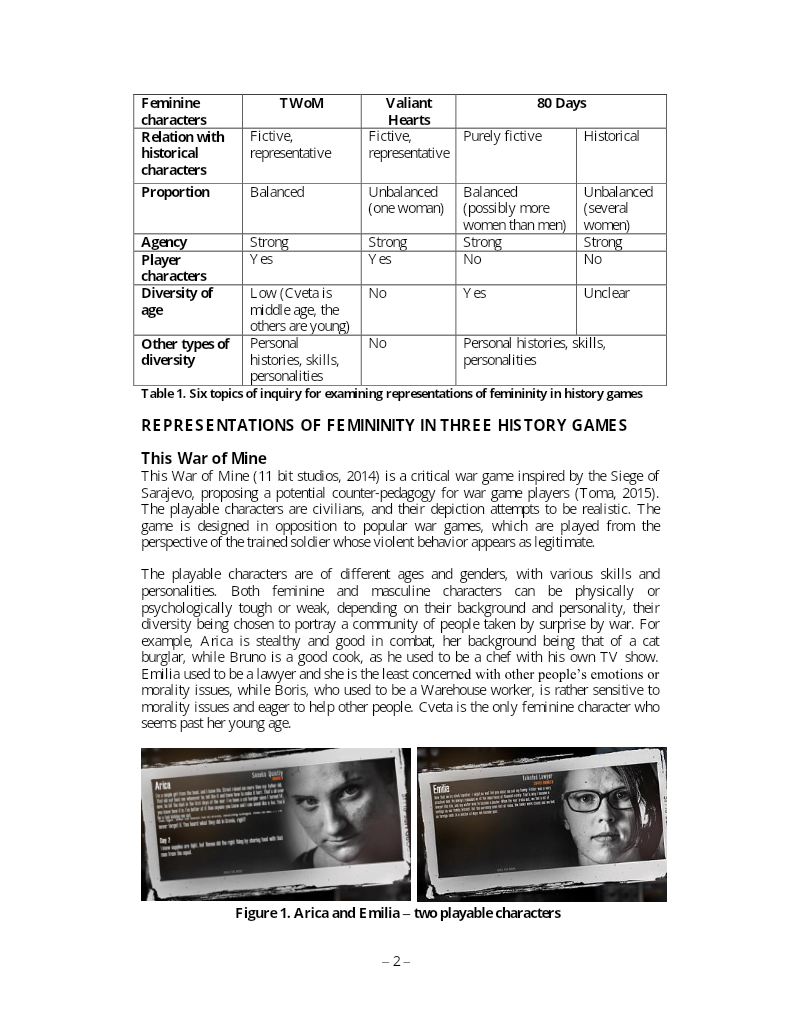
- The paper proposes six indicators for systematically assessing feminine character representation in historical video games: the link to real historical persons (historical, fictive-representative, or purely fictive), proportion of women, strength of agency, playability as a player character, age diversity, and other diversity such as personal histories, skills, and personalities.
- The authors argue that historical video games have received far less critical attention than historical texts and films, making systematic evaluation of their representation of women especially important.
- The analysis of three games shows each has both strengths and weaknesses: This War of Mine offers balanced, individualized playable civilians of varied ages and backgrounds, though only one woman appears in its civilian cast balanced with men.
A Playful Tinder-Like Interface for Search and Rescue
This paper presents aeroSee, a web-based micro-volunteering platform that uses drone-captured imagery to support search and rescue efforts for missing persons in rural environments.
- aeroSee is a web-based micro-volunteering platform that uses drone-captured imagery to support search and rescue for missing persons in rural environments, relying on volunteers to sort and tag photos at scale.
- The core proposition is that a playful, Tinder-inspired swiping interface can motivate volunteers to process large photo sets, grounded in the authors' co-design work and prior research on gamification and citizen science.
- An earlier alpha trial using a points-based leaderboard to encourage textual tagging produced no measurable gain in performance or tag quality, prompting a redesign that removed points, rewards and leaderboards in favour of interaction, story and community.