1 free read left. Create a free account for unlimited reading + AI research.
Create free accountWhitepaper DiGRA
1 free read left. Create a free account for unlimited reading + AI research.
Create free accountWhitepaperDiGRA
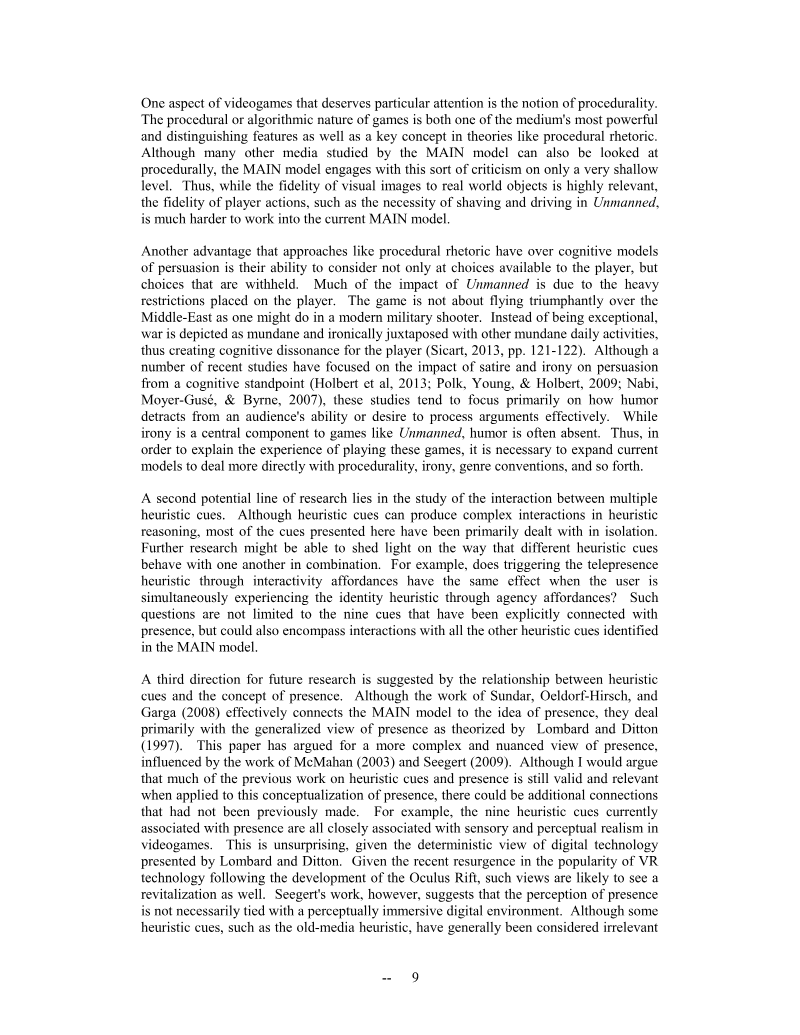
The paper argues that design features trigger heuristic cues that evoke presence and shape how players process a message.
Persuasive games are examined here through a cognitive lens, with the central claim that persuasion in games depends less on their surface messaging than on how their design features trigger heuristic cues that evoke presence and shape how players process a message. Drawing on the Heuristic-Systematic and Elaboration Likelihood models, and on Sundar's MAIN model of modality, agency, interactivity, and navigability, the analysis argues that procedural rhetoric, the way a game's rules and systems make arguments, can produce lasting attitude change when it engages players systematically. The authors maintain that existing return-on-investment metrics fail to explain why some persuasive games succeed and others do not.
The analysis finds that heuristic cues can heighten presence and increase cognitive engagement, yet presence alone does not guarantee persuasion. Messages must also generate relevant favorable thoughts in the player. Examples ranging from a Republican-sponsored game about George W. Bush and the military-themed title Unmanned to the Howard Dean campaign game illustrate both the promise and the limits of this approach. The crude Tax Invaders is singled out as a case where negative cues such as flow disruption and distraction likely outweigh positive ones, casting doubt on its persuasive impact.
The work's scope spans political campaigning, health promotion, and commercial and critical games, with its theoretical framework extended beyond games to social agents such as Microsoft's Clippy, whose widespread dislike is attributed to intrusiveness, excessive bells-and-whistles, and distraction. The authors argue that designers can deliberately use isolated heuristic cues when a heuristic rather than systematic mode of processing suits a persuasive goal. Their conclusions call for more refined conceptions of presence, closer study of how multiple cues interact, and greater attention to procedurality and irony. Because the argument rests largely on prior literature and secondary sources rather than original data, the authors position it as a theoretical agenda for a rapidly growing field.
Each row is a game or company this document names, each column a document, oldest first. A mark means that document names it. Select a row to see those documents.
DiGRA · 2019
DiGRA · 2019
DiGRA · 2019
DiGRA · 2019
DiGRA · 2019
DiGRA · 2019
DiGRA · 2019
DiGRA · 2019
DiGRA · 2019
DiGRA · 2019
DiGRA · 2019
DiGRA · 2019
DiGRA · 2014