1 free read left. Create a free account for unlimited reading + AI research.
Create free accountArticle DiGRA
1 free read left. Create a free account for unlimited reading + AI research.
Create free accountArticleDiGRA
It examines structure and behavioral scripts rather than covering the field of game narrative as a whole.
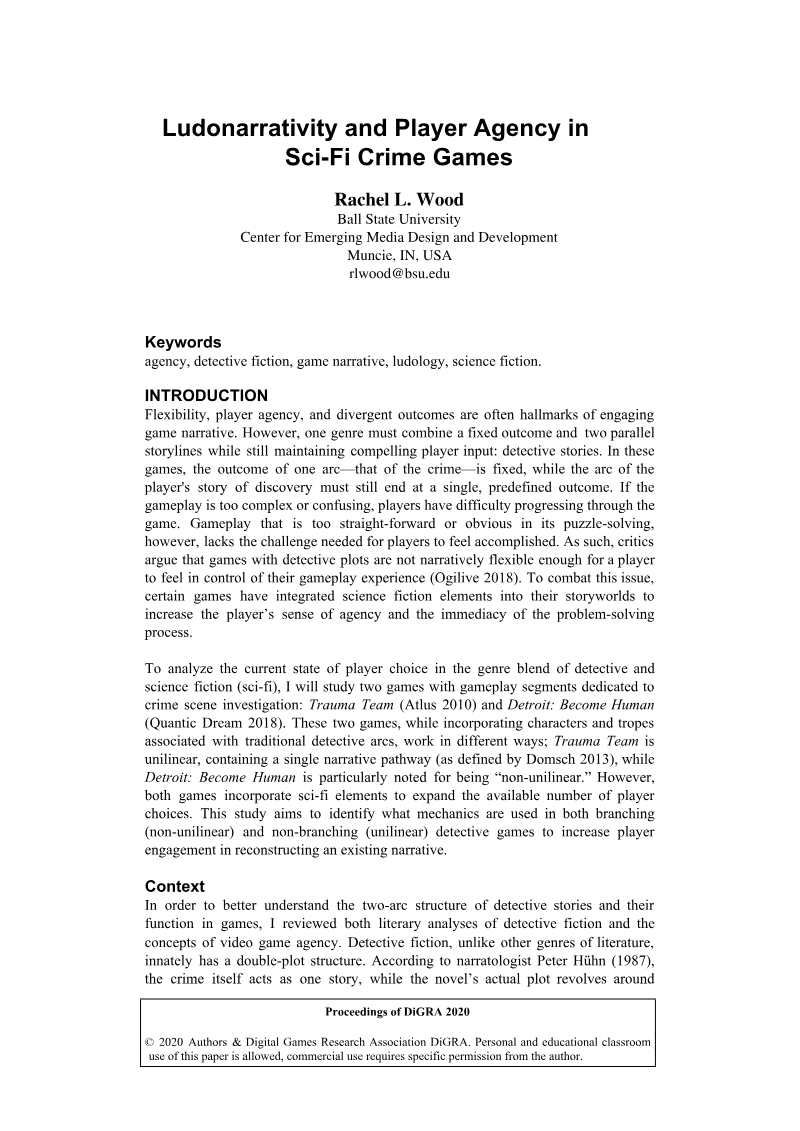
Detective fiction offers a productive lens for understanding how gameplay and narrative relate in digital games. Rather than imposing a top-down framework, as earlier work by Murray and Koenitz and colleagues did, this extended abstract for DiGRA 2018 takes an inductive approach: it studies a specific corpus of mystery and detective stories and games to draw broader conclusions about game narrative. The method has precedent in Montfort's use of riddles to analyze interactive fiction and Suits's analysis of five-minute mysteries as game-like literature. The scope is deliberately limited to two aspects, and the work does not claim to cover all of game narrative.
The first aspect is structure. Drawing on Todorov, the argument holds that detective stories contain two stories: the crime that occurred before the narrative begins and the investigation that uncovers it. Where the crime's revelation drives the plot, the result is the whodunit or clue-puzzle form; where the detective's adventures are intertwined with resolving the case, the result is the thriller. Both structures lend themselves to story-driven gameplay in which players reconstruct past events. Examples include Sherlock Holmes and Agatha Christie adaptations, Myst, and walking simulators such as Dear Esther for the whodunit pattern, and the Blackwell series and L.A. Noire for the thriller pattern.
The second aspect is behavioral scripts. Building on Murray's idea of scripting the interactor and Schechner's restored behavior, the abstract argues that genres create expectations about what players should do without explicit instruction. Different detectives, such as Holmes, Nancy Drew, Miss Marple, and Philip Marlowe, work in distinct ways, and those methods can supply a game's core mechanics. Digital games have handled this inconsistently: many Sherlock Holmes adaptations rely on stock adventure game mechanics, while Deadly Premonition successfully casts its player character as a counterpart to Twin Peaks' Dale Cooper.
The abstract closes by noting further avenues the detective lens could open, including spaces as hermeneutic challenges, such as reading crime scenes or navigating urban settings, and the genre's habit of shifting its own rules, since an established pattern makes the solution too obvious.
Each row is a game or company this document names, each column a document, oldest first. A mark means that document names it. Select a row to see those documents.

DiGRA · 2026

DiGRA · 2026



DiGRA · 2026



DiGRA · 2026



DiGRA · 2026



DiGRA · 2026



DiGRA · 2026



DiGRA · 2026



DiGRA · 2026

DiGRA · 2026



DiGRA · 2026



DiGRA · 2026
DiGRA · 2026