Tower Defense reports and market data
Documents
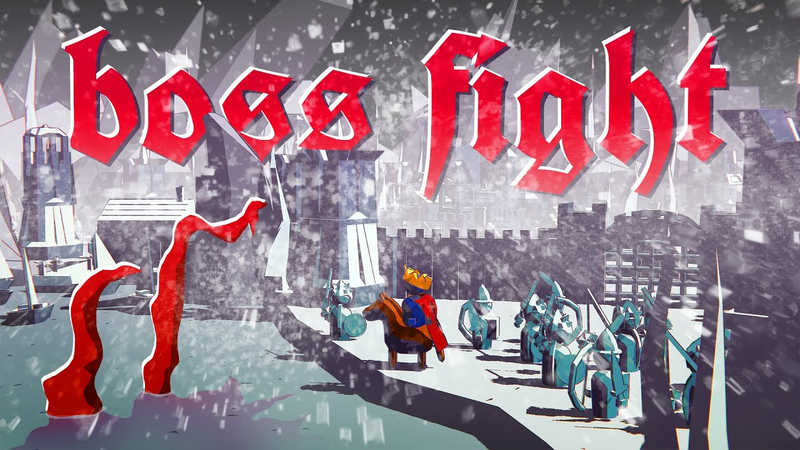
Making an Epic Boss For our Castle Builder Game (Devlog)
The development of the minimalist base defense game Thronefall focuses on expanding player agency and strategic depth through a series of iterative design updates.
- Thronefall transitioned from predefined building paths to a choice-based upgrade system, allowing players to specialize units like spearmen and archers for greater tactical depth.
- Developers replaced passive character scaling with active upgrade choices at the castle center to support diverse playstyles, ranging from aggressive to economic strategies.
- Technical adjustments were implemented to curb gameplay exploits, including the addition of spawn damage to prevent spawn camping and modified unit behavior to stop players from bypassing combat mechanics.
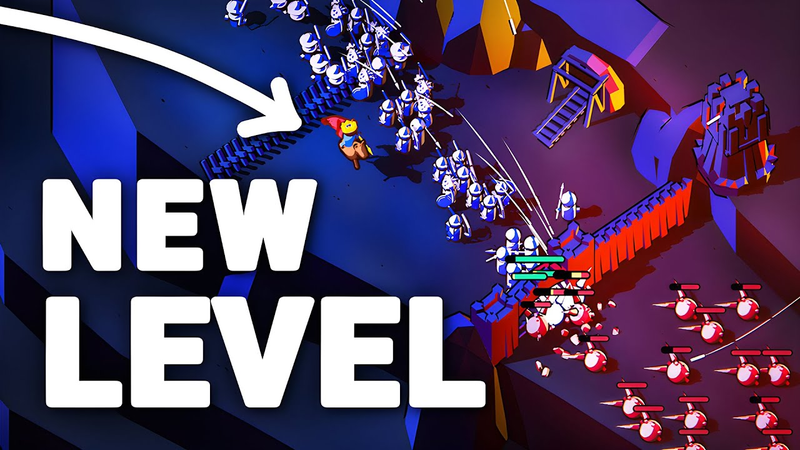
100 Days of Game Dev | Making of Thronefall (Devlog)
The development of Thronefall, a minimalist medieval base defense game, reached its 100-day milestone through an iterative process focused on balancing core mechanics, level design, and player feedback.
- The 100-day development milestone focused on transitioning from a conceptual prototype to a playable build by integrating core systems like save-load functionality, navigation meshes, and tutorials.
- Developers prioritized gameplay clarity by removing ambient elements like wandering villagers, concluding that visual clutter detracted from the core base-building and defense loop.
- The introduction of weapon-specific active abilities and a unit command system was implemented to address combat depth limitations and improve player control over troops.
Our Minimalist Base Defense Game is Taking Shape! (Devlog)
Thronefall is a minimalist medieval base defense game currently in development, focusing on a cyclical gameplay loop where players manage castle construction and economic upgrades during the day and defend against enemy waves at night.
- Thronefall utilizes a cyclical gameplay loop where players manage economic and castle upgrades during the day and defend against enemy waves at night.
- The developers removed manual building repairs by implementing automatic respawn mechanics for structures and units to eliminate common genre frustrations.
- A custom mesh generator tool was developed within Unity to streamline level design, including path creation, river rendering, and boundary establishment.
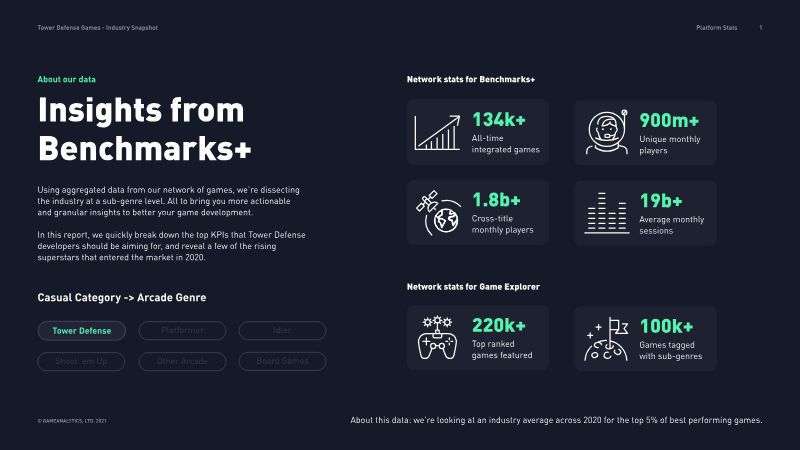
Tower Defense Games: Deconstructing the Superstars (2020 Industry Snapshot)
The tower defense sub-genre represents a high-performing segment within the casual arcade category, characterized by strong monetization potential and deep player engagement.
- Tower defense games demonstrate high monetization efficiency with an ARPPU of $83, an ARPDAU of $1.66, and a daily conversion rate of 3.83%.
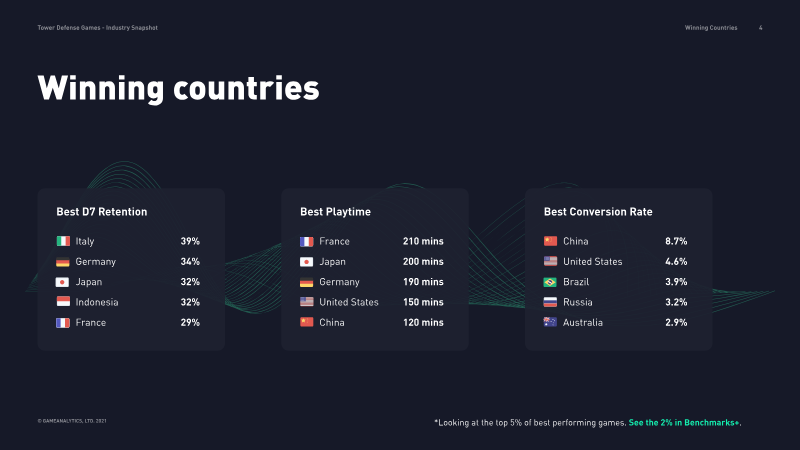
- China is the most lucrative market for the genre, achieving an 8.7% conversion rate, which is nearly double that of the United States.
- Regional engagement metrics vary significantly, with Italy leading in Day 7 retention at 39% and France recording the highest average daily playtime at 210 minutes.
Top 10 Tips on How To Balance Your Game
Effective game balancing is a critical determinant of a title's success, functioning similarly to the precise ingredient ratios required for a high-quality cake.
- Effective game balancing requires an integrated approach that spans game design, level architecture, code, and art rather than treating it as an isolated numerical task.
- Developers should prioritize situational utility over pure mathematical optimization to avoid creating bland, repetitive gameplay experiences.
- Implementing a rock-paper-scissors framework forces players to make meaningful, context-dependent choices by assigning distinct upsides and downsides to mechanics.
The Art of Reanimating Plants vs. Zombies 2
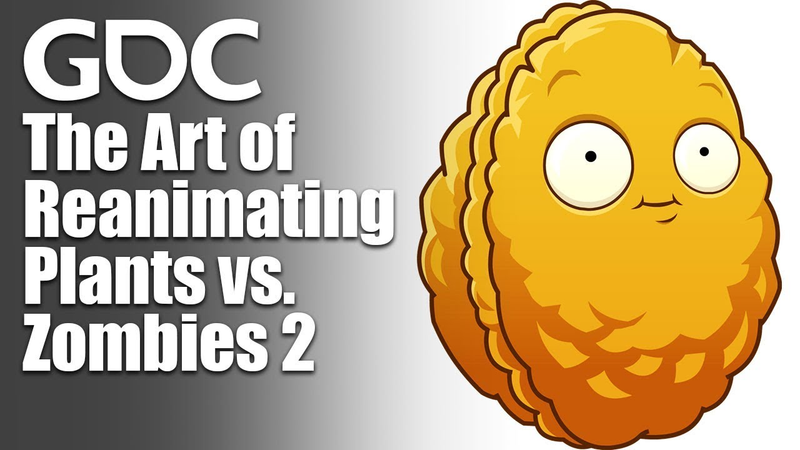
This presentation outlines the artistic development process for Plants vs. Zombies 2, focusing on the challenges of creating a sequel to a highly acclaimed, genre-defining title.
- Successful sequels must prioritize protecting the core identity and mechanics of the original title rather than attempting to replace them.
- The development team transitioned from hand-drawn art to a vector-based aesthetic using Flash to improve animation efficiency and visual readability on smaller mobile screens.
- The narrative shift to a time-travel theme allowed for the introduction of new environments and mechanics while maintaining the franchise's established visual language.

FTUE: Timenauts
This analysis examines the first-time user experience (FTUE) of Timenauts, a mobile tower defense game developed by DeNA.
- DeNA’s Timenauts utilizes a comedy-licensed theme featuring Gabriel 'Fluffy' Iglesias to drive engagement within a side-scrolling tower defense framework.
- The FTUE effectively balances accessibility and depth by introducing core combat and metagame progression systems without overwhelming players with complex statistics.
- The game’s progression loop relies on earning experience points, coins, and character shards to facilitate unit upgrades in a simplified RPG-lite layer.

Monetizer: World Zombination
World Zombination, a tower defense title developed by Proletarian Inc., utilizes a traditional free-to-play mobile monetization model centered on unit collection and time-gated progression.
- World Zombination by Proletarian Inc. utilizes a traditional free-to-play model centered on unit collection and time-gated progression.
- The game features a three-tier currency system: two soft currencies (supplies and food) for upgrades and one hard currency (coins) for accelerating timers and purchasing unit packs.
- Core monetization is driven by players spending hard currency to bypass time-based bottlenecks in unit training and base construction.
Monetizer: Royal Revolt 2
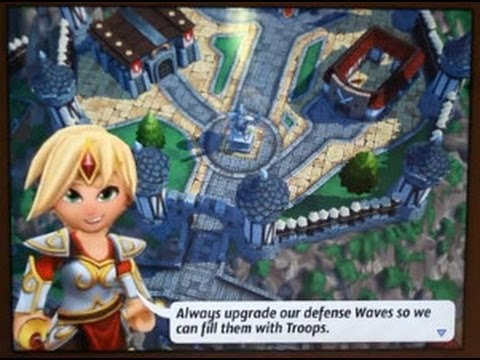
Royal Revolt 2, developed by Flaregames, is a mobile title that integrates city-building mechanics with tower defense gameplay.
- Royal Revolt 2 utilizes a dynamic 'percentage fill' resource mechanic where players purchase a percentage of their storage capacity rather than fixed amounts, creating a fluctuating exchange rate tied to progression.
- The game employs a high-value conversion tactic by offering a permanent 'third builder' as an incentive for a significant one-time hard currency purchase.
- Hard currency (gems) is integrated into core progression by allowing players to directly purchase experience points, accelerate construction, and unlock additional troop or spell slots.
Monetizer: Plants vs. Zombies 2
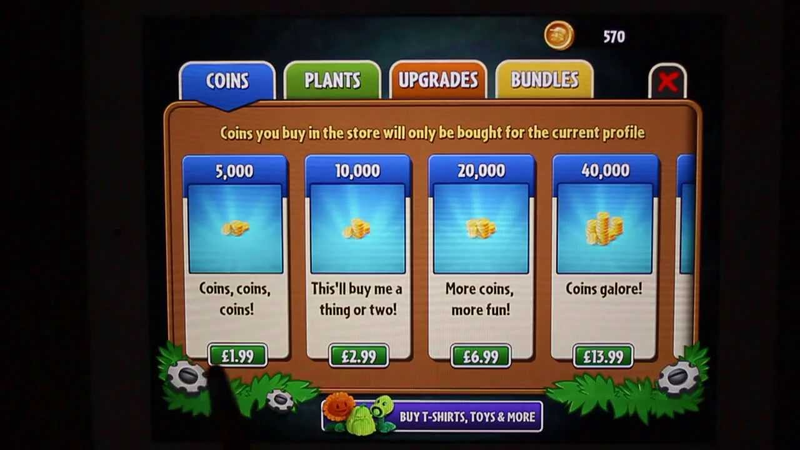
Plants vs. Zombies 2, developed by EA and PopCap, serves as a case study for sophisticated, multi-layered free-to-play monetization on mobile platforms.
- Plants vs. Zombies 2 achieved 16 million iOS downloads within two weeks of release, reaching top-100 grossing status in over 50 countries.
- The game utilizes a tiered virtual currency system with a 2.7x efficiency ratio between the lowest and highest price points, significantly higher than the industry standard of 1.5x.
- Monetization is designed as a convenience tool rather than a progression gate, allowing players to choose between grinding or purchasing power-ups to bypass difficulty spikes.