Serbia
Documents
Serbian Gaming Industry Report 2023
The 2023 Serbian gaming industry assessment quantifies the sector’s rapid expansion, maps its ecosystem, and evaluates the conditions shaping future growth. Drawing on a 97‑question survey that reached 80 % of the domestic ecosystem and validated financial data for the 21 leading firms, the analysis establishes a clear upward trajectory for Serbia’s game development landscape.
Total industry revenue reached €175 million, a 17 % year‑on‑year increase, while the workforce nearly doubled to roughly 4,300 professionals. The market now hosts 38 active studios producing 81 titles, with mobile‑first games still dominant but ceding share to core and original‑IP projects. Talent inflows from Russia, Ukraine and Belarus, together with 70 % of respondents expressing optimism, underpin this momentum, and a quarter of companies are planning foreign offices despite lingering concerns over tax incentives and regulatory red tape.
The ecosystem comprises more than 140 companies and over 500 regional stakeholders, featuring high‑profile successes such as Foxy Voxel’s “Going Medieval” (850 k+ copies), GameBiz Consulting’s $250 million revenue from 80+ global studios, Onyx Studio’s 57 million monthly players, and Sozap’s NASDAQ listing with 30 million downloads. Collaborative ties with DICE/EA, Microsoft, Google and Epic Games, alongside mentoring programmes, Gamescom exposure, and the Shift2Games and Playing Narratives initiatives, reinforce Serbia’s emergence as a European development hub. At the same time, the rollout of generative‑AI tools raises IP, privacy and deep‑fake risks, prompting EU‑wide regulatory scrutiny.
Overall, the sector is maturing into a diversified, internationally connected hub with strong growth prospects. Realising its potential will require addressing regulatory and fiscal barriers, leveraging AI responsibly, and sustaining education and mentorship programmes that nurture talent and support SMEs in scaling their operations.
- The Serbian gaming industry generated €175 million in revenue in 2023, marking a 17% year-on-year increase.
- The sector's workforce nearly doubled to approximately 4,300 professionals, supported by talent inflows from Russia, Ukraine, and Belarus.
- The ecosystem now includes 38 active studios producing 81 titles, with a strategic shift occurring from mobile-first games toward core and original-IP projects.
- High-profile industry successes include Foxy Voxel’s 'Going Medieval' (850k+ copies), Onyx Studio’s 57 million monthly players, and Sozap’s NASDAQ listing.
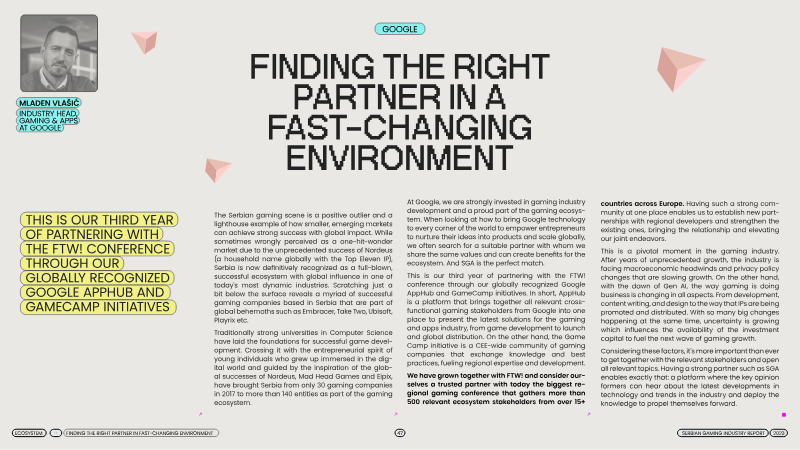
- Serbia has established strong collaborative ties with major global players including DICE/EA, Microsoft, Google, and Epic Games.
2023 Serbian Gaming Industry Report
The report demonstrates that Serbia’s gaming sector has experienced a dramatic expansion in 2023, with the workforce more than doubling from roughly 1,700 to over 4,300 employees. Revenue climbed 17 % year‑on‑year to €175 million, largely driven by mobile titles and original intellectual property, while about a third of earnings originate from overseas markets. The growth is underpinned by an influx of talent from Russia, Ukraine and Belarus, a robust mix of large international studios—such as Ubisoft Belgrade, Playrix Serbia and Wargaming—and a vibrant indie scene that includes boutique developers like Yboga, Art Bully and Flat Hill Games.
Key findings reveal that mobile gaming dominates the revenue landscape, with Android accounting for 60 % of market share and large studios (40+ staff) capturing the majority of profits. Smaller firms, though experiencing higher employee growth, face heightened client concentration and single‑client risk. The industry’s service arm also flourishes; firms such as GameBiz Consulting manage substantial revenue streams and provide financial, tax and user‑acquisition support to local studios.
Serbia’s strategic positioning on the European stage is evident through participation in mentoring programs, visibility at Gamescom, and targeted funding from Creative Europe’s €16 million grant pool. Partnerships with global players like Google, Epic Games and major publishers reinforce the country’s reputation as a regional hub.
Education and talent pipelines have expanded markedly, with universities, technical schools and informal hubs offering comprehensive programs that feed a growing workforce. Initiatives such as the Serbian Games Association’s “Playing Narratives” and Shift2Games demonstrate successful placement of graduates into industry roles.
Overall, the sector’s rapid growth is tempered by regulatory complexity, limited funding access and emerging legal challenges around AI‑generated content. Continued policy support and diversification of revenue sources will be essential to sustain Serbia’s ascent as a leading contributor to AAA, mobile F2P and emerging VR experiences across Europe.
- Serbia’s gaming workforce grew significantly in 2023, more than doubling from approximately 1,700 to over 4,300 employees.
- Industry revenue reached €175 million in 2023, a 17% year-on-year increase driven primarily by mobile titles and original intellectual property.
- Mobile gaming dominates the market with a 60% share on Android, while large studios with 40+ staff capture the majority of industry profits.
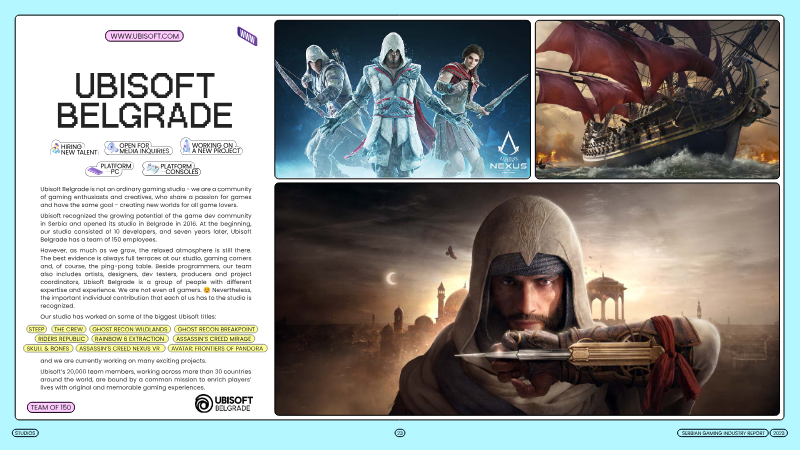
- The sector is bolstered by a mix of major international studios like Ubisoft Belgrade, Playrix Serbia, and Wargaming, alongside a growing indie scene and specialized service firms like GameBiz Consulting.
- Growth is supported by an influx of talent from Russia, Ukraine, and Belarus, paired with expanded local educational pipelines like the 'Playing Narratives' initiative.
Serbian Gaming Industry Report 2021
In 2021 Serbia’s gaming ecosystem emerged as a rapidly expanding, export‑oriented sector that combined a sizable studio base with a vibrant indie community. Roughly 130 development studios employed 1,548 people, of whom 30 % were women, and produced about 2,200 titles that generated an estimated US$125 million in revenue. The majority of earnings—between 75 % and 100 %—derived from markets outside the country, and 64 % of games relied on a free‑to‑play model supplemented by advertising.
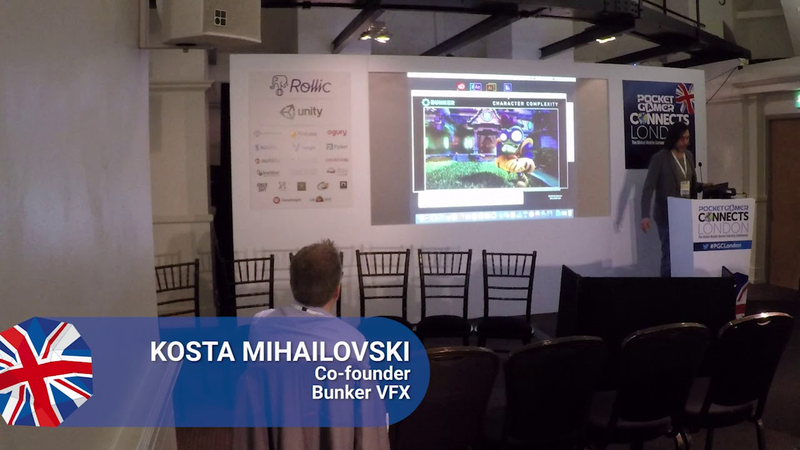
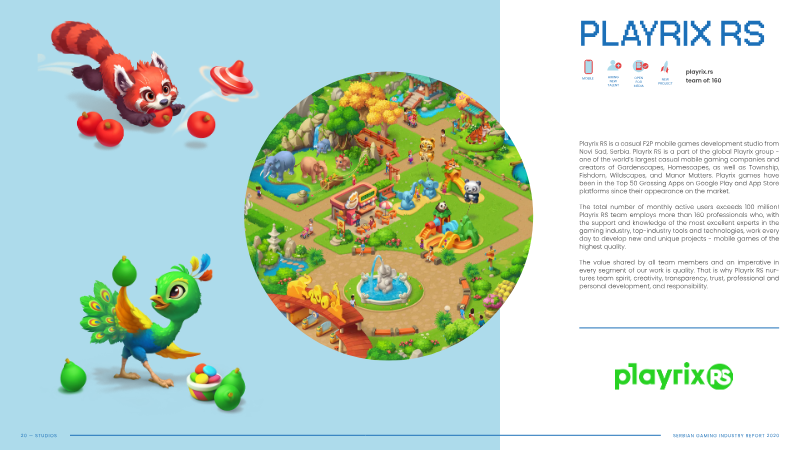
Mid‑sized studios such as Nordeus and Playrix RS demonstrated strong user bases, while larger contributors including Ubisoft Belgrade and the VFX house Bunker underscored Serbia’s capacity to support AAA‑level production and international client work. The esports landscape, led by Fortuna’s Balkan League, attracted roughly half a million viewers and distributed €220 k in prize money, highlighting the sector’s growing competitive dimension. Indie developers, ranging from solo creators to teams of forty, pursued diverse platforms—PC, mobile, VR/AR—and increasingly leveraged tools like Epic’s MetaHuman Creator, signalling a shift toward high‑fidelity, narrative‑driven experiences.
Policy initiatives reinforced this momentum. The “Serbia Innovates” super‑cluster, backed by U.S. assistance, positioned gaming, VR, and Web3 technologies as a multidisciplinary hub, while tax‑incentive reforms such as the IP‑Box and double R&D deductions attracted capital and talent. Educational collaborations, exemplified by new university programs and industry‑led training platforms, created a pipeline that bridges skill gaps and sustains growth.
Sustainable development is viewed as dependent on three pillars: compelling IP, robust publishing partnerships, and cross‑sector cooperation, suggesting that continued alignment of studio capabilities, policy support, and talent development will cement Serbia’s role as a notable exporter in the global games market.
- In 2021, Serbia’s gaming sector comprised approximately 130 studios employing 1,548 people, generating $125 million in revenue with 75% to 100% of earnings derived from international exports.
- The industry is heavily reliant on the free-to-play model, which accounts for 64% of all games produced, while the total output reached roughly 2,200 titles.
- The ecosystem supports a diverse production scale, ranging from indie developers using high-fidelity tools like MetaHuman Creator to major contributors such as Nordeus, Playrix RS, and Ubisoft Belgrade.

- Government policy has actively fostered growth through tax incentives like the IP-Box and double R&D deductions, alongside the 'Serbia Innovates' super-cluster initiative.
- The esports sector is a significant competitive pillar, with the Fortuna-led Balkan League attracting 500,000 viewers and distributing €220,000 in prize money.
Gaming Industry Report: Serbia 2020
The 2020 assessment of Serbia’s video‑game sector presents a rapidly expanding ecosystem that has moved beyond a modest, paper‑based association to become a central hub for nearly one hundred companies. In a single year the industry surpassed €100 million in revenue, a 20 percent increase over the previous period, while supporting 120 development teams and roughly 2 100 employees, about one‑third of whom are women. The market delivered 41 new mobile titles, with most studios concentrated in Belgrade and financing split between angel investors and state‑funded programmes, which together account for 45 percent of capital. A clear majority of firms intend to grow their staff in 2021, despite citing regulatory red‑tape, limited legal incentives and insufficient console support as persistent obstacles.
The sector is dominated by small‑to‑mid‑size studios, typically employing five to twenty‑five people, that provide full‑cycle development, consulting and backend‑as‑a‑service solutions. Companies such as Elbet and Tummy Games have already achieved notable market traction, with Elbet’s products operating on more than 130 operators across 30 countries. The pandemic forced a swift transition to remote work, exposing resource constraints and talent‑recruitment challenges, yet overall productivity remained stable and the community’s outlook stayed positive.
Industry networking was sustained through a dedicated Discord community of over a thousand members and forty channels, while the Serbian Games Association launched talent‑development initiatives including a “Shift 2 Games” job‑role series and a mentorship pilot for fifteen participants. Parallel to these efforts, game‑related education expanded dramatically: the Master 4.0 Hub in Gaming at the University of Kragujevac and a new master’s programme at the University of Arts in Belgrade will together serve more than 1 500 students, supported by over thirty professors and a dozen new degree and certificate programmes across ten institutions. Backed by partners such as Epic Games, Crater Training Center and Nordeus, this coordinated educational push is poised to supply a robust pipeline of world‑class talent for Serbia’s indie and mid‑size studios.
- Serbia’s video-game industry reached over €100 million in revenue in 2020, marking a 20 percent year-over-year growth across 120 development teams.
- The sector employs approximately 2,100 people, with women accounting for one-third of the workforce and a majority of firms planning to increase staff in 2021.
- Educational infrastructure expanded significantly with new programs at the University of Kragujevac and the University of Arts in Belgrade, supported by partners like Epic Games and Nordeus to serve over 1,500 students.
- The ecosystem is composed of nearly 100 companies, primarily small-to-mid-size studios of 5 to 25 employees, with 45 percent of capital sourced from angel investors and state-funded programs.
- Market output in 2020 included 41 new mobile titles, with companies like Elbet achieving international scale by operating on more than 130 platforms across 30 countries.
Serbian Gaming Industry Report 2018
The inaugural Serbian Games Association report maps a rapidly expanding national gaming ecosystem that now comprises more than 60 members across indie development, esports, visual‑effects houses and internationally linked studios, employing over 1,500 skilled professionals. Funding is diversified, with roughly 40 % of capital sourced from angel investors, 30 % from crowdfunding and 20 % from venture capital, and the largest single infusion recorded at €650 k. Flagship entities such as 3Lateral (recently integrated into Epic Games), Nordeus with its 200 million‑user “Top Eleven” platform, and Ubisoft Belgrade’s 107‑person team working on major AAA titles illustrate the sector’s growing global relevance.
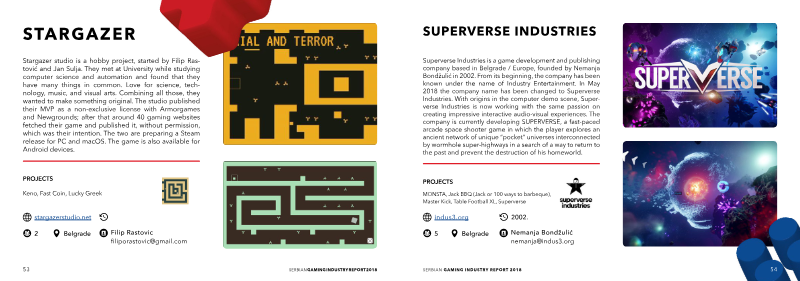
A vibrant indie segment is driven by small, highly creative teams—often one to three developers—producing titles ranging from cyber‑punk point‑and‑click adventures to hyper‑casual mobile games. Studios like Munzesky Games, Oraharo Entertainment, PWN.RS, Stargazer, Superverse Industries, Tummy Games and Zero Gravity showcase cross‑border collaborations and distinctive artistic approaches, while highlighting the need for stronger B2B networking, regular industry events and formalized game‑art education to sustain momentum.
Technical education underpins this growth, with approximately 30 000 university students enrolled in IT‑related programs and programming introduced at the primary‑school level. Government incentives, EU grants and private investment have bolstered studio formation, yet most companies still rely on organic installs and limited ad‑network usage for user acquisition. Community initiatives—including frequent association meet‑ups, two industry‑backed GameJams, the annual GameUp expo attracting over 2 500 participants, and the Nordeus Hub co‑working space offering a six‑month mentorship—are actively closing knowledge gaps and fostering collaboration.
Media outlets such as Svet kompjutera, JVC Gamer and the online PLAY! Zine maintain visibility for Serbian developers both domestically and abroad. Surveyed stakeholders anticipate a rise in paid user‑acquisition capabilities and an increase in successful Serbian titles, positioning the country to become a more prominent player in the regional and global gaming market.
- The Serbian gaming industry comprises over 60 member entities and employs more than 1,500 professionals, anchored by major players like Nordeus, Ubisoft Belgrade, and 3Lateral.
- Funding for the sector is diversified, with 40% sourced from angel investors, 30% from crowdfunding, and 20% from venture capital, with the largest single investment reaching €650,000.
- A robust pipeline of technical talent is supported by approximately 30,000 university students in IT-related programs and the integration of programming into primary-school curricula.
- The indie segment is characterized by small, highly creative teams of one to three developers, though these studios currently rely heavily on organic installs rather than paid user-acquisition strategies.
- Industry growth is bolstered by community-led initiatives such as the GameUp expo, which attracts over 2,500 participants, and mentorship programs like the Nordeus Hub.
Serbian Gaming Industry Report 2019
The Serbian games sector is emerging as a rapidly expanding, diversified ecosystem that now supports more than 80 companies and roughly 2,000 employees, reflecting a 3.4 % year‑on‑year increase in staff. Studios range from micro‑teams of five to large developers of up to 180 personnel, many of which are actively recruiting, indicating robust talent demand. Revenue generation has risen to approximately €100 million, with 2019 mobile‑first, free‑to‑play titles produced on modest budgets of €0‑100 k and average team sizes of six to ten, while flagship projects such as Nordeus’s Top Eleven and Playrix RS’s titles have amassed over 100 million monthly active users, underscoring Serbia’s capacity for both high‑volume mobile and higher‑budget productions.
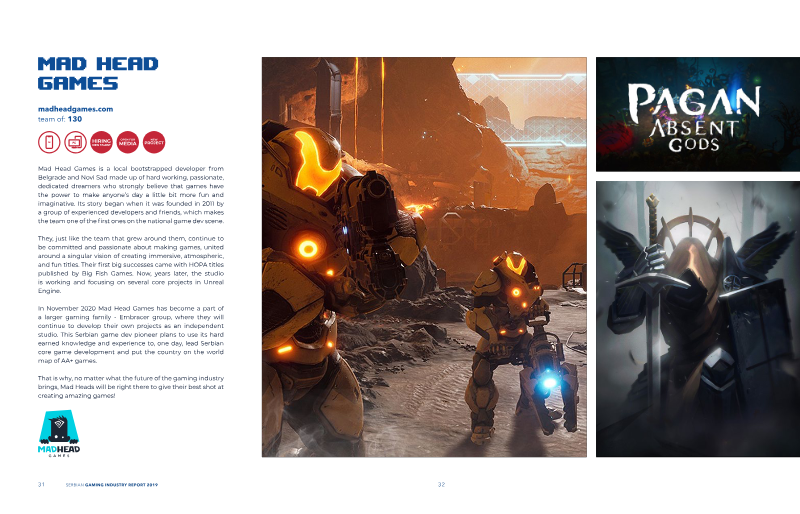
The market is highly fragmented, comprising dozens of small‑to‑mid‑size studios that specialize in mobile, hyper‑casual, AR/VR, backend services, and outsourcing. Notable commercial successes include Sozap’s Armed Heist with more than 14 million installs and PixQuake’s server‑side analytics suite. Institutional support has intensified through the Serbian Gaming Association, the Nordeus Hub, and university initiatives, including a multi‑university “Master 4.0” curriculum that integrates IT, business, and creative disciplines and has spawned dozens of new gaming degree programmes.
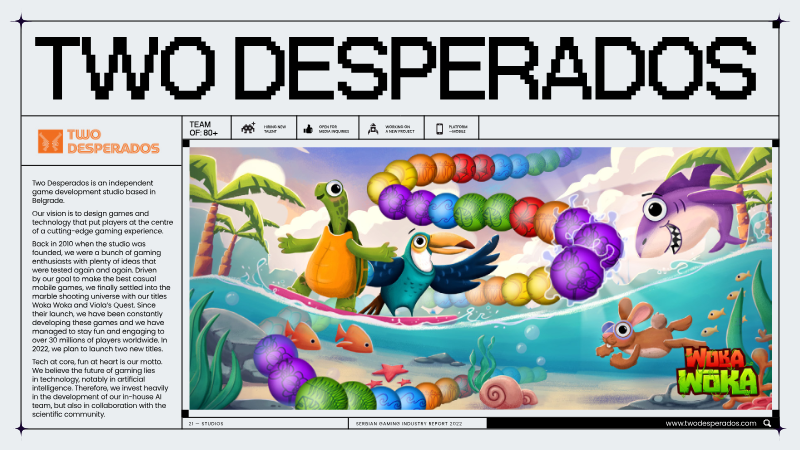
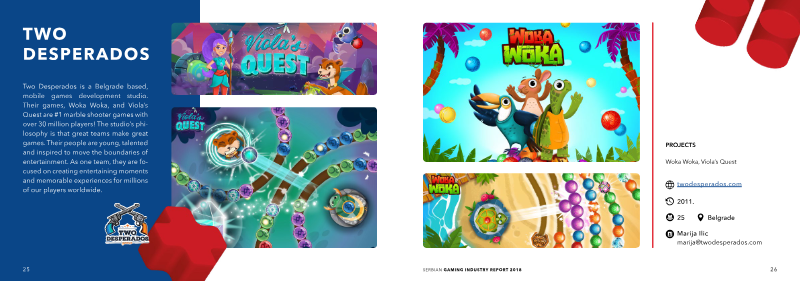
Mentorship and structured education that blend soft‑skill and technical training are identified as critical for talent development, with studios such as Digital Arrow, Two Desperados, and Ubisoft Belgrade highlighting the need for custom tech‑art pipelines, AI integration, and data‑driven design. The coordinated push toward professionalisation, exemplified by accelerator programs and community events, positions Serbia to sustain its growth trajectory and increase its contribution to both regional and global game markets.
- The Serbian gaming sector generated approximately €100 million in revenue in 2019, supported by an ecosystem of over 80 companies and 2,000 employees.
- Flagship mobile titles from companies like Nordeus and Playrix RS have achieved massive scale, amassing over 100 million monthly active users.
- The industry is experiencing steady growth with a 3.4% year-on-year increase in staff and robust recruitment demand across studios ranging from micro-teams to 180-person developers.
- Market production is highly diversified, ranging from low-budget mobile and hyper-casual titles costing €0–100k to specialized work in AR/VR, backend services, and server-side analytics.
- Institutional support has matured through the Serbian Gaming Association and the 'Master 4.0' university curriculum, which integrates IT, business, and creative disciplines to formalize talent development.