Mobile
Documents
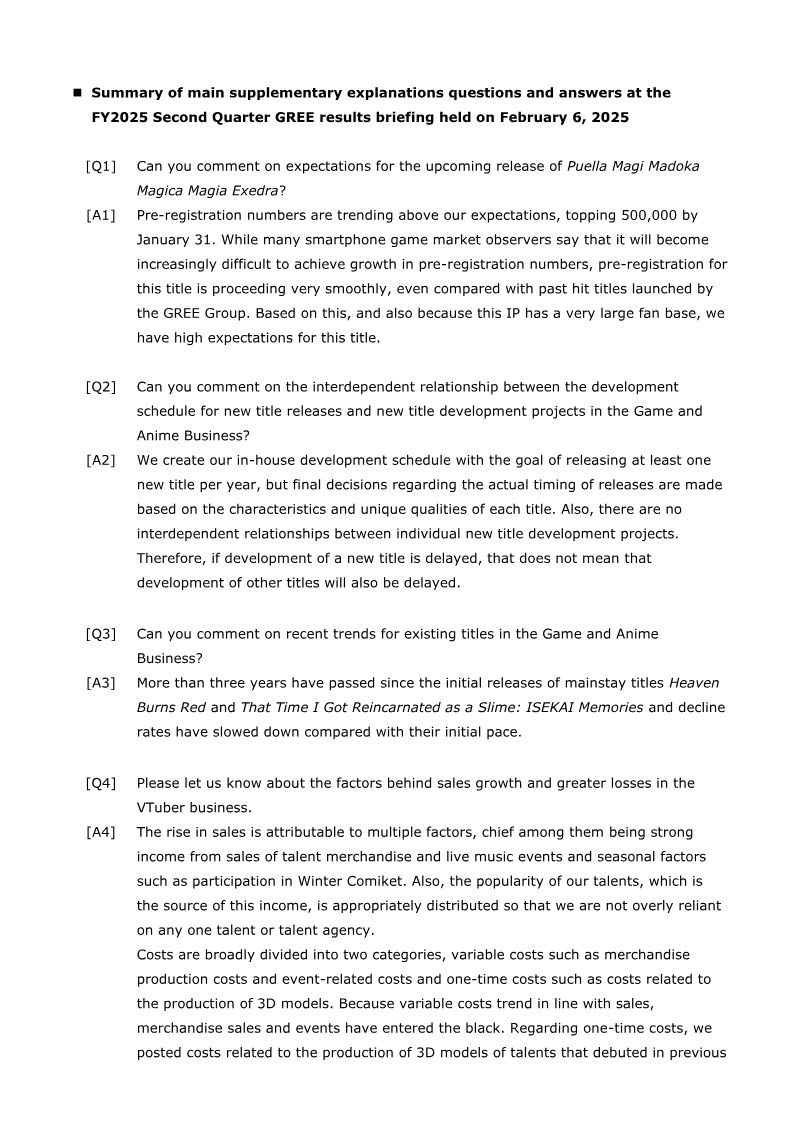
Summary of Main Supplementary Explanations Questions and Answers: FY2025 Second Quarter GREE Results Briefing
The briefing outlines GREE’s performance and strategic outlook for FY2025 Q2, focusing on game releases, existing title dynamics, and the VTuber business. Pre‑registration for “Puella Magi Madoka Magica Magia Exedra” surpassed 500,000 by January 31, exceeding expectations and reinforcing confidence in the IP’s strong fan base. The company maintains an annual release cadence for new titles, but schedules are determined independently per project; delays in one title do not cascade to others. Existing flagship games such as Heaven Burns Red and That Time I Got Reincarnated as a Slime: ISEKAI Memories have experienced a deceleration in decline rates after three years, indicating sustained player engagement.
In the VTuber segment, sales growth is driven by talent merchandise, live music events, and seasonal participation in Winter Comiket. Revenue has turned profitable as variable costs align with sales, while one‑time expenses—primarily 3D model production for new and returning talents—have increased quarterly, contributing to larger losses. Management anticipates that expanding the talent roster will stabilize one‑time costs and enhance profitability.
Looking ahead, GREE projects monthly profitability in FY2026 with annual VTuber sales near ¥3.0 billion, followed by accelerated growth targets. The briefing underscores a balanced approach to new title development, sustained performance of legacy games, and a focused strategy for scaling the VTuber business while managing cost structures.
- GREE targets monthly profitability for its VTuber segment in FY2026, with annual sales projected to reach approximately ¥3.0 billion.
- Pre-registration for the upcoming title 'Puella Magi Madoka Magica Magia Exedra' exceeded 500,000 by January 31, signaling strong market interest.
- Flagship games 'Heaven Burns Red' and 'That Time I Got Reincarnated as a Slime: ISEKAI Memories' have stabilized, showing a deceleration in decline rates after three years of operation.
- The VTuber business is currently experiencing increased quarterly losses due to one-time 3D model production expenses, though variable costs have successfully aligned with sales.
- GREE maintains an independent release schedule for new games, ensuring that project-specific delays do not impact the broader annual release cadence.
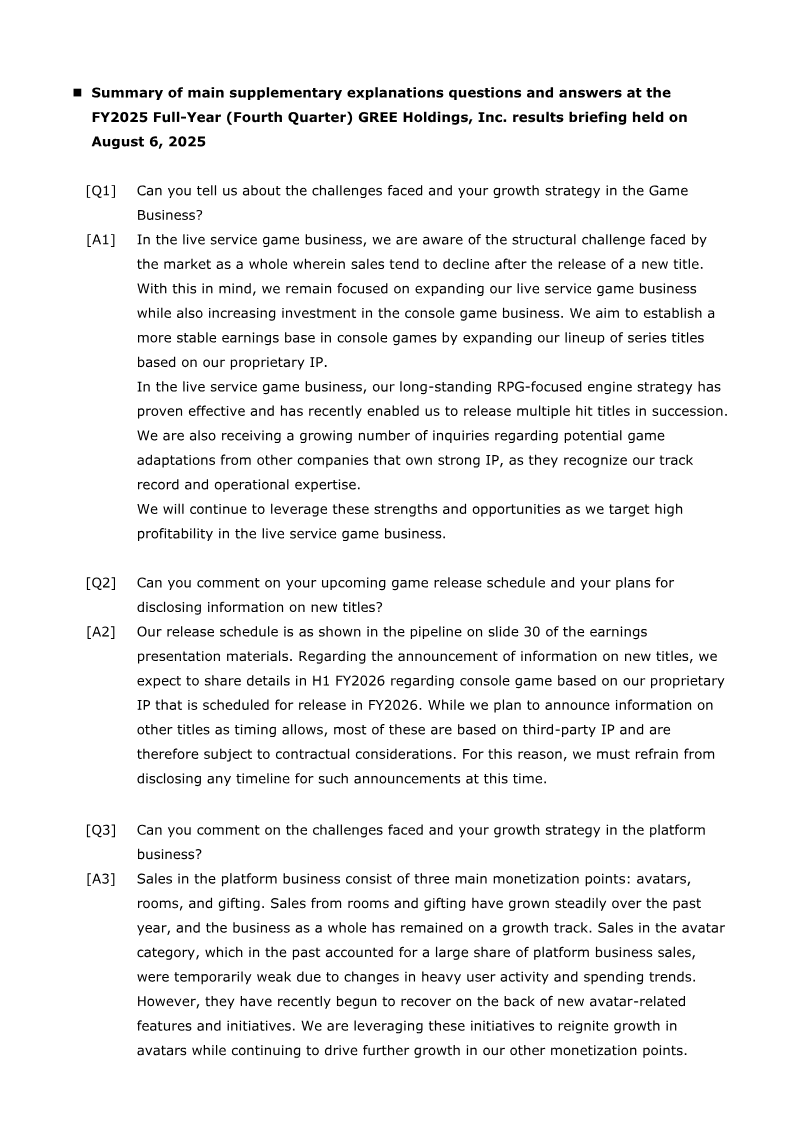
Summary of Main Supplementary Explanations Questions and Answers: FY2025 Full-Year Results
GREE Holdings outlines its FY2025 full‑year results and forward strategy across several business segments. In the game division, the company acknowledges the typical post‑launch decline in live‑service titles and counters it by expanding both its live‑service portfolio—leveraging a proven RPG engine—and investing in console games built on proprietary IP to create a steadier earnings base. The company reports multiple recent hit releases and anticipates further inquiries for third‑party IP adaptations, positioning itself to capture high profitability in the live‑service arena.
The platform business remains growth‑oriented, with steady increases in room and gifting revenue offsetting a temporary dip in avatar sales. New avatar features are expected to revive this segment, while the company continues to push other monetization channels. In the VTuber sector, GREE pursues a two‑stage growth model: first expanding its talent roster—now about 90 talents—and then boosting sales per talent through diversified merchandise channels and nascent live‑event advertising. Sales per talent have doubled since FY2024, and the company maintains a balanced portfolio to avoid over‑reliance on any single talent.
The DX business is undergoing a structural shift from one‑time project sales to recurring revenue, with modest growth projected through FY2026 as the transition completes. Investment activities in FY2026 will see increased volatility due to fund maturity and potential impairment, yet the company expects stable income streams from dividends and performance fees. Overall, GREE projects balanced returns while navigating market challenges across its diversified entertainment portfolio.
- GREE is shifting its game division strategy to balance post-launch live-service volatility by investing in console titles built on proprietary IP.
- The VTuber business has doubled sales per talent since FY2024, supported by a roster of approximately 90 talents and expanded merchandise and advertising channels.
- The DX business is transitioning from a one-time project sales model to a recurring revenue structure, with modest growth expected through FY2026.
- Platform revenue growth is currently driven by room and gifting monetization, which is offsetting a temporary decline in avatar sales.
- Investment activities in FY2026 are expected to experience increased volatility due to fund maturity and potential impairments, though stable income from dividends and performance fees is anticipated.
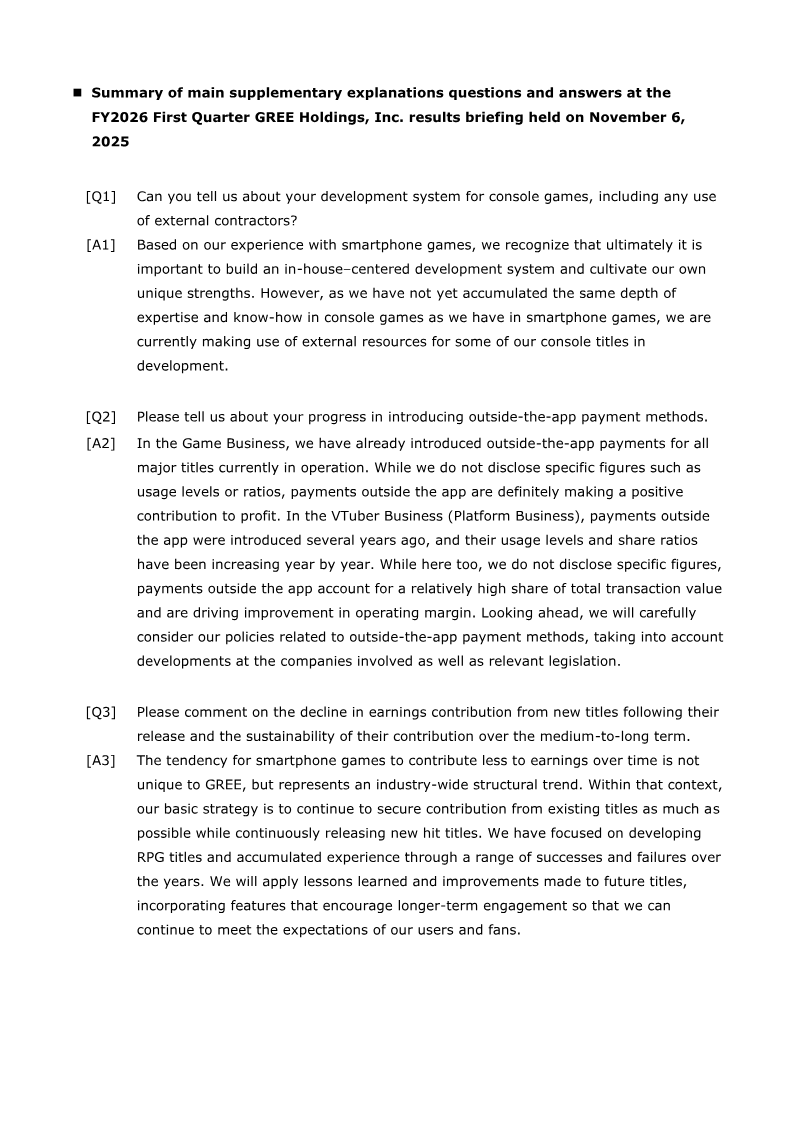
Summary of main supplementary explanations questions and answers at the FY2026 First Quarter GREE Holdings, Inc. results briefing held on November 6, 2025
GREE Holdings’ FY2026 first‑quarter briefing clarified strategic priorities across its game, VTuber, and investment divisions. The company emphasized a shift toward an in‑house development model for console titles while still leveraging external contractors to bridge current expertise gaps. In the mobile game segment, outside‑app payment methods have been fully deployed across all major titles and are contributing positively to profitability; the VTuber platform has similarly expanded its outside‑app transactions, boosting operating margins. The firm acknowledges a structural decline in earnings from new smartphone releases but plans to sustain revenue by focusing on long‑term engagement features and continuous hit title launches, particularly within the RPG genre.
Market outlooks reveal a plateau in smartphone installs but growing potential through high‑value IP and outside‑app monetization. Console gaming is viewed as a long‑term investment, with an emphasis on cultivating enduring IP series. The VTuber market is still expanding globally, especially overseas, and the company projects full‑year profitability for its VTuber production arm by FY2027 as higher‑margin merchandise and live events offset earlier talent acquisition costs.
Exit strategies for the investment business have shifted from IPOs to M&A, reflecting broader market conditions. Generative AI is being integrated across game development, VTuber content creation, and digital transformation services to enhance efficiency and service quality, though its direct earnings impact remains difficult to quantify. Overall, GREE aims to strengthen core competencies, diversify revenue streams, and adapt to evolving market dynamics while pursuing sustainable growth.
- GREE is transitioning to an in-house development model for console titles, utilizing external contractors to address current expertise gaps while focusing on long-term IP cultivation.
- Outside-app payment methods have been fully implemented across all major mobile titles and the VTuber platform, directly contributing to improved operating margins.
- The VTuber production arm is projected to reach full-year profitability by FY2027 as high-margin merchandise and live events offset initial talent acquisition costs.
- The company is shifting its investment business exit strategy from IPOs to M&A to better align with current market conditions.
- Generative AI is being integrated into game development, VTuber content creation, and digital transformation services to improve operational efficiency and service quality.
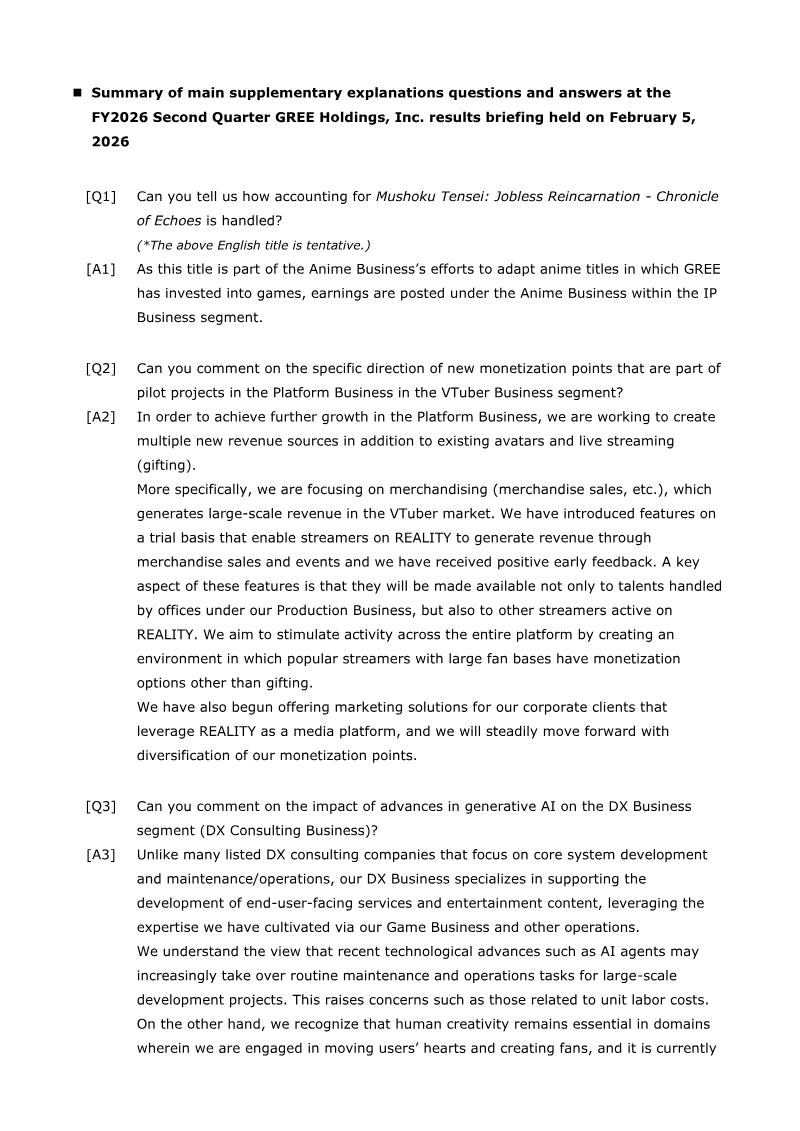
Summary of main supplementary explanations questions and answers at the FY2026 Second Quarter GREE Holdings, Inc. results briefing held on February 5, 2026
The briefing clarified GREE Holdings’ strategic priorities across its core business segments for FY2026. In the Anime Business, earnings from the newly announced “Mushoku Tensei: Jobless Reincarnation – Chronicle of Echoes” are recorded under the IP Business segment, reflecting the company’s focus on monetizing anime titles it has invested in. The Platform Business within the VTuber segment is expanding beyond traditional gifting revenue by piloting merchandise sales and event features on its REALITY platform; early feedback indicates positive reception, and the company plans to extend these monetization tools to a broader streamer base while offering corporate marketing solutions. In the DX Consulting Business, GREE emphasizes its niche in end‑user entertainment services and acknowledges that generative AI may automate routine maintenance but is unlikely to erode its creative‑driven value proposition in the short term. Regarding financial outlook, a downward revision of FY26 earnings was justified by recent softness in existing game titles; however, the company maintains confidence in its three‑year medium‑term targets (FY28) by shifting emphasis toward continuous growth businesses and reducing reliance on volatile game revenues. Finally, the Anime Business will pursue acquisition of production capabilities—through both in‑house development and M&A—within 2–3 years to secure control over high‑quality, timely anime output. These initiatives collectively aim to diversify revenue streams, strengthen creative control, and sustain long‑term growth across GREE’s entertainment ecosystem.
- GREE Holdings revised its FY26 earnings downward due to recent performance softness in existing game titles.
- The company is shifting its long-term strategy toward continuous growth businesses to reduce reliance on volatile game revenue, maintaining its medium-term targets for FY28.
- GREE plans to acquire anime production capabilities through in-house development and M&A within the next 2–3 years to secure control over output quality and timing.
- The REALITY platform is expanding its VTuber monetization model beyond gifting by piloting merchandise sales and event features, with plans to integrate corporate marketing solutions.
- Revenue from the new title 'Mushoku Tensei: Jobless Reincarnation – Chronicle of Echoes' is being categorized under the IP Business segment to reflect the company's focus on monetizing its anime investments.
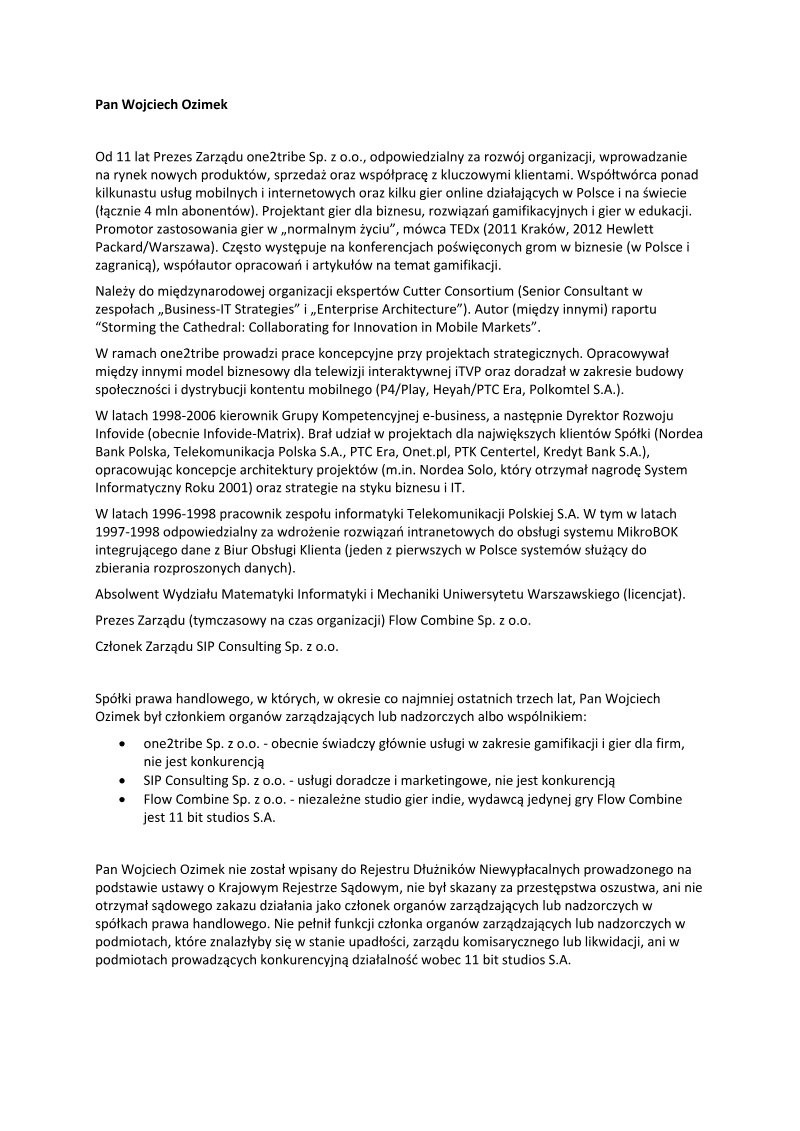
Wojciech Ozimek: Profile and Expertise
Wojciech Ozimek has led one2tribe Sp. z o.o. for eleven years as CEO, overseeing organizational growth, product launches, sales and key client relationships. Under his direction the company has co‑created more than a dozen mobile and internet services, as well as several online games that collectively attract four million subscribers worldwide. Ozimek’s expertise lies in designing business‑oriented games, gamification solutions and educational titles, positioning him as a proponent of integrating gaming into everyday life. He has spoken at TEDx Kraków (2011) and Hewlett Packard/Warsaw (2012), frequently presenting at business‑gaming conferences in Poland and abroad, and co‑authored articles on gamification.
Ozimek is a senior consultant with the international Cutter Consortium, contributing to “Business‑IT Strategies” and “Enterprise Architecture” teams. He authored the report “Storming the Cathedral: Collaborating for Innovation in Mobile Markets.” Within one2tribe he has led concept development for strategic projects, including a business model for interactive TV (iTVP) and advisory work on mobile content distribution for P4/Play, Heyah/PTC Era, and Polkomtel S.A. Prior to one2tribe, he managed the e‑business competency group and later served as Director of Development at Infovide (now Infovide‑Matrix), delivering architecture concepts for major clients such as Nordea Bank Polska, Telekomunikacja Polska S.A., PTC Era, Onet.pl, PTK Centertel and Kredyt Bank S.A. His notable project Nordea Solo earned the 2001 System Informatyczny Roku award.
Ozimek’s earlier career included a role in the IT team at Telekomunikacja Polska S.A., where he implemented intranet solutions for the MikroBOK system, one of Poland’s first distributed data collection platforms. He holds a bachelor’s degree in Mathematics, Computer Science and Mechanics from the University of Warsaw.
In recent years he has served on the boards of Flow Combine Sp. z o.o., SIP Consulting Sp. z o.o., and temporarily on the board of Flow Combine, a studio that published its sole title through 11 Bit Studios S.A. No records of insolvency, fraud convictions or court‑ordered prohibitions exist for Ozimek, and he has not held executive roles in companies undergoing bankruptcy or competing with 11 Bit Studios.
- Wojciech Ozimek has served as CEO of one2tribe for 11 years, overseeing the development of online games and services that have reached four million subscribers globally.
- His professional focus centers on gamification and business-oriented game design, supported by his role as a senior consultant for the Cutter Consortium’s Business-IT Strategies and Enterprise Architecture teams.
- Prior to one2tribe, Ozimek held leadership roles at Infovide, where he directed development and architecture for major clients including Nordea Bank Polska, Telekomunikacja Polska S.A., and Onet.pl.
- He led strategic advisory projects for telecommunications firms such as P4/Play, Heyah/PTC Era, and Polkomtel S.A., and developed business models for interactive TV (iTVP).
- His technical background includes a bachelor’s degree in Mathematics, Computer Science, and Mechanics from the University of Warsaw and early experience implementing distributed data collection platforms like MikroBOK.
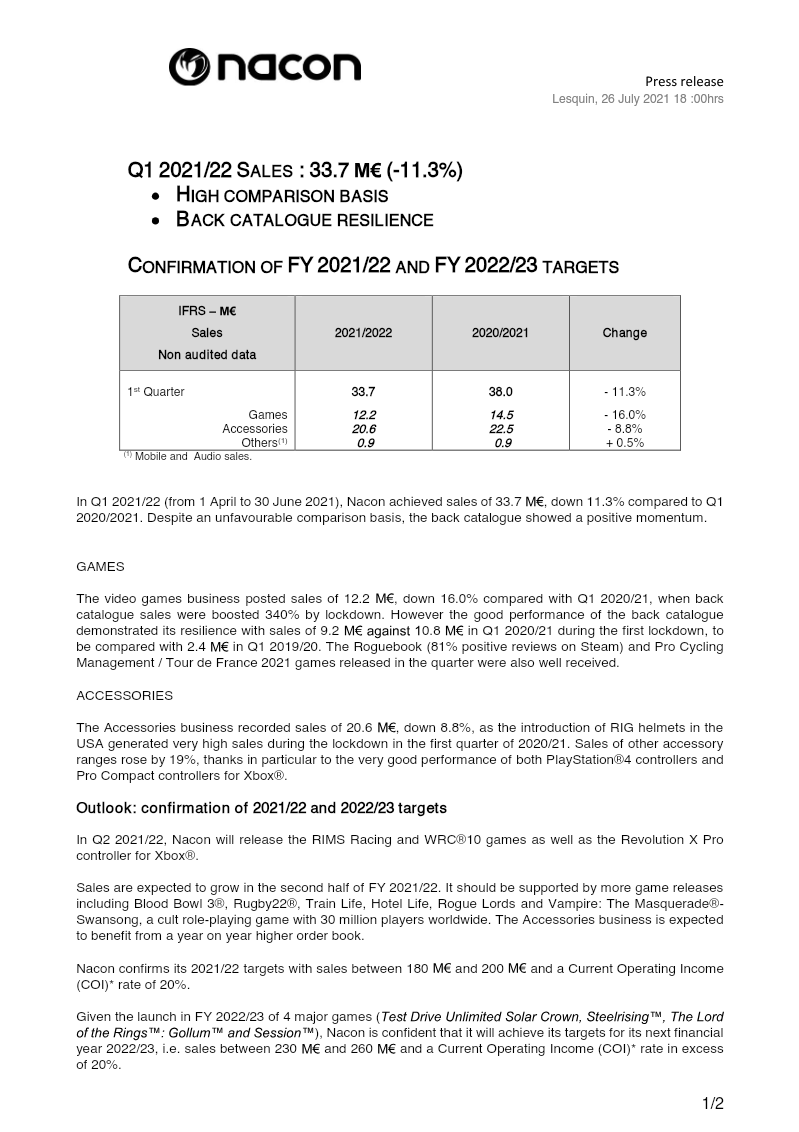
Q1 2021/22 Sales: 33.7 M€
Nacon reported first‑quarter sales of €33.7 million for the period 1 April to 30 June 2021, a decline of 11.3 % versus the same quarter in 2020‑21. The drop reflects an unfavorable comparison basis, yet back‑catalogue performance remained resilient with €9.2 million in sales compared to €10.8 million during the initial lockdown, and a substantial 340 % lift in back‑catalogue revenue that quarter. Game sales fell 16 % to €12.2 million, while accessories declined 8.8 % to €20.6 million; the accessories segment benefited from a 19 % rise in non‑RIG helmet ranges, notably PlayStation 4 and Xbox® controllers. Mobile and audio sales remained flat at €0.9 million.
The company confirmed its 2021‑22 and 2022‑23 targets, projecting total annual sales of €180–200 million with a current operating income (COI) margin of 20 %. For FY 2022‑23, Nacon aims for €230–260 million in sales and a COI margin above 20 %, supported by four major game launches (Test Drive Unlimited Solar Crown, Steelrising™, The Lord of the Rings™: Gollum™, and Session™). Second‑half growth is expected from additional titles such as Blood Bowl 3®, Rugby22®, Train Life, Hotel Life, Rogue Lords, and Vampire: The Masquerade®‑Swansong. Nacon’s integrated structure—comprising 11 development studios, publishing of AA titles, and premium hardware design—underpins its strategy to leverage synergies across a global distribution network covering 100 countries. The company, listed on Euronext Paris, employs over 600 staff and operates through 16 subsidiaries.
- Nacon reported Q1 2021/22 sales of €33.7 million, representing an 11.3% decline compared to the same period in the previous fiscal year.
- The company maintained its financial guidance, targeting €180–200 million in sales for FY 2021-22 and €230–260 million for FY 2022-23, both with a current operating income margin of at least 20%.
- Segment performance saw game sales fall 16% to €12.2 million and accessories decline 8.8% to €20.6 million, though non-RIG helmet ranges and console controllers grew by 19%.
- Back-catalogue sales reached €9.2 million, showing resilience despite a difficult comparison against the previous year's lockdown-driven 340% revenue surge.
- Future growth is anchored by four major upcoming releases: Test Drive Unlimited Solar Crown, Steelrising, The Lord of the Rings: Gollum, and Session.
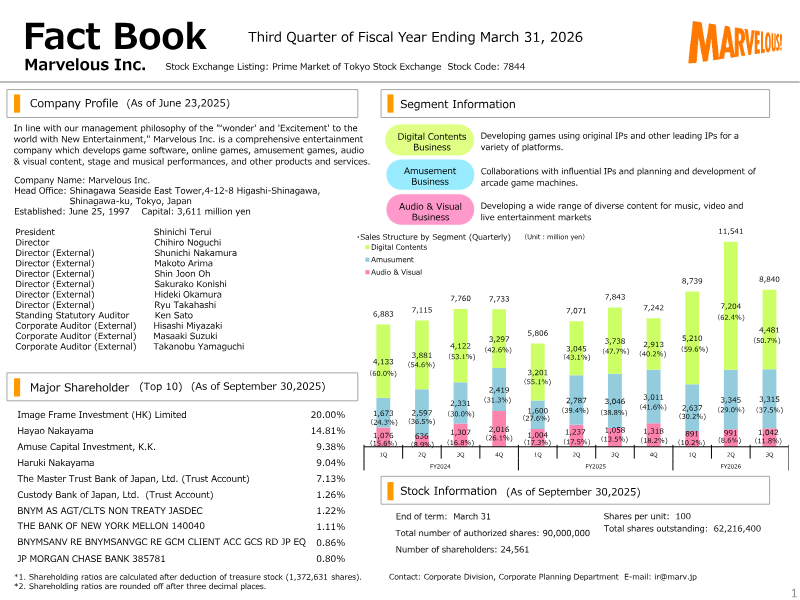
Factbook: Third Quarter of Fiscal Year Ending March 31, 2026
Marvelous Inc., listed on Tokyo’s Prime Market, released its third‑quarter financial results for the fiscal year ending March 31 2026. The company’s core business spans digital content, amusement, audio‑visual production and live entertainment, with a focus on original IPs and collaborations. Revenue rose to ¥29.1 billion in Q3, up 4.5% from the prior quarter and 10.6% year‑on‑year, driven primarily by digital content sales of ¥7.2 billion and amusement revenue of ¥3.0 billion. Gross operating profit reached ¥10.4 billion, a 12% increase over Q2 and a 9% rise versus the same period last year, reflecting improved cost control in production and marketing.
Operating profit fell to ¥1.8 billion, a 12% decline from Q2, largely due to higher selling‑general‑administrative expenses of ¥8.6 billion compared with ¥7.9 billion in Q2. Net income attributable to shareholders was ¥1.5 billion, down 18% from Q2, with a net profit margin of 5.3%. The company’s cash‑flow position remained solid, with operating cash flow of ¥2.8 billion and a cash‑equivalent balance of ¥16.4 billion at quarter end.
Geographically, the report covers Japan and overseas markets where Marvelous operates. The data derive from consolidated financial statements prepared under Japanese GAAP, covering all subsidiaries and affiliates. Key metrics such as return on equity (13.7%) and asset turnover (0.82) indicate healthy profitability, while dividend payout remained at 52% of net income. Overall, the quarter shows revenue growth but margin pressure from higher operating costs, prompting management to focus on cost efficiency and portfolio diversification.
- Marvelous Inc. reported Q3 revenue of ¥29.1 billion, representing a 10.6% year-on-year increase driven by digital content sales of ¥7.2 billion and amusement revenue of ¥3.0 billion.
- Operating profit declined 12% quarter-on-quarter to ¥1.8 billion, primarily due to an increase in selling, general, and administrative expenses from ¥7.9 billion in Q2 to ¥8.6 billion.
- Gross operating profit rose 9% year-on-year to ¥10.4 billion, reflecting improved cost control in production and marketing despite the overall pressure on net margins.
- Net income attributable to shareholders fell 18% from the previous quarter to ¥1.5 billion, resulting in a net profit margin of 5.3%.
- The company maintains a solid financial position with ¥16.4 billion in cash equivalents, an operating cash flow of ¥2.8 billion, and a return on equity of 13.7%.
Annual Report 2005
Printed in Japan This annual report is printed on recycled paper. 2004 2005 2004 2005 2004 2005 2004 2005 2004 2005 2004 2005 Total Games (Offline) Games (Online) Mobile Phone Content Publication Others Financial Highlights ________________________________________ 1 Disclaimer Regarding Forward-Looking Statements To Our Shareholders ____________________________________ 2 Statements in this annual report with respect to the current plans, estimates, stra...
- Square Enix's net income significantly increased to ¥14,520 million in FY2005, up from ¥4,355 million in FY2004, and ¥2,296 million in FY2003.
- Total consolidated net sales for Square Enix reached ¥73,865 million in FY2005, an increase from ¥63,202 million in FY2004 and ¥21,877 million in FY2003.
- The 'Games (Offline)' segment was the largest contributor to net sales in FY2005 at ¥41,944 million, followed by 'Games (Online)' at ¥13,853 million and 'Publication' at ¥10,859 million.
- Notes and accounts receivable decreased by ¥4,375 million to ¥7,670 million in FY2005, primarily because no "million-seller" titles were released during the fiscal year.
- Intangible assets decreased by ¥1,454 million to ¥6,096 million in FY2005, mainly due to ¥1,236 million in goodwill depreciation from the UIEvolution Inc. purchase in the previous fiscal year.

Annual Report 2006
SQUARE ENIX CO., LTD, TH SQUARCCNIX www.square-enix.com/ ANNUAL REPORT 2006 Net Sales Ratio Net Sales (Billions of yen) Games (Offline) 36.9% 2005 Net Sales Ratio Net Sales (Billions of yen) Games (Online) 12.6% 2005 Net Sales Ratio Net Sales (Billions of yen) Mobile Phone Content 4.1% 2005 Net Sales Ratio Net Sales (Billions of yen) Net Sales Ratio Net Sales (Billions of yen) Net Sales Ratio Net Sales (Billions of yen) Contents ...
- Square Enix acquired 93.7% of TAITO CORPORATION in September 2005 via a takeover bid, subsequently merging it with SQEX, Inc. to make Taito a wholly owned subsidiary.
- The company's content production account decreased by ¥8,197 million to ¥7,312 million as of March 31, 2006, primarily due to expensing production costs for major titles like "FINAL FANTASY XII" and "KINGDOM HEARTS II" upon their domestic release.
- Deferred tax assets significantly increased as of March 31, 2006, with current deferred tax assets rising by ¥4,437 million to ¥7,877 million and non-current deferred tax assets increasing by ¥4,754 million to ¥6,523 million, partly due to tax differences from the Taito acquisition.
- Square Enix is expanding its business beyond growing existing communities by developing new ones and actively seeking to approach outside communities, providing value-added services to third parties like EZ Game Street! and On Demand TV, and forming joint ventures such as with Xavel, Inc.
- The company reported net income of ¥14,932 million for the year ended March 31, 2006, a decrease from ¥17,076 million in the previous year, despite an increase in income before income taxes to ¥25,556 million from ¥8,990 million.
Annual Report 2015
FUN AND OUR MISSION “Dreams, Fun and Inspiration” are the Engine of Happiness. Through our entertainment products and services, BANDAI NAMCO will continue to provide “Dreams, Fun and Inspiration” to people around the world, based on our boundless creativity and enthusiasm. As an entertainment leader across the ages, exploring new areas and heights in entertainment.
- Bandai Namco's vision is to be the "Leading Innovator in Global Entertainment" by exploring new areas and heights in entertainment, aiming to expand its business in Asia and achieve growth for the next 10-20 years.
- The company achieved solid results in both operational and quantitative areas under its previous Mid-term Plan, driven by the IP axis strategy, and plans to continue this strategy.
- Bandai Namco is entering a period where digital networks will be integrated into real life, leading to the creation of the Network Entertainment SBU to develop content and businesses for both digital and real networks.
- The Visual and Music Production SBU focuses on entertaining people globally through IP production, with successful examples like "Love Live! School Idol project" and "Mobile Suit Gundam UC (Unicorn) episode 7: Over the Rainbow" contributing to performance.
- The company aims for ¥60.0 billion in sales in Asia (including exports) by FY2018.3, expanding popular IPs like "Yo-kai Watch DX" into established brands in the region.
Integrated Report 2018
I N T E G R AT E D R E P O R T 2 0 1 8 develops entertainment-related toys, network content, home video games, amusement machines, amusement facilities, and visual and music content. Under the Mid-term Plan, which was launched in April 2018, the Group aims to achieve “CHANGE” to progress to the next stage, with a Mid-term Vision of CHANGE for the NEXT: Empower, Gain Momentum, and Accelerate Evolution. “Dreams, Fun and Inspiration”are the Engine of Happiness.
- BANDAI NAMCO Group aims for ¥750 billion in net sales and ¥75 billion in operating profit by March 31, 2021, with an operating profit margin and ROE of 10% or more.
- The Group's business is segmented into Toys and Hobby, Network Entertainment, and Visual and Music Production, with Network Entertainment encompassing network content, home video games, arcade machines, and amusement facilities.
- In FY2018.3, amusement facilities generated ¥64.2 billion in sales from 1,870 facilities (293 directly managed, 1,563 revenue-sharing), while amusement machines generated ¥28.2 billion.
- BANDAI NAMCO Group was ranked among the top global app market publishers in 2017 based on revenue for iOS and Google Play, with Tencent being the top publisher.
- The Group emphasizes work-life balance through systems like extended childcare leave, flextime, shorter working hours, and support for family caregiving, exceeding legal requirements.
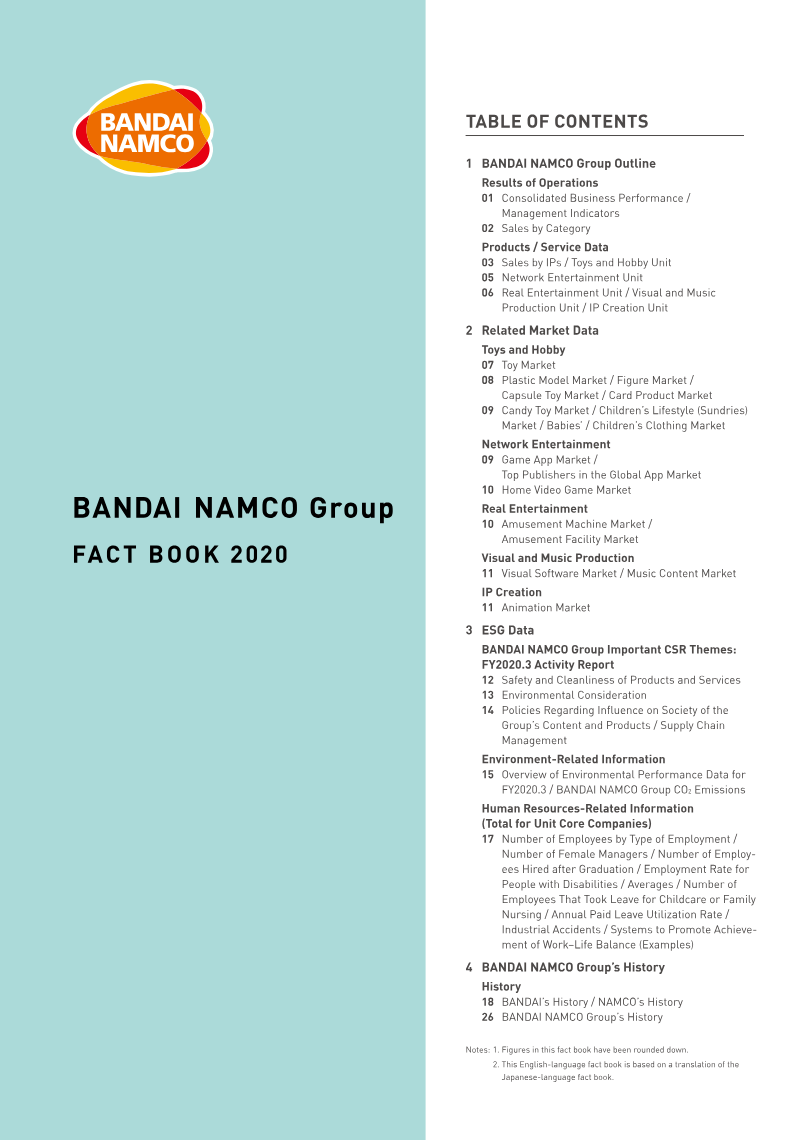
Bandai Namco Group Fact Book 2020
01 Consolidated Business Performance / 03 Sales by IPs / Toys and Hobby Unit 05 Network Entertainment Unit 06 Real Entertainment Unit / Visual and Music Production Unit / IP Creation Unit 08 Plastic Model Market / Figure Market / Capsule Toy Market / Card Product Market 09 Candy Toy Market / Children’s Lifestyle (Sundries) Market / Babies’ / Children’s Clothing Market Top Publishers in the Global App Market BANDAI NAMCO Group 10 Home Video Game Market 10 Amusement Machine Market /...
- Bandai Namco Group's Toys and Hobby Unit has achieved significant cumulative shipment volumes for key product lines as of March 2020: Gundam plastic models (696.73 million units), Ultraman soft figures (98.77 million units), Super Sentai series robots (30.45 million units), and Digital Monsters (14.15 million units).
- The Network Entertainment Unit's sales for network content decreased from ¥211.1 billion in FY2019.3 to ¥200.9 billion in FY2020.3, while home video game sales also slightly declined from ¥102.1 billion to ¥99.0 billion in the same period.
- As of March 2020, Bandai Namco Rights Marketing Inc. reported a cumulative total of 492,924,783 fee-based viewings for on-demand animation delivery since October 2002, with 4,508 productions (71,739 episodes) available.
- Bandai Namco Group was formed in September 2005 through the management integration of BANDAI and NAMCO, establishing NAMCO BANDAI Holdings Inc.
- The Japanese figure market reached ¥30.5 billion in FY2019, while the digital card market, where Bandai holds a significant share (60.8% in FY2019), was ¥24.7 billion in FY2019.