Mobile
Documents
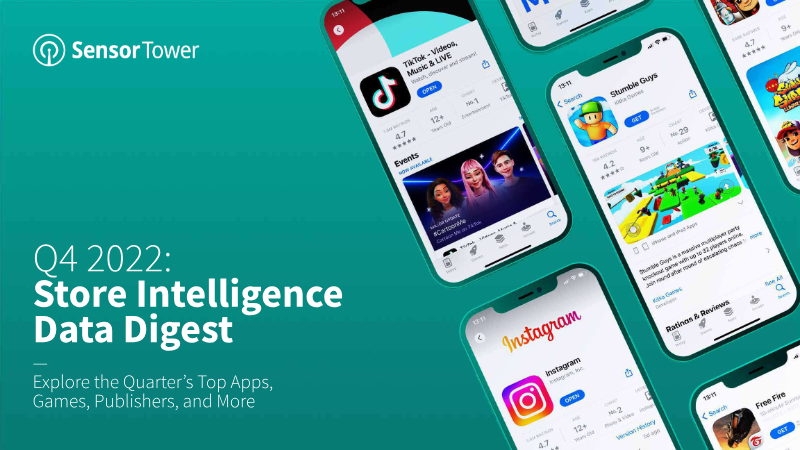
Store Intelligence Data Digest: Q4 2022
The fourth quarter of 2022 delivered a nuanced portrait of the mobile‑app ecosystem, tracking download activity across the world’s two dominant storefronts and highlighting shifts in consumer preference. Global install volume slipped marginally to 35.5 billion, a 0.1 % decline, while the Apple App Store posted a 2.4 % rise to 8.1 billion downloads and Google Play contracted 0.9 % to 27.5 billion. Instagram reclaimed the top‑ranked position worldwide, and Meta’s portfolio occupied half of the top‑ten list, underscoring the company’s entrenched influence. TikTok, CapCut and the newly launched game Stumble Guys emerged as the fastest‑growing titles, signaling continued appetite for short‑form video and casual gaming.
In the Asian market, video‑centric applications remained dominant. TikTok delivered roughly 29 million installs despite a 19 % quarter‑over‑quarter dip, while Instagram led Google Play with more than 116 million downloads, driven largely by India’s sizable user base. The FIFA World Cup spurred a surge in football‑related games, with FIFA Mobile and Soccer Super Star posting 136 % and 112 % QoQ growth respectively. New releases such as Gas (7,102 % QoQ in the United States), Makeover Studio (2,035 % QoQ) and MARVEL SNAP broke into the top‑20, and Ludo King amassed over 36 million Asian downloads.
Meta and Google continued to dominate the download landscape, with Meta recapturing the No. 1 slot on Google Play. Regional spikes, notably Stumble Guys’ peak performance in Indonesia, illustrate how localized trends can amplify global patterns. Overall, the quarter reflects a stable yet evolving market where established platforms retain supremacy while emerging titles and event‑driven spikes reshape the
- Global mobile app installs remained stable at 35.5 billion in Q4 2022, with the Apple App Store growing 2.4% to 8.1 billion downloads while Google Play contracted 0.9% to 27.5 billion.
- Meta maintained significant market influence, with Instagram reclaiming the top-ranked global position and Meta’s portfolio occupying half of the top-ten most downloaded apps.
- The FIFA World Cup drove massive engagement in sports gaming, resulting in quarter-over-quarter growth of 136% for FIFA Mobile and 112% for Soccer Super Star.
- New viral titles saw explosive growth in Q4, led by Gas at 7,102% and Makeover Studio at 2,035% quarter-over-quarter growth in the United States.
- TikTok, CapCut, and the casual game Stumble Guys emerged as the fastest-growing titles, reflecting a sustained consumer appetite for short-form video and casual gaming.

DeNA Integrated Report 2022
DeNA is undergoing a strategic evolution to diversify its portfolio into two primary pillars: "Entertain," comprising Games and Live Streaming, and "Serve," focusing on Healthcare and Sports. This transition is supported by core competencies in artificial intelligence, agile in-house development, and a regional "Home Base" strategy centered in Yokohama. By leveraging high-potential technologies such as Web3 and health big data, the organization aims to balance stable cash flow from established entertainment properties with high-growth opportunities in medical data and global streaming markets.
Financial performance in fiscal year 2021 reflects this transition, with profit attributable to owners reaching 30.5 billion yen and a return on equity of 13.2%. While the Game Business experienced a revenue decline to 74.7 billion yen due to a lack of new hits, the Live Streaming segment saw a 1.4x revenue increase, and the Healthcare segment achieved its first quarterly profit. Strategic capital moves, including the sale of approximately half of the company's Nintendo shareholdings and the acquisition of subsidiaries like IRIAM and DATA HORIZON, have been implemented to increase asset efficiency and expand the medical database to over 15 million insured individuals.
Operational and governance structures have been modernized to support this multi-sector growth. The January 2022 establishment of a cross-departmental Product Development Department and a new Group Executive System aims to accelerate business execution and talent cultivation. Personnel strategies now emphasize specialized technical rankings to attract top-tier engineers, while executive compensation is increasingly linked to mid-to-long-term growth indicators. Looking ahead, the strategy focuses on releasing three to five global game titles annually, expanding the Pococha streaming service into the United States and India, and deepening the long-term strategic partnership with Nintendo to secure a robust global presence.
- DeNA is pivoting toward a dual-pillar strategy of 'Entertain' (Games and Live Streaming) and 'Serve' (Healthcare and Sports) to balance stable cash flow with high-growth sectors.
- Fiscal year 2021 financial results included 30.5 billion yen in profit attributable to owners and a 13.2% return on equity.
- The Game Business revenue declined to 74.7 billion yen due to a lack of new hits, while the Live Streaming segment grew 1.4x and the Healthcare segment achieved its first quarterly profit.
- Strategic capital reallocation included selling approximately half of the company's Nintendo shareholdings and acquiring subsidiaries like IRIAM and DATA HORIZON to expand its medical database to over 15 million insured individuals.
- The company is targeting an annual release cadence of three to five global game titles and is expanding the Pococha streaming service into the United States and India.

Mobile Game Marketing: Insights & Trends of Popular Game Genres Q3 2022
The analysis examines mobile‑game marketing dynamics during the third quarter of 2022, concentrating on the performance of leading genres and the geographic distribution of traffic and revenue. By comparing download activity, user engagement, and monetisation across regions, it identifies where growth opportunities are emerging and which markets continue to dominate the ecosystem.
Casual games recorded only modest increases in downloads, adding roughly five million installs versus the previous quarter and less than one percent year‑on‑year growth. Despite the limited acquisition surge, daily‑active‑user and monthly‑active‑user ratios remained stable, while revenue climbed seven percent year‑on‑year, an uplift of about thirty million dollars. The United States accounted for the largest share of earnings, generating more than $250 million—46 percent of total casual‑game revenue—and posted an eleven‑percent increase over the prior year. Meanwhile, less‑developed markets showed accelerating expansion, signalling untapped monetisation potential.
Regionally, North America retained its position as the primary source of mobile‑game traffic, delivering a five‑percent year‑on‑year rise in downloads and a modest one‑percent quarter‑on‑quarter gain. Southeast Asia emerged as the fastest‑growing market, with download growth of eleven percent year‑on‑year and twelve percent quarter‑on‑quarter, underscoring its role as a catalyst for user‑base expansion. The contrast between the mature, revenue‑rich U.S. market and the rapidly scaling Southeast Asian audience highlights divergent strategic imperatives for acquisition versus monetisation.
Overall, the findings suggest that while casual‑game revenue remains anchored by the United States, future growth will be driven by intensified marketing efforts in emerging regions, particularly Southeast Asia. Companies that balance retention‑focused tactics in established markets with aggressive user‑acquisition campaigns in high‑growth territories are likely to optimise both short‑term earnings and long‑term audience development.
- The United States remains the dominant revenue driver for casual games, generating over $250 million in Q3 2022, which represents 46% of total revenue and an 11% year-on-year increase.
- Southeast Asia is the fastest-growing market for mobile game downloads, recording 11% year-on-year and 12% quarter-on-quarter growth.
- Casual games experienced stagnant download growth of less than 1% year-on-year, yet generated a 7% year-on-year revenue increase, totaling approximately $30 million in additional earnings.
- North America continues to lead in total mobile game traffic, posting a 5% year-on-year increase in downloads and a 1% quarter-on-quarter gain.
- While casual game download growth is limited, user engagement metrics—specifically daily and monthly active user ratios—remained stable throughout Q3 2022.
Hyper-Casual Benchmark Report Q3 2022
The hyper-casual gaming landscape continues to evolve as developers navigate shifting attribution models and monetization strategies. Analysis of the sector reveals that advertising remains the primary revenue driver, with a heavy reliance on high-volume user acquisition and optimized ad mediation. Data from 2021 and 2022 indicates that the top-performing ad networks for hyper-casual titles are those capable of delivering massive scale at low costs per install, while simultaneously providing robust monetization tools to capture value from short-lived player lifecycles.
Geographic trends show a significant concentration of activity in established markets, though emerging regions are increasingly contributing to the global install base. The industry segments covered include both Android and iOS platforms, with a specific focus on how privacy changes have impacted attribution and marketing efficiency. Statistics suggest that while the cost of acquiring users has fluctuated, the most successful publishers are those utilizing sophisticated data analytics to balance spend across a diverse range of ad networks.
Methodological insights derived from industry benchmarks highlight the importance of real-time data processing and cross-platform tracking. By examining the performance of the top ten ad networks, it becomes clear that market leadership is defined by the ability to integrate seamlessly with attribution partners. The findings conclude that the hyper-casual market remains resilient, provided that developers adapt to the technical requirements of modern mobile advertising and maintain a rigorous focus on retention metrics and effective ad placement strategies.
- Hyper-casual revenue remains primarily driven by high-volume user acquisition paired with optimized ad mediation to maximize value during short player lifecycles.
- Market leadership among ad networks is defined by the ability to deliver massive scale at low costs per install while integrating seamlessly with attribution partners.
- Successful publishers are mitigating the impact of privacy-driven attribution changes by utilizing sophisticated data analytics to balance ad spend across diverse networks.
- Real-time data processing and cross-platform tracking are essential technical requirements for maintaining performance in the current mobile advertising landscape.
- While hyper-casual activity remains concentrated in established markets, emerging regions are increasingly contributing to the global install base.
Japan Mobile App Trends 2022: Essential App Performance Benchmarks and Insights
The Japanese mobile app market underwent a period of significant expansion between 2020 and mid-2022, characterized by a 19% increase in total installs and a 12% rise in user sessions. Gaming remains the primary driver of this growth, with installs surging 52% year-over-year. Within this vertical, Hyper Casual and RPG titles command the largest market shares, accounting for 15% and 13% of installs respectively. While gaming leads in volume, the Fintech and E-commerce sectors have reached record engagement levels, with E-commerce sessions growing 29% over 2020 benchmarks and Fintech sessions rising 13% annually.
User acquisition dynamics in Japan reveal a complex landscape of costs and returns across different platforms and genres. Dating apps face particularly high acquisition hurdles, with costs per install peaking at $6.60, while puzzle games average a $5.48 cost per install. Data indicates that Android users frequently outperform iOS users in terms of conversion efficiency and return on ad spend, particularly within the gaming and dating verticals. These performance metrics suggest that while the market is maturing, strategic platform selection remains critical for optimizing marketing budgets.
Looking toward future growth, the Japanese digital landscape is shifting toward multi-channel engagement, with Connected TV emerging as a vital marketing frontier. Projections suggest that ad spend in the Japanese Connected TV sector will reach ¥58.8 billion by 2024. This evolution, supported by data from the top 2,000 performing apps, underscores a resilient mobile economy where traditional gaming dominance is being supplemented by rapid digital transformation in financial services and retail. The transition from 2020 through the first half of 2022 highlights a market that is both expanding in scale and diversifying in its technological reach.
- The Japanese mobile market saw a 19% increase in total installs and a 12% rise in user sessions between 2020 and mid-2022, driven primarily by a 52% year-over-year surge in gaming installs.
- Hyper Casual and RPG titles dominate the gaming sector, accounting for 15% and 13% of total installs respectively.
- E-commerce and Fintech are experiencing significant engagement growth, with sessions rising 29% and 13% respectively compared to 2020 benchmarks.
- User acquisition costs are high, with Dating apps peaking at $6.60 per install and Puzzle games averaging $5.48 per install.
- Android users demonstrate superior conversion efficiency and return on ad spend compared to iOS users, particularly within the gaming and dating verticals.
The Rise of Midcore Mobile Games Snapshot Report July 2022
The midcore mobile gaming sector is experiencing a significant shift as AAA developers and high-fidelity titles increasingly challenge the historical dominance of casual and hyper-casual games. Analysis of the US iOS market between Q1 2021 and Q1 2022 reveals that midcore was the only category to achieve revenue growth, currently accounting for 36.73% of total mobile game revenue. This trend is further evidenced by the fact that nine midcore titles released in the past year remain in the top 200 grossing chart, compared to only three casual titles.
The success of these games, such as Diablo Immortal, Genshin Impact, and Apex Legends Mobile, is attributed to three essential design pillars: sophisticated control systems, diversified monetization, and high content cadence. Top-performing midcore games differentiate themselves by offering precise, console-like manual controls and minimizing reliance on autoplay. Furthermore, they utilize complex monetization strategies; 75% of top-grossing midcore games employ Battle Pass systems, and over 63% feature five or more distinct gacha mechanics.
Live operations and player engagement are equally critical, with 100% of top-tier midcore games utilizing recurring live events. A notable 80% of these titles implement special event-specific currencies to manage game economies and drive temporary sinks. Additionally, a burgeoning trend involves publishers establishing external web stores to bypass standard app store commission fees. Data for this analysis was sourced from the GameRefinery SaaS platform, focusing on feature adoption and revenue performance within the US iOS market to identify the specific mechanics that separate market leaders from the broader competitive field.
- Midcore mobile games were the only category to achieve revenue growth in the US iOS market between Q1 2021 and Q1 2022, now capturing 36.73% of total mobile gaming revenue.
- New midcore titles are outperforming casual games in long-term retention, with nine midcore releases from the past year remaining in the top 200 grossing chart compared to only three casual titles.
- Top-performing midcore titles like Diablo Immortal, Genshin Impact, and Apex Legends Mobile prioritize console-like manual controls over autoplay mechanics to drive engagement.
- Monetization in the sector is highly complex, with 75% of top-grossing midcore games utilizing Battle Pass systems and over 63% incorporating five or more distinct gacha mechanics.
- Live operations are universal among top-tier midcore games, with 100% employing recurring live events and 80% using event-specific currencies to manage game economies.
The Rise of Midcore Mobile Games Snapshot Report
The midcore mobile gaming sector is experiencing a significant shift as AAA developers successfully port major PC and console franchises to mobile devices. Between Q1 2021 and Q1 2022, midcore games represented the only category to see market share growth, accounting for nearly 37% of US iOS mobile game revenue. This trend is further evidenced by the fact that nine midcore titles released in the past year remain in the top-200 grossing charts in the US, compared to only three casual titles.
The success of these high-performing midcore games is attributed to three essential design pillars: sophisticated control systems, diversified monetization, and high content cadence. Leading titles like Diablo Immortal and Genshin Impact have moved away from traditional mobile autoplay mechanics, instead favoring precision-based manual controls and immersive storytelling that mirror premium console experiences. These games effectively cater to player motivations centered on mastery and the adrenaline rush of reaction-based skills.
Monetization strategies in the midcore space have become increasingly complex. Top-performing games are significantly more likely to utilize Battle Passes, with 75% of the top 20% grossing midcore games employing the feature compared to just 25% of lower-ranking titles. Furthermore, gacha systems remain a dominant revenue driver; over 65% of top midcore games feature more than five different gachas. To maximize margins, a emerging trend shows publishers establishing external web stores to bypass standard app store commission fees.
Finally, maintaining a massive content cadence is critical for retention. Approximately 80% of top midcore games utilize special live event currencies to create temporary economic sinks and drive daily engagement. By combining frequent limited-time events with a steady stream of cosmetic updates and new gameplay modes, successful developers ensure long-term player interest in an increasingly competitive AAA mobile landscape.
- Midcore games were the only mobile category to see market share growth between Q1 2021 and Q1 2022, capturing nearly 37% of US iOS mobile game revenue.
- Successful midcore titles are increasingly adopting high-cadence content strategies, with 80% of top-performing games using special live event currencies to drive daily engagement.
- Battle Passes are a primary monetization driver for top-tier midcore games, utilized by 75% of the top 20% grossing titles compared to only 25% of lower-ranking games.
- Leading titles like Genshin Impact and Diablo Immortal are shifting away from mobile autoplay mechanics in favor of precision-based manual controls and immersive storytelling to mirror console experiences.
- Gacha systems remain a dominant revenue source, with over 65% of top midcore games featuring more than five distinct gacha mechanics.
The Rise of Midcore Mobile Games
This analysis explores the significant growth and evolving landscape of midcore mobile games, particularly in the United States market as of mid-2022. While casual and hyper-casual titles historically dominated the mobile space, midcore games—often high-quality AAA experiences ported from PC and console franchises—are increasingly capturing market share. Data indicates that midcore titles accounted for nearly 37% of US iOS mobile game revenue in Q1 2022, representing the only category to see year-over-year growth during that period.
The findings highlight a clear performance gap between top-tier midcore games and their competitors. In a 365-day sample, nine midcore titles maintained positions in the top-200 grossing US charts, compared to only three casual titles. Success in this segment is driven by three primary pillars: sophisticated control systems that emulate the precision of console gaming, massive content cadence through live events, and diversified monetization strategies. Notably, 75% of top-grossing midcore games utilize Battle Passes, and over 65% feature five or more distinct gacha mechanics.
The scope of the research focuses on the US iOS market, utilizing a proprietary three-layered taxonomy to analyze genre-specific trends. Key case studies include Diablo Immortal, Apex Legends Mobile, and Genshin Impact, which are cited for their ability to balance core gameplay depth with mobile-specific monetization. Additionally, the analysis identifies an emerging trend of publishers implementing external web stores to bypass traditional app store commission fees. The methodology relies on data-driven analysis from the GameRefinery SaaS platform, incorporating feature-level comparisons and revenue tracking to distinguish the design elements that define market leaders.
- Midcore mobile games accounted for 37% of US iOS mobile game revenue in Q1 2022 and were the only category to experience year-over-year growth.
- Top-tier midcore titles demonstrate superior retention, with nine midcore games maintaining top-200 grossing positions over a 365-day period compared to only three casual titles.
- Monetization in top-grossing midcore titles is heavily standardized, with 75% of games utilizing Battle Passes and over 65% incorporating five or more distinct gacha mechanics.
- Success in the midcore segment is driven by a combination of console-quality control systems, high-frequency content updates via live events, and diversified monetization.
- Major titles such as Diablo Immortal, Apex Legends Mobile, and Genshin Impact serve as benchmarks for balancing core gameplay depth with mobile-specific monetization.
2022 Israeli Mobile Game Market Report
The 2022 Israeli mobile‑game market is portrayed as a rapidly expanding sector that now commands a global presence, with the analysis aiming to quantify its economic weight, identify the drivers behind its growth, and assess its competitive standing worldwide. In 2022 the market generated roughly nine billion dollars in revenue, supported by about two hundred development studios employing fourteen thousand people. Social and casual titles dominate both investment flows and install numbers, while action, strategy and hyper‑casual games lead in downloads and earnings, exemplified by hits such as Coin Master, PUBG Mobile and Fill the Fridge!.
The surge was accelerated by the COVID‑19 pandemic, which deepened user engagement and boosted in‑app purchases, turning mobile gaming into a habitual pastime for a broad audience. Leading Israeli publishers—Playtika, Plarium, Moon Active and Crazy Labs—have leveraged this momentum to become global players, delivering diversified portfolios that span social, casino, RPG and simulation genres and consistently ranking among the world’s top‑performing titles.
Beyond domestic performance, the study highlights divergent creative advertising formats across key international markets. U.S. campaigns favor live‑action influencer videos, Japanese ads emphasize character artwork, voice acting and gacha‑driven narratives, while South Korean promotions adopt their own distinct stylistic approaches. These regional preferences underscore the importance of tailored marketing strategies for Israeli developers seeking to expand beyond their home market.
- The Israeli mobile game market generated approximately $9 billion in revenue in 2022, supported by 200 development studios and a workforce of 14,000 employees.
- Major Israeli publishers including Playtika, Plarium, Moon Active, and Crazy Labs have established themselves as global leaders by maintaining diversified portfolios across social, casino, RPG, and simulation genres.
- While social and casual titles attract the highest investment and install volumes, action, strategy, and hyper-casual games—exemplified by titles like Coin Master, PUBG Mobile, and Fill the Fridge!—lead in total downloads and earnings.
- The COVID-19 pandemic served as a primary growth catalyst, significantly increasing user engagement and in-app purchase frequency to solidify mobile gaming as a habitual consumer activity.
- Successful international expansion requires region-specific marketing strategies, such as utilizing live-action influencer content in the U.S. versus character-driven, gacha-focused narratives in Japan.
Innovative Monetization Features Snapshot Report June 2022
The mobile gaming landscape in mid-2022 is defined by the maturation and diversification of Battle Passes and gacha mechanics, which serve as the primary drivers for revenue in top-grossing titles. Battle Passes have evolved into sophisticated retention tools, appearing in 60% of high-performing games and incorporating social elements like guild-wide rewards and cooperative progression. Gacha mechanics remain even more pervasive, integrated into 93% of top titles in Japan and 75% of the top 20% grossing games in the United States. To maintain player trust and engagement, these systems increasingly feature transparency-focused innovations such as "pity" mechanics, player-selected prize pools, and social "joint-pull" events.
Monetization strategies are shifting away from direct gameplay boosters toward meta-layer engagement, focusing on narrative depth and cosmetic customization. Successful developers utilize psychological triggers like urgency and exclusivity through "Mystery Shops" and randomized discount events. For instance, mechanics that allow players to manipulate bundle contents or discount rates increase perceived agency, while quantity-based limitations create social pressure to purchase. These tactics are particularly effective when combined with hybrid monetization models, such as ad-supported tracks that convert non-paying users into the ecosystem.
Data indicates a clear correlation between sophisticated in-app purchase structures and market success. Progressive reward systems, which grant bonuses based on cumulative spending thresholds, are utilized by 23% of the top 20% grossing US iOS games, a significantly higher adoption rate than the 9% seen in lower-performing titles. By prioritizing player agency and social integration over simple transactional offers, developers are able to drive higher conversion rates and long-term player loyalty across diverse global markets and genres.
- Gacha mechanics are the dominant revenue driver, integrated into 93% of top-grossing Japanese titles and 75% of the top 20% of US-grossing games.
- Battle Passes have matured into primary retention tools, appearing in 60% of high-performing games and increasingly incorporating social and cooperative progression features.
- Progressive reward systems, which grant bonuses based on cumulative spending, are utilized by 23% of top-performing US iOS games compared to only 9% of lower-performing titles.
- Developers are shifting monetization focus toward meta-layer engagement, such as narrative depth and cosmetic customization, rather than direct gameplay boosters.
- To maintain player trust, developers are increasingly implementing transparency-focused gacha features, including 'pity' mechanics, player-selected prize pools, and joint-pull events.
The Highest-Grossing Mobile Games on iOS & Android: Q2 2022
The analysis set out to pinpoint the highest‑grossing mobile games of the second quarter of 2022, evaluating performance across Android and iOS markets. Data were drawn exclusively from Apptica’s Top Apps section, covering 37 countries between 1 April and 30 June 2022, and were segmented into casual, casino and mid‑core categories without supplementation from other analytics services.
Across both platforms, mid‑core titles generated the greatest revenue, with “Rise of Kingdoms” leading the chart at $179.5 million. Other top earners included “Candy Crush Saga” ($122 million), “Coin Master” ($99.2 million) and “Roblox” ($68.1 million). Casual games such as “Homescapes,” “Gardenscapes” and “Royal Match” each surpassed $20 million, while casino titles like “Slotomania” and “Jackpot Party” contributed between $10 million and $30 million. Organic traffic dominated most titles, typically accounting for 70‑95 % of user acquisition, with paid channels playing a smaller role.
Publisher analysis showed King as the highest‑grossing publisher with over $264 million from four leading titles, followed closely by Lilith Games ($254.6 million) and Playrix ($182.8 million). Playrix and Playtica each appeared in 16.2 % of top‑10 slots, while Supercell and King accounted for 10.8 % each, and Lilith Games 8.1 %. Studios headquartered in the United States held the most positions (17), with Finland, Singapore, Hong Kong and Israel also featuring prominently.
The study concludes that mid‑core games dominate revenue in Q2 2022, “Rise of Kingdoms” stands as the single biggest earner, and a relatively small group of publishers and studios capture the bulk of market share, underscoring the concentration of financial success within a few leading developers and regions.
- Mid-core titles dominated Q2 2022 revenue, led by 'Rise of Kingdoms' which generated $179.5 million.
- King was the highest-grossing publisher during the period, earning over $264 million across four leading titles.
- Top-earning games outside the mid-core category included 'Candy Crush Saga' ($122 million), 'Coin Master' ($99.2 million), and 'Roblox' ($68.1 million).
- Organic traffic accounted for 70–95% of user acquisition for the majority of top-performing titles, significantly outpacing paid marketing channels.
- Market success remains highly concentrated, with a small group of publishers like Lilith Games ($254.6 million) and Playrix ($182.8 million) capturing the bulk of revenue.

Mobile Advertising Benchmark Report Q2 2022
The analysis evaluates how the universal rollout of Apple’s AppTrackingTransparency framework reshaped media‑mix decisions for performance‑driven mobile‑app advertisers between the second quarters of 2021 and 2022. By comparing adoption rates and share‑of‑wallet across the principal acquisition channels, it demonstrates that Apple Search Ads (ASA) has moved from a peripheral position to a core component of the duopoly with Google, overtaking Facebook in advertiser adoption while narrowing the gap in spend allocation.
ASA’s adoption climbed to 94.8 %—a four‑point year‑over‑year increase—and its share‑of‑wallet rose five points to 15 %. In contrast, Facebook’s adoption slipped to 82.8 % (down three points) and its share‑of‑wallet fell four points to 28 %, though a modest rebound from Q4 2021 to Q2 2022 hints at recovery. Google remained stable, with roughly 95 % adoption and a 34 % share‑of‑wallet, reflecting its dominance on Android. Among lower‑tier channels, TikTok’s adoption fell to 43.2 % (down seven points) while its spend share held steady at 3 %; Snap’s adoption edged up to 32.7 % after a dip, yet its share‑of‑wallet halved to 2 %. Top‑five DSPs and ad networks grew to 27 % adoption, indicating a shift toward non‑self‑attributing solutions
- Apple Search Ads (ASA) has emerged as a core duopoly partner alongside Google, with advertiser adoption reaching 94.8% and share-of-wallet increasing by five points to 15%.
- Facebook’s market position declined between Q2 2021 and Q2 2022, with adoption dropping to 82.8% and share-of-wallet falling four points to 28%.
- Google remains the dominant advertising channel with 95% adoption and a 34% share-of-wallet, largely driven by its stability on the Android platform.
- Advertisers are increasingly diversifying into non-self-attributing solutions, as evidenced by the top-five DSPs and ad networks growing to 27% adoption.
- TikTok experienced a seven-point decline in adoption to 43.2%, while its share-of-wallet remained stagnant at 3%.