Showing 30 of 69 results · 0.80s
May 2025
Press Start on Growth: Unlocking the Full Potential of the UK Video Games Industry
Ukie
Subscription revenue rose modestly as price hikes offset a near‑saturation of console subscriber bases. Hardware sales weakened for PS5 disc and Xbox consoles and for the Nintendo
Report2 pages
Jan 2025
Interactive Entertainment: Global Market Sizing & Forecast 2025
Aldora
rebound follows a period of cyclical transition, characterized by a significant contraction in console hardware sales and a strategic shift toward efficiency and transmedia integration among major industry
Report15 pages
Jan 2025
Annual Report of the German Games Industry 2025
game
revenues were €1.9 billion and €1.5 billion, respectively, while hardware sales fell 10 %, with consoles down 26 %. The workforce expanded to 37.5 million players, nearly half women
Report39 pages
Jan 2021
Next-Gen Mobile Games: The Arrival of Cross-Platform and Evolution of High-Fidelity Mobile Games
Newzoo
grossing iOS titles in that region. The convergence of mobile hardware and traditional console capabilities is a primary driver of this trend. Advancements in 5G connectivity, cloud computing
Report47 pages
Bilan du Marché Français: 2025
SELL – Syndicat des Éditeurs de Logiciels de Loisirs
national cultural economy. Growth was primarily fueled by a rebound in console hardware sales and a record-breaking 11% surge in the mobile sector, which reached €1.792 billion
Report39 pages
Jan 2025
Japan Market Report 2025
Association for UK Interactive Entertainment, Ukie
strong preference for domestic franchises and Nintendo’s 70% dominance of console hardware, a substantial $2.5 to $3.0 billion opportunity exists for international stakeholders when excluding mobile
Report37 pages
Jan 2025
UK Interactive Entertainment Japan Market Report 2025
UK Interactive Entertainment
playing games with deep narratives, and a dominance of domestic publishers—70 % of console hardware sales are controlled by Japanese firms. Nintendo’s presence is particularly pronounced, while
Report37 pages
Jan 2025
German Games Industry: 2025
game – Verband der deutschen Games-Branche e. V.
billion. This downturn, driven by a decline in mobile revenue and console hardware sales, resulted in the first recorded reduction in the number of active companies and industry
Report39 pages
Jan 2023
Newzoo’s Global Gamer Study 2023
Newzoo
months. While mobile remains the most accessible entry point due to low hardware barriers, console gaming maintains the highest player-to-payer conversion rate, driven by subscriptions
Report28 pages
Jan 2025
Championing the 25 Retailers and Digital Services Who Connect Music, Video and Games Creators with UK Fans Yearbook
ERA
sharp 34.5% collapse in physical software sales and a cyclical downturn in hardware as major consoles reach maturity. Despite this, gaming remains overwhelmingly digital, with 98.6% of consumer
Report112 pages
Jan 2025
InvestGame Q4'24 Report (Unknown Time)
InvestGame
over pure content. This report covers global gaming industry segments including PC, console, mobile, and hardware, with a specific focus on M&A, private equity, and public offerings
Report29 pages
Jan 2025
New Zealand Plays
New Zealand Game Developers Association
multiple gaming devices. Seventy‑three percent of residences own two or more consoles or similar hardware, and eighty‑one percent of the population engages in gaming, most
Report32 pages
Nov 2022
Analyzing the Consumer and Market Impacts of Chinese Games Market Policies
Newzoo
VPNs) and game accelerators to access international platforms like Steam, while console users often purchase hardware and software from overseas markets to bypass local content limitations. Additionally, some
Report29 pages
Jan 2023
Creative Industries in the UK Report
ERA
account for 90% of this spend, led by mobile gaming and console downloadable content. Although hardware sales faced challenges due to global supply chain constraints, the market remains
Report108 pages
Jan 2020
Europe's Video Game Industry: Key Facts 2020
Interactive Software Federation of Europe
revenue is generated through in-game extras and downloadable content. Console gaming remains the leading hardware category by revenue at 43%, closely followed by mobile and tablets
Report20 pages
Nov 2009
Estudio aDeSe 2009: Usos y Hábitos de los Videojugadores Españoles
AEVI
gaming ecosystem in Spain, characterized by widespread access to PC hardware and a substantial, though smaller, console base. The concentration of players in mid‑size municipalities suggests that
Report35 pages
Q4 2022-23 Sales and Annual Sales: FY 2022-23
Nacon
million, largely due to a global console shortage that dampened demand for new‑generation hardware; however, the decline slowed in Q4, suggesting a potential rebound. Other categories, including
Report2 pages
Jan 2025
Video Gaming Report 2025: How Platforms Are Colliding and Why This Will Spark the Next Era of Growth
Boston Consulting Group
stagnation, transitioning toward a future defined by platform convergence and hardware-agnostic ecosystems. The traditional era of console-centric competition is being replaced by a multiplatform landscape where
Report26 pages
Sep 2025
Square Enix Special Feature: Erdrick Trilogy Reimagined
Square Enix
revitalization of legacy content. By targeting next-generation hardware like the Nintendo Switch 2 alongside established consoles and PC storefronts, there is a clear intent to maximize reach
Report2 pages
Playing for the Planet: Untangling the Carbon Complexities of the Video Gaming Industry
Playing for the Planet Alliance, Carbon Trust, Unity Charitable Fund, Ukie
Carbon intensity across the supply chain varies markedly by hardware, display technology, and regional electricity mix. Current‑generation consoles draw 150–200 W during gameplay, while
Report75 pages
May 2025
The State of Video Gaming in 2026
Epyllion
download volumes and rising user acquisition costs. Meanwhile, the console sector shows signs of stagnation, with current-generation hardware trailing its predecessors in total unit sales. As traditional
Report231 pages
Jan 2021
Newzoo’s Global Games Market Report 2021
Newzoo
virtual concerts in Fortnite and Roblox. In the hardware sector, supply chain disruptions will continue to limit next-generation console availability, while AAA software delays are expected
Report23 pages
Mar 2024
Level Up – Harnessing the Power of Gaming Audiences
Comscore
play models. Genre preferences also vary by hardware, with PC players favoring first-person shooters and RPGs, while console players show a strong affinity for action-adventure
Report26 pages
Jan 2023
Libro Blanco de Accesibilidad para Desarrolladores
AEVI
compatible adaptive peripherals. The analysis of hardware solutions lists the principal adaptive controllers and accessories available for major consoles, including the Xbox Adaptive Controller, Hori Flex, PlayStation Access
Report106 pages
Jan 2024
Games Market Trends 2024
Newzoo
anticipated launch of next-generation Nintendo hardware. The scope of this research is global, covering mobile, PC, and console segments with revenue and engagement forecasting extending from
Report27 pages
Jan 2022
Games, Esports, Live Streaming, Cloud and the Metaverse: 2022 Trends to Watch
Newzoo
serves as a critical bridge to overcome hardware constraints, allowing publishers to reach broader audiences on mobile devices and legacy consoles. Simultaneously, the metaverse is maturing into
Report30 pages
Jan 2024
Games Market Trends to Watch in 2024
Newzoo
costs and stricter privacy regulations. Major hardware and distribution shifts are also anticipated, including the launch of a new Nintendo console and the introduction of an Xbox mobile
Report27 pages
Middle East & Africa Gaming Review 2025
Lucidity Insights
capital, mentorship and infrastructure support. Legacy hardware sales remain a key revenue driver, with story‑rich single‑player titles and console sales generating multi‑billion dollar revenues. However
Report52 pages
Jan 2021
Global Games Market Report 2021: The VR & Metaverse Edition
Newzoo
pandemic-related supply chain disruptions, hardware shortages, and significant delays in AAA game releases, which have disproportionately impacted the console and PC segments. Despite these challenges, mobile gaming
Report38 pages
Jan 2025
Global Games Market Report 2025
Newzoo
through 2028. The approach excludes taxes, hardware and gambling from revenue calculations and provides detailed platform‑by‑platform forecasts (PC, console, mobile, cloud, VR) alongside analytical tools
Report67 pages
Press Start on Growth: Unlocking the Full Potential of the UK Video Games Industry
May 20252 pages1k words
Summary
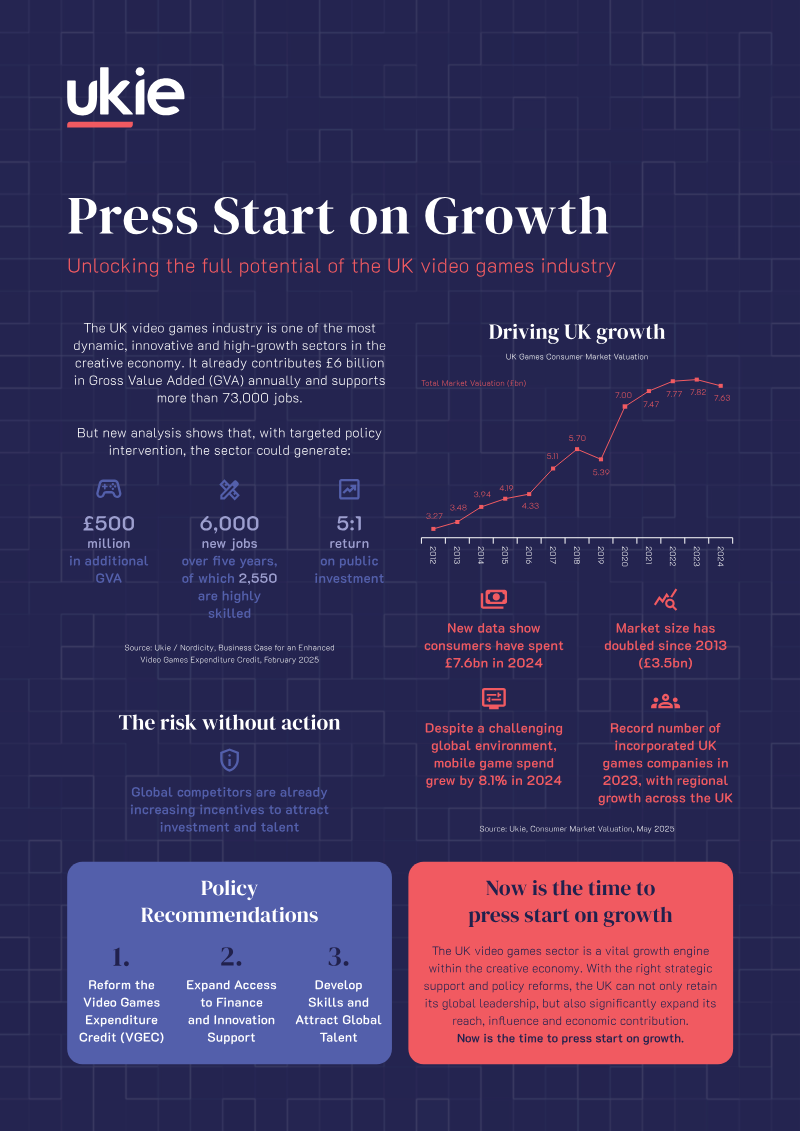
The analysis argues that the United Kingdom’s video‑games sector is a high‑growth pillar of the creative economy, already delivering roughly £6 billion in gross value added (GVA) and supporting more than 73 000 jobs, and that strategic policy action could lift its contribution to about £7.6 billion in 2024 and generate an additional £5.7 billion GVA and up to 5.4 million jobs over the next five years. The assessment covers the full UK market from 2022 through 2024, spanning software, hardware, live events, esports, ancillary merchandise and related media, and benchmarks performance against Western‑European averages.
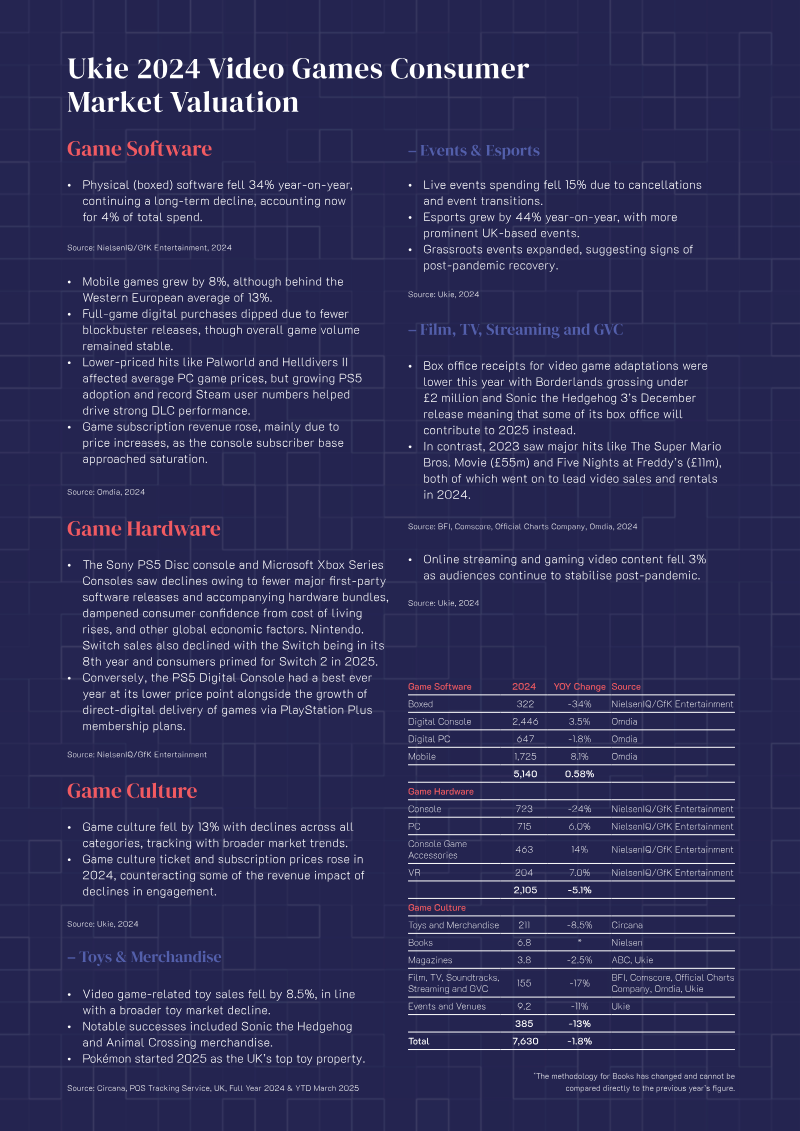
Key findings show a continued erosion of physical boxed software, which fell 34 % year‑on‑year and now accounts for only 4 % of total spend, while mobile games grew 8 %—still below the 13 % regional average. Full‑game digital purchases slipped due to a thin slate of blockbuster releases, yet overall game volume remained stable. Live‑event spending contracted 15 % after pandemic‑related cancellations, whereas esports surged 44 % YoY, driven by a rise in UK‑based tournaments. Subscription revenue rose modestly as price hikes offset a near‑saturation of console subscriber bases. Hardware sales weakened for PS5 disc and Xbox consoles and for the Nintendo Switch, while the PS5 digital edition posted record software sales at a lower price point. Game‑culture engagement declined 13 % across PC and console categories, and related toy and merchandise sales fell 8.5 %.
The conclusions stress that without targeted reforms—particularly in financing, skills development, and talent support—the sector risks losing its global leadership. Conversely, coordinated policy could unlock further growth, broaden international reach, and reinforce the UK’s position as a leading hub for video‑games innovation and cultural influence. Data are drawn from industry sources such as Omdia, Ukie, NielsenIQ/GfK Entertainment, BFI, Comscore and the Official Charts Company, reflecting a comprehensive market‑valuation approach across multiple
Pages
Insights
- The UK video games industry currently contributes £6 billion in gross value added (GVA) and supports over 73,000 jobs, with the potential to add £5.7 billion in GVA and 5.4 million jobs over the next five years through strategic policy intervention.
- Physical boxed software sales have collapsed, falling 34% year-on-year to represent only 4% of total market spend.
- Esports experienced a significant surge of 44% year-on-year, driven by an increase in UK-based tournaments, contrasting with a 15% contraction in live-event spending.
- Mobile gaming in the UK grew by 8%, though this remains below the 13% regional Western-European average.
- Hardware sales for major consoles, including the PS5 disc edition, Xbox, and Nintendo Switch, weakened, while the PS5 digital edition achieved record software sales at a lower price point.
Showing 1 – 30 of 69