Showing 30 of 222 results · 0.49s
Jan 2021
Match3 Genre Snapshot Report May 2021 (2021)
GameRefinery
Data indicates that recurring live events, special event rewards, and limited-time in-app purchase offers have the highest impact on revenue. Social features, including guild mechanics
Report20 pages
Jan 2022
Brutally Honest #69: No BS Newsletter With Useful Stuff About UA in the Post IDFA World
Brutally Honest
models; for instance, SayGames reported a 350% year-over-year increase in in-app purchase revenue, reaching $37.5 million in 2022. This growth is attributed to a strategic
Article
Jan 2021
King: Full UA, GD and Ads Analysis
Two & a Half Gamers
table. Transitioning to more sophisticated ad tech stacks and diversifying monetization beyond in-app purchases could unlock the projected 30% revenue increase. This analysis suggests that while King
Article
Jan 2019
Mobile Benchmarks Report GameAnalytics
GameAnalytics
reflects a significant structural shift as developers increasingly pivot from in-app purchases toward ad-based monetization models. Analysis of 100,000 titles and 1.2 billion monthly active
Report34 pages
Mar 2026
Brutally Honest #153: Useful Stuff About UA in the Post IDFA World
Matej Lancaric
Challenge, which generates approximately $300,000 per day through a hybrid of in-app purchases and advertisements. Analysis of the strategy genre suggests that while the primary demographic
Article
Jan 2024
Casual Gaming Apps Report 2024
GameRefinery
traditional advertising. The rise of "progressive offers" and "engagement offers" has transformed in-app purchases by tying discounts and rewards directly to active gameplay milestones. Furthermore, the industry
Report40 pages
Mar 2026
Brutally Honest #117: User Acquisition in the Post IDFA World
Newzoo
accounts for 90% of its total revenue, compared to only 10% from in-app purchases. This performance is achieved with a relatively efficient daily marketing spend
Article
Jan 2023
Mobile Growth & Monetization Report 2023
Unity
reflects a strategic pivot toward operational efficiency as developers navigate softening in-app purchase (IAP) and advertising revenues. Success currently hinges on capturing player interest within the first
Report41 pages
May 2025
Conference Call Q1 2025
Modern Times Group
million in the quarter, followed by Word Games and Tower Defense. In-app purchases (IAP) have increased to 76% of total revenue, up from 61% in the prior
Financial12 pages
Jun 2021
Analyzing the Top‑Grossing Steam Games of 2021
GameDiscoverCo
games in the Platinum and Gold tiers, 92% utilized in-app purchases or downloadable content. Conversely, premium standalone titles without recurring monetization were largely relegated to the Bronze
Article
Sep 2020
Behind the Dizzying Ride to the Top for Among Us
GameDiscoverCo
East, with mobile platforms serving as the primary revenue drivers through cosmetic in-app purchases. Early visibility on itch.io and subsequent promotion by international YouTubers established a foundation
Article1 pages
Jan 2023
Gaming Spotlight 2023: The Year in Review
data.ai
leveraged strong intellectual property and sophisticated monetization strategies, such as high-value in-app purchases and social engagement features. A significant portion of the analysis examines user acquisition
Report33 pages
Jan 2023
Two & a Half Gamers Session #51: Live Special @ Gamesforum Barcelona
Two & a Half Gamers
eCPMs and the strategic integration of hybrid monetization models that balance in-app purchases with sophisticated rewarded video and interstitial placements. User acquisition trends for the 2023 period
Article
May 2021
Match3 Genre Snapshot: US iOS (May 2021)
GameRefinery
Data indicates that recurring live events, special event rewards, and limited-time in-app purchase offers have the highest impact on revenue. Furthermore, social features such as guild
Report20 pages
Dec 2018
High Hopes for Kids Games
SuperJoost
monetization and systemic failures in user acquisition. Specifically, the prevalence of intrusive in-app purchases and poorly targeted advertisements—which often expose minors to violent content despite
Article
Jun 2026
Vietnam Game Industry Monthly Report: May 2026
Gamota
underscoring a reliance on consistent launch pipelines and recognizable themes. Conversely, total in-app purchase (IAP) revenue grew by 3.13% month-over-month, with midcore revenue rising
Report23 pages
Jan 2022
Match 3D User Acquisition Playbook
Brutally Honest
campaigns. Because Match 3D games typically derive 60-70% of revenue from in-app purchases, optimizing for blended ROAS via mediation tools is essential. Other high-performing channels
Article
Mar 2024
Brutally Honest #157: When to Scale a Mobile Game
Brutally Honest
game achieved $3.6 million in monthly revenue through a 60/40 split between in-app purchases and rewarded video ads, primarily by targeting low cost-per-install (CPI) regions
Article
Jan 2026
Gaming Deep Dive: Ad Monetization 2026
Sensor Tower
profitability. Instead, top-tier publishers are shifting toward hybrid strategies that integrate in-app purchases with ad monetization. This approach allows developers to capture value from non-spending
Report39 pages
Aug 2026
The Gaming Industry in 2026
Bain & Company
audience is aware of D2C payment options, conversion remains a challenge, as in-app purchasing remains the preferred, more convenient method for most players. Consequently, developers are increasingly
Article1 pages
Sep 2026
Japan’s Mobile Market: 2026
Adjust, Sensor Tower
digital economies. In the gaming sector, mobile titles generated $10.6 billion in in-app purchase revenue, with total engagement reaching 16.58 billion hours. While overall game installs grew
Article1 pages
Jan 2021
Games Marketing Insights for 2021
King
analysis recommends a mixed monetization model that balances ad-supported content with in-app purchases to capture diverse spending habits. It concludes that developers must embrace "always
Report24 pages
Mar 2026
Brutally Honest #92: UA in the Post-IDFA World
Matej Lancaric
Doodle Magic: Wizard vs. Slime, reveal high-performance metrics with estimated daily in-app purchase revenues reaching $300,000. The analysis suggests that while these titles find success
Article
Jan 2024
Mobile Growth and Monetization Report 2024
Unity
value retention and diversified monetization. While only 1.83% of users convert to in-app purchases, nearly 29% of those individuals become repeat buyers, with the vast majority
Report48 pages
Jan 2015
The Math of Money in Freemium
FamousAspect
paying user. In contrast, successful titles like Temple Run utilize consumable in-app purchases to allow for unlimited spending. The author concludes that developers must prioritize business modeling
Article
Ninjala: 12 Million Downloads Worldwide
GungHo Online Entertainment
play digital download, it also offers a physical package version and various in-app purchase options. This performance reflects the publisher's ongoing commitment to its corporate philosophy
Article2 pages
Jan 2023
Gaming Report 2023
Unity
player behavior, moving toward a balanced model where ad-supported structures and in-app purchases hold nearly equal weight. To ensure financial viability, 70% of studios now integrate
Report57 pages
Aug 2026
Mobile Casual Games in H1 2026
AppMagic
during the first half of 2026, generating approximately $11 billion in net in-app purchase (IAP) revenue. This performance was largely driven by three core genres: Puzzle, Casino
Article1 pages
Jul 2026
Mobile Game Ad Monetization in 2026
Sensor Tower, PWN Games
hybrid monetization models as developers seek to maximize revenue in a stagnating in-app purchase (IAP) environment. As of mid-2026, 56% of mobile games incorporate ad monetization
Article1 pages
Jul 2026
Weekly Gaming Reports Recap: July 13 - July 17, 2026
GameDev Reports
struggled, recording its weakest quarterly performance since 2023 with $19.4 billion in in-app purchase revenue and a five-year low in new installs. Console markets similarly faced
Article1 pages
Match3 Genre Snapshot Report May 2021 (2021)
Jan 202120 pages1k words
Summary
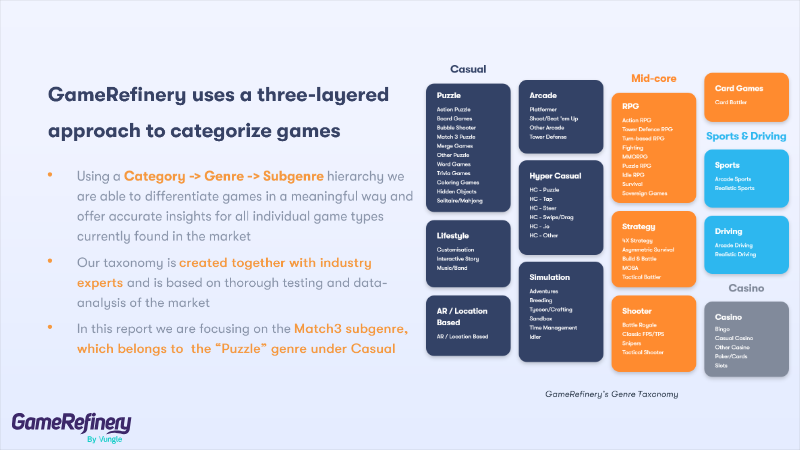
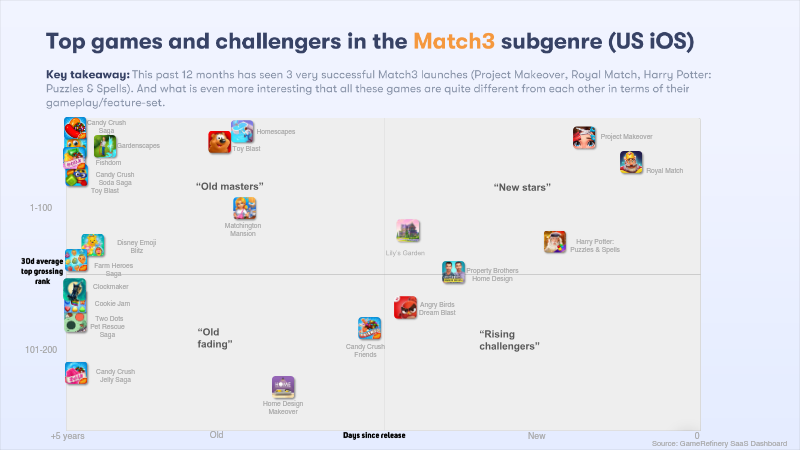
The Match3 subgenre represents the largest segment of the US iOS mobile gaming market, accounting for approximately 16% of total revenue as of mid-2021. While established titles have dominated the charts for years, the landscape is evolving through the integration of complex meta-layers and sophisticated monetization strategies. Notably, every new Match3 title that entered the top 500 grossing rankings between late 2019 and early 2021 utilized traditional swapping mechanics, signaling a preference for familiar core gameplay enhanced by modern secondary features.
Meta-elements, particularly customization and decoration, have become essential components of modern Match3 success. Recent megahits like Royal Match and Project Makeover demonstrate this trend by blending core puzzle mechanics with narrative progression and aesthetic choices. Beyond gameplay, monetization has shifted toward loss aversion mechanics and diverse live operations. Data indicates that recurring live events, special event rewards, and limited-time in-app purchase offers have the highest impact on revenue. Social features, including guild mechanics and "send/ask help" systems, further bolster engagement and retention within the subgenre.
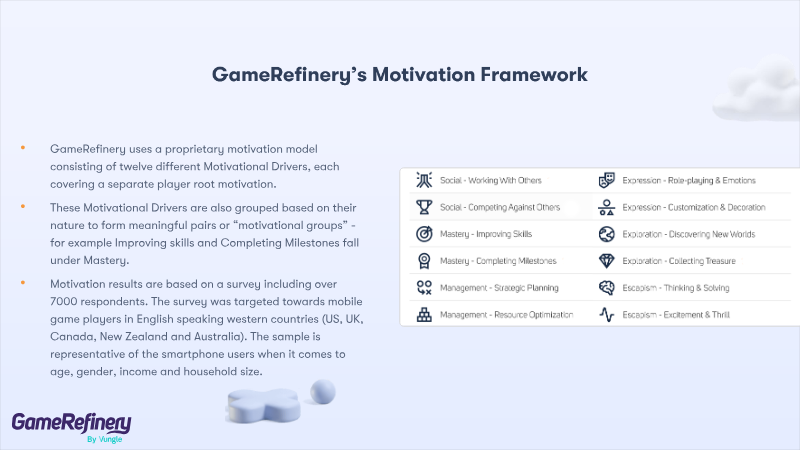
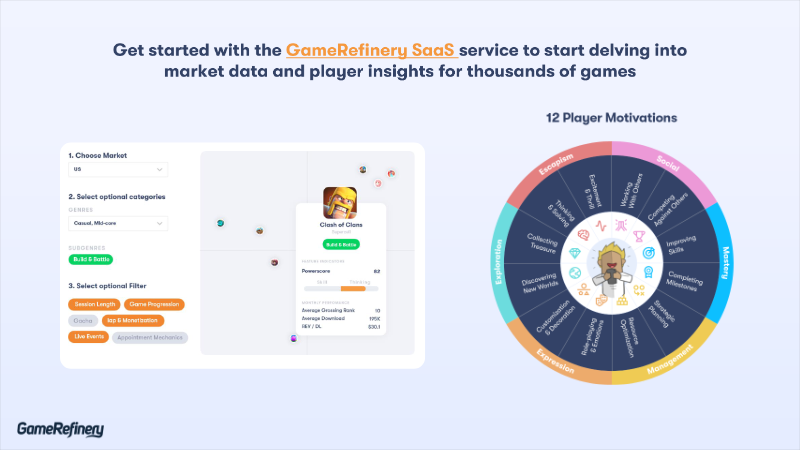
Player motivation analysis, based on a survey of over 7,000 mobile gamers across major English-speaking markets, reveals distinct psychological drivers. While traditional titles like Candy Crush Saga rely heavily on the "Thinking & Solving" and "Completing Milestones" drivers, the broader Match3 market is increasingly leaning into "Customization & Decoration." This shift highlights a move away from pure puzzle-solving toward a more expressive and multi-layered player experience. The findings suggest that future growth in the category depends on balancing core puzzle mastery with social competition and deep meta-progression.
Pages

Insights
- As of mid-2021, the Match3 subgenre is the largest segment of the US iOS mobile gaming market, generating approximately 16% of total revenue.
- Every new Match3 title that entered the top 500 grossing rankings between late 2019 and early 2021 retained traditional swapping mechanics, confirming that core gameplay innovation is less critical than secondary feature integration.
- Success in the modern market is driven by meta-layers like customization and decoration, as evidenced by the performance of titles such as Royal Match and Project Makeover.
- Revenue optimization in the subgenre is currently driven by loss aversion mechanics, recurring live events, special event rewards, and limited-time in-app purchase offers.
- Player motivation has shifted from pure puzzle-solving toward expressive experiences, with 'Customization & Decoration' now serving as a primary psychological driver alongside traditional 'Thinking & Solving' and 'Completing Milestones' goals.
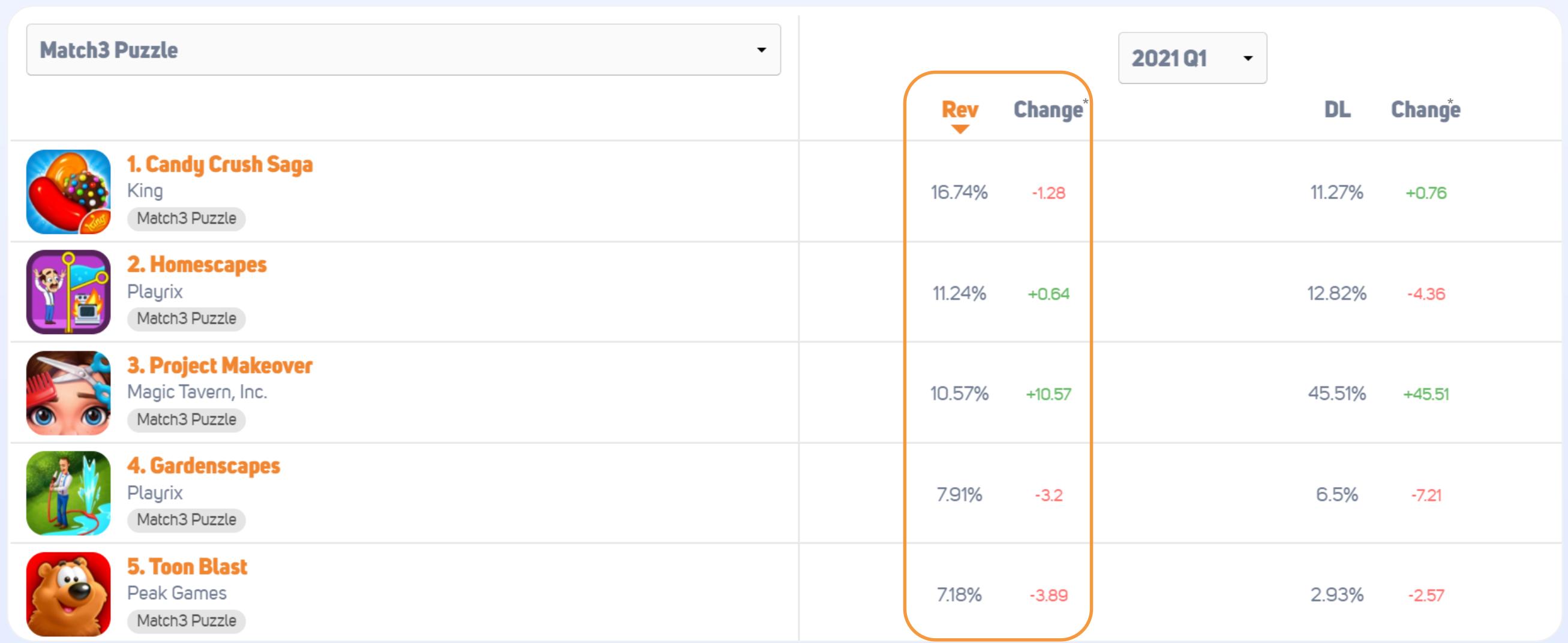
This image from a game industry report displays the top 5 Match3 Puzzle games in Q1 2021, showing their revenue share and change, as well as download share and change. The highlighted column specifically focuses on the revenue share and its percentage change for each game.