The gaming industry is experiencing a period of tempered growth, characterized by a significant downward revision in long-term revenue forecasts. While the market reached $202 billion in 2025, annual growth is now projected at a modest 3%, with expectations for 2029 revenue set at $232 billion. This represents a notable cooling compared to previous industry outlooks, as analysts suggest the sector has largely saturated its available audience and reached a plateau in total media consumption time.
These findings are based on a June 2026 survey of 5,339 gamers across eight global markets, including the US, UK, Japan, Brazil, India, and Saudi Arabia, alongside industry data from sources such as IDC and PwC. The analysis highlights a highly fragmented landscape where player preferences vary significantly by age and geography. Notably, interest in user-generated content and sandbox titles declines sharply with age, while the most active 20% of players account for 59% of total playtime and 73% of total spending.
Strategic focus has emerged as a critical determinant of commercial success. Projects with clearly defined target audiences demonstrate an 83% success rate, compared to 50% for those without. While artificial intelligence is increasingly utilized to accelerate production, it is not viewed as a panacea for poor strategic planning; rather, it may cause unfocused studios to fail more rapidly.
Distribution strategies are also shifting toward direct-to-consumer (D2C) models to capture higher margins. While 68% of the gaming audience is aware of D2C payment options, conversion remains a challenge, as in-app purchasing remains the preferred, more convenient method for most players. Consequently, developers are increasingly leveraging personalized offers to incentivize web-store usage, as these targeted strategies prove significantly more effective at driving conversion than broad-based discount incentives.
Boston Consulting Group · 2025
Sensor Tower · 2026

InvestGame · 2026
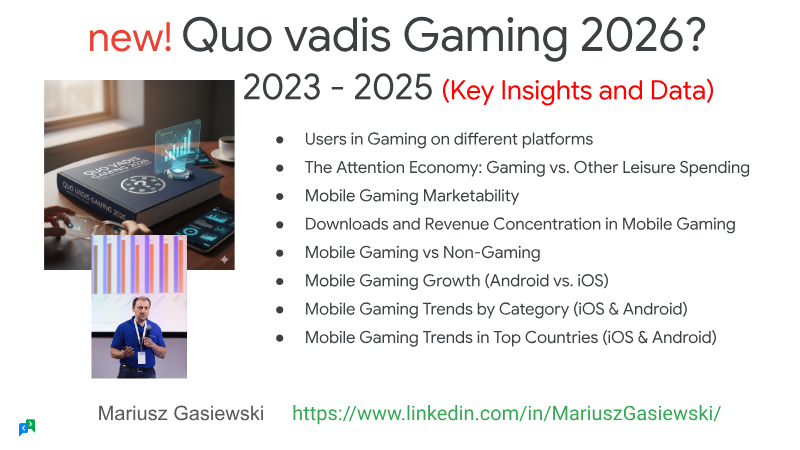
InvestGame · 2026
AlixPartners · 2025
Basic Roots Consulting · 2025
Sensor Tower · 2025
Boston Consulting Group · 2025

Sensor Tower · 2025
Xsolla · 2025
Game Developers Conference · 2025
Boston Consulting Group · 2025