Showing 30 of 654 results · 0.83s
Jan 2024
Sensor Tower Global Mobile Gaming Industry Outlook 2024
Sensor Tower
Global mobile gaming experienced a minor 2% year-on-year decline in in-app purchase revenue in 2023, totaling $76.7 billion. Despite this slight contraction, the market remains
Report25 pages
Jun 2019
Global Market Trends: Mobile Gaming Benchmarks (H1 2019)
GameAnalytics
global mobile gaming landscape in the first half of 2019 reflects a significant pivot in monetization strategies, characterized by a 15-20% year-over-year decline
Report34 pages
Apr 2023
Mobile Game Market Review October 2023
GameRefinery
mobile gaming market in October 2023 was characterized by a heavy reliance on seasonal Halloween content and innovative social features to drive monetization and engagement. Analysis
Report10 pages
Jan 2025
Reclaiming the Game Distribution Landscape
Aptoide
This analysis examines the shifting dynamics of the mobile game distribution market as of Summer 2025, focusing on the transition from a duopoly dominated by Apple and Google
Report21 pages
Jan 2019
Czech Video Game Industry: PC, Console and Mobile Game Developers in Czech Republic 2019
Institute for Digital Economy
CONSOLE AND MOBILE GAME DEVELOPERS IN CZECH REPUBLIC 2019 DEVELOPERS IN CZECH REPUBLIC 2019 This Study was prepared by the Institute for Digital Economy (www.digitalniekonomika.cz) in cooperation with
Report47 pages
Sep 2023
Insights into Marketing Trends of Global Mobile Games: Q3 2023
SocialPeta
analysis focuses on contemporary marketing dynamics within the global mobile gaming sector, emphasizing how creative diversification and platform targeting shape user acquisition performance. In the third quarter
Report42 pages
Jan 2024
State of Mobile Games in Japan
Sensor Tower
analysis provides a comprehensive overview of Japan’s mobile‑gaming ecosystem in 2024, measuring the market’s size, growth dynamics, and competitive landscape. Total in‑app purchase
Report30 pages
Jan 2025
Sensor Tower India: Mobile Game Market Insights 2025
Sensor Tower
India is positioned as the world’s largest mobile‑gaming market, with 8.45 billion downloads recorded in FY 2024‑25 yet only $400 million in in‑app purchase
Report29 pages
Public Mobile Gaming Publishers: Resilience & Adaptation in a Shifting Landscape
InvestGame
analysis examines the post‑IDFA mobile gaming landscape, focusing on revenue dynamics, user acquisition spending, profitability trends, and market valuation shifts across key publishers. Data reveal that annual
Report7 pages
Jan 2025
Annual Report of the German Games Industry 2025
game
game purchases, which fell 17 %, while online gaming and subscription services surged 43 % to €3.26 billion, underscoring a decisive shift toward digital and cloud‑based play. In‑game
Report39 pages
Dec 2024
Insights into Global Mobile Game Marketing Trends for H1 2025
SocialPeta
first half of 2025 reveals a rapid shift in mobile‑game user‑acquisition toward AI‑driven creative production, with short‑form video, live‑action clips and in‑game
Report66 pages
Jan 2021
Mobile Game Genre Report: Comparing & Contrasting Eastern and Western Markets 2021
Newzoo
This report examines the mobile gaming landscape in 2021, focusing on the strategic differences between Eastern and Western markets regarding genre popularity, monetization, and user acquisition. While mobile
Report25 pages
Jan 2023
2023 A Liftoff Company Midcore Gaming Apps Report
A Liftoff Company
Midcore mobile games now represent roughly one‑third of U.S. iOS gaming revenue, a share that has expanded thanks to higher player engagement and diversified monetization streams
Report32 pages
Jan 2021
Newzoo Trends to Watch 2021
Newzoo
sector, mobile titles like PUBG Mobile and Garena Free Fire are now challenging traditional PC giants in viewership, signaling a shift toward mobile-first competitive gaming. Methodologically
Report23 pages
Jan 2025
Newzoo Puzzle Games Report: Mobile Game Genre Insights
Newzoo
through a partnership between Newzoo and Pangle, this analysis examines the global mobile puzzle game market with a specific focus on the divergent trends between Western and Eastern
Report26 pages
Sep 2023
Mobile Games: State of the Market & Playtime Benchmarks Q3 2023
Apptica
analysis evaluates the current performance of the mobile‑games ecosystem, concentrating on download popularity, revenue generation, and user‑engagement metrics across key Western and Asian markets. By comparing
Report36 pages
Jan 2024
Mobile Gaming Benchmarks: Q1 2024
GameAnalytics
mobile gaming benchmarks provide a comprehensive analysis of player engagement metrics, specifically retention rates, session lengths, and session counts across 15 game genres. The analysis is based
Report24 pages
May 2022
Mobile Gaming Market Outlook 2022
Sensor Tower
global mobile gaming landscape has entered a period of stabilization following pandemic-era surges, with quarterly downloads maintaining a steady baseline of 14 billion. Although total revenue experienced
Report48 pages
Jan 2024
2023 Global Mobile Games Marketing Trends White Paper
SocialPeta
global mobile gaming landscape underwent a significant transformation in 2023, characterized by a strategic shift toward the hybrid-casual model. This evolution combines the accessibility of hyper-casual
Report78 pages
Mar 2025
Mobile Games Industry Trends Survey: Winter 2024/25
PocketGamer.biz
mobile games industry entered a period of significant recalibration during the winter of 2024/25, characterized by a transition from rapid expansion to a focus on long-term sustainability
Report32 pages
Jan 2021
Post-IDFA Mobile Game Advertising Costs: Casual vs Core
Moloco
Apple’s post‑IDFA privacy updates have reshaped user‑acquisition economics for mobile games, contrasting casual titles with core experiences. By aggregating 13.5 billion programmatic ad impressions from
Report8 pages
Feb 2026
Take Rates in China
Niko Partners
analysis evaluates how take‑rate structures shape mobile game monetisation in China and whether higher‑quality development can outweigh the pressure of traditional distribution fees. It contrasts Apple
Report10 pages
May 2026
Digital Market Index: Q1 2026
Sensor Tower
during the first quarter of 2026, characterized by a pivot away from traditional mobile gaming toward generative artificial intelligence and short-form entertainment. While global in-app purchase
Report57 pages
Jan 2022
The State of Mobile Gaming: Market Trends and Top Titles in the U.S., Europe, and Asia 2022
Sensor Tower
analysis demonstrates that the global mobile‑gaming market entered a contraction phase in early 2022, with revenue falling 6 % year‑over‑year and the first decline since
Report67 pages
Jan 2020
The Past, Present and Future of Games
Newzoo
rise of “games as a service,” cloud gaming, and esports ecosystems, citing 2020 revenue growth of 29 % in PC games and a 19.6 % increase in mobile downloads, with
Report33 pages
Jan 2025
Rewarded Returns
Almedia
controversial incentivized traffic tactic to a sophisticated, data-driven pillar of modern mobile game marketing. The primary thesis is that technological advancements and deeper reward structures have effectively
Report17 pages
Jan 2022
Casual Gaming Apps Report 2022
GameRefinery
mobile gaming landscape entered a period of transition in early 2022, marked by the first year-over-year decline in global spending during the first quarter. Despite this
Report34 pages
Jan 2021
The State of Mobile Game Advertising 2021
Sensor Tower
more balanced mix of gaming and non‑gaming ads, with SOV from games ranging 40–60 %. AppLovin and MoPub shifted toward gaming in late‑2018, investing heavily
Report30 pages
Feb 2026
Gaming and Esports in Vietnam: A New Arena for Brands
Decision Lab
interaction (46.5 %). Streaming platforms such as YouTube Gaming and Facebook Gaming lead, with Twitch lagging behind. Brands that sponsor mobile esports events or partner with key opinion leaders
Report88 pages
Oct 2022
Female Gamers in Asia: Version for Women in Games Asia Panel
Niko Partners
randomized respondents who identified as active gamers across mobile, PC, and console platforms. Mobile gaming is the dominant platform for this demographic, utilized by 95% of female gamers
Report14 pages

Sensor Tower Global Mobile Gaming Industry Outlook 2024
Jan 202425 pages5k words
Summary
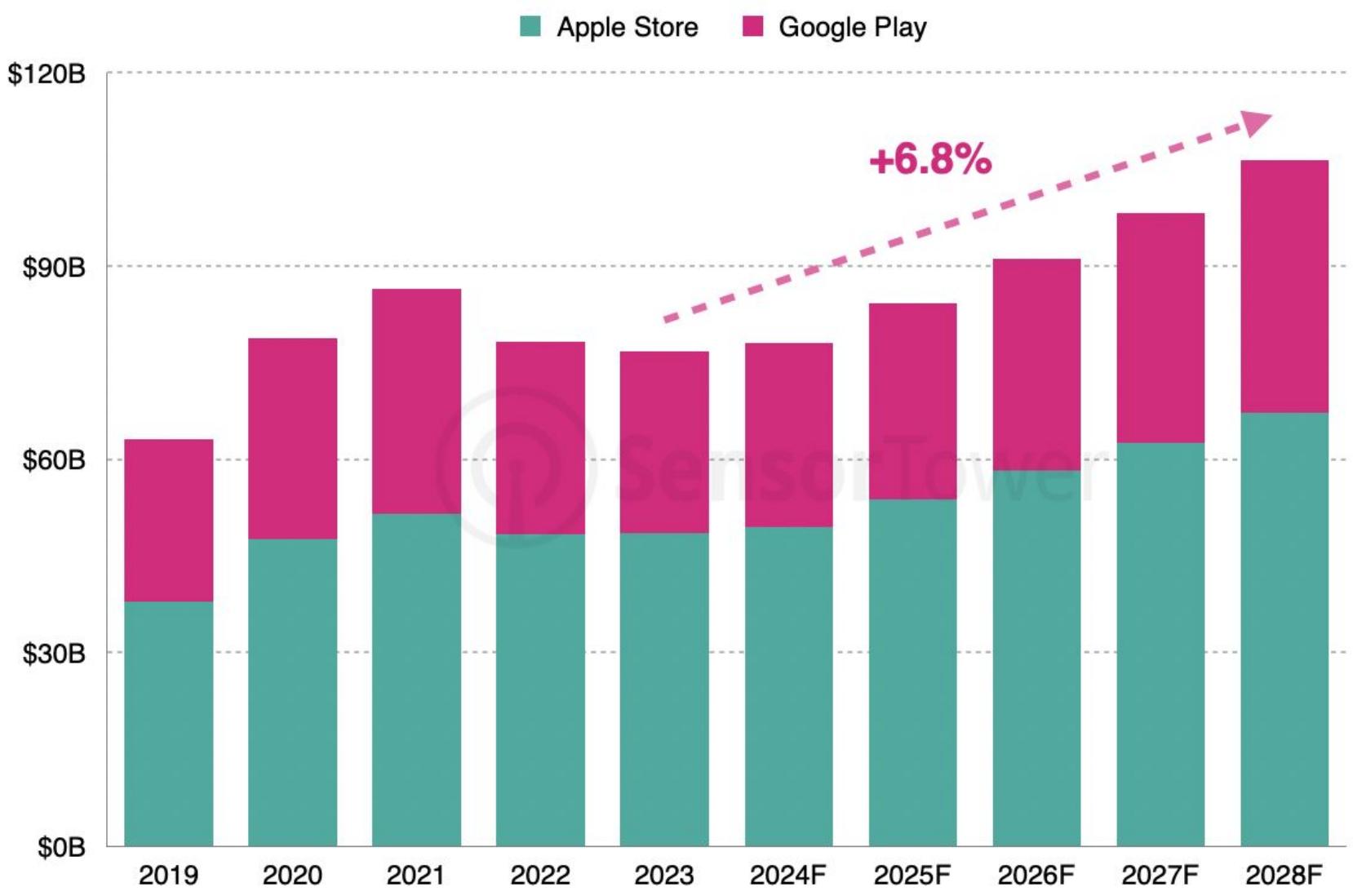
Global mobile gaming experienced a minor 2% year-on-year decline in in-app purchase revenue in 2023, totaling $76.7 billion. Despite this slight contraction, the market remains 22% larger than pre-pandemic levels in 2019. Projections indicate a recovery to $78 billion in 2024, with a long-term growth trajectory expected to surpass $100 billion by 2028 at an average annual growth rate of 6.8%. These findings are based on Sensor Tower App Performance Insights, covering the App Store and Google Play across major global markets including the United States, China, Japan, and South Korea.
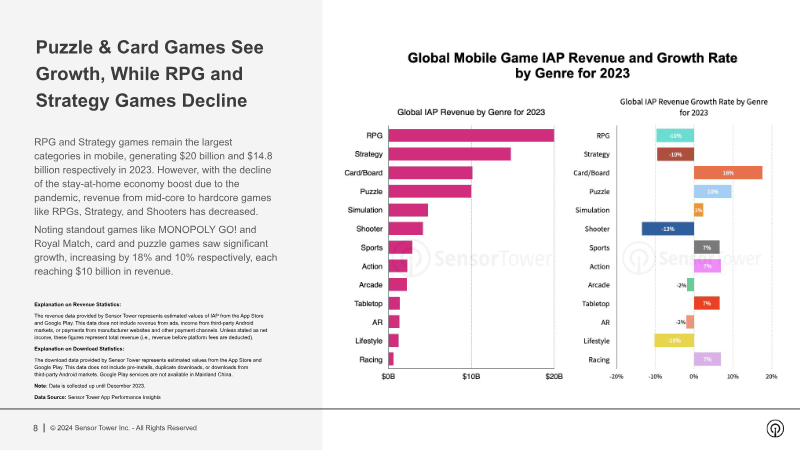
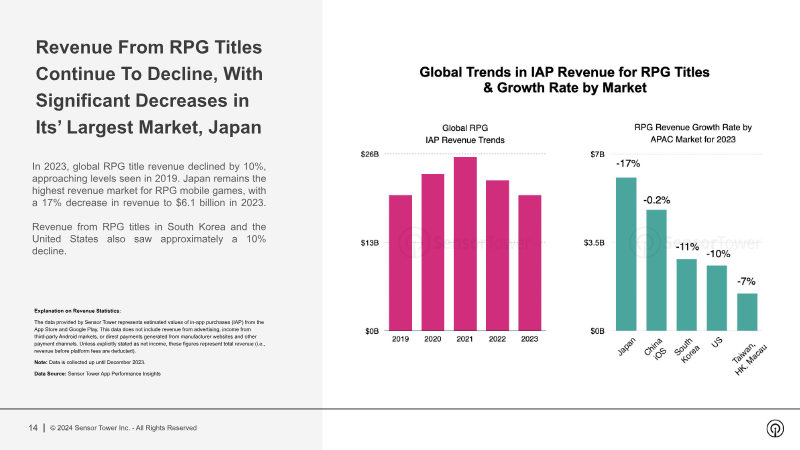
The industry is currently defined by a shift in consumer spending from mid-core and hardcore titles toward casual and hybrid-casual models. Casual game revenue grew 8% to $28.6 billion in 2023, now accounting for 38% of the global market. Hybrid-casual games showed the most aggressive growth, increasing 30% to exceed $2.1 billion. In contrast, traditional high-revenue genres like RPGs and Strategy games both saw 10% revenue declines as the pandemic-era stay-at-home boost faded. Despite these drops, RPGs and Strategy remain the largest individual segments, generating $20 billion and $14.8 billion respectively.
Geographically, the United States remains the largest market at $22.2 billion, followed by the Chinese iOS market at $15.1 billion. While the Japanese and South Korean markets saw declines of 13% and 7% respectively, specific titles defied broader trends. MONOPOLY GO! and Royal Match emerged as major drivers in the casual sector, with the former generating $1.2 billion and the latter surpassing Candy Crush Saga in monthly revenue. In the mid-core space, new entrants like Honkai: Star Rail and Whiteout Survival achieved significant growth, particularly in APAC markets, by utilizing innovative themes and integrated gameplay mechanics.
Pages


Insights
- Global mobile gaming revenue reached $76.7 billion in 2023, a 2% year-on-year decline, but is projected to recover to $78 billion in 2024 and exceed $100 billion by 2028.
- Consumer spending is shifting toward casual and hybrid-casual models, with casual revenue growing 8% to $28.6 billion and hybrid-casual revenue surging 30% to over $2.1 billion.
- Traditional high-revenue segments, specifically RPGs and Strategy games, experienced a 10% decline in 2023, though they remain the largest categories at $20 billion and $14.8 billion respectively.
- The United States remains the top global market with $22.2 billion in revenue, followed by the Chinese iOS market at $15.1 billion.
- Casual titles like MONOPOLY GO!, which generated $1.2 billion, and Royal Match, which surpassed Candy Crush Saga in monthly revenue, are currently driving market growth.
This stacked bar chart illustrates the historical and projected consumer spending on mobile apps and games across the Apple App Store and Google Play from 2019 to 2028, showing a forecasted compound annual growth rate (CAGR) of 6.8% for the total market. It breaks down the revenue contribution from each platform, with Apple Store consistently generating more revenue than Google Play.