Market (Mobile)·Updated Apr 8, 2026 by Sensor Tower
Report · January 1, 2022
Published by Sensor Tower
The analysis demonstrates that the global mobile‑gaming market entered a contraction phase in early 2022, with revenue falling 6 % year‑over‑year and the first decline since 2019. The United States and Japan, historically dominant markets, experienced double‑digit drops in consumer spending—particularly a 22 % decline on Google Play in the U.S.—while emerging APAC regions such as India, Brazil, and Vietnam captured growing market share. Download volumes remained steady at roughly 14 billion worldwide; India retained the largest install base but is losing ground to Brazil, which is poised to overtake it. Regional dynamics reveal divergent trends. Europe’s spending rose 18 % to $8.6 B, driven largely by hyper‑casual titles and rapid growth in Turkey (6 % YoY) and Poland (8 % YoY). In contrast, Asia’s revenue fell 7 % to $11.2 B, with China and Japan maintaining top positions but India’s spending accelerating despite lower monetisation rates. Genre‑level data shows a decline across the five largest categories, yet strategy games remain the strongest, generating over $4 B quarterly since late 2020. Hyper‑casual installs surged to 3.5 billion, accounting for 32.5 % of all downloads, while puzzle and arcade titles saw double‑digit revenue drops. Monetisation strategies continue to evolve. Gacha mechanics dominate the mid‑core segment, often combined with season passes, subscriptions, or live‑ops to boost spend. Season passes have proven effective beyond shooters, doubling weekly revenue for titles such as *Lords Mobile* and revitalising legacy games like *Hay Day*. The data underscores the necessity of flexible, hybrid monetisation models—particularly in markets where overall genre revenues are contracting—to sustain profitability across diverse player bases.
SensorTower dda-u GEL M Pad so po Ges Woool Seeeg 221:17 22:10 ROYAL 2 MATCH! The State of M E Mobile Gaming Roval Match 20 2022 Dream Games, Ltd. 2 GET — 76K RATINGS AGE CHART DEV An Analysis of Mobile Gaming Market Trends 4.7 4+ No.24 Dream and Top Titles in the U.S., Europe, and Asia Years Old Puzzle and Top Titles U.S., in the Europe, and Asia
Sensor Tower Terms of Use Table of Contents Modification, republication, distribution, or other unauthorized usage violate 03 - Market Overview: Worldwide 15 - Market Overview: United States 21 - Market Overview: Europe 32 - Market Overview: Asia 43 - Game Genre Trends 51 - Monetization Trends 62 - Conclusion Download our latest Store Intelligence Data Digest report on the mobile market at sensortower.com/reports
Senso ower ower ower ower ower PLAYERUNKNOWN'S PLAYERUNKNOWN'S PLAYERUNKNOWN'S PLAYERUNKNOWN'S PLAYERUNKNOWN'S BATTLEGROUNDS BATTLEGROUNDS BATTLEGROUNDS BATTLEGROUNDS BATTLEGROUNDS MOOILE MOOILE MOOILE MOOILE MOOILE ower ower ower ower PLAYERUNKNOWN'S PLAYERUNKNOWN'S PLAYERUNKNOWN'S PLAYERUNKNOWN'S BATTLEGROUNDS BATTLEGROUNDS BATTLEGROUNDS BATTLEGROUNDS MOOILE MOOILE MOOILE MOOILE Market Overview: ower Worldwide — PLAYERUNKNOWN'S An Overview of Mobile Gaming Worldwide BATTLEGROUNDS MOOILE
After COVID, Global Game Revenue Declines for the First Time Worldwide quarterly consumer spending in mobile games on the App Store and Google Play Global mobile game revenue surged during the start of the COVID-19 pandemic, seeing App Store Google Play its largest year-over-year growth in Q2 2020 at $25B 33 percent. Player spending peaked in Q1 2021 -6% at $22.6 billion. +27% $20B Mobile game revenue declined Y/Y for the first time in history during Q1 2022. Player spending +18% 8.4B 8.6B 9.4B 9.1B 9.2B 8.9B 8.2B declined 6 percent Y/Y to 21.2 billion, primarily 8.1B 1.5B 1.6B 1.6B due to the high base of comparison from the 15B 7.0B 1.4B 1.4B previous year. Spending was still up nearly 6.5B 6.5B 20 percent compared to Q1 2020. 6.0B 6.1B 1.1B 1.2B 1R $10B 12.1B 12.4B 12.3B 13.2B 12.7B 13.3B 12.9B 13.0B 5B 9.0B 9.1B 10.0B 9.9B 10.8B $0 Note: Q1 2019 Q2 2019 Q3 2019 Q4 2019 Q1 2020 Q2 2020 Q3 2020 Q4 2020 Q1 2021 Q2 2021 Q3 2021 Q4 2021 Q1 2022 Revenue figures are gross revenue (including the cut taken by Apple or Google). Market Overview: Worldwide
Sensor Tower Lineage W Was the Only Game to Break into The Top Charts in Q1 2022 Top mobile games by worldwide revenue on the App Store and Google Play 2019 2020 2021 This report and all original content contained within are wholly owned by PUBG Mobile 1 Honor of Kings - 1 PUBG Mobile +1 1 Tencent Tencent Tencent 2 PUBG Mobile NEW 2 Honor of Kings -1 2 Honor of Kings Tencent Tencent Tencent 3 Fate/Grand Order - 3 Pokémon GO +3 3 Genshin Impact Sony Niantic miHoYo 4 Candy Crush Saga - 4 Coin Master NEW 4 Roblox King Moon Active Roblox publishers and are used expressly for the purpose of editorial commentary Coin Master 5 Monster Strike -3 5 Roblox NEW 5 Moon Active Mixi Roblox 6 Pokémon GO - 6 Candy Crush Saga -2 6 Candy Crush Saga Niantic King King 7 Fantasy Westward Journey - 7 Monster Strike -2 7 Pokémon GO NetEase Mixi Niantic 8 Lineage M -3 8 Rise of Kingdoms NEW 8 Garena Free Fire NCSOFT Lilith Games Garena 9 Clash of Clans - 9 Gardenscapes NEW 9 Uma Musume Pretty Derby Supercell Playrix Cygames 10 Homescapes NEW 10 Fate/Grand Order -7 10 Three Kingdoms Tactics Playrix Sony Alibaba Market Overview: Worldwide NEW NEW NEW NEW Game Mid-Core Casino Class Casual Sports & Racing Q1 2022 - 1 Honor of Kings +1 Tencent - 2 PUBG Mobile -1 Tencent 3 Genshin Impact - miHoYo +1 4 Roblox - Roblox -1 5 Candy Crush Saga +1 King - 6 Lineage W NEW NCSOFT -4 7 Coin Master -2 Moon Active 8 Uma Musume Pretty Derby +1 Cygames 9 Three Kingdoms Tactics +1 Alibaba
Sports & Racing Q1 2022 - 1 Honor of Kings +1 Tencent - 2 PUBG Mobile -1 Tencent 3 Genshin Impact - miHoYo +1 4 Roblox - Roblox -1 5 Candy Crush Saga +1 King - 6 Lineage W NEW NCSOFT -4 7 Coin Master -2 Moon Active 8 Uma Musume Pretty Derby +1 Cygames 9 Three Kingdoms Tactics +1 Alibaba 10 Garena Free Fire -2 Garena
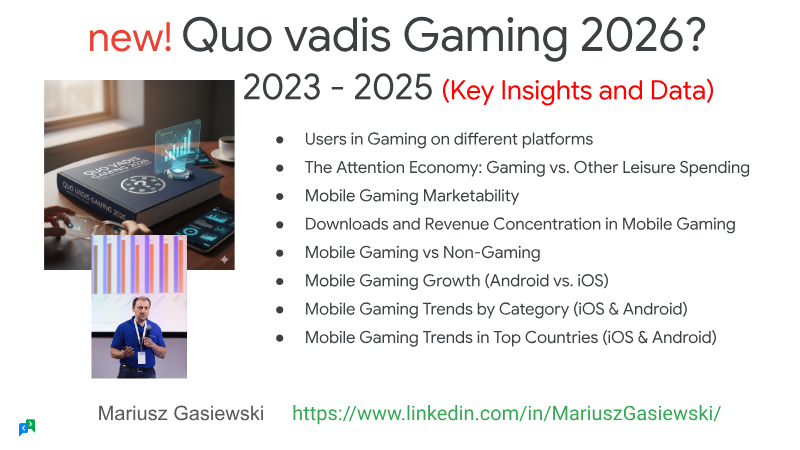
The 2026 State of Gaming analysis demonstrates a shifting landscape in which mobile gaming remains the largest driver of downloads—approximately 50 billion in 2025—but its growth rate is slowing. Revenue, however, continues to climb as monetization models mature and lifetime value deepens, especially within hybrid‑casual titles that now generate the most incremental income. In contrast, PC and console platforms experience record revenue growth, with Steam’s premium segment up 32 % and blockbuster releases such as Battlefield 6 capturing significant market share from incumbents. Shooter downloads on these platforms have plateaued, suggesting new titles are primarily cannibalizing existing audiences rather than expanding the category. Genre‑specific dynamics reveal that strategy games are the only mobile genre to grow in downloads, driven by 4X titles from Eastern developers. Action and shooter games dominate PC/console gains, while hyper‑casual remains the largest download engine but shows a notable lift in time spent, particularly in Tier 2 markets. Casual titles face declining day‑7 retention, indicating a stickiness challenge that could erode long‑term player value. Live‑ops and acquisition strategies have evolved toward retention‑focused events, multi‑tier season passes, and expedition‑style rewards. These mechanisms now represent the most reliable revenue drivers across competitive genres such as RPG, action, and simulation. Advertising spend remains concentrated on social channels—YouTube, Facebook/Instagram—and high‑attention formats like video, playable, and rewarded ads. Battlefield 6’s pre‑launch spend surpassed Call of Duty titles, leveraging Facebook, Reddit, and desktop display, while its post‑launch strategy pivoted to YouTube with cinematic, celebrity‑hook creatives. Geographically, the U.S. market shows a skew toward lifestyle and puzzle categories despite lower IAP shares, whereas casino titles exhibit higher spend‑to‑revenue efficiency. Overall, the industry is moving from acquisition toward deeper monetization per user, with indie shooters and simulation titles gaining traction amid intense competition in the shooter segment.
I W w k o A look A T k T ATT o - l W x l M l v l l . I l l v w l ll l w l w ll w . W w ll ll v l k v v lv k l . A l w l l 2 l .
The interim filing presents the fourth‑quarter 2025 financial results for a midcore‑casual gaming group, emphasizing a record‑setting revenue run and the successful execution of a transformation agenda that includes the integration of the Plarium acquisition and the rollout of a new district structure in early 2026. Revenue reached SEK 3,123 million, reflecting 108 % organic growth year‑on‑year and a 25 % increase on a constant‑currency basis, while adjusted EBITDA rose to SEK 717 million, delivering a 23 % margin that matches the full‑year figure. Unlevered free cash flow amounted to SEK 878 million, with a cash‑conversion rate of 66 % and a leverage ratio of five times EBITDA, underscoring robust liquidity and disciplined capital management. User‑acquisition spending accelerated, representing 38 % of quarterly revenue—up from 37 % in the prior quarter—and grew 76 % on a reported basis, driven by heightened investment in original studios, new casual titles, and the racing franchise. The direct‑to‑consumer channel expanded by 600 basis points to 32 % of total revenue, reflecting a strategic shift toward higher‑margin in‑app purchases. Across the fiscal year, the company posted a 9 % organic revenue increase, with word‑games, racing, and RAID franchises delivering the strongest quarter‑end performance. Operating cash flow for the quarter stood at SEK 840 million, while adjusted net income was SEK 1,390 million, translating to an adjusted EPS of SEK 11.33. The financial outcomes exceed guidance and position the firm to meet its medium‑term outlook, with a pre‑IPO study for PlaySimple concluded and the midcore transformation progressing as planned.
The global video game industry is currently undergoing a structural correction following a decade of rapid expansion that concluded in 2021. The primary thesis of this transition is that the industry’s previous growth engines—mobile expansion, live-service models, and pandemic-era engagement—have plateaued, leading to a 12% decline in real-term content spending. This downturn is characterized by widespread commercial underperformance, record-high layoffs, and a significant contraction in venture capital funding. As production budgets for AAA titles balloon toward $500 million, the market has become increasingly polarized, with player engagement and revenue heavily concentrated within a small cohort of long-standing, established franchises that effectively crowd out new releases. Geographically and sectorally, the landscape is shifting as Chinese developers gain significant global market share, rising from 0.5% to 12.5% of non-domestic content spending over the last 13 years. While the mobile sector faces a 23% revenue drop due to privacy-related user acquisition costs and competition from social media, the industry is pivoting toward cross-platform accessibility and hardware-agnostic distribution. Platforms like Roblox and Steam continue to dominate engagement, though developers face increasing pressure from high platform commission fees and the necessity of navigating a saturated market where discovery is increasingly difficult. Looking forward, the industry is attempting to mitigate these challenges through technological and business model innovation. Strategies include the integration of generative AI to enhance NPC behavior, the adoption of cloud-native simulations, and a strategic pivot toward programmatic advertising to supplement stagnant game pricing. Furthermore, regulatory pressures on app stores are expected to improve developer margins, while a resurgence in handheld hardware and cross-platform connectivity aims to unify fragmented ecosystems. Ultimately, the industry is moving toward a risk-averse, multiplatform approach, prioritizing long-term engagement and operational efficiency to survive an increasingly competitive and capital-intensive environment.