Showing 30 of 85 results · 0.26s
Jan 2022Google
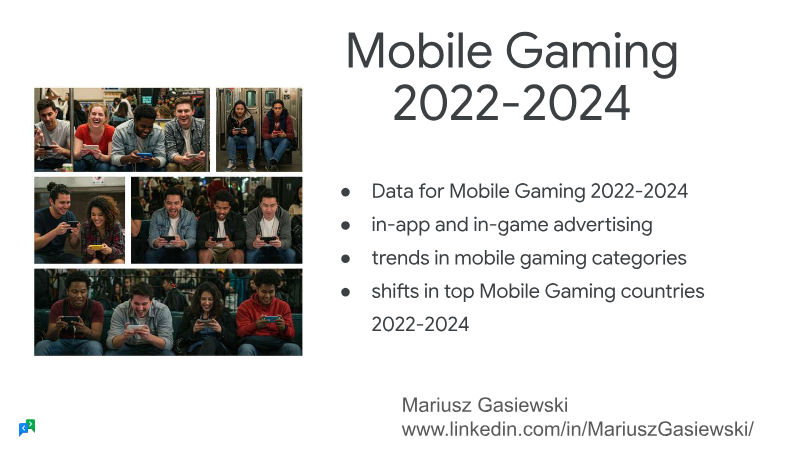
Data for Mobile Gaming 2022-2024
strategic shift toward in-game advertising, which is currently outpacing traditional in-app purchases as a primary revenue stream. Global market dynamics remain anchored by the United States
Report56 pages
Jan 2025
Newzoo Hypercasual Mobile Game Genre Report: Eastern vs Western Markets
Newzoo
banner ads. However, hybrid monetization is rising, with developers increasingly offering in-app purchases for ad removal or exclusive content. Data from 2021 indicates that the hypercasual sector
Report28 pages
Jun 2019
Global Market Trends: Mobile Gaming Benchmarks (H1 2019)
GameAnalytics
monetization strategies, characterized by a 15-20% year-over-year decline in in-app purchase revenue metrics such as ARPPU and ARPDAU. This downturn suggests a broader industry
Report34 pages
Jan 2025
Mobile Game Market Insights: India 2025
Sensor Tower
than double that of Indonesia, the market faces significant monetization hurdles. Total in-app purchase revenue stands at approximately $400 million, reflecting a cost-sensitive consumer base that
Report29 pages
Direct-to-Consumer: A $17 Billion Market for Mobile Gaming
Appcharge, GDC
poised to mirror the success of mobile gaming, with the global in-app purchase market projected to reach $721.4 billion by 2034. DTC strategies are no longer
Report17 pages
Jan 2025
The Gaming and Interactive Media Opportunity in India
BITKRAFT Ventures, Redseer
enhance user engagement. Monetization strategies are maturing alongside this expansion, moving toward in-app purchases, subscriptions, and nanotransactions facilitated by seamless payment systems like UPI AutoPay. These financial
Report52 pages
Jan 2025
Cross-Platform Gaming: Bridging Mobile and PC/Console
Sensor Tower
mobile is projected to reach 52 billion downloads and $82 billion in in-app purchase revenue in 2025, while the PC and console segment generates over $12 billion
Report34 pages
Dec 2024
2024 Global Mobile Games Marketing Trends & Insights
SocialPeta
moving toward hybrid-casual models that blend ad-based revenue with in-app purchases to offset rising user acquisition costs. Strategic priorities for 2025 include the expansion
Report74 pages
Jan 2025
Key Insights into Role-Playing Games (RPGs)
Newzoo
play models, which reach 97% of the player base, followed closely by in-app purchases at 90%. Geographically, the United States and Japan lead in monthly active users
Report26 pages
Sep 2025
Video Game Market Update: Q3 2025
Aream & Co
during the third quarter of 2025, driven by a rebound in mobile in-app purchases and robust performance across PC and console platforms. The launch of the Nintendo
Report35 pages
Jan 2021
Market Snapshot: Q2 2021 US, China & Japan
GameRefinery
Developers are increasingly prioritizing engagement through non-recurring live events and limited in-app purchase offers, which saw frequency increases of 143% and 122%, respectively. These features
Report20 pages
Jun 2022
Innovative Monetization Features Snapshot Report
GameRefinery
employ gacha mechanics. A significant shift is occurring in the nature of in-app purchases, moving away from direct gameplay boosters toward meta-layer content such as narrative
Report35 pages
Nov 2024
Levelling Up: State of India Interactive Media & Gaming Research FY'24
Lumikai
expansion is primarily driven by a 41% year-on-year increase in in-app purchase revenue, particularly within the midcore segment, which grew by 53%. While Real Money
Report15 pages
Mar 2024
Turning Organic Success into Long-Term Revenue: A Framework for F2P Mobile Games
SuperScale
campaigns. The first phase focuses on monetization through ad mediation and in-app purchases (IAP). Key findings suggest that implementing a hybrid ad mediation setup—combining real-time
Report29 pages
Jan 2023
2023 Casual Gaming Apps Report
Liftoff
competitive social features, over simple core mechanics. By blending ad-based and in-app purchase monetization models, developers are successfully targeting crossover audiences and extending the lifecycle
Report36 pages
Jan 2021
Mobile Game Genre Report: Comparing & Contrasting Eastern and Western Markets
Newzoo
genre is currently shifting toward hybrid models that integrate traditional gacha-based in-app purchases with rewarded video advertisements. Data indicates that 83% of players are receptive
Report30 pages
Jan 2024
Sensor Tower Global Mobile Gaming Industry Outlook 2024
Sensor Tower
Global mobile gaming experienced a minor 2% year-on-year decline in in-app purchase revenue in 2023, totaling $76.7 billion. Despite this slight contraction, the market remains
Report25 pages
Aug 2025
Digital Market Index: Q2 2025
Sensor Tower
landscape reached a significant milestone in the second quarter of 2025, as in-app purchase revenue hit a record $40 billion. This period marked a historic structural shift
Report46 pages
Jan 2026
China WeChat Mini Games Industry Report 2026
Meridian Play, Jinke
projections exceeding RMB 70 billion for 2026. Revenue is primarily driven by in-app purchases, which account for 68.11% of total earnings, while advertising monetization contributes the remaining
Report24 pages
Mar 2025
State of Mobile Gaming 2025
Sensor Tower
high-value player retention. While total downloads declined by 6.6%, global in-app purchase revenue grew by 4% to reach $82 billion. This growth was primarily driven
Report50 pages
Jan 2025
State of Mobile 2025: TikTok Edition
Sensor Tower
reached a significant milestone in 2024, generating a record $150 billion in in-app purchase revenue, representing a 12.5% year-over-year increase. While global downloads experienced
Report80 pages
May 2026
Vietnam Domestic Gaming Industry Report: 2025
Ocean Entertainment Group, Meridian Play
user-friendly ad formats, prompting a shift toward rewarded ads and enhanced in-app purchase strategies. To navigate these complexities, stakeholders are increasingly relying on local advisory
Report15 pages
Game no Yakusoku Communication Book
CESA – Computer Entertainment Supplier's Association
familiarize themselves with common gaming terminology and technical concepts such as in-app purchases, server stability, and online etiquette. By understanding these elements, parents can provide more informed
Report2 pages
Jan 2021
Mobile Game Genre Report: Role-Playing Games 2021
Pangle
consistent content updates, social competitive mechanics, and time-limited gacha systems. Although in-app purchases remain the primary revenue driver—particularly among high-income male audiences—there
Report30 pages
Jan 2023
Hybridcasual Games Playbook (2023)
Sensor Tower, Homa
advertisements remain a core component, they are increasingly optional and rewarded, allowing in-app purchases (IAPs) to account for a growing share of total revenue. Successful implementation
Report32 pages
Jan 2025
The State of Puzzle Games: An Analysis of the Puzzle Category in Mobile Gaming
Sensor Tower, Pathmatics
interest by blending accessible gameplay with more sophisticated monetization tactics, such as in-app purchases, which were previously less common in hypercasual-leaning segments. The data indicates that
Report23 pages
Jun 2025
Mobile Game Feature Impact Spotlight
Sensor Tower
research identifies significant growth opportunities in the hybridcasual segment, where features like in-app purchase (IAP) bundles remain underutilized despite correlating with a $1.77 increase in lifetime revenue
Report16 pages
Mar 2025
Mobile Games Industry Trends Survey: Winter 2024/25
PocketGamer.biz
prioritize top-line revenue and retention as their primary performance indicators. In-app purchases and video advertisements remain the foundational business models, though rising acquisition costs are cited
Report32 pages
Jan 2024
Global Mobile Gaming Industry Outlook 2024
Sensor Tower
mobile gaming market experienced a period of stabilization in 2023, with total in-app purchase (IAP) revenue reaching $76.7 billion. While this figure represents a 2% year
Report25 pages
Jan 2023
Gaming Spotlight 2023 Review
data.ai
concentrated among high-performing titles that leveraged Gen Z engagement and sophisticated in-app purchase models. Monopoly GO and Honkai: Star Rail emerged as standout performers, generating hundreds
Report33 pages
Data for Mobile Gaming 2022-2024
Jan 202256 pages4k words
Summary
Mobile gaming maintains its position as the primary driver of industry expansion, fueled by widespread smartphone adoption and consistent engagement across both emerging and established markets. Between 2022 and 2024, the sector has demonstrated a clear trend where revenue growth consistently outpaces download volume on both iOS and Android platforms. This financial trajectory is increasingly supported by a strategic shift toward in-game advertising, which is currently outpacing traditional in-app purchases as a primary revenue stream.
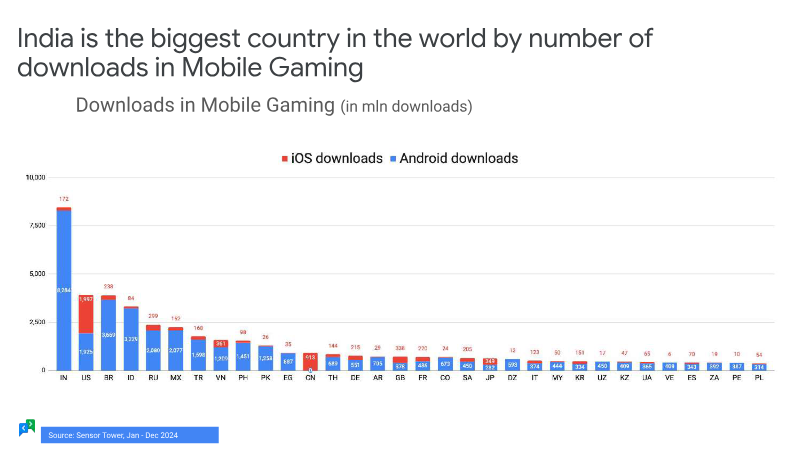
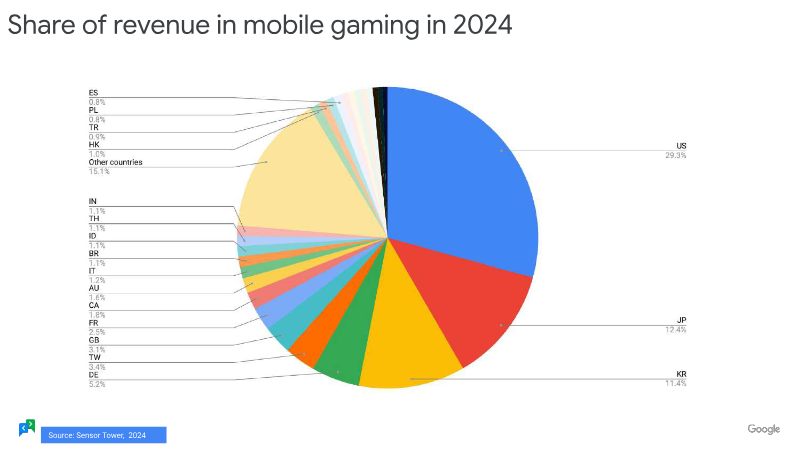
Global market dynamics remain anchored by the United States, China, and Japan, which continue to serve as the most significant revenue generators. However, emerging markets are playing an increasingly critical role in the industry’s growth, particularly in regions like Brazil, where smartphone gaming penetration has surpassed 90% across all demographics. In these regions, player behavior is heavily influenced by free-to-play accessibility, narrative depth, and social recommendations. Furthermore, data from the U.S. and U.K. confirms that younger demographics prioritize smartphones over consoles and PCs, solidifying the mobile device as the central hub for modern gaming.
Despite the proliferation of available titles, the global player base exhibits a preference for focused engagement, with many users choosing to dedicate their time to a single game rather than managing multiple titles simultaneously. While market concentration among top-tier publishers remains stable, the rapid expansion of the advertising sector suggests a fundamental change in how developers monetize their audiences. Ultimately, the industry is transitioning toward a model that prioritizes long-term retention and diversified revenue streams over simple volume-based growth, ensuring that mobile gaming remains the most influential segment of the broader interactive entertainment landscape.
Pages

Insights
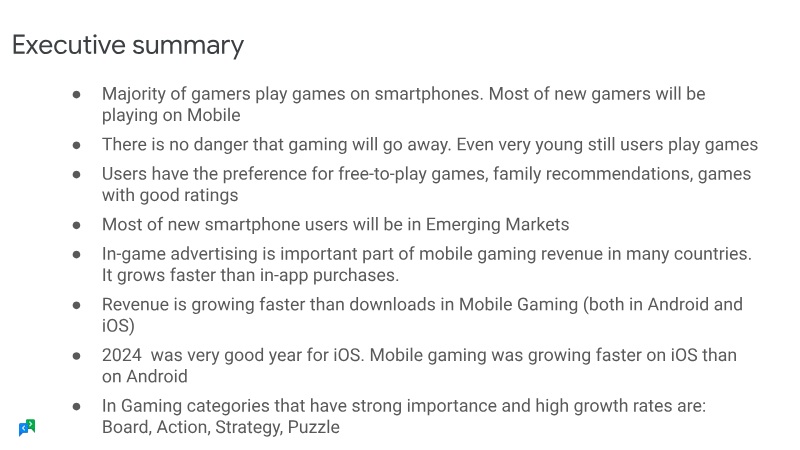
- Mobile gaming revenue growth is consistently outpacing download volume across iOS and Android platforms between 2022 and 2024.
- In-game advertising has overtaken traditional in-app purchases as the primary revenue stream for mobile developers.
- The United States, China, and Japan remain the dominant global revenue generators, while Brazil has reached over 90% smartphone gaming penetration across all demographics.
- Younger demographics in the U.S. and U.K. are increasingly prioritizing smartphones over consoles and PCs as their primary gaming platform.
- Player behavior is shifting toward focused engagement, with users increasingly dedicating their time to a single title rather than managing multiple games.
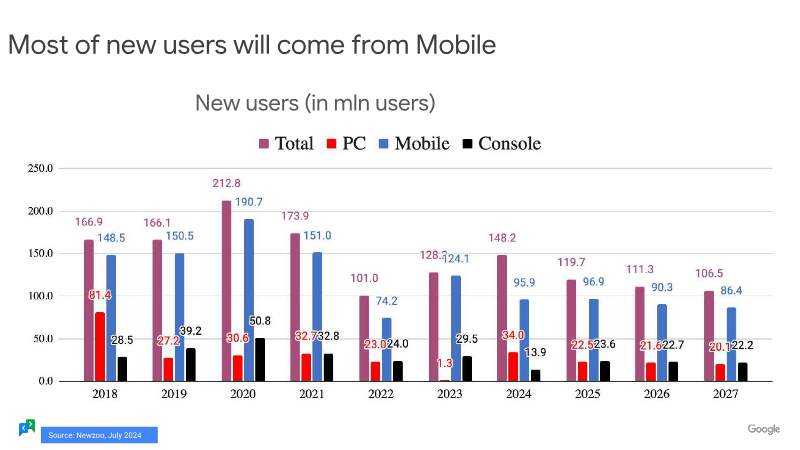
Most of new users will come from Mobile