Report30 pages
Q4 2023 Gaming Industry Report: Global & MENAP Outlook
The Q4 2023 Gaming Industry Report presents a global market that expanded to $212 billion, with the MENAP region contributing $2.8 billion and experiencing a 30% quarter‑over‑quarter rise in both gamers and investment activity. Mobile gaming remains the dominant platform, accounting for 46% of the global player base, while indie PC titles capture a growing share of revenue at roughly 30%. The report also highlights the continued diversification of the industry, noting that game‑to‑movie adaptations generated over $1.4 billion in 2023, underscoring cross‑media opportunities.
Regulatory scrutiny intensified across the sector, with a 15% increase in litigation and high‑profile antitrust cases against major platform holders such as Google and Apple. Significant fines were imposed for deceptive practices, reflecting a tightening legal environment that could reshape market dynamics.
M&A activity rebounded sharply in Q4, with transactions totaling $68.7 billion—a 769% jump largely driven by the Activision‑Blizzard deal—while global venture capital funding fell. In contrast, MENAP venture activity rose 30%, indicating a strategic pivot toward emerging markets including Asia, Africa, and MENAP for future consolidation. This trend presents both challenges and opportunities for indie studios, potentially enabling higher‑quality titles through increased resources.
Shorooq Partners focuses on early‑stage gaming investments within MENAP, targeting pre‑seed to Series A deals with ticket sizes of $1–8 million. The firm prioritizes studios that possess strong intellectual property, robust monetization models, and software solutions that enhance processing efficiency and scalable user connectivity. By engaging through conferences such as the WN Conference Abu Dhabi and LEAP 2024, newsletters, and partnership initiatives, Shorooq aims to nurture the growing MENAP gaming ecosystem.
- The global gaming market reached $212 billion in Q4 2023, with M&A activity surging to $68.7 billion, a 769% increase primarily driven by the Activision-Blizzard acquisition.
- Mobile gaming remains the industry's primary platform, capturing 46% of the global player base, while indie PC titles have grown to represent approximately 30% of total revenue.
- The MENAP region is a key growth area, contributing $2.8 billion to the market and recording a 30% quarter-over-quarter increase in both gamer population and venture capital investment.
- Regulatory pressure is intensifying, marked by a 15% rise in litigation and significant antitrust actions against major platform holders like Google and Apple regarding deceptive practices.
- Cross-media expansion is a proven revenue driver, with game-to-movie adaptations generating over $1.4 billion in 2023.
+1
Shorooq Partners

Report121 pages
African Video Game Report 2026
The report establishes that Africa’s video‑game industry has entered a phase of rapid maturation, driven largely by mobile play in urban centres such as South Africa, Nigeria and Kenya. Mobile accounts for roughly 90 % of the $1.8 billion market in 2024, with a 10 % year‑over‑year rise in players to 349 million. PC and console remain niche but critical for studio visibility, with Steam dominating distribution (≈70 % of PC use) and local platforms like Gara and Jiwe capturing the remainder. Funding for studios is overwhelmingly sourced from international incubators and grants—Pro Helvetia, the French Agence Française de Développement, the British Council’s Ignite Culture and Digital Lab Africa—yet local infrastructure gaps (low internet penetration, limited payment systems, unreliable electricity) continue to constrain broader market development.
Key findings show that the fastest‑growing economies—Eritrea, Niger, Egypt, Ethiopia, Nigeria and South Africa—host studios such as Maliyo Games, Kayfc and Legends of Orisha that are producing mobile‑first IP while experimenting with higher‑production PC/console titles. Female representation and gender inclusivity are addressed through programmes like Pro Helvetia’s “She Got Game”, yet overall skill development remains uneven, with many studios still operating at the indie level and lacking robust business training.
The esports sector mirrors this mobile dominance, with titles like PUBG Mobile and Free Fire generating substantial prize pools and viewership across hubs such as Morocco, Egypt and Kenya. However, talent development is concentrated in a handful of urban centres, leaving Francophone and non‑English speaking regions underrepresented.
The analysis concludes that sustainable growth hinges on three pillars: deeper, studio‑level talent development; reliable data infrastructure for market intelligence; and evolved payment systems that reduce friction. Strengthening African‑European partnerships, expanding local incubation pathways, and ensuring annual data updates are essential to unlock the continent’s commercial potential while preserving African leadership in game creation.
- Africa’s video game market reached $1.8 billion in 2024, with mobile gaming accounting for 90% of the market and a player base that grew 10% year-over-year to 349 million.
- Market growth is concentrated in urban hubs across South Africa, Nigeria, Kenya, Egypt, Ethiopia, Niger, and Eritrea, where studios like Maliyo Games and Kayfc are prioritizing mobile-first IP.
- Studio funding is heavily reliant on international grants and incubators, including Pro Helvetia, the Agence Française de Développement, and the British Council’s Ignite Culture.
- PC and console gaming remain niche, with Steam capturing approximately 70% of PC distribution, while local platforms like Gara and Jiwe serve the remaining market share.
- Esports viewership and prize pools are dominated by mobile titles such as PUBG Mobile and Free Fire, though talent development remains geographically limited to a few major urban centers.
SpielFabriqueApr 2026

Report93 pages
Die Games - Branche in Deutschland 2025
The study evaluates the German games industry in 2025, building on earlier reports to assess economic performance, employment, and the influence of federal funding. It surveys 343 companies—28 % of a population of 1,205—and integrates primary data with secondary sources such as gamesmap and DLR. The sector has expanded rapidly, doubling core‑market firms from 619 in 2018 to roughly 1,200 by mid‑2025 and nearly doubling the extended core market. Revenue rose from €3.06 bn in 2018 to €3.73 bn in 2024, a 22 % increase, with development‑sector sales growing 148 %. Despite this growth, the market remains highly fragmented: three‑quarters of firms employ fewer than ten people and only 19 % belong to foreign conglomerates. Export earnings dominate, accounting for 76 % of revenue, largely within the EU and North America/Asia.
Employment data reveal a clear link between company size and workforce composition. Larger firms (>€25 M revenue) employ 85 % full‑time staff, whereas micro‑enterprises rely heavily on owners and freelancers. Female representation has risen to nearly one‑third of the workforce, and international talent now constitutes 35 % of employees. Technical and creative roles dominate, while commercial positions have declined. Salaries average €62 k annually, with lead‑level pay ranging from €50–80 k and a strong correlation between company size and remuneration.
Federal funding has been pivotal, with 71 % of developers receiving or planning to receive support. In 2023, €70 million in subsidies generated €277 million of investment and €453 million of total value‑creation, yielding a multiplier of 6.5 for output and 2.5 for fiscal impact. However, high personnel costs remain a significant challenge, with 57 % of respondents rating them as “very bad.” The industry also serves as a talent magnet and innovation catalyst, with 70 % of spill‑overs stemming from game engines, gamification, and AR/VR technologies adopted across automotive, architecture, film, training, AI, and other sectors.
- The German games industry has nearly doubled its core-market presence since 2018, growing from 619 to approximately 1,200 firms by mid-2025.
- Federal funding acts as a major economic driver, where €70 million in 2023 subsidies generated €453 million in total value-creation, representing a 6.5x output multiplier.
- Industry revenue reached €3.73 billion in 2024, a 22% increase since 2018, with the development sector specifically surging by 148%.
- Export earnings are the primary revenue driver, accounting for 76% of total sales, with key markets located in the EU, North America, and Asia.
- The sector is highly fragmented, with 75% of companies employing fewer than ten people and only 19% of firms owned by foreign conglomerates.
gameApr 2026

Report53 pages
Ad Monetization Without Killing Retention
Hybrid monetization can increase revenue without eroding player retention by treating advertisements as an integral part of the game’s design system. Three core ad formats—interstitials, rewarded video (RV), and banners—are positioned strategically through careful gating on level progression, playtime, or cooldown periods. Optimal triggers and placement reduce player frustration while maximizing eCPM, ensuring that monetization flows naturally with gameplay.
Rewarded video is most effective when offered during high‑stakes moments such as revives, boosters, or time‑limited rewards. Leveraging scarcity and urgency in these contexts drives conversions while preserving the core experience. Consistent visual cues, a clear distinction between coin rewards and RV value, and optional “No Ads” bundles further balance monetization with player comfort.
Selling “No Ads” bundles requires thoughtful presentation. Bundles should appear side‑by‑side with regular items, use distinct visual cues and anchoring to convey high value, and be gated behind a minimum purchase tier to protect payer retention. Segmenting ad exposure—capping impressions, applying cooldowns, and filtering out disruptive creatives—maintains a positive user experience while sustaining revenue.
Overall, the strategy blends ad formats with gameplay mechanics, employs scarcity and urgency for rewarded video, and offers high‑value “No Ads” options. This approach delivers robust monetization across diverse segments while safeguarding long‑term player engagement and retention.
- Integrate advertisements as core gameplay design elements rather than external overlays to increase revenue without negatively impacting player retention.
- Deploy rewarded video ads during high-stakes moments—such as revives, boosters, or time-limited rewards—to leverage scarcity and urgency for higher conversion rates.
- Implement strategic gating for ad triggers based on level progression, total playtime, or specific cooldown periods to minimize player frustration.
- Market 'No Ads' bundles by presenting them alongside regular items using clear visual anchoring to establish high value, while gating them behind minimum purchase tiers to protect payer retention.
- Maintain a positive user experience by segmenting ad exposure through impression caps, cooldown timers, and the filtering of disruptive creative content.
+2
Sensor TowerApr 2026

Report33 pages
2026 Global Non‑Gaming App Trends Report
The report argues that non‑gaming mobile applications are experiencing accelerated growth driven by AI integration, short‑form content, and intensified user acquisition competition. Key findings show that Android dominates download volume—particularly in Utilities (79 % of installs) and Life Services (58 %)—while iOS generates a higher share of revenue, especially in Finance & Business (56 % of iOS revenue) and Life Services (57 %). In 2025, AI‑focused apps such as ChatGPT (+1,340 %) and Perplexity (+3,613 %) achieved the highest year‑over‑year download growth, and Short Drama titles like Kuku TV (+45 % k) and RapidTV (+498 %) recorded explosive revenue increases, with AI Social apps (e.g., Character AI +918 %) also driving significant monetization.
User acquisition activity expanded across all major categories, with Life Services (+42 %) and Finance & Business (+43.5 %) leading the rise in app counts. Smart bidding adoption surged, with Target ROAS spend increasing by 50 % and Target CPE spending up 57 %, particularly in Utilities and Entertainment. Cost‑per‑install (CPI) analysis revealed that E‑Commerce on Android commands a 3× premium, while Finance & Business on iOS reaches 4.6×, underscoring high competition for transactional users.
Monetization patterns shift toward in‑app advertising (IAA), dominating across Education, Utilities, and Entertainment. Video formats—rewarded and interstitial—outperform banner ads by 128–165× eCPM, with North America delivering the highest rewarded video eCPMs (up to 11.8× in Short Drama). The report covers global markets excluding Mainland China from January to December 2025, drawing on anonymized data from Mintegral and Insightrackr across 100+ key app categories.
- AI-focused applications experienced massive 2025 growth, led by Perplexity (+3,613%), ChatGPT (+1,340%), and Character AI (+918%).
- Short Drama apps like RapidTV (+498%) and Kuku TV (+45k%) are driving explosive revenue, with North American rewarded video eCPMs for this category reaching up to 11.8x.
- Android leads in global download volume, particularly in Utilities (79%) and Life Services (58%), while iOS captures the majority of revenue in Finance & Business (56%) and Life Services (57%).
- User acquisition competition is intensifying, evidenced by a 50% increase in Target ROAS spending and a 57% rise in Target CPE spending, particularly within Utilities and Entertainment.
- Cost-per-install (CPI) premiums remain high for transactional users, reaching 3x for E-Commerce on Android and 4.6x for Finance & Business on iOS.
MintegralApr 2026

Report97 pages
State of Mobile 2026
The 2026 State of Mobile report demonstrates that the global mobile ecosystem remains mature yet increasingly monetized, with 2025 in‑app purchase (IAP) revenue reaching $85.6 billion—a 21 % year‑over‑year rise that now places non‑game apps ahead of games for the first time. Generative AI and short‑form drama have become the fastest‑growing subgenres, driving double‑digit IAP growth; AI assistants such as ChatGPT alone generated $3.4 billion in 2025, while short‑drama apps captured more than ten percent of global video‑entertainment time. These categories also show a shift from acquisition to retention, with session volumes outpacing downloads and time spent tripling in AI apps.
Hybrid‑casual and hyper‑casual games continue to lead revenue growth, especially in Tier 2 markets where downloads are falling but engagement is surging. Publishers targeting these segments can capture higher revenue per user, though they face tighter ad‑spend competition and a move toward high‑attention formats. In the gaming web arena, Roblox dominates with 74 % of game‑publisher site visits in 2025, underscoring the importance of product‑centric web design.
Beyond entertainment, general‑shopping apps such as Temu and Amazon maintain massive download volumes, with grocery and buy‑and‑sell subgenres growing 5 % and 4 % YoY, respectively. Food & drink apps hit a record 2.4 billion downloads in 2025, driven largely by emerging markets like India and the Middle East. Mobility and sports apps also show notable shifts: Waymo’s standalone app captured 15 % of rideshare MAUs in key U.S. metros, while DFS‑style sports betting apps now command 80 % of the betting‑app MAU share, reflecting regulatory impacts and new market entrants.
Overall, the report covers a global geographic scope with particular emphasis on the U.S., India, Western Europe, and emerging Tier 2 markets. It spans 2025 data with forward‑looking insights for 2026, highlighting AI’s transformative role across monetization, user engagement, and competitive dynamics in the mobile industry.
- Non-game apps surpassed games in in-app purchase (IAP) revenue for the first time in 2025, contributing to a total global IAP market of $85.6 billion, a 21% year-over-year increase.
- Generative AI and short-form drama are the fastest-growing subgenres, with AI assistants like ChatGPT generating $3.4 billion in 2025 and short-drama apps capturing over 10% of global video-entertainment time.
- Roblox solidified its dominance in the gaming web arena, accounting for 74% of all game-publisher site visits in 2025.
- Hybrid-casual and hyper-casual games are seeing surging engagement and higher revenue per user in Tier 2 markets, despite a broader trend of declining download volumes.
- Daily Fantasy Sports (DFS)-style apps now command 80% of the betting-app monthly active user (MAU) share, driven by new market entrants and regulatory shifts.
Sensor TowerApr 2026

Report90 pages
2026 Global Mobile Gaming Marketing Trends White Paper
The white paper establishes that the mobile‑gaming advertising ecosystem expanded rapidly in 2025, with more than 90 000 active advertisers and an influx of roughly 8 000 new entrants each month, a 22 % year‑over‑year rise. Advertisers increasingly deploy fresh creatives, with video accounting for 74 % of all ads—up 14 % YoY—and Android remains the dominant acquisition platform, though iOS shares grow for mid‑core and hard‑core titles.
Top mobile games in 2025 show a clear split between volume‑driven casual installs and value‑focused premium titles. Casual hits such as Block Blast! and Subway Surfers dominate downloads, while mid‑core and premium games generate the bulk of revenue. Leading spenders—FunPlus, Yotta Games, Hungry Studio—continue to favor Android for lower cost‑per‑install acquisition, whereas iOS delivers higher monetization per install.
The industry is moving from a linear funnel to an “Infinity Loop” model that integrates acquisition, retargeting, and lifecycle actions. Aarki’s supervised‑AI engine demonstrates the potential to boost lifetime value by up to 30 % and reduce campaign volatility, underscoring the importance of a unified, data‑driven full‑funnel strategy that prioritizes LTV over instant installs.
Early‑stage mobile games must achieve rapid habit formation, with 60‑minute daily play by week 2 and high alliance join rates. Paid‑traffic validation is critical; a Day‑1 acquisition rate below 35 % signals readiness issues. Creative trends vary by genre: lightweight socializing and parkour mini‑games dominate SLG spend, RPGs favor narrative IP‑linked content, while simulation and casual titles rely on realistic or viral short‑video formats that capture 70–80 % of impressions.
Regional insights reveal puzzle and casino titles lead creative trends in 2026, with Japan/Korea driving new creative volume and Southeast Asia showing higher local IP acceptance. Mobile‑gaming ad spend rises modestly in Oceania and South America, with Android dominating creative output. A strategic pivot toward “authenticity‑utility‑impact” stacks—solving real problems and building defensible communities—drives higher retention, while AI‑powered creatives accelerate rapid testing. Finally, marketers increasingly adopt AI and programmatic DSPs beyond walled gardens; performance gaps and trust issues persist, yet data show significant install uplifts when CTV campaigns complement mobile ads, indicating a shift toward transparent, scalable programmatic solutions.
- The mobile gaming advertising ecosystem grew by 22% year-over-year in 2025, with over 90,000 active advertisers and 8,000 new entrants joining monthly.
- Video content now accounts for 74% of all mobile game ads, representing a 14% year-over-year increase in usage.
- A shift toward an 'Infinity Loop' marketing model, supported by supervised AI, can increase player lifetime value (LTV) by up to 30% by integrating acquisition, retargeting, and lifecycle management.
- Android remains the primary platform for volume-driven acquisition due to lower costs, while iOS is increasingly favored for mid-core and hard-core titles to maximize monetization per install.
- Early-stage games require a Day-1 acquisition rate of at least 35% and 60 minutes of daily play by week two to signal long-term viability.
+1
SocialPetaApr 2026
Report52 pages
State of the Game Industry 2026
The industry snapshot reveals a workforce that remains predominantly male and White, yet shows growing diversity in gender identity, sexual orientation, and geographic mobility. Two‑thirds of respondents are male, 24 % female, and 8 % non‑binary, with 28 % identifying as LGBTQ+. The U.S. dominates the sample (54 %), and California remains the top state of residence, while Washington has experienced the largest influx. Most workers are under 35 (64 %) and concentrated in design, programming, and visual arts roles.
Layoffs continue to be a significant concern, especially within AAA studios where two‑thirds of respondents report company layoffs and nearly one in five have been personally let go. Indie studios experience fewer corporate cuts, yet a higher proportion of individuals report personal layoffs. Roughly half of all respondents anticipate no layoffs in the next year, but those with prior layoff experience express greater uncertainty.
Generative AI elicits polarized views: 42 % see it as a productivity catalyst, while 38 % view it as ethically problematic and potentially job‑threatening. The debate centers on balancing efficiency gains against concerns over originality, labor displacement, and environmental impact.
VR/AR/MR remains a niche segment, with only 8 % of respondents engaged in such projects. Meta Quest/Horizon dominates the market, and accessibility features are widely adopted, though advanced options lag behind. Monetization trends show premium titles favor digital downloads and physical copies, whereas free‑to‑play games rely heavily on in‑app purchases for currency and cosmetics.
Crunch culture persists, with 87 % of workers clocking overtime in the past year and over half citing essential work or self‑pressure as drivers. Union support is strong in the U.S., with 82 % backing unionization and a majority expressing interest, though leadership opinions are slightly more divided.
- Layoffs remain a critical industry issue, with two-thirds of AAA studio employees reporting company-wide cuts and nearly 20% of the total workforce having been personally let go.
- Workplace culture remains characterized by persistent crunch, as 87% of employees clocked overtime in the past year, largely driven by perceived necessity or self-imposed pressure.
- Generative AI adoption is deeply polarized, with 42% of professionals viewing it as a productivity tool while 38% fear it poses ethical risks and threats to job security.
- Support for labor organization is high, with 82% of U.S. respondents backing unionization and a majority expressing personal interest in joining a union.
- The industry workforce is predominantly male (66%) and under 35 (64%), with a significant concentration of talent located in the United States (54%), particularly in California and Washington.
GDCApr 2026
Report80 pages
PC & Console Gaming Report 2026
1. Market trajectory What direction is the PC and console market heading in 2026? 8 What direction is the PC and console market heading in 2026? 2. Attention & value allocation Where do players spend time and money on PC and console? 17 3. Market concentration What happens if you are not a top-20 game? 45 4.
- PC player base is projected to exceed one billion by 2028, with a CAGR of 2.9% from 2025-2028, while console player growth moderates with a 2.2% CAGR in the same period.
- Almost two-thirds of console revenues (PlayStation and Xbox) go to the top 20 games, whereas on PC, over half of revenue comes from games ranked 21+.
- PC is the only platform effectively monetizing Free-to-Play (F2P) games, with revenue holding stable despite falling playtime in the west; on console, F2P revenue is dropping faster than engagement.
- Games ranked 21+ are capturing a growing share of playtime across platforms, with PC showing the strongest shift since 2022, indicating market disaggregation and growth from outside the top 20 titles.
- Premium game revenue is growing on PC and PlayStation, but Xbox's more modest growth cannot offset declines in F2P and Call of Duty.
+3
NewzooApr 2026
Report33 pages
The Future of Consumer Apps: How AI and Game Design Principles Are Reshaping Every Category
The analysis establishes that consumer applications are entering a “Game‑Design 2.0” era, driven by AI‑native personalization, real‑time feedback and progression systems that elevate engagement and monetization across education, fintech, e‑commerce, health, social media and emerging verticals. 2025 data reveal that spending on non‑gaming apps has already eclipsed gaming, with AI emerging as the primary revenue catalyst and consumer demand for instant, tailored experiences rising sharply. Founders are advised to secure durable competitive advantages by harvesting proprietary data from launch, embedding culturally resonant narratives, and deploying AI to deliver seamless, game‑like value rather than merely branding an app as “AI‑powered.”
In high‑friction sectors, AI‑augmented game mechanics transform user behavior. Fintech platforms such as StockGro employ practice portfolios, leaderboards and AI‑personalized tutorials to convert financial discipline into instant gratification. E‑commerce brands like Temu and Bins use algorithmic discovery feeds, mystery boxes and streak rewards to boost retention beyond price. Health apps leverage voice‑first AI coaches with progression loops, while social networks such as TikTok demonstrate that behavioral AI coupled with variable rewards can drive record‑setting daily engagement. These examples underscore how immersive, AI‑enhanced game design unlocks higher user engagement and monetization in traditionally low‑engagement sectors.
BITKRAFT Ventures positions itself as a top‑decile investor in consumer apps, employing equity, crypto and non‑dilutive user acquisition financing to accelerate growth. The firm projects that by 2025 non‑gaming mobile apps will surpass gaming revenue, reaching $150 B by 2030, and that AI‑driven gamification will create rapid, defensible moats. By 2035, BITKRAFT forecasts that at least five consumer non‑gaming companies could exceed $10 B in valuation, highlighting the strategic importance of AI and game design for future digital experiences.
- Non-gaming mobile app revenue is projected to reach $150 billion by 2030, with spending in this sector already surpassing traditional gaming apps as of 2025.
- AI-driven gamification is the primary catalyst for revenue and engagement, with BITKRAFT forecasting at least five non-gaming consumer companies will exceed $10 billion valuations by 2035.
- High-friction sectors are successfully using game mechanics to drive retention; for example, fintech platforms like StockGro use leaderboards and AI-personalized tutorials to convert financial discipline into instant gratification.
- E-commerce brands such as Temu and Bins are leveraging algorithmic discovery feeds, mystery boxes, and streak rewards to boost user retention beyond simple price competition.
- Behavioral AI combined with variable rewards, as demonstrated by TikTok, is the current industry standard for driving record-setting daily engagement across social platforms.
+2
BITKRAFT VenturesMar 2026
Report19 pages
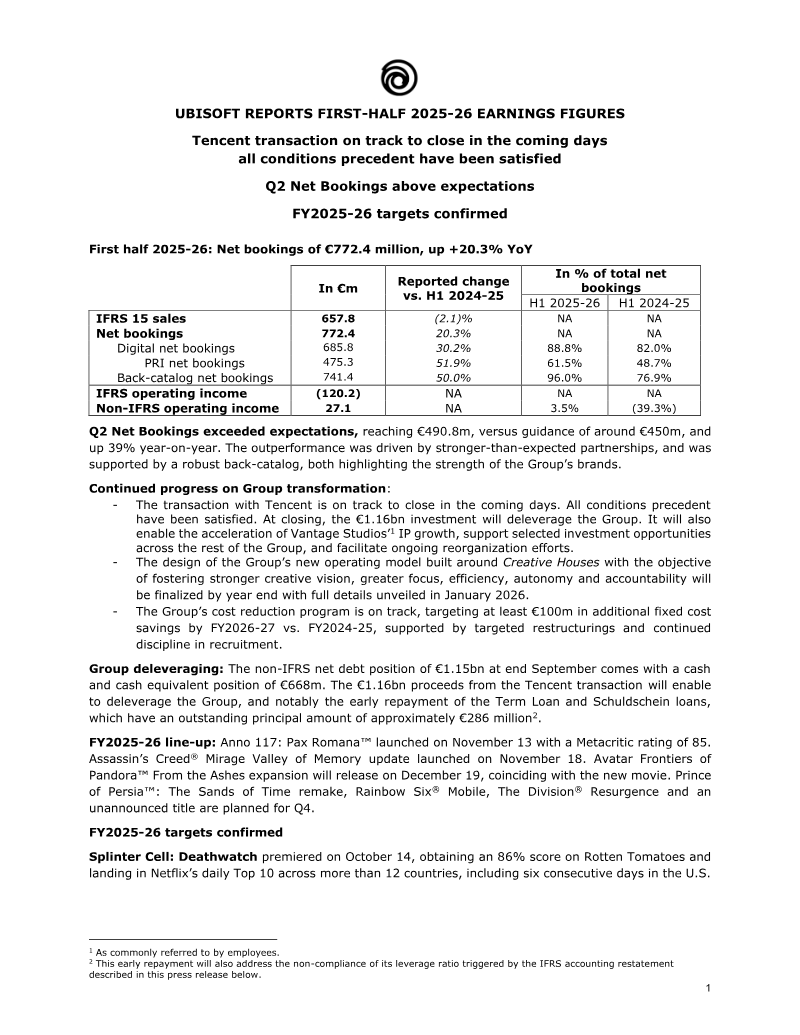
Ubisoft First-Half 2025-26 Earnings Figures
UBISOFT REPORTS FIRST-HALF 2025-26 EARNINGS FIGURES Tencent transaction on track to close in the coming days all conditions precedent have been satisfied Q2 Net Bookings above expectations First half 2025-26: Net bookings of €772.4 million, up +20.3% YoY Reported change In % of total net In €m vs.
- Ubisoft's H1 2025-26 net bookings reached €772.4 million, a 20.3% year-over-year increase, with Q2 net bookings exceeding expectations at €490.8 million (versus guidance of €450 million) due to strong partnerships and back-catalog performance.
- The transaction with Tencent, involving a €1.16 billion investment, is on track to close soon, with all conditions precedent satisfied, which will deleverage Ubisoft by enabling early repayment of approximately €286 million in loans.
- Ubisoft confirmed its FY2025-26 targets, expecting stable net bookings year-on-year, approximately break-even non-IFRS operating income, and negative free cash flow, but anticipates returning to positive non-IFRS operating income and free cash flow in FY27.
- Digital net bookings grew by 30.2% year-over-year to €685.8 million, representing 88.8% of total net bookings, while back-catalog net bookings increased by 50.0% to €741.4 million.
- Ubisoft's headcount decreased by approximately 1,500 employees over the past 12 months to 17,097, with a targeted Voluntary Leave Program and restructuring introduced at Nordic studios in October.
+2
Ubisoft
Report9 pages
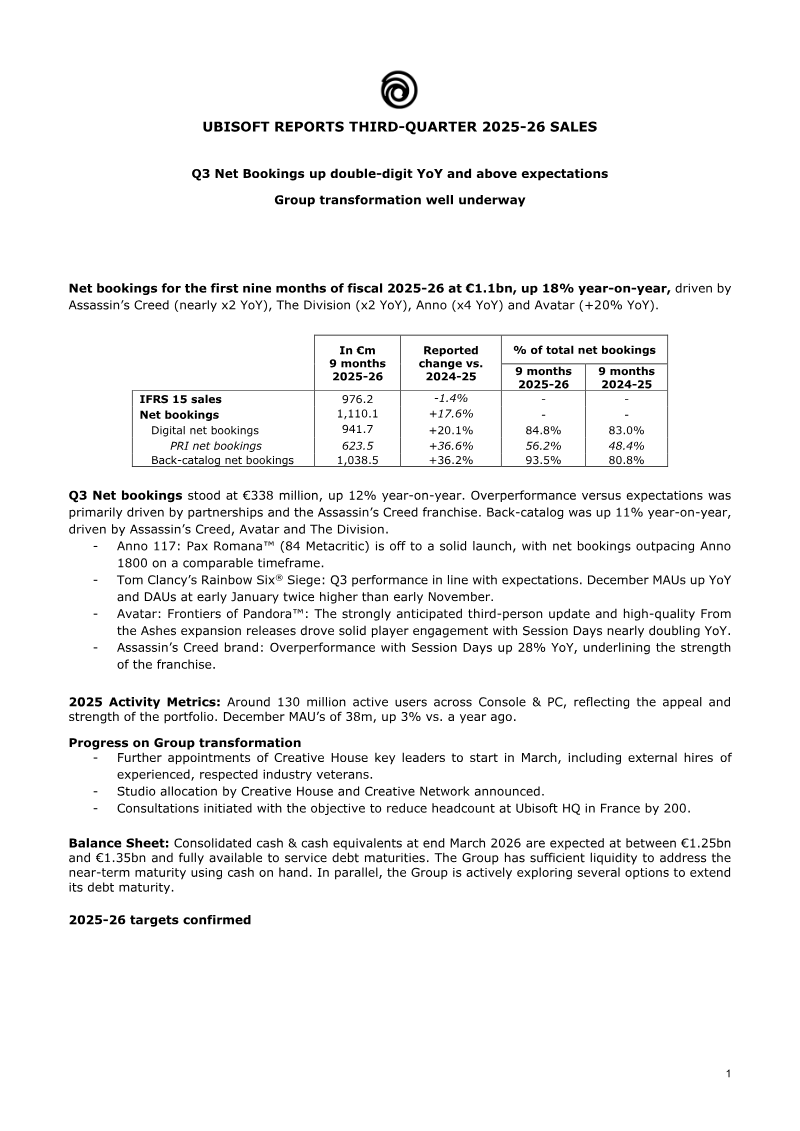
Ubisoft Reports Third-Quarter 2025-26 Sales
Ubisoft announced that net bookings for the first nine months of fiscal 2025‑26 reached €1.11 billion, an 18 % year‑on‑year increase driven by strong performance from Assassin’s Creed, The Division, Anno 117: Pax Romana and Avatar. Digital net bookings rose 20 % to €941.7 million, while back‑catalog sales grew 36 % to €1.04 billion, reflecting sustained demand for legacy titles and new releases such as Assassin’s Creed Shadows on Switch 2 and the Avatar: Frontiers of Pandora expansion. The third‑quarter figure of €338 million exceeded guidance by 12 %, with partnerships and franchise sales contributing most to the lift. Player activity metrics remained robust, with 130 million unique active users in 2025 and December MAUs at 38 million, up 3 % YoY.
The Group’s transformation continues, with the new Creative House operating model taking shape through studio reallocation and senior leadership appointments. Headcount reductions of 200 positions at Ubisoft HQ France are underway to streamline operations. Financially, consolidated cash stands between €1.25 billion and €1.35 billion, sufficient to cover near‑term debt maturities while the Group explores extensions of its debt profile.
Outlook for 2025‑26 confirms net bookings near €1.5 billion, non‑IFRS EBIT around –€1 billion, and free cash flow between –€400 million and –€500 million. Q4 launches include Rainbow Six Mobile, scheduled for February 23, and The Division Resurgence, with additional content planned across the franchise portfolio. Geographic revenue shares show Europe at 40 %, Northern America 46 %, and the rest of the world 14 %. Platform distribution remains dominated by consoles (55 %) and PCs (28 %), with mobile contributing 7 %.
- Ubisoft reported nine-month net bookings of €1.11 billion, an 18% year-on-year increase, with third-quarter results of €338 million exceeding guidance by 12%.
- Back-catalog sales grew 36% to €1.04 billion, driven by sustained demand for legacy titles and new releases like the Avatar: Frontiers of Pandora expansion and Assassin’s Creed Shadows.
- The company maintains a consolidated cash position between €1.25 billion and €1.35 billion while undergoing a restructuring that includes 200 headcount reductions at its French headquarters.
- Full-year 2025-26 outlook projects net bookings near €1.5 billion, with non-IFRS EBIT expected at –€1 billion and free cash flow between –€400 million and –€500 million.
- Player engagement remains strong with 130 million unique active users in 2025 and December monthly active users (MAUs) reaching 38 million, a 3% year-on-year increase.
+1
Ubisoft
Report7 pages
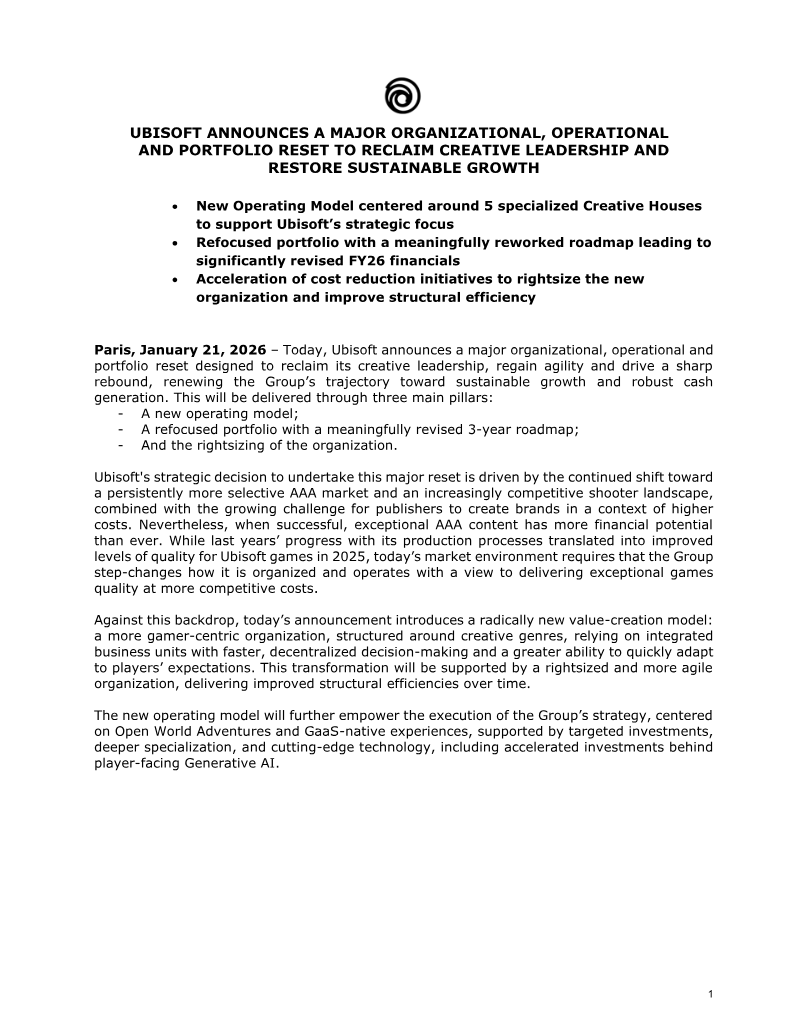
Ubisoft announces a major organizational, operational and portfolio reset to reclaim creative leadership and restore sustainable growth
Ubisoft announces a comprehensive reset aimed at restoring creative leadership and sustainable growth amid a more selective AAA market. The strategy centers on three pillars: a new operating model, a refocused portfolio with an updated three‑year roadmap, and organizational rightsizing. The operating model introduces five Creative Houses—each genre‑focused, fully responsible for development, publishing, and financial performance—supported by a Creative Network of studios and shared Core Services. This structure is intended to accelerate decision‑making, deepen specialization in Open World Adventures and GaaS‑native experiences, and embed generative AI initiatives.
Portfolio adjustments include discontinuing six titles that fail new quality thresholds, extending development timelines for seven games to meet higher standards, and reallocating resources toward high‑potential IPs such as “March of Giants.” These changes are expected to reduce net bookings for FY26 by roughly €330 million and push non‑IFRS EBIT into the negative, reflecting one‑off depreciation costs. Free cash flow is projected between –€400 million and –€500 million, with net debt rising to €150–250 million.
Cost‑reduction efforts target a total fixed‑cost savings of approximately €500 million since FY22, with an accelerated €100 million cut already achieved by March 2026 and a further €200 million planned over the next two years, bringing fixed costs to about €1.25 billion by March 2028. The reset is set to take effect in early April, with a revised FY26–27 financial outlook to be released in May.
- Ubisoft is restructuring into five genre-focused 'Creative Houses' to accelerate decision-making and specialize in Open World Adventures and GaaS-native experiences.
- The company is discontinuing six titles and extending development timelines for seven others to meet new quality thresholds, resulting in a projected €330 million reduction in FY26 net bookings.
- Financial projections for FY26 include negative non-IFRS EBIT, free cash flow between –€400 million and –€500 million, and a net debt increase to €150–250 million.
- Fixed-cost reduction targets aim to bring total costs to approximately €1.25 billion by March 2028, with an additional €200 million in cuts planned over the next two years.
- The organizational reset includes the integration of generative AI initiatives and a strategic resource reallocation toward high-potential IPs such as 'March of Giants.'
+1
Ubisoft
Report3 pages
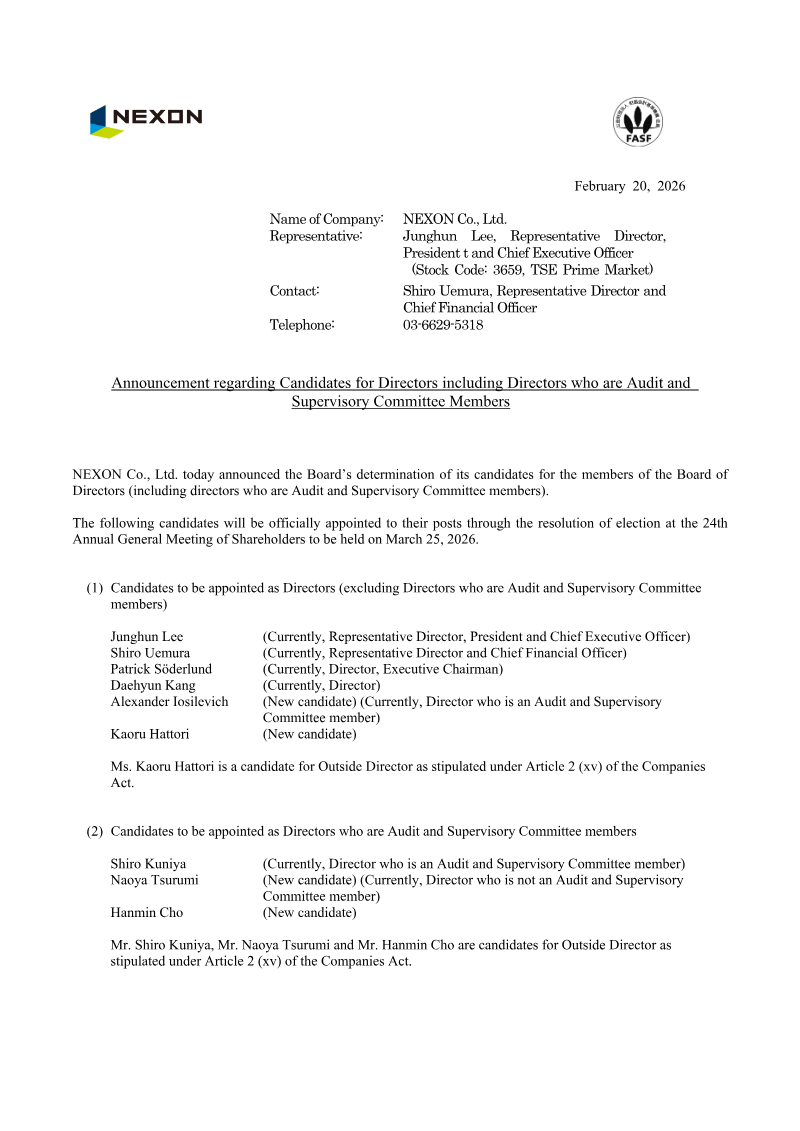
2026.02.20 Announcement regarding Candidates for Directors including Directors who are Audit and Supervisory Committee Members
NEXON Co., Ltd. announced the Board’s selection of candidates for its 24th Annual General Meeting on March 25, 2026. The slate includes six directors, among them two new outside directors and three individuals who will serve concurrently on the Audit and Supervisory Committee. Current executives Junghun Lee, Shiro Uemura, Patrick Söderlund and Daehyun Kang are retained. New appointments comprise Alexander Iosilevich, a seasoned investment‑banking executive with no shareholding in NEXON, and Kaoru Hattori, a Japanese lawyer and partner at Nagashima Ohno & Tsunematsu who also holds trustee and board roles in Toyo Seikan Group Holdings. The Audit and Supervisory Committee will be strengthened by Shiro Kuniya, Naoya Tsurumi—an experienced Sega executive with extensive leadership roles across SEGA subsidiaries—and Hanmin Cho, a private‑equity professional who has led investment divisions at NXC Corporation and holds directorships in NXMH B.V. and Bitstamp Limited.
The announcement details each candidate’s career trajectory, concurrent positions, and share ownership (all new candidates hold zero shares). The selection aligns with Korean Companies Act provisions for outside directors and reflects NEXON’s strategy to blend internal leadership continuity with external expertise in finance, gaming operations, and regulatory oversight. The candidates’ diverse backgrounds—spanning global investment banking, legal practice, gaming industry leadership, and private‑equity management—are intended to enhance governance, strategic direction, and risk oversight for the company’s operations in South Korea and its international markets.
- NEXON Co., Ltd. will present a slate of six director candidates for approval at its 24th Annual General Meeting on March 25, 2026.
- The board is retaining current executives Junghun Lee, Shiro Uemura, Patrick Söderlund, and Daehyun Kang to ensure leadership continuity.
- New outside director appointments include Alexander Iosilevich, an investment-banking executive, and Kaoru Hattori, a partner at the law firm Nagashima Ohno & Tsunematsu.
- The Audit and Supervisory Committee will be strengthened by the addition of Shiro Kuniya, former Sega executive Naoya Tsurumi, and private-equity professional Hanmin Cho.
- The new director candidates hold zero shares in NEXON, and their appointments are intended to bolster governance and regulatory oversight in South Korea and international markets.
+1
NEXON Co.
Report15 pages
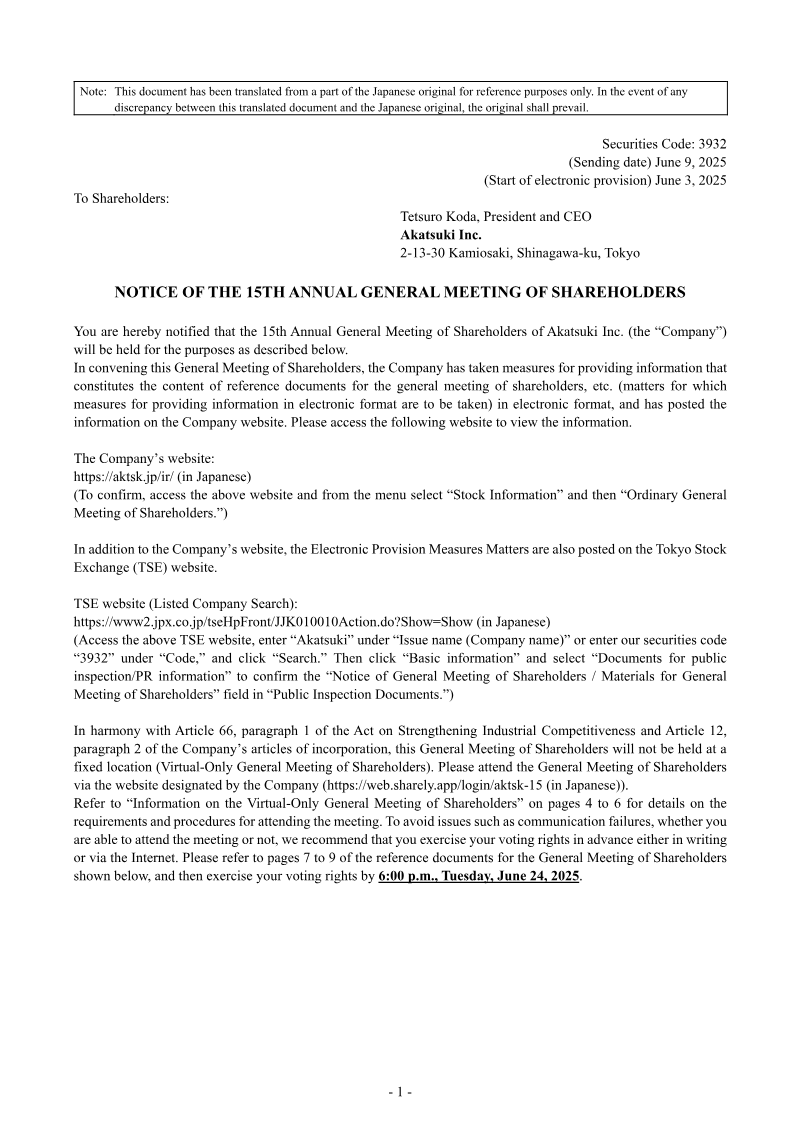
Notice of the 15th Annual General Meeting of Shareholders: Akatsuki Inc.
Note: This document has been translated from a part of the Japanese original for reference purposes only. In the event of any discrepancy between this translated document and the Japanese original, the original shall prevail. (Start of electronic provision) June 3, 2025 Tetsuro Koda, President and CEO 2-13-30 Kamiosaki, Shinagawa-ku, Tokyo NOTICE OF THE 15TH ANNUAL GENERAL MEETING OF SHAREHOLDERS You are hereby notified that the 15th Annual General Meeting of Shareholders of Akatsuki Inc.
- Akatsuki Inc. will hold its 15th Annual General Meeting of Shareholders virtually, with electronic provision of information starting June 3, 2025, and the meeting scheduled for June 25, 2025, at 10:00 a.m. JST.
- Shareholders are encouraged to exercise voting rights in advance either in writing or via the Internet by 6:00 p.m. on Tuesday, June 24, 2025.
- The company proposes the election of four Directors, as the terms of all five current Directors expire at the conclusion of this meeting. The Nomination Committee, comprising a majority of independent Outside Directors, provided a report on candidate selection.
- Tetsuro Koda, President and CEO, and Kazuhiro Ishikura, CFO, are nominated for re-election as Directors, recognized for their leadership, business development, and expertise in corporate finance and investment, respectively.
- Hisashi Katsuya and Tetsuya Mizuguchi are nominated as Outside Directors, with Mizuguchi expected to contribute to the game business and provide objective oversight on officer selection and remuneration.
Akatsuki
Report2 pages
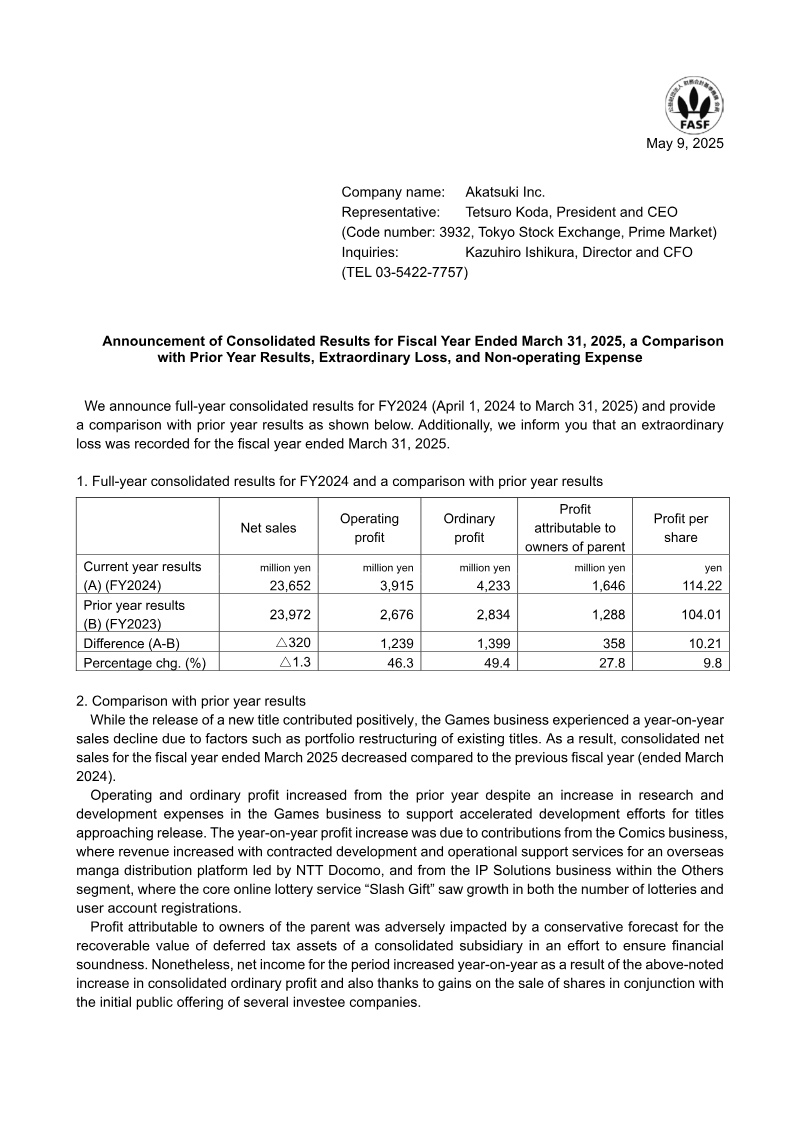
Announcement of Consolidated Results for Fiscal Year Ended March 31, 2025, a Comparison with Prior Year Results, Extraordinary Loss, and Non-operating Expense
Akatsuki Inc. reported consolidated financial results for the fiscal year ending March 31, 2025 (April 1 2024–March 31 2025). Net sales fell by 1.3 % to ¥23,652 million from ¥23,972 million in FY2023, reflecting a decline in the Games segment despite a new title launch. Operating ordinary profit rose by ¥1,239 million (46.3 %) to ¥3,915 million, driven largely by gains in the Comics and IP Solutions businesses; the former benefited from contracted services for an overseas manga platform, while the latter saw growth in its online lottery service “Slash Gift.” Ordinary profit attributable to parent shareholders increased by ¥1,399 million (49.4 %) to ¥4,233 million, and net income attributable to owners of the parent grew by ¥358 million (27.8 %) to ¥1,646 million, aided by gains on share sales from IPOs of investee companies. A conservative write‑down of deferred tax assets reduced the profit attributable to owners, yet overall net income still improved.
An extraordinary loss of ¥593 million was recorded on the valuation of investment securities held by the group, reflecting a conservative assessment of recoverable value amid market uncertainty. On a non‑consolidated basis, the company recorded a ¥5,776 million provision for doubtful accounts and a ¥2,454 million loss on valuation of shares in affiliated companies; these items are largely confined to consolidated subsidiaries and have a minor impact on the consolidated results. The report covers Japan‑based operations for FY2025, with data derived from internal financial statements and market assessments.
- Akatsuki Inc. reported a 49.4% increase in ordinary profit to ¥4,233 million for the fiscal year ending March 31, 2025, despite a 1.3% decline in net sales to ¥23,652 million.
- Operating ordinary profit grew by 46.3% to ¥3,915 million, driven by strong performance in the Comics segment and the 'Slash Gift' online lottery service within the IP Solutions business.
- Net income attributable to owners of the parent rose 27.8% to ¥1,646 million, bolstered by gains from share sales related to the IPOs of investee companies.
- The Games segment experienced a decline in revenue during FY2025, failing to offset the overall sales decrease despite the launch of a new title.
- The company recorded an extraordinary loss of ¥593 million due to a conservative valuation of investment securities held by the group.
+1
Akatsuki
Report11 pages
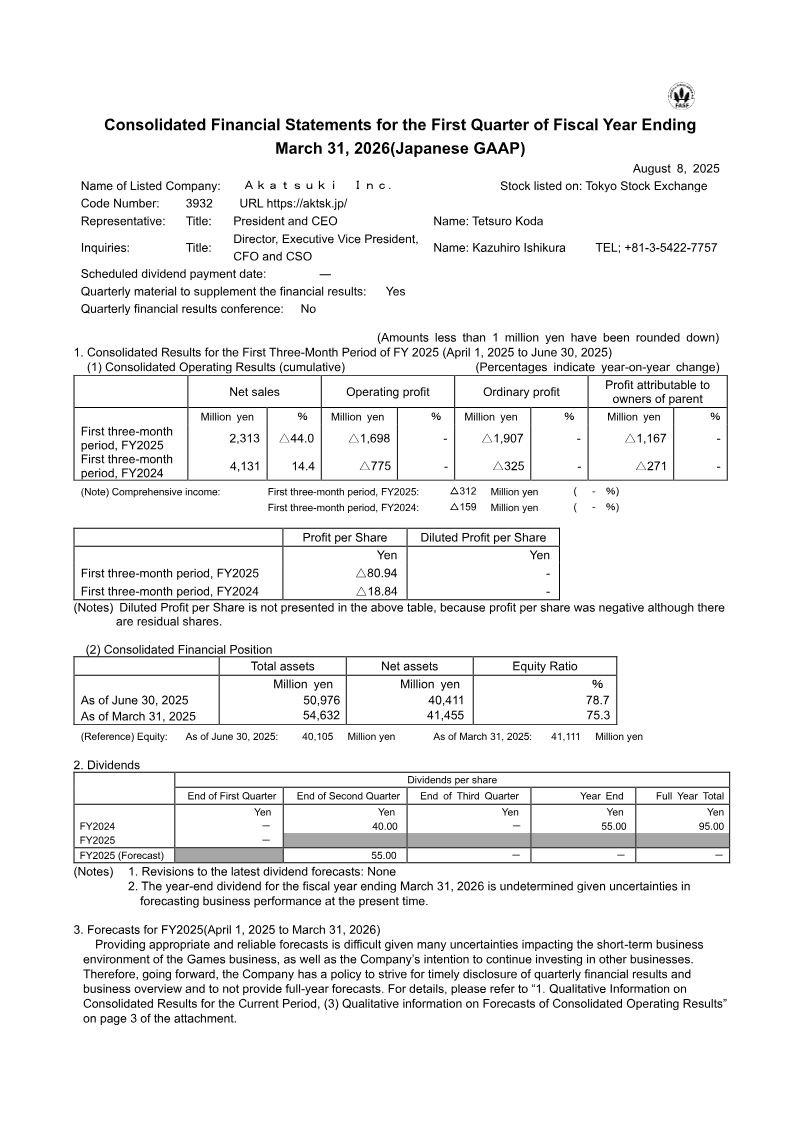
Consolidated Financial Statements: Q1 Fiscal Year 2026 (Japan)
Akatsuki Inc. reports a first‑quarter fiscal 2025 performance that reflects a sharp contraction in its core gaming and comics businesses amid a challenging macro‑environment. Net sales fell 44 % YoY to ¥2,313 million, while operating loss widened to ¥1,698 million from a prior‑year loss of ¥775 million. The company’s consolidated equity ratio improved to 78.7 % from 75.3 %, but total assets declined by ¥3,656 million to ¥50,976 million. Net loss attributable to parent shareholders reached ¥1,167 million, a significant increase from the prior‑year loss of ¥271 million. Comprehensive income deteriorated to ¥312 million in losses versus ¥159 million previously.
Segment analysis shows the Games unit suffered a 52.3 % sales decline and an operating loss of ¥1,643 million; the Comics unit posted a modest profit of ¥20 million after an 18.3 % sales drop; the newly standalone IP Solutions unit grew sales by 167 % and generated a ¥122 million profit, largely driven by the inclusion of subsidiary CRAYON, Inc. The Others segment recorded a small profit after an 80.9 % sales increase.
Geographically, the report focuses on Japan with no disclosed overseas revenue breakdown. Methodologically, figures are based on Japanese GAAP quarterly consolidation; no full‑year forecasts are provided due to market uncertainty. The company maintains a policy of timely quarterly disclosure while withholding FY2026 forecasts, citing volatile gaming and investment conditions.
- Akatsuki Inc. experienced a sharp financial downturn in Q1 FY2025, with net sales falling 44% year-over-year to ¥2,313 million and operating losses widening to ¥1,698 million.
- The core Games unit was the primary driver of the deficit, suffering a 52.3% decline in sales and recording an operating loss of ¥1,643 million.
- Net loss attributable to parent shareholders increased significantly to ¥1,167 million, compared to a ¥271 million loss in the same period last year.
- The IP Solutions unit emerged as a growth driver, increasing sales by 167% and generating a ¥122 million profit, largely due to the inclusion of subsidiary CRAYON, Inc.
- The Comics unit remained marginally profitable at ¥20 million, despite an 18.3% decline in segment sales.
+1
Akatsuki
Report3 pages
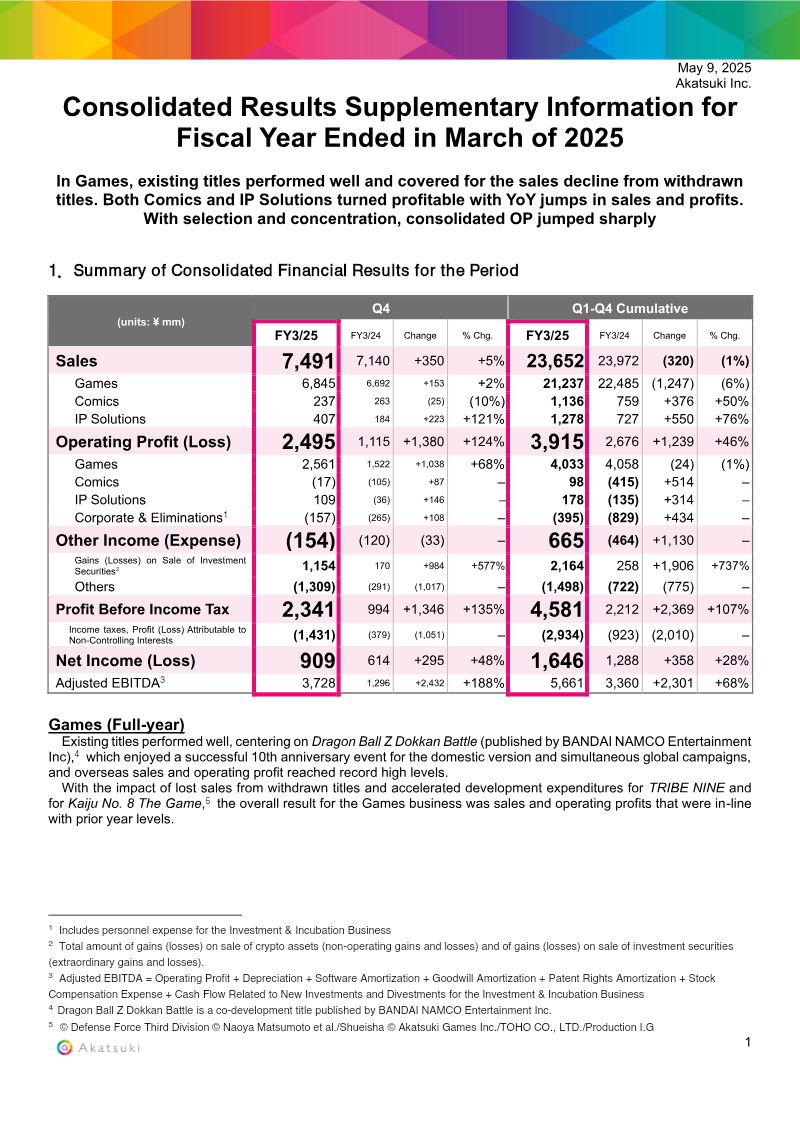
Consolidated Results Supplementary Information: Fiscal Year Ended March 2025
Akatsuki Inc. reported consolidated financial results for fiscal year ended March 2025, showing a modest 5 % increase in sales to ¥23.652 billion compared with the prior year, driven primarily by strong performance of existing games such as Dragon Ball Z Dokkan Battle. Games sales rose 2 % to ¥21.237 billion, while comics and IP Solutions segments returned to profitability with 10 % and 121 % year‑over‑year sales gains, respectively. Operating profit surged 124 % to ¥3.915 billion, largely due to a sharp rise in operating profit from games (68 % increase) and significant gains on the sale of investment securities, which contributed ¥1.154 billion to profit before tax.
Net income increased 48 % to ¥1.646 billion, supported by a 28 % rise in adjusted EBITDA (¥5.661 billion). The company’s balance sheet remained solid, with total assets of ¥54.632 billion and net assets of ¥41.455 billion, while total liabilities decreased to ¥13.177 billion. Cash balances were maintained at ¥33.300 billion, reflecting disciplined working‑capital management.
The results cover the Japanese market and global operations for games, comics, and IP solutions. Methodology includes consolidated financial statements with adjustments for investment and incubation business personnel expenses, and gains on crypto asset sales are classified as non‑operating. Overall, Akatsuki’s selective focus on high‑performing titles and profitable IP solutions has driven a sharp improvement in operating profitability despite the withdrawal of some titles.
- Akatsuki Inc. reported a 124% surge in operating profit to ¥3.915 billion for the fiscal year ended March 2025, driven by a 68% increase in gaming segment profit and ¥1.154 billion in gains from the sale of investment securities.
- Total sales grew 5% year-over-year to ¥23.652 billion, supported by the continued strong performance of existing titles like Dragon Ball Z Dokkan Battle.
- Net income rose 48% to ¥1.646 billion, while adjusted EBITDA increased 28% to ¥5.661 billion.
- The comics and IP Solutions segments returned to profitability, recording year-over-year sales gains of 10% and 121%, respectively.
- The company maintained a strong financial position with ¥33.300 billion in cash and a reduction in total liabilities to ¥13.177 billion.
+1
Akatsuki
Report12 pages
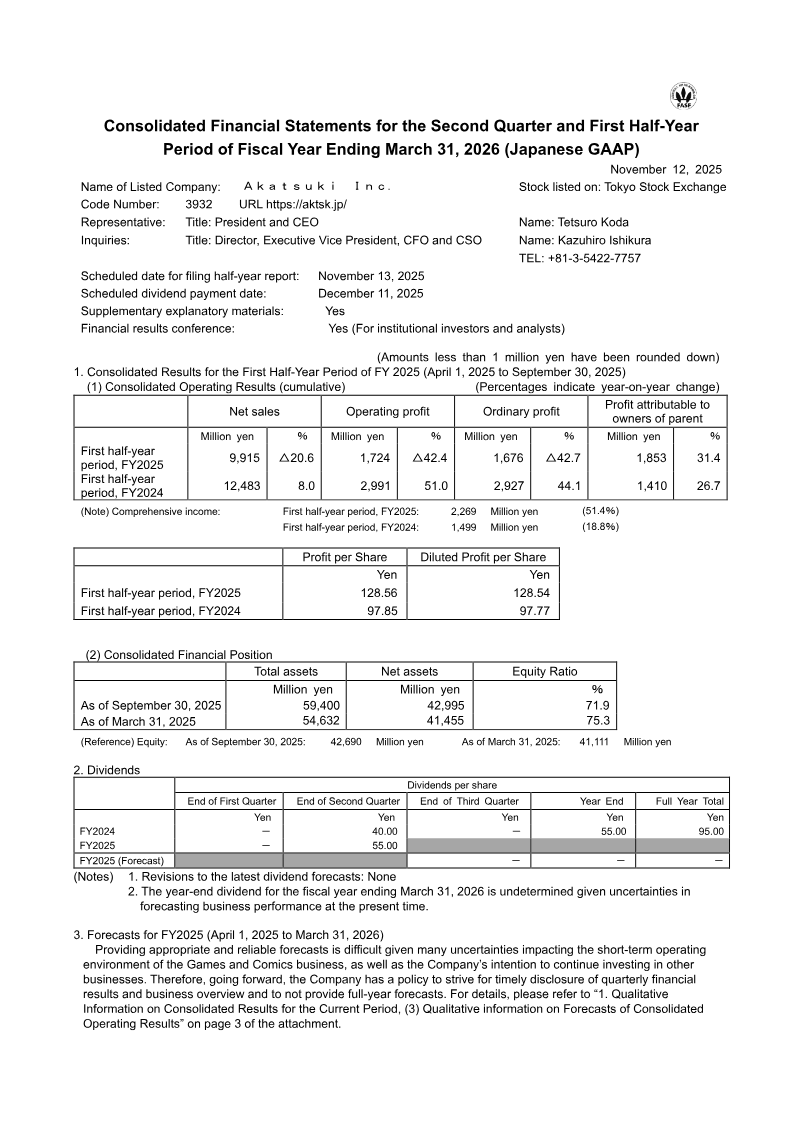
Consolidated Financial Statements: Second Quarter and First Half-Year Period of Fiscal Year Ending March 31, 2026
Akatsuki Inc. reports consolidated financial results for the first half of fiscal year ending March 31, 2026 (April 1–September 30, 2025). Net sales fell 20.6 % YoY to ¥9,915 million, while operating profit declined 42.4 % to ¥1,724 million; ordinary profit dropped 42.7 % to ¥1,676 million, yet net income attributable to parent rose 31.4 % to ¥1,853 million, driven by a higher comprehensive income of ¥2,269 million versus ¥1,499 million the prior year. Profit per share diluted increased from ¥97.85 to ¥128.56. Total assets grew to ¥59,400 million, with net assets rising to ¥42,995 million and equity ratio improving to 71.9 %. Cash flows from operating activities were modest at ¥369 million, while investing cash outflows of ¥5,433 million reflected significant purchases of investment securities and intangible assets. Financing activities generated net inflows of ¥1,775 million, offset by dividends paid of ¥795 million.
Segment analysis shows the Games and Comics business experienced a 23.2 % sales decline to ¥9,257 million and a 41.2 % profit drop, whereas the Entertainment and Lifestyle segment grew sales by 76.1 % to ¥649 million, achieving a 90.7 % profit increase. The Others segment recorded a sharp sales decline and continued losses.
The report notes significant consolidation changes: six new subsidiaries, including CRAYON Inc., were added; Akatsuki Fukuoka was liquidated. Goodwill increased by ¥4,316 million due to acquisitions of Natee and PAPABUBBLE JAPAN. No full‑year forecasts are provided, reflecting uncertainty in the Games and Comics market and ongoing investment plans.
- Akatsuki Inc. reported a 20.6% YoY decline in net sales to ¥9,915 million and a 42.4% drop in operating profit to ¥1,724 million for the first half of the fiscal year ending March 31, 2026.
- Net income attributable to the parent rose 31.4% to ¥1,853 million, with diluted earnings per share increasing from ¥97.85 to ¥128.56.
- The core Games and Comics segment, which accounts for the majority of revenue, saw a 23.2% sales decline and a 41.2% drop in profit.
- The Entertainment and Lifestyle segment showed strong growth, with sales increasing 76.1% to ¥649 million and profit rising 90.7%.
- The company increased goodwill by ¥4,316 million following the acquisitions of Natee and PAPABUBBLE JAPAN, while investing cash outflows reached ¥5,433 million.
+1
Akatsuki
Report4 pages
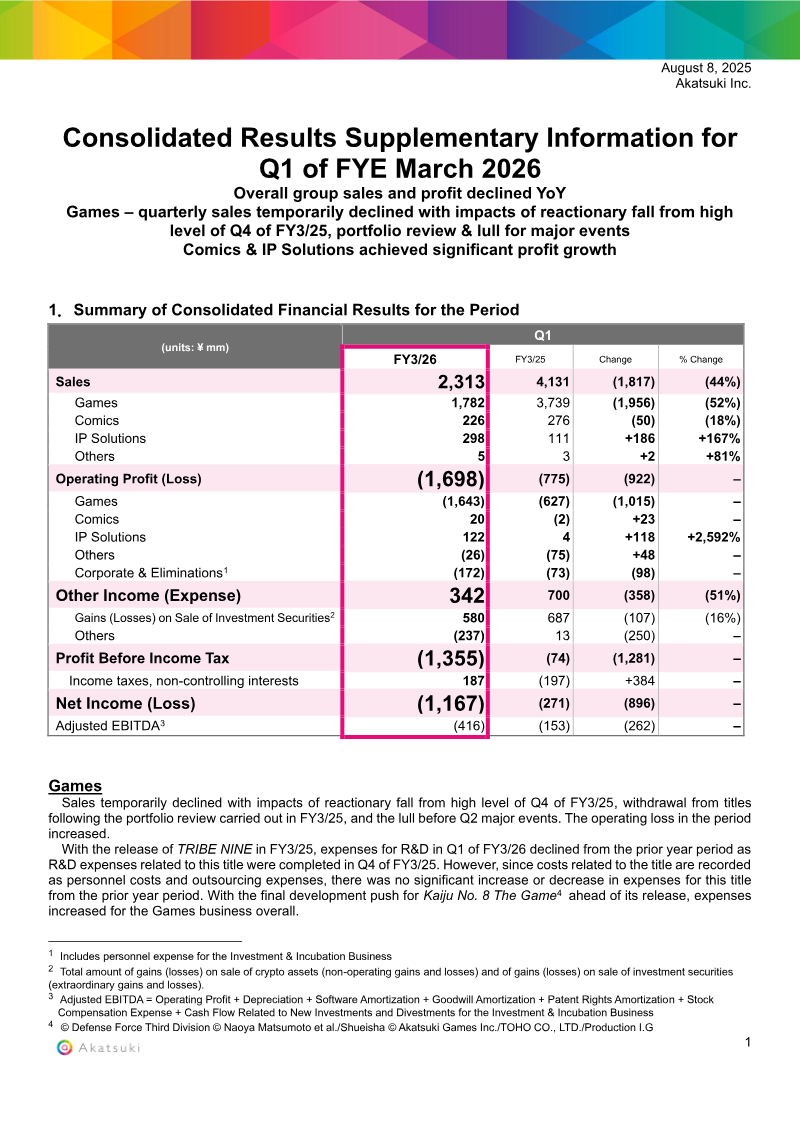
Consolidated Results Supplementary Information: Q1 FYE March 2026
Akatsuki Inc. reported a sharp decline in consolidated sales and operating results for Q1 of the fiscal year ending March 2026, with total group sales falling 44% YoY to ¥2,313 million. The Games segment suffered the largest hit, dropping 52% to ¥1,782 million and recording an operating loss of ¥1,643 million, largely due to a post‑Q4 portfolio review withdrawal and the absence of high‑profile releases. R&D spending for the Games business fell from the previous year as development on “TRIBE NINE” concluded, but costs for the upcoming title “Kaiju No. 8 The Game” increased personnel and outsourcing expenses.
In contrast, the Comics division saw a modest 18% sales decline to ¥226 million but improved profitability, with operating profit rising from a loss of ¥2 million to ¥20 million. The division’s focus on original works and continued service provision to the overseas platform MANGA MIRAI contributed to this turnaround. The IP Solutions unit experienced explosive growth, with sales up 167% to ¥298 million and operating profit soaring 2,592% to ¥122 million, driven by the successful online lottery “Slash Gift” and the inclusion of CRAYON, Inc. in consolidation.
Other income sources shifted, with gains on investment securities decreasing by ¥107 million to ¥580 million. Net income swung from a loss of ¥271 million in FY3/25 to a larger loss of ¥1,167 million in FY3/26, reflecting the combined impact of segment downturns and higher operating losses. Adjusted EBITDA also deteriorated from ¥153 million to a loss of ¥416 million.
The financial data cover the Japanese market, covering all core segments—Games, Comics, IP Solutions, and ancillary services—from Q1 FY3/24 through Q1 FY3/26. The analysis relies on consolidated financial statements, trend tables, and explanatory notes detailing segment performance, expense composition, and investment activity.
- Akatsuki Inc. reported a 44% year-over-year decline in total consolidated sales to ¥2,313 million for Q1 FYE March 2026, resulting in a net loss of ¥1,167 million.
- The Games segment experienced a 52% sales drop to ¥1,782 million and an operating loss of ¥1,643 million, driven by a portfolio review withdrawal and a lack of major new releases.
- The IP Solutions unit achieved significant growth, with sales increasing 167% to ¥298 million and operating profit rising 2,592% to ¥122 million, bolstered by the 'Slash Gift' online lottery and the consolidation of CRAYON, Inc.
- The Comics division improved profitability, turning a ¥2 million loss into a ¥20 million operating profit despite an 18% decline in sales to ¥226 million.
- Adjusted EBITDA for the group deteriorated from a profit of ¥153 million in the previous year to a loss of ¥416 million in Q1 FY3/26.
+1
Akatsuki