Report3 pages
2025 Half-Year Market Model Update: Asia & MENA
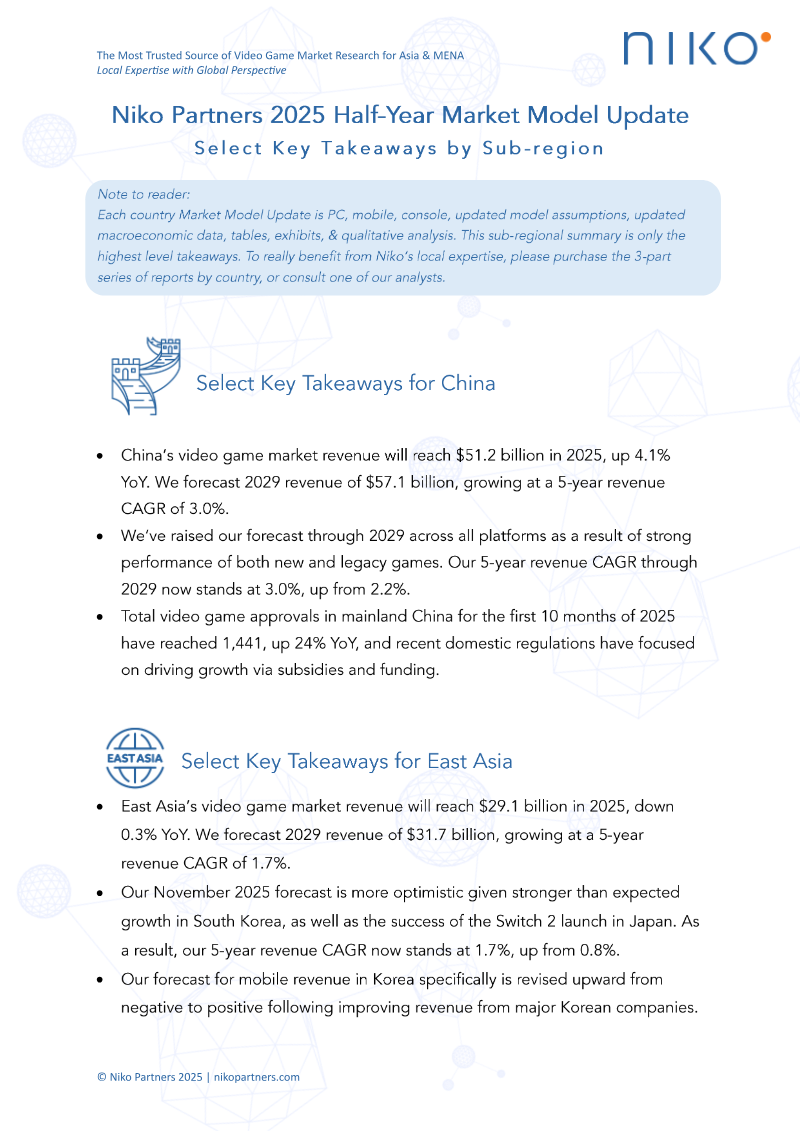
The 2025 Half-Year Market Model Update provides a comprehensive assessment of the video game industry across Asia and the Middle East and North Africa (MENA) region. By synthesizing macroeconomic data, platform-specific performance metrics, and regulatory developments, the analysis offers updated revenue forecasts through 2029 for key markets, including China, East Asia, India, Southeast Asia, and the MENA-3 region. The primary objective is to adjust long-term growth expectations based on recent industry performance, government policy shifts, and evolving consumer behavior.
Regional performance varies significantly, with India emerging as a high-growth market, projected to reach $1.1 billion in 2025 with a robust 12.9% five-year compound annual growth rate (CAGR). China remains the dominant market, with 2025 revenue expected to hit $51.2 billion, supported by a 24% year-over-year increase in game approvals. Conversely, East Asia and Southeast Asia show more moderate growth trajectories, with five-year CAGRs of 1.7% and 3.5%, respectively. The MENA-3 region is forecasted to reach $2.2 billion in 2025, though long-term projections have been tempered by economic headwinds in Egypt and slower mobile growth in Saudi Arabia and the UAE.
Methodologically, these insights are derived from proprietary market models that integrate platform-specific data for PC, mobile, and console segments. The analysis highlights the critical role of government intervention, such as the PROG act in India and regulatory subsidies in China, in shaping market expansion. By updating previous forecasts to reflect current fiscal realities and hardware cycles, such as the Switch 2 launch in Japan, the findings offer a refined outlook for stakeholders navigating the complex regulatory and economic landscapes of these diverse geographic segments.
- China remains the dominant regional market with projected 2025 revenue of $51.2 billion, bolstered by a 24% year-over-year increase in game approvals.
- India is positioned as a high-growth market expected to reach $1.1 billion in 2025 with a 12.9% five-year compound annual growth rate (CAGR).
- The MENA-3 region is forecasted to reach $2.2 billion in 2025, though long-term growth is tempered by economic headwinds in Egypt and slowing mobile performance in Saudi Arabia and the UAE.
- East Asia and Southeast Asia exhibit moderate growth trajectories, with five-year CAGRs of 1.7% and 3.5%, respectively.
- Market expansion across these regions is increasingly driven by government policy, including the PROG act in India and regulatory subsidies in China.
+5
Niko PartnersJan 2025

Report65 pages
The State of AAA Game Advertising: 2023 Review
The 2023 AAA game advertising landscape underwent a strategic pivot toward launch-focused campaigns, with new releases accounting for half of all top-tier spending. This shift reflects a broader industry trend of prioritizing high-impact, multi-channel visibility to capture immediate market share. While YouTube remains the dominant advertising medium for PC and console titles, publishers have increasingly diversified their media mix by integrating Facebook, TikTok, and Instagram to target specific demographics. This evolution in outreach is complemented by a growing reliance on platform-based partnerships, such as deep Xbox branding and hardware collaborations, which serve to anchor major titles within broader ecosystem strategies.
Creative execution in 2023 varied significantly based on the title’s core value proposition. Successful campaigns ranged from the consistent, exploration-themed branding of single-player experiences like Hogwarts Legacy to the dark, horror-inspired aesthetics and live-service integration of titles like Diablo IV. Furthermore, the industry increasingly utilized transmedia efforts and review-based accolades to sustain momentum. However, the year also highlighted the risks of fragmented marketing, as seen with Call of Duty: Modern Warfare III, which suffered from a lack of a cohesive reveal campaign and negative consumer perception regarding its status as a standalone sequel.
Ultimately, the year demonstrated that while massive advertising budgets and established intellectual property remain primary drivers for AAA success, organic viral growth and streamlined gameplay models also provide viable paths to market dominance. The industry is currently defined by a tension between traditional, high-spend multi-channel campaigns and the rising influence of mobile-first strategies and community-driven engagement. As publishers navigate these shifting dynamics, the ability to align creative messaging with specific platform strengths and cross-industry partnerships has become the definitive factor in maintaining visibility within an increasingly competitive global market.
- In 2023, AAA publishers shifted toward launch-focused campaigns, with new releases accounting for 50% of all top-tier advertising expenditure.
- While YouTube remains the primary advertising medium for PC and console games, publishers are increasingly diversifying their media mix by integrating Facebook, TikTok, and Instagram to target specific demographics.
- Strategic platform-based partnerships, such as deep Xbox branding and hardware collaborations, are now essential for anchoring major titles within broader ecosystem strategies.
- The failure of Call of Duty: Modern Warfare III demonstrated that fragmented marketing and a lack of a cohesive reveal campaign can severely damage consumer perception and market performance.
- Successful 2023 campaigns utilized varied creative strategies, ranging from exploration-themed branding for single-player titles like Hogwarts Legacy to horror-inspired aesthetics and live-service integration for Diablo IV.
+3
Sensor TowerJan 2025

Report25 pages
The Big Game Engine Report: 2025
The game engine landscape is undergoing a significant transition as developers increasingly move away from proprietary, in-house solutions in favor of established third-party platforms. This shift is driven by the need for immediate development readiness, access to advanced graphical features like Nanite and Lumen, and the ability to leverage a broader, pre-trained talent pool. While custom engines historically dominated the industry, their market share has declined sharply over the last decade, falling to approximately 13% of new releases by 2024.
Unreal Engine has emerged as the primary beneficiary of this trend, particularly among large-scale AAA studios. By 2024, Unreal Engine and custom engines collectively accounted for the majority of unit sales on Steam, with Unreal Engine 5 becoming the industry standard for high-fidelity projects. Conversely, Unity maintains a dominant position in terms of the sheer volume of games released, particularly within the indie and smaller-scale development sectors. However, Unity faces intensifying competition from smaller, specialized engines like Godot and GameMaker, which have captured a growing segment of the indie market.
The analysis, which covers over 13,000 games released on Steam, utilizes proprietary tagging and estimation methodologies to track engine adoption trends. Data indicates that engine preference is heavily influenced by game scale and genre; high-graphics, large-budget titles skew heavily toward Unreal Engine, while strategy and simulation games remain strongholds for Unity. Looking toward 2030, the industry is expected to see continued consolidation as more studios abandon legacy in-house tools to mitigate the high costs of engine maintenance, further cementing the market dominance of third-party public engines.
- Proprietary in-house engines have seen their market share of new game releases decline to approximately 13% by 2024.
- Unreal Engine 5 has established itself as the industry standard for high-fidelity, large-scale AAA projects.
- Unity maintains market dominance by volume, particularly within the indie and smaller-scale development sectors.
- Engine selection is highly correlated with project type, as high-graphics titles favor Unreal Engine while strategy and simulation games remain concentrated in Unity.
- Specialized engines like Godot and GameMaker are successfully capturing an increasing share of the indie market, intensifying competition for Unity.
+3
VG InsightsJan 2025

Report25 pages
The Big Game Engine Report: End of the Era of In-House Engines
The game engine landscape is undergoing a significant structural shift, characterized by the decline of proprietary in-house technology in favor of established third-party platforms. While custom engines historically dominated the industry, their market share has eroded substantially over the last decade, falling to approximately 13 percent of new releases by 2024. This transition is driven by the increasing complexity of modern development, which makes the maintenance of internal engines cost-prohibitive and less efficient compared to the immediate, high-fidelity capabilities offered by public alternatives.
Unreal Engine has emerged as the primary beneficiary of this trend, particularly within the AAA segment. Following the release of Unreal Engine 5, the platform has successfully reclaimed market share lost during the pandemic, becoming the preferred choice for large-scale, high-budget productions. Conversely, Unity maintains a dominant position in terms of total volume of games released, particularly among indie and smaller developers, though it faces increasing competition from smaller engines like Godot, which has seen notable growth since 2020. Despite Unity’s high release volume, Unreal Engine and custom AAA engines continue to command a larger portion of total units sold, underscoring their prevalence in high-performing commercial titles.
The analysis relies on data from over 13,000 games released on Steam, utilizing proprietary estimation algorithms and tagging methodologies to categorize engine usage by game size, genre, and unit sales. The findings indicate that while the choice of engine is often dictated by project scale—with smaller titles favoring Unity and larger, graphics-intensive projects gravitating toward Unreal Engine—the industry is moving toward a standardized ecosystem. As studios weigh the benefits of third-party support, talent accessibility, and advanced graphical features against the loss of proprietary control, the reliance on external engines is expected to continue its upward trajectory through 2030.
- Proprietary in-house engine usage has declined significantly, accounting for only 13 percent of new game releases by 2024.
- Unreal Engine has become the industry standard for high-budget AAA productions, particularly following the release of Unreal Engine 5.
- Unity maintains the highest total volume of game releases, primarily driven by adoption among indie and smaller-scale developers.
- While Unity leads in release volume, Unreal Engine and custom AAA engines command a larger share of total units sold in the commercial market.
- The open-source Godot engine has experienced notable growth since 2020, emerging as a competitive alternative to established platforms.
+3
Video Game InsightsJan 2025
Report20 pages
The Importance of Wishlists in 2025: Do Wishlists Matter?
Steam wishlists serve as a critical metric for predicting commercial success in the video game industry, functioning as a primary indicator of pre-launch momentum. Data analysis reveals that wishlist distribution is highly top-heavy, with a significant majority of games launching with fewer than 10,000 wishlists, while only a small fraction of titles achieve the 100,000-plus threshold required to reliably forecast a breakout performance. There is a strong 70% correlation between pre-launch wishlist counts and first-month unit sales, particularly for titles that surpass the 100,000-wishlist milestone.
Genre-specific trends highlight that action and adventure titles consistently generate the highest levels of pre-release buzz, often benefiting from the brand equity and marketing budgets of AAA and AA publishers. Conversely, casual and MMO titles frequently rely on post-launch engagement, such as live updates and community building, rather than pre-release wishlist accumulation. Regardless of genre, the timing of a Steam page launch is vital; top-performing games typically establish their presence six to twelve months before release, utilizing a steady stream of trailers and development updates to build and maintain audience interest.
The findings are based on an analysis of games launched on Steam from March 2024 onwards, utilizing proprietary estimation models and industry data. The research emphasizes that while wishlists are not a guarantee of success for every title, they act as a essential barometer for market interest. For developers and publishers, the data underscores that early visibility and sustained marketing efforts are necessary to reach the wishlist tiers that statistically correlate with long-term commercial viability.
- Steam wishlists are a primary indicator of commercial success, showing a 70% correlation between pre-launch counts and first-month unit sales.
- The 100,000-wishlist threshold is the critical benchmark required to reliably forecast a breakout performance for a new title.
- The vast majority of games launch with fewer than 10,000 wishlists, reflecting a highly top-heavy distribution of pre-launch momentum.
- Top-performing titles typically establish their Steam page six to twelve months before release to maintain audience interest through consistent updates.
- Action and adventure games generate the highest pre-release buzz, while casual and MMO titles rely more heavily on post-launch engagement than wishlist accumulation.
+3
Video Game InsightsJan 2025
Report24 pages
Key Insights into Shooter Games
Shooter games represent the fifth highest‑earning genre worldwide, generating approximately $2.24 billion in 2022 across all platforms. The report focuses on the genre’s popularity, player demographics, engagement patterns, and monetization strategies within a global context that excludes China and India. Data derive from Newzoo’s Global Games Market, Consumer Insights – Games & Esports 2022, and the Newzoo Expert platform, covering 37 markets with a sample of 19,544 recent shooter players and 60,020 broader gamers.
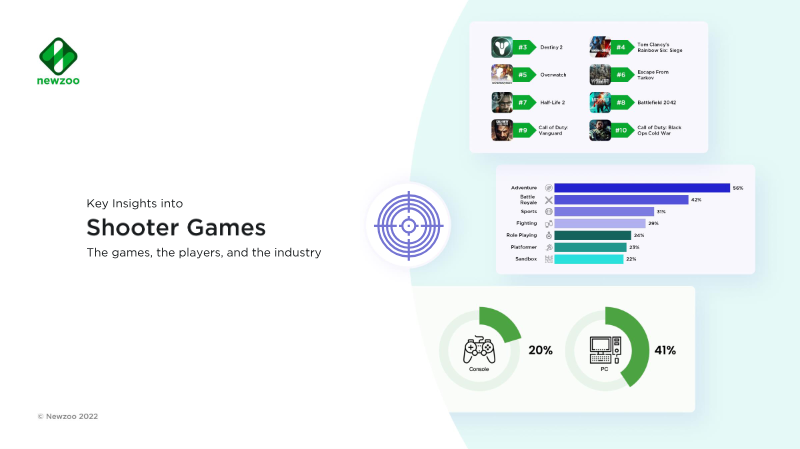
Key findings show that shooters dominate PC and console play, with 68 % of monthly active users (MAU) on these platforms also engaging in shooter titles. Player overlap with other genres is high: 56 % of shooter players also play adventure games, while strategy and simulation overlap remains low. The contemporary war theme and level‑based mechanics are the most common in shooter titles. Monetization is overwhelmingly pay‑to‑play; 97 % of shooter players experience in‑app purchases, and advertising is the least used model.
Demographically, core personas—Ultimate Gamers and All‑Round Enthusiasts—account for the largest shooter player base, yet nearly all persona groups play shooters. Motivations to spend include social interaction and access to special offers, with 13,659 of the 19,544 shooter players identified as payers. Live‑streaming data indicate that shooters rank highly on Twitch and Facebook Gaming, reinforcing the genre’s strong community presence. The report underscores shooters’ robust revenue streams, broad demographic appeal, and central role in competitive online play.
- Shooter games generated approximately $2.24 billion in 2022 across 37 global markets, excluding China and India.
- Shooters are a dominant force on PC and console platforms, capturing 68% of monthly active users.
- Monetization in the genre is heavily driven by in-app purchases, which are experienced by 97% of shooter players, while advertising remains the least utilized revenue model.
- Shooter players exhibit high cross-genre engagement, with 56% of the player base also participating in adventure games.
- The genre maintains a strong community presence and competitive profile, consistently ranking highly on streaming platforms like Twitch and Facebook Gaming.
+2
NewzooJan 2025

Report13 pages
China Game Industry Report 2025
The China Game Industry Report for 2025 presents a comprehensive assessment of the domestic and overseas gaming markets, highlighting sustained growth driven by youth protection initiatives, technological innovation, and cross‑sector integration. In 2025, China’s self‑developed mobile games generated US$20.455 billion in overseas revenue, a 10.23% year‑on‑year increase and the sixth consecutive year surpassing RMB 100 billion. Strategy games, including SLG, dominated overseas earnings at 49.97%, followed by shooters (9.69%) and RPGs (9.39%). The United States remains the largest market, contributing 32.31% of overseas revenue, with Japan (16.35%) and South Korea (9.15%) also significant.
Domestically, mobile games accounted for 73.29% of total sales, with MOBA leading at 19.45%, followed by shooting (18.29%) and RPG (15.10%). The domestic console market expanded sharply, reaching RMB 8.362 billion (US$1.18 billion) in 2025, a 37.38% year‑on‑year rise, driven by both software and hardware sales.
Global market projections indicate the worldwide gaming industry will reach RMB 130.17 billion in 2025, with mobile gaming contributing RMB 66.69 billion—a growth rate of 4.93%, slower than previous years but still positive.
Methodologically, the report aggregates data from CADPA’s industry surveys and market analyses, covering 2020‑2025 for domestic sales and 2019‑2025 for overseas performance. The findings underscore a resilient Chinese gaming sector, poised to maintain strong export growth while deepening domestic diversification across mobile and console platforms.
- Chinese self-developed mobile games generated US$20.455 billion in overseas revenue in 2025, marking a 10.23% year-on-year increase and the sixth consecutive year exceeding RMB 100 billion.
- The United States remains the primary overseas market for Chinese games, accounting for 32.31% of total export revenue, followed by Japan at 16.35% and South Korea at 9.15%.
- Strategy games (SLG) dominate the overseas market, capturing 49.97% of earnings, significantly outpacing shooters at 9.69% and RPGs at 9.39%.
- The domestic Chinese console market experienced a sharp 37.38% year-on-year growth in 2025, reaching a total value of RMB 8.362 billion (US$1.18 billion).
- Mobile gaming continues to lead the domestic market, representing 73.29% of total sales, with MOBA (19.45%), shooting (18.29%), and RPG (15.10%) as the top-performing genres.
+4
Meridian PlayJan 2025

Report25 pages
The Big Game Engine Report of 2025
The Big Game Engine Report 2025 examines the shifting landscape of game development technology, focusing on the transition from proprietary in-house tools to third-party public engines. The analysis covers over 13,000 games released on Steam, tracking market share trends from 2012 through 2024 with projections reaching 2030. Findings are based on proprietary estimations and tagging methodologies that categorize engines into three tiers: dominant public engines (Unity and Unreal), smaller public engines (Godot, GameMaker, RPG Maker), and custom in-house engines used by major AAA studios.
The central thesis posits that the era of dominant in-house engines is ending as major studios increasingly adopt Unreal Engine 5 to reduce maintenance costs and access a broader talent pool. While custom engines powered over 70% of Steam releases in 2012, they accounted for only 13% of releases in 2024. In terms of commercial performance, custom engines still represent 42% of units sold, but this is the first time they have fallen below the 50% threshold. Unreal Engine has capitalized on this shift, particularly in the AAA space, while Unity remains the leader in sheer volume, powering 51% of all 2024 releases.
The data highlights a clear correlation between game size and engine choice. Unity dominates the "Tiny" and "Small" categories (under 100k units), whereas custom engines and Unreal Engine control the "Large" segment (over 1M units). Emerging trends show Godot as the fastest-growing smaller engine, driving over two-thirds of the growth in its tier since 2020. Looking forward, the industry expects a continued migration toward Unreal Engine 5, with Unity projected to face increasing pressure from open-source alternatives like Godot in the indie sector while struggling to gain further ground in the high-end AAA market.
- The share of Steam releases powered by custom in-house engines plummeted from over 70% in 2012 to 13% in 2024.
- Custom engines have fallen below 50% of total unit sales for the first time, currently accounting for 42% of the market.
- Unity remains the volume leader, powering 51% of all Steam releases in 2024, primarily dominating the 'Tiny' and 'Small' categories under 100k units.
- Major AAA studios are increasingly migrating to Unreal Engine 5 to reduce maintenance costs and access a larger talent pool, solidifying its control over the 'Large' segment of games exceeding 1M units.
- Godot is the fastest-growing smaller engine, accounting for over two-thirds of the growth within its tier since 2020.
Video Game InsightsJan 2025

Report117 pages
State of Gaming & Influencer Marketing 2025
The global gaming industry has entered a period of stabilization, with 2024 revenues reaching $187.7 billion and a projected player base of 4 billion by 2027. While mobile gaming remains the dominant sector, accounting for nearly half of all revenue at $92.6 billion, the market is undergoing a structural shift. PC gaming has emerged as a primary growth driver, evidenced by Steam’s record $10.8 billion revenue in 2024 and a historic surge in indie game sales, which surpassed AA and AAA titles for the first time. This evolution is supported by a transition toward hybrid monetization, cross-platform experiences, and a hardware market projected to reach $120 billion by 2028.
Influencer marketing has become an indispensable pillar of this ecosystem, with spending expected to hit $32.55 billion by 2025. The landscape is moving away from raw traffic metrics toward "influence quality," where authentic storytelling and niche engagement take precedence over total follower counts. Nano-influencers, particularly on platforms like TikTok and Twitch, are achieving engagement rates exceeding 10%, significantly outperforming larger creators. While Instagram remains the preferred platform for 90% of brand partnerships, the rise of AI-driven optimization and virtual influencers is reshaping how content is produced and consumed across YouTube and emerging platforms like Kick.
Successful game launches now rely on sophisticated, multi-platform influencer funnels that utilize early access marathons and Twitch Drops to convert awareness into long-term community advocacy. As social commerce expands globally, particularly following its success in Asian markets, the industry is prioritizing long-term strategic planning over short-term user acquisition. The integration of AI tools, augmented reality, and direct-shopping features indicates a future where gaming and creator content are inextricably linked, requiring brands to adopt agile, data-driven strategies to maintain loyalty in an increasingly fragmented global market.
- The global gaming industry reached $187.7 billion in 2024, with mobile gaming remaining the dominant sector at $92.6 billion and the total player base projected to hit 4 billion by 2027.
- PC gaming is a primary growth driver, highlighted by Steam’s record $10.8 billion revenue in 2024 and indie game sales surpassing those of AA and AAA titles for the first time.
- Influencer marketing spending is projected to reach $32.55 billion by 2025, with a strategic shift toward niche engagement and nano-influencers who achieve engagement rates exceeding 10%.
- The gaming hardware market is projected to reach $120 billion by 2028, supported by a broader industry transition toward cross-platform experiences and hybrid monetization.
- While 90% of brand partnerships currently favor Instagram, the industry is increasingly adopting AI-driven optimization, virtual influencers, and multi-platform funnels like Twitch Drops to drive long-term community advocacy.
+1
AAA AgencyJan 2025

Report65 pages
The State of AAA Game Advertising: A Look Back on the Biggest Launches and Trends of the Past Year
The 2023 PC and console gaming landscape was defined by a strategic pivot toward new title launches, which commanded 50% of top advertising expenditures compared to only 20% the previous year. While established live-service giants like Fortnite maintained the highest individual ad spend at $57 million, new AAA releases such as Hogwarts Legacy and Diablo IV dominated the market through concentrated, multi-platform campaigns. Marketing budgets increasingly diversified across a broader media mix; although YouTube remained the primary channel with 35% of spend, platforms like TikTok, Instagram, and Over-the-Top services captured significant market share by utilizing short-form video content to drive engagement.
Success in the AAA sector relied on distinct promotional philosophies tailored to specific business models. Diablo IV leveraged a live-service framework and extensive open betas to generate $666 million in five days, while Starfield utilized its inclusion in Xbox Game Pass to balance traditional sales with subscription-based accessibility. Marketing tactics for these titles ranged from long-term anticipation building to high-frequency social media accolades. Conversely, franchises facing critical headwinds, such as Call of Duty: Modern Warfare III, shifted their focus from celebrity-driven advertisements to influencer-led content and innovative cross-media partnerships with film and music icons to sustain momentum despite declining initial sales.
The industry also witnessed the growing power of transmedia synergy and organic virality. The Fallout television series demonstrated the potential of cross-media adaptations by triggering a sixfold increase in mobile downloads and renewed interest in the legacy franchise. Similarly, Honkai: Star Rail illustrated how mobile-first spending can successfully drive multi-platform engagement. However, the emergence of titles like Lethal Company and PalWorld proved that traditional high-budget marketing is not the only path to success, as viral gameplay and creator-driven interest can achieve millions of sales with minimal advertising investment. This evolution highlights a market where massive corporate spending and organic digital trends coexist as primary drivers of commercial performance.
- AAA advertising shifted heavily toward new title launches in 2023, which accounted for 50% of total ad spend compared to just 20% in the previous year.
- YouTube remains the dominant advertising channel at 35% of total spend, though marketing budgets are increasingly diversifying into TikTok, Instagram, and OTT services to leverage short-form video engagement.
- High-budget marketing is no longer the sole path to success, as titles like Lethal Company and PalWorld achieved millions of sales through viral gameplay and creator-driven interest with minimal ad investment.
- Transmedia synergy is a proven growth driver, evidenced by the Fallout television series triggering a sixfold increase in mobile downloads for the legacy franchise.
- Individual ad spending remains high for established live-service titles, with Fortnite leading the market at $57 million in annual advertising expenditure.
+2
Sensor TowerJan 2025

Report37 pages
Starfield: How It Achieved 10M Players
The marketing and commercial performance of Bethesda’s Starfield reflects a strategic evolution in digital promotion, transitioning from traditional trailer-based campaigns to a diversified, multi-channel approach. By prioritizing platforms like TikTok, Twitch, and Instagram during the 2023 pre-order phase, the campaign successfully built massive momentum, culminating in the title reaching the top of Steam’s Wishlist and securing over 300,000 followers prior to launch. A critical component of this success was the integration with Microsoft’s ecosystem, specifically leveraging "Day One on Game Pass" messaging and Bing’s AI search capabilities to maximize visibility and accessibility across the Xbox and PC markets.
Upon release, the title became the largest launch in Bethesda’s history, surpassing 10 million players despite a highly competitive landscape featuring major RPG rivals. This achievement was supported by a substantial $21.2 million advertising investment, which ranked second in the RPG category for the year. A significant portion of this budget—over one-third—was allocated to Over-the-Top (OTT) advertising, signaling a shift toward high-impact streaming services. While the game achieved a favorable critical reception with a Metacritic score of 84, user sentiment remained polarized across Steam and Game Pass, and initial Twitch viewership saw a steady decline following the early-access period.
The broader industry context for these findings is supported by digital marketing intelligence that tracks competitor spending, creative messaging, and regional targeting. By analyzing spend patterns across social and digital platforms, the data illustrates how major publishers are increasingly moving away from centralized video platforms toward fragmented, high-engagement social media and streaming services to capture audience attention in a crowded marketplace. This analysis covers the primary 2021 to 2023 launch window, focusing on the global RPG segment and the shifting dynamics of digital ad distribution.
- Starfield reached 10 million players at launch, marking the largest release in Bethesda’s history despite a competitive RPG market.
- The marketing campaign utilized a $21.2 million advertising budget, the second-highest in the RPG category for 2023.
- Over one-third of the total advertising budget was allocated to Over-the-Top (OTT) streaming services, reflecting a strategic shift toward high-impact digital distribution.
- Pre-launch momentum was driven by a multi-channel social strategy on TikTok, Twitch, and Instagram, resulting in over 300,000 followers and the top spot on Steam’s Wishlist.
- Integration with the Microsoft ecosystem, specifically 'Day One on Game Pass' messaging and Bing’s AI search, was critical to maximizing visibility across Xbox and PC.
+2
Sensor TowerJan 2025
Report6 pages
2025 eSports Player Rankings: By Game and Earnings in Korea
South Korea’s professional gaming landscape is characterized by a title-centered evaluation system where prize earnings are highly concentrated among elite players. Analysis of the country’s top eSports competitors across five major PC-based titles—League of Legends, StarCraft II, Valorant, Overwatch 2, and PlayerUnknown’s Battlegrounds (PUBG)—reveals significant disparities in cumulative wealth based on the longevity and global scale of each game’s competitive scene.
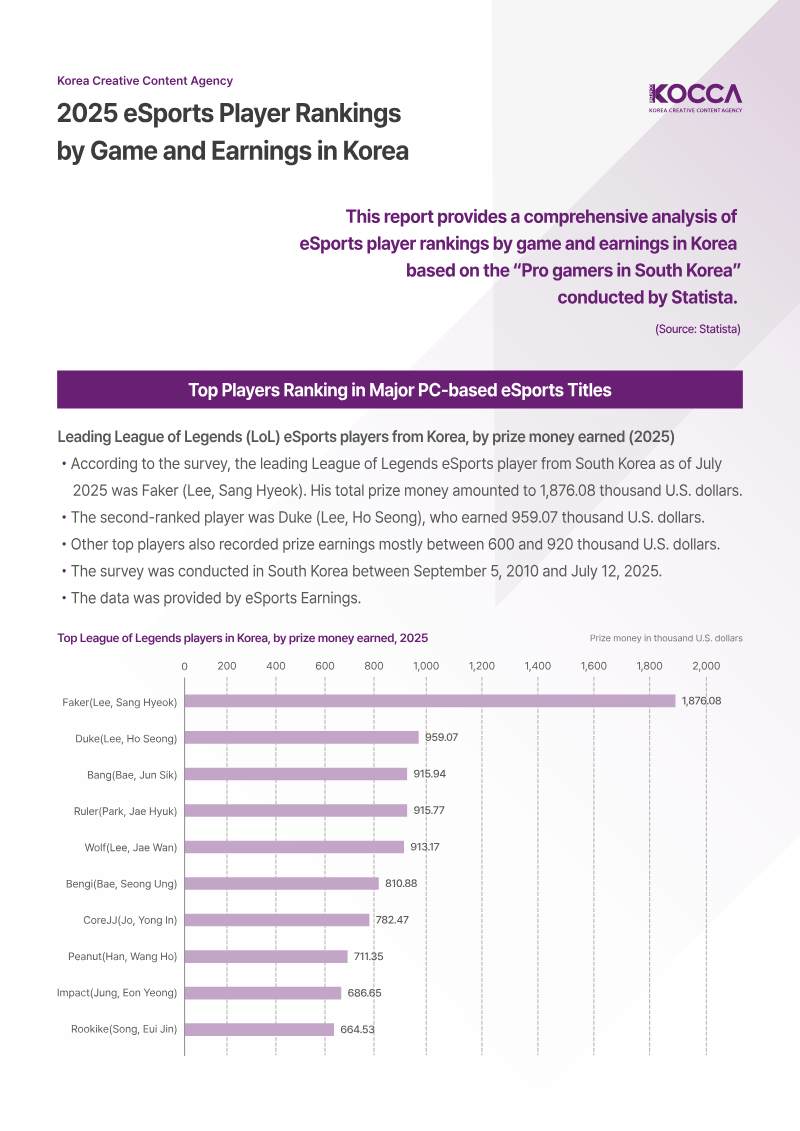
League of Legends remains a dominant sector, with Lee Sang-hyeok (Faker) leading all players with approximately $1.88 million in prize money as of July 2025. This exceeds the top earners in other disciplines, such as Cho Sung-choo (Maru) in StarCraft II, who earned $1.39 million, and Park Jung-young (Loki) in PUBG, who secured $1.25 million. In contrast, newer or more recently transitioned titles like Overwatch 2 and Valorant show lower cumulative earnings, with top players Choi Tae-min (MER1T) and Kim Jong-min (Lakia) earning $375,450 and $164,980 respectively.
The data, sourced from eSports Earnings and compiled by the Korea Creative Content Agency, utilizes a longitudinal methodology tracking performance from as early as 2010 through mid-2025. While the rankings for League of Legends, StarCraft II, and Valorant reflect 2025 figures, the data for Overwatch 2 and PUBG is current through late 2024. This segmentation highlights a fragmented domestic performance structure where success is measured by game-specific milestones rather than a unified national ranking. The findings underscore a mature market where established titles continue to provide the highest financial returns for top-tier professional talent.
- League of Legends remains the most lucrative eSports title in South Korea, with top earner Lee Sang-hyeok (Faker) accumulating $1.88 million in prize money as of July 2025.
- Established titles offer significantly higher financial returns than newer games, as evidenced by StarCraft II leader Cho Sung-choo earning $1.39 million and PUBG leader Park Jung-young earning $1.25 million.
- Newer competitive titles show a substantial earnings gap compared to legacy games, with top Overwatch 2 player Choi Tae-min earning $375,450 and Valorant leader Kim Jong-min earning $164,980.
- The South Korean professional gaming market lacks a unified national ranking system, relying instead on a fragmented structure where success is measured by game-specific milestones.
- Data compiled by the Korea Creative Content Agency indicates that cumulative wealth in the sector is heavily concentrated among elite players at the top of their respective disciplines.
+1
KOCCA – Korea Creative Content AgencyJan 2025

Report4 pages
Top Game Creators Academy: Tokyo Game Show 2025 Exhibition
Top Game Creators Academy (TGCA) is being introduced to the public for the first time at the Tokyo Game Show 2025, where it will occupy Hall 10’s organizer’s corner. The initiative, run by the Computer Entertainment Association in partnership with the Agency for Cultural Affairs and the Japan Arts & Culture Promotion Agency, aims to accelerate the development of next‑generation game creators by pairing them with active industry advisors and providing exposure through domestic and international events. The exhibition showcases ten emerging developers, each presenting a work‑in‑progress title ranging from an online cooperative 3D jump‑action (IN HARNESS) to a 2D puzzle platformer (Out of Skull), a collaborative “game‑making relay” (カラクリリレー!), a first‑person horror action (Ghost in the brain), a formula‑driven shooter (CYBER JANITOR), a rhythm‑action experience (OVER BEATS MYSELF), an exploratory RPG (Recover from Ruin), a 2D stealth‑action novel (Near The Sun), and a competitive typing‑board hybrid (NyctoType). All projects remain under development and may evolve before final release.
The program, launched in April 2025, is structured as a two‑year pipeline in which creators receive ongoing mentorship and are encouraged to gather visitor impressions as direct feedback for iterative improvement. Although no quantitative metrics are provided, the breadth of genres and innovative mechanics underscores TGCA’s commitment to diversifying Japan’s game development talent pool and facilitating global market entry. The announcement concludes with a call for attendees to submit their reactions, positioning audience interaction as a core component of the creators’ growth trajectory.
- The Computer Entertainment Association, in partnership with the Agency for Cultural Affairs and the Japan Arts & Culture Promotion Agency, launched the Top Game Creators Academy (TGCA) in April 2025 to accelerate the development of next-generation talent.
- The TGCA program utilizes a two-year pipeline structure that pairs emerging developers with active industry advisors to facilitate professional growth and global market entry.
- Ten emerging developers are debuting work-in-progress titles at the Tokyo Game Show 2025 in Hall 10, representing diverse genres including 3D action, 2D puzzle platformers, horror, and rhythm-action.
- Audience interaction is a core component of the program, with creators actively soliciting visitor feedback at the Tokyo Game Show to drive iterative improvements for their projects.
- The initiative aims to diversify Japan’s game development talent pool by providing creators with exposure through both domestic and international industry events.
+3
CESA – Computer Entertainment Supplier's AssociationJan 2025
Report23 pages
PC & Console Year in Review 2025
Alinea Analytics provides a comprehensive review of the PC and console gaming market for 2025, offering data-driven insights into player behavior, revenue trends, and regional growth. The analysis highlights a year defined by the continued rise of indie and "Triple-I" titles, which accounted for over 25% of Steam’s revenue. Major success stories like RimWorld’s Odyssey DLC, which earned $10 million to date, and the rapid development of viral hits like RV There Yet? underscore a market where high return on investment is increasingly decoupled from massive studio sizes.
Geographically, the report identifies China as a dominant force, ranking as the top market for Steam and the fifth for PlayStation. This surge is attributed to the momentum of titles like Black Myth: Wukong, with Chinese players making up a significant percentage of the audience for games such as Escape from Duckov and Monster Hunter Wilds. In Europe, the Swedish development scene saw a massive year, capturing significant market share through titles like R.E.P.O. and Split Fiction.
Technical and genre trends show Unreal Engine maintaining its position as the industry standard for AA and AAA development, while Unity remains the backbone for indie successes. Co-op games emerged as a primary revenue driver, representing 11 of the top 20 highest-grossing titles. While adventure and RPGs remain popular, "cute" and "realistic" tags saw the highest year-over-year revenue growth. The data also notes a shift in marketing dynamics: while wishlist campaigns are now standard—requiring nearly 200,000 wishlists to break the top 200 most-anticipated list—conversion rates have declined, placing greater emphasis on post-launch player reception and "shadow drops" for viral success.
- Indie and 'Triple-I' titles have become a major market force, accounting for over 25% of total Steam revenue in 2025.
- Co-op games are a primary revenue driver, representing 11 of the top 20 highest-grossing titles of the year.
- China has emerged as a dominant global market, ranking as the top region for Steam and the fifth for PlayStation, largely driven by the success of titles like Black Myth: Wukong.
- Marketing dynamics have shifted as wishlist conversion rates decline, with developers now requiring nearly 200,000 wishlists to break into the top 200 most-anticipated games list.
- Unreal Engine remains the industry standard for AA and AAA development, while Unity continues to serve as the primary engine for indie market successes.
+1
Alinea AnalyticsJan 2025
Report41 pages
PC/Console Gaming Index: A Look at the Top Games, Publishers, and Platforms in 2025 So Far
The 2025 PC and console landscape is dominated by Steam, which recorded 450 million downloads and is projected to achieve a record $12 billion in premium revenue, reflecting a 15 percent year‑to‑date increase. PlayStation and Xbox follow with 376 million and 283 million downloads respectively, underscoring Steam’s clear lead in both user acquisition and monetisation. Across the combined market, action titles command the highest demand at 262 million downloads, while shooters and role‑playing games attract 189 million and 131 million downloads, indicating a strong preference for high‑intensity, narrative‑driven experiences among gamers.
Premium revenue accounts for the majority of earnings on the leading platforms, with Steam generating 79 percent of its income from premium sales and PlayStation reaching 83 percent, highlighting the continued viability of upfront purchase models despite the growth of free‑to‑play alternatives. The data suggest that while free‑to‑play titles remain a significant segment, the premium‑heavy ecosystem retains a decisive advantage in revenue generation.
Overall, the findings illustrate a globally integrated market in 2025 where PC distribution via Steam outpaces console rivals, genre preferences skew toward action‑oriented titles, and premium monetisation continues to dominate the financial structure of the industry.
- Steam leads the 2025 PC and console market with 450 million downloads and a projected $12 billion in premium revenue, representing a 15 percent year-to-date increase.
- Premium purchase models remain the primary revenue driver, accounting for 79 percent of Steam's income and 83 percent of PlayStation's earnings.
- Steam outperforms console competitors in user acquisition, recording 450 million downloads compared to 376 million for PlayStation and 283 million for Xbox.
- Action titles are the most popular genre in 2025, generating 262 million downloads across the combined market.
- Shooters and role-playing games follow action titles in popularity, attracting 189 million and 131 million downloads respectively.
+1
Sensor TowerJan 2025
Report36 pages
Gaming Industry Report: Q3 2024
• 2024 market size: $188bn (+2.1% YoY) Total gamers in 2024 by region (millions): • Public markets: leading public gaming ETFs up 22- • 36% YTD (vs S&P 500 = 21%) Middle East & Africa Venture funding in Q3‘ 24: $517m across 92 deals 559 (funding +1% QoQ, number of deals -14% QoQ) (16%) • Epic sidesteps Apple in the EU, sues Google Europe (454 3,422m • Discord launches Activities ...
- The gaming market size in 2024 is $188 billion, showing a 2.1% year-over-year growth. Asia-Pacific accounts for the largest share of gamers with 1,809 million (53%), followed by Europe with 454 million (13%).
- Venture funding in Q3 2024 reached $517 million across 92 deals, marking a 1% increase in funding quarter-over-quarter but a 14% decrease in the number of deals. Total private market funding for 2024 is $3,739 million, with a 15% QoQ increase in Q3.
- Public market gaming ETFs are significantly outperforming the S&P 500, with leading ETFs up 22-36% year-to-date compared to the S&P 500's 21%.
- Unity has fully removed its Runtime Fee, reverting to a seat-based subscription model with increased revenue and funding ceilings for Unity Personal (up to $200k) and price increases for Unity Pro (+8%) and Unity Enterprise (+25%).
- Epic Games is actively challenging platform policies, launching its own iOS app store in the EU with a maximum 12% commission and suing Google and Samsung over anti-competitive practices related to app distribution on Android.
+5
KonvoyOct 2024
Report17 pages
Console/PC Games Investment Report September 2024
The analysis presents a comprehensive review of investment and merger‑and‑acquisition activity within the console and PC video‑game sector for the 2023 fiscal year, positioning 2023 as an outlier driven primarily by Microsoft’s $68.7 billion acquisition of Activision Blizzard. Total deal value reached $69.5 billion across 200 transactions, a 612 % increase in value yet a 25 % decline in transaction count compared with 2022, and twice the combined value of the preceding five‑year period (2018‑2022). Investment volume fell to $627.8 million across 161 deals, while M&A volume surged to $68.8 billion in 39 deals, accounting for more than 99 % of North American M&A value. IPO activity contracted sharply, with six offerings generating $46 million in market capitalisation, down 85 % from the prior year.
Geographically, North America and Europe dominated private investment, contributing $184.7 million (29 % of volume) and $358.8 million (57 % of volume) respectively, while Australia and New Zealand saw limited activity aside from a government grant program. Investors favored micro‑studios (median six employees), whereas acquirers targeted slightly larger teams (median 39 employees). Blockchain‑related deals comprised 15 % of investment value but only 13 % of transaction count, highlighted by Mythic Protocol’s $6.5 million seed round.
Methodologically, the review counts only closed transactions, excluding announced deals, and treats SPAC proceeds as the investment amount rather than post‑transaction valuation. Data are drawn from a proprietary, sixteen‑year‑old database that tracks Western‑focused game‑industry deals across development, publishing, and technology, ensuring consistency and comparability across quarters. The findings underscore a market concentrated around a few mega‑deals, with modest activity elsewhere and a clear shift toward larger, strategic acquisitions.
- The 2023 fiscal year saw total deal value reach $69.5 billion, a 612% increase driven almost entirely by Microsoft’s $68.7 billion acquisition of Activision Blizzard.
- While total deal value surged, the actual number of transactions fell by 25% compared to 2022, and investment volume dropped to $627.8 million across 161 deals.
- M&A activity dominated the market with $68.8 billion across 39 deals, accounting for more than 99% of North American M&A value.
- IPO activity contracted significantly in 2023, with only six offerings generating $46 million in market capitalization, an 85% decline from the previous year.
- Private investment was concentrated in Europe and North America, which contributed 57% ($358.8 million) and 29% ($184.7 million) of investment volume, respectively.
+2
DDMSept 2024

Report20 pages
The Ultimate Game Hype Tracking Guide
This guide provides a framework for tracking game performance through the purchase funnel, emphasizing the importance of monitoring consumer sentiment from the pre-launch phase through the post-release lifecycle. The primary thesis is that success in the competitive PC and console gaming market requires a data-driven understanding of player awareness, purchase intent, and demographic behavior. By benchmarking these metrics against competitors, developers can optimize marketing spend, identify target audiences, and sustain long-term engagement.
The analysis relies on data from the Game Health Tracker, which surveys over 3,000 PC and console players in the United States monthly. Key metrics include unaided awareness, which measures spontaneous brand recall, and aided awareness, which gauges maximum reach through prompted recognition. The findings demonstrate that awareness often fluctuates based on major industry events, such as trailer releases or gameplay reveals. Furthermore, the conversion rate—defined as the percentage of aided-aware players who express purchase intent—serves as a critical indicator of marketing effectiveness.
The research highlights that demographic profiling and channel analysis are essential for resource allocation. For example, data shows that younger players may be more effectively reached through specific social media platforms like TikTok and Snapchat, whereas older or different segments might prioritize online stores or gaming subscriptions. Post-release, the guide notes that awareness naturally plateaus, necessitating tactical interventions such as price drops, DLC releases, or content updates to re-engage potential buyers. Ultimately, the document concludes that while initial hype is valuable, sustained success depends on continuously monitoring the purchase funnel and adapting strategies to meet the evolving motivations of both primary and secondary player audiences.
- Success in the PC and console market requires tracking the purchase funnel through three core metrics: unaided awareness, aided awareness, and purchase intent conversion rates.
- The Game Health Tracker methodology relies on monthly surveys of over 3,000 PC and console players in the United States to benchmark performance against competitors.
- Conversion rate, defined as the percentage of aided-aware players who express purchase intent, serves as the primary indicator for measuring marketing effectiveness.
- Awareness levels are highly volatile and correlate directly with major industry milestones, such as trailer releases and gameplay reveals.
- Marketing resource allocation must be demographic-specific, as younger players are more effectively reached via TikTok and Snapchat, while older segments prioritize online stores and subscriptions.
+3
NewzooFeb 2024

Report46 pages
Newzoo PC & Console Gaming Report 2024
The 2024 Newzoo PC & Console Gaming Report presents a cautiously optimistic outlook for the global market, with 2023 revenues rising 2.6 % to $93.5 bn. Growth is largely driven by PC game sales, while console revenue increased modestly at 1.7 % YoY. Playtime is falling, and player growth is flattening: PC players are projected to grow at 1.6 % CAGR and console players at 3 % through 2026, making it increasingly difficult to expand the player base. Premium transactions dominate spending, accounting for roughly 56–57 % of total spend; live‑service and subscription models still lag behind full‑price titles, underscoring the need for studios to focus on high‑quality releases and robust content pipelines.
Fortnite and Roblox command over 60 % of total playtime in 2023, reinforcing a highly concentrated market where established platforms and annual franchises dominate engagement. Quarterly playtime has fallen 26 % since Q1 2021, with older titles accounting for more than 60 % of hours and new releases only about 8 %. Live‑service pay‑to‑play games capture the majority of new‑title revenue, making it challenging for fresh IPs to gain traction.
Concentration among publishers has tightened further: between 28 and 34 publishers captured 80 % of monthly active users in 2023, a trend that has been tightening since 2021. While the number of titles driving 75–90 % of MAU has remained roughly flat, playtime per user is falling. Over half of the top new releases are franchise titles, and remakes or transmedia adaptations can boost both new and legacy game MAU by 35–60 %.
Multi‑platform play is significant, with nearly half of gamers (47 %) playing on two or more platforms. Multi‑platform players spend 79 % of their time and represent 41 % of the total player base, indicating higher engagement and spend. Emerging markets are projected to outpace established ones with a 4.7 % CAGR versus 0.2 %, and cloud gaming is identified as a key entry point due to high awareness (32 %) and low hardware barriers. Expanding beyond a single platform—especially into mobile or cloud services—offers new revenue routes but requires tailored experiences and messaging for diverse audiences.
- The market is highly consolidated, with 28 to 34 publishers capturing 80% of monthly active users and just two titles, Fortnite and Roblox, commanding over 60% of total playtime in 2023.
- Engagement is dominated by legacy content, as older titles account for over 60% of total hours played, while new releases capture only 8% of playtime.
- Premium transactions remain the primary revenue driver, accounting for 56–57% of total spending and outperforming live-service and subscription models.
- Global PC and console revenue grew 2.6% to $93.5 billion in 2023, though player growth is flattening with projected CAGRs of only 1.6% for PC and 3% for console through 2026.
- Quarterly playtime has declined 26% since Q1 2021, and over half of the top new releases are franchise titles, highlighting the difficulty of establishing fresh IPs.
+1
NewzooJan 2024

Report15 pages
Interactive Entertainment 2025: Global Market Sizing & Forecast
The interactive entertainment market is projected to reach $250.2 billion in consumer spending by 2025, representing a 4.6% year-over-year growth. This recovery follows a period of transition characterized by a significant cyclical downturn in console hardware, which is expected to decline by 31% in 2024 as the industry prepares for next-generation devices. The analysis covers global consumer spending across software publishing, hardware, emerging technology, and live-streaming segments for the period spanning 2023 through 2025.
Software publishing remains the primary market driver, with mobile gaming leading as the largest category, forecasted to reach $115.7 billion in 2025. While PC gaming shows the strongest growth rate at 8.1% for 2025, console software spending is also expected to rise in anticipation of new hardware cycles. In contrast, the esports and live-streaming sectors face ongoing profitability challenges; esports revenue is projected to decline by 8.3% in 2025, while streaming platforms struggle with high operational costs despite modest growth in user engagement.
Emerging technologies, including virtual reality and blockchain gaming, are identified as latent disruptors fueled by venture capital and platform investments. Virtual reality is expected to grow by 11% in 2025, supported by new hardware like the Apple Vision Pro. Additionally, the market is seeing a strategic shift as major entertainment firms like Sony and Disney evolve into all-round media conglomerates, leveraging established intellectual property across games, film, and virtual storefronts in platforms like Roblox to reach new audiences. Data for these findings is derived from company financials and a proprietary partner network tracking over 200 consumer brands.
- The global interactive entertainment market is projected to reach $250.2 billion in consumer spending by 2025, marking a 4.6% year-over-year growth.
- Mobile gaming remains the industry's largest segment, with forecasted consumer spending of $115.7 billion in 2025.
- Console hardware is experiencing a significant cyclical downturn, with spending expected to decline by 31% in 2024 ahead of next-generation device launches.
- PC gaming is the fastest-growing software segment, projected to achieve an 8.1% growth rate in 2025.
- Esports revenue is facing a downturn, with a projected decline of 8.3% in 2025 due to ongoing profitability challenges.
+3
AldoraJan 2024