
Report23 pages
UKIE Annual Review 2024
Ukie’s 2024 annual review presents a comprehensive account of the UK video‑games sector’s performance, strategic direction and advocacy work over the past twelve months. The central thesis is that the industry, now a £6 billion economic engine supporting 76 000 jobs, must be “supercharged” through coordinated efforts to energise businesses, empower talent and elevate games as cultural and educational assets. The review outlines the new five‑year “Supercharged” strategy, which frames Ukie’s campaigning and support programmes for the next decade.
Key findings highlight robust economic contributions: consumer spending on games rose 4 % to £7.82 billion, while a joint analysis with FTI Consulting estimated video‑game technology spill‑overs added up to £760 million to UK GDP and created nearly 10 000 jobs in 2021. International trade activities at Gamescom and GDC generated over £70 million in business wins and attracted more than £150 million of foreign direct investment for 180 UK companies. Policy influence is demonstrated by over 100 engagements with MPs, successful submissions to Ofcom on online safety, and a manifesto that secured inclusion of the sector in major party election platforms. Education initiatives reached 299 470 learners through the Digital Schoolhouse programme, and IP protection actions removed 1.5 million infringing links and prevented £100 million of illicit digital sales.
The review’s scope covers the UK video‑games ecosystem from indie studios to multinational publishers, spanning 2023‑24 and encompassing economic, cultural and regulatory dimensions. Methodologically, the analysis combines internal data on events, memberships and media coverage with external research collaborations, consultation responses and round‑table workshops to produce evidence‑based recommendations. The narrative underscores a commitment to diversity, with a newly approved five‑year EDI strategy and over 20 inclusion‑focused events, positioning the sector for sustained growth and global competitiveness.
- The UK video games sector is a £6 billion economic engine supporting 76,000 jobs, with consumer spending rising 4% to £7.82 billion in the 2023-24 period.
- Video game technology spill-overs contributed £760 million to UK GDP and created nearly 10,000 jobs as of 2021.
- International trade activities at events like Gamescom and GDC generated over £70 million in business wins and attracted more than £150 million in foreign direct investment for 180 UK companies.
- Ukie’s IP protection efforts successfully removed 1.5 million infringing links, preventing an estimated £100 million in illicit digital sales.
- The Digital Schoolhouse education programme reached 299,470 learners, supporting the industry's focus on talent development.
UkieOct 2024
Report13 pages
Game Development Studie 2024: Die wirtschaftliche Bedeutung der österreichischen Spieleentwicklungsbranche, ihre Dynamiken und Einflüsse auf die Gesamtwirtschaft
The study evaluates the state of Austria’s game‑development sector in the first half of 2024, tracing its evolution since a comparable survey in 2018 and quantifying its economic contribution. By updating the Institute of Industrial Research’s developer database to 149 active firms and collecting completed questionnaires from 80 companies (a 53.7 % response rate), the analysis combines firm‑level survey data with input‑output modelling to assess employment, turnover and multiplier effects.
The industry has expanded rapidly: the number of firms rose 71.3 % to 149, with 81 % classified as micro‑enterprises (≤9 employees) and 54 % located in Vienna. Turnover reached €92.8 million in 2023—a nominal increase of 285 % since 2017—and employment grew from 474 jobs in 2017 to 1 080 in 2024 (128 % rise). Direct, indirect and induced effects generate a total of €188.7 million in revenue and support roughly 2 260 jobs across the Austrian economy, a multiplier of about 2.0 for both revenue and employment.
Product portfolios remain dominated by entertainment titles (85 % of respondents), while serious and educational games have gained prominence (29 % and 30 %). Development focuses on PC and mobile platforms, with Unity used by 55 % of firms. The workforce is young and highly educated—nearly half are aged 25‑34 and 80 % hold tertiary degrees. Export orientation is strong, 82 % of firms sell to the EU‑27/UK and substantial shares reach the Americas and Asia. Financing relies chiefly on internal funds (92 % deem it very important); public subsidies rank second (62 %). One‑third of firms applied for public funding in the past two years, achieving a 65 % success rate.
Looking ahead, respondents anticipate a slowdown in growth; projections suggest 2029 revenues of €149 million and employment of about 1 540, still representing robust expansion. Nevertheless, the sector rates Austria’s location policy poorly, calling for stronger governmental support, clearer financing mechanisms and improved tax conditions
- Austria’s game development sector has experienced rapid growth since 2017, with turnover increasing 285% to €92.8 million in 2023 and employment rising 128% to 1,080 jobs by 2024.
- The industry generates a total economic impact of €188.7 million in revenue and supports approximately 2,260 jobs across the Austrian economy, reflecting a multiplier effect of 2.0.
- The sector consists of 149 active firms, 81% of which are micro-enterprises with nine or fewer employees, and 54% are concentrated in Vienna.
- Development is highly export-oriented, with 82% of firms selling to the EU-27 and UK markets, while financing remains heavily reliant on internal funds (92%) rather than external investment.
- While the workforce is highly educated—with 80% holding tertiary degrees—the industry anticipates a growth slowdown, projecting revenues of €149 million and 1,540 jobs by 2029.
+1
PGDA – Pioneers of Game Development AustriaOct 2024

Report39 pages
State of the Game Industry 2025
The global game industry entered 2025 defined by a paradox of technological advancement and profound structural instability. While PC remains the dominant platform for 80% of projects, the workforce faces significant volatility, with 41% of developers impacted by layoffs or studio closures over the past year. This instability has triggered a shift in studio composition, marked by a decline in AAA representation to 15% and a corresponding rise in solo developers, who now constitute 21% of the workforce. Despite these pressures, the industry continues to diversify, with women and non-binary individuals making up 32% of the workforce and LGBTQ+ representation reaching 25%.
Operational trends indicate a cooling of the initial fervor surrounding generative AI. Although 52% of developers utilize the technology, 51% express deep ethical concerns regarding intellectual property theft and job displacement, leading 27% of companies to abandon interest in the tools entirely. Simultaneously, the market is pivoting away from the live-service model due to saturation and burnout, with 42% of developers expressing no interest in the format. This strategic shift coincides with a tightening of the financial landscape; 56% of all developers and 82% of independent creators now rely on self-funding as traditional venture capital and publishing deals become increasingly scarce.
Labor conditions have tightened for the first time in several years, with the average workweek lengthening and the percentage of developers working 40 hours or less dropping to 57%. While 58% of the workforce supports unionization as a remedy for crunch and job insecurity, active organizing remains limited to 22% of respondents. Furthermore, external environmental factors are becoming a tangible operational risk, as 16% of developers report that natural disasters such as wildfires and floods have directly impacted their productivity. These combined factors suggest an industry in a state of cautious restructuring, balancing ethical and financial hurdles against a diversifying talent pool.
- The industry is experiencing significant instability, with 41% of developers affected by layoffs or studio closures and a shift toward smaller teams, as AAA representation drops to 15% while solo developers rise to 21%.
- Financial access is tightening, forcing 56% of all developers and 82% of independent creators to rely on self-funding due to a scarcity of venture capital and publishing deals.
- Generative AI adoption is cooling; while 52% of developers use the technology, 51% cite ethical concerns regarding IP theft and job displacement, leading 27% of companies to abandon the tools.
- Market sentiment is shifting away from live-service models due to saturation and burnout, with 42% of developers expressing no interest in pursuing the format.
- Labor conditions are deteriorating, as the percentage of developers working 40 hours or less has dropped to 57%, prompting 58% of the workforce to support unionization.
+2
InformaMay 2024
Report52 pages
Developer Satisfaction Survey 2023 - Summary Report
The 2023 global game development landscape is defined by a period of intense economic contraction and employment volatility, marked by the highest rates of layoffs and terminations recorded since 2014. While the workforce remains predominantly composed of highly educated men in their thirties, there is significant representation from neurodivergent and LGBTQ+ communities. Despite a broad consensus on the importance of workplace diversity, a profound disconnect exists between corporate policy and reality. Two-thirds of developers report that equal opportunity does not exist within the industry, and fewer than half believe that existing equity policies are adequately enforced.
Labor conditions remain a primary concern as "crunch" culture persists, with nearly one-third of developers working over 60 hours per week during peak production cycles. This instability has fueled a growing interest in unionization, particularly through national sectoral unions, as workers seek to address a lack of transparency in crediting and disciplinary procedures. Financial disparities are also widening between full-time employees and precarious workers. While a majority of full-time staff earn over $50,000 annually with access to healthcare and retirement benefits, 66% of freelancers earn below that threshold and lack basic protections such as paid sick leave or vacation time.
The industry’s overall benefit structure is in decline, with health coverage gaps more than doubling over the past year. Self-employed developers and small studio owners face particularly acute financial instability; many frequently forgo their own salaries to cover business overhead, and nearly one-third earn less than $15,000 USD annually. Ultimately, the sector is characterized by a tension between high levels of creative autonomy and a precarious economic environment where frequent layoffs, inadequate enforcement of equity initiatives, and a lack of protections for non-traditional workers undermine long-term sustainability.
- The 2023 game industry experienced its highest rates of layoffs and terminations since 2014, reflecting a period of intense economic contraction and employment volatility.
- Labor conditions remain poor, with nearly one-third of developers working over 60 hours per week during peak production cycles, fueling increased interest in unionization.
- A significant disconnect exists regarding workplace equity, as two-thirds of developers report that equal opportunity is absent and fewer than half believe existing policies are adequately enforced.
- Financial disparities are widening, as 66% of freelancers earn less than $50,000 annually and lack basic protections like paid sick leave, compared to the majority of full-time staff.
- Industry benefit structures are declining, with health coverage gaps for developers more than doubling over the past year.
+1
International Game Developers' AssociationMar 2024

Report41 pages
Canada’s Video Game Industry: Powering the Future of Play
Canada’s video‑game industry is portrayed as a mature, high‑value sector that now consists of 821 firms employing roughly 34,000 full‑time workers and delivering a $5.1 billion economic impact. While the overall number of companies has contracted by 9 % since 2021, the decline is confined to micro‑studios of two to four staff; larger studios with 51 or more employees have remained stable or expanded, underscoring a concentration of activity in more sizable operations.
In the 2023‑24 fiscal year the sector generated a $356 million operating surplus, representing a 7 % margin, and direct labour income rose 21 % to $3.5 billion, with indirect and induced effects adding another $600 million. Flexible work arrangements dominate, especially in firms with 100+ employees, where 83 % of staff follow hybrid schedules. Larger studios report longer time‑to‑market—about five months more—while smaller studios move faster, and nearly half of all companies are employing generative AI primarily for ideation. Funding access hampers small firms, talent shortages constrain the very largest, and market discoverability is a universal obstacle.
A refined economic‑impact model introduces finer size categories and a custom induced‑impact multiplier based on Canada’s marginal propensity to consume and import. Applying this methodology retroactively to 2021 data raises total full‑time‑equivalent employment to 35,250 (a 9 % increase) and labour‑income to C$3.88 billion (up 6 %), while total GDP contribution adjusts downward to C$5.5 billion, reflecting more precise accounting of indirect and induced effects. The analysis covers the national landscape, focusing on the period from 2021 through 2024 and encompassing firms of all sizes within the video‑game development and publishing ecosystem.
- Canada’s video game industry supports 34,000 full-time jobs and generates a $5.1 billion economic impact, with direct labour income reaching $3.5 billion in the 2023-24 fiscal year.
- While the total number of firms contracted by 9% since 2021, this decline was limited to micro-studios, while studios with 51 or more employees remained stable or grew.
- The sector achieved a $356 million operating surplus in 2023-24, reflecting a 7% profit margin.
- Flexible work is standard in larger operations, with 83% of staff at firms with 100+ employees working hybrid schedules.
- Nearly 50% of all Canadian studios are currently utilizing generative AI, primarily to assist with the ideation phase of development.
+2
ESAC – Entertainment Software Association of CanadaMar 2024

Report4 pages
Manifesto 2024-2029: Più di un (video)gioco
The manifesto articulates a strategic vision for positioning Europe as a leading global hub for video‑game development, emphasizing the sector’s unique blend of technology and creativity. It calls for coordinated EU‑wide actions to strengthen the talent pipeline, ensure transparent content acquisition, and protect the distinctive nature of games while integrating them responsibly into broader cultural and educational contexts. Central to the argument is the need to maintain an open, competitive market; any imposed taxes, fees, or distribution constraints are portrayed as threats to investment, innovation, and the integrity of the single European market.
Key proposals include adapting the Creative Europe programme and extending the General Exemption Regulation to accommodate the specific requirements of video games, thereby aligning funding mechanisms with industry realities. The manifesto underscores the value of the PEGI rating system and co‑regulation, urging continued support for self‑regulatory frameworks that address consumer and business concerns swiftly. It advocates for comprehensive intellectual‑property safeguards, revised NACE codes to capture the sector’s economic contribution, and targeted funding through Horizon initiatives for mapping and skill‑gap analysis.
The scope spans the entire European Union and its member states, covering policy, education, and market regulation for the video‑game industry over the 2024‑2029 horizon. While no quantitative survey data are presented, the text references a network of national associations and industry bodies, indicating broad stakeholder consultation. The overarching aim is to foster diversity, equality, inclusion, climate responsibility, and child‑protection within a thriving European gaming ecosystem.
- The manifesto advocates for EU-wide policy alignment to establish Europe as a global video-game development hub by 2029, prioritizing the protection of an open, competitive market against new taxes or distribution constraints.
- Industry stakeholders are lobbying for the adaptation of the Creative Europe programme and the extension of the General Exemption Regulation to better align public funding mechanisms with the specific economic realities of game development.
- The proposal calls for the revision of NACE codes to accurately measure and report the sector's economic contribution to the European Union.
- The industry supports the continued use of the PEGI rating system and self-regulatory frameworks as the primary tools for addressing consumer protection and business concerns.
- Strategic initiatives for 2024–2029 include utilizing Horizon funding to conduct formal mapping and skill-gap analyses to strengthen the European talent pipeline.
Video Games EuropeMar 2024

Report40 pages
European Key Facts 2024: Video Games
The European video games industry represents a high-growth strategic sector that generated €26.8 billion in revenue in 2024, with digital channels accounting for 90% of all sales. This robust economic activity supports over 116,000 skilled professionals across 6,000 studios and serves a diverse player base comprising 54% of the European population. Mobile gaming remains the dominant platform, utilized by 71% of the region's 127 million players. To manage this vast ecosystem, the industry relies on the PEGI age-rating system across 40 countries, ensuring a standardized approach to consumer protection and responsible gameplay.
Central to the industry’s operational integrity is a rigorous regulatory framework focused on monetization transparency and online safety. Updated standards mandate the disclosure of loot box probabilities and strictly prohibit the exchange of virtual items for real-world currency. Safety protocols are reinforced by comprehensive parental controls, currently adopted by 67% of parents, alongside mandatory age-verification tools and reporting mechanisms for harmful content. Compliance is maintained through a tiered enforcement system, where severe violations of age-rating or safety standards can result in financial penalties of up to €500,000.
Beyond economic and regulatory concerns, the sector is increasingly defined by its commitment to social and environmental responsibility. Major regional initiatives across Spain, the United Kingdom, and Germany are driving diversity and inclusion through measurable policy changes and scholarships aimed at increasing female participation. Simultaneously, the industry is pursuing aggressive decarbonization through the Playing for the Planet Alliance and voluntary agreements that have already yielded significant energy savings in hardware manufacturing. These efforts are complemented by the integration of environmental themes into gameplay and the development of carbon calculators to assist studios in achieving long-term sustainability goals.
- The European video games industry generated €26.8 billion in 2024, with digital channels accounting for 90% of total sales.
- The sector supports 116,000 professionals across 6,000 studios and serves 127 million players, representing 54% of the European population.
- Mobile gaming is the primary platform in the region, utilized by 71% of the total player base.
- Regulatory frameworks now mandate the disclosure of loot box probabilities and prohibit the exchange of virtual items for real-world currency, with non-compliance penalties reaching up to €500,000.
- Consumer safety is supported by parental controls adopted by 67% of parents and the standardized PEGI age-rating system operating across 40 countries.
+1
Video Games EuropeMar 2024

Report19 pages
European Key Facts 2023: Video Games Industry
The European video games industry is a significant cultural and economic driver, characterized by steady growth and a commitment to responsible gameplay. In 2023, the European market reached €25.7 billion in revenue, a 5% year-on-year increase. The sector employs approximately 115,000 people across Europe, with 90,000 based in the EU. This growth is supported by a diverse player base; 53% of the European population aged 6-64 plays video games, with an average player age of 31.4 years. Notably, 75% of players are adults, and women make up 43.5% of the total gaming population.
The industry emphasizes a robust framework for minor protection and consumer transparency through the Pan European Game Information (PEGI) system. Celebrating its 20th anniversary, PEGI has issued nearly 40,000 age rating licenses across 40 countries. Awareness of these labels is high, with 79% of parents whose children play games recognizing the system. Furthermore, the industry actively promotes diversity and inclusion through various regional initiatives and addresses environmental sustainability via the Games Consoles Voluntary Agreement and the Playing for the Planet Alliance.
To maintain global competitiveness, the industry advocates for a strategic EU policy framework. Key priorities include recognizing video games as unique creative works distinct from the audiovisual sector, addressing the digital skills gap through education and STEAM programs, and maintaining a fair regulatory environment that supports small and medium-sized enterprises. The data for these findings is derived from GameTrack and Games Sales Data (GSD) surveys conducted by Ipsos, involving a sample of 60,000 individuals across major European markets to ensure national representation.
- The European video games industry generated €25.7 billion in revenue in 2023, representing a 5% year-on-year growth.
- The sector employs 115,000 people across Europe, with 90,000 of those roles based within the EU.
- Video games reach 53% of the European population aged 6–64, with an average player age of 31.4 years, 75% adult representation, and 43.5% female participation.
- The PEGI age-rating system has issued nearly 40,000 licenses over 20 years, with 79% of parents recognizing the labels.
- Industry advocacy focuses on securing a policy framework that classifies video games as unique creative works distinct from the audiovisual sector.
+1
Video Games EuropeMar 2024

Report56 pages
Paving Ways to the Games Industry: 2024
The Swedish games industry stands at a critical juncture, balancing rapid expansion with systemic structural challenges that threaten its long-term competitiveness. As of 2022, the sector encompasses 939 companies and over 8,400 employees, yet it remains heavily reliant on international labor to compensate for a persistent domestic skills gap. The primary thesis posits that sustainable growth depends on transitioning from a reliance on traditional recruitment toward a more inclusive, flexible, and collaborative ecosystem that integrates diverse talent, including newly arrived immigrants and individuals from non-traditional backgrounds.
To bridge the gap between current educational outputs and industry requirements, the sector must overcome significant bureaucratic and social barriers. While a robust network of regional incubators and innovation hubs provides a foundation for entrepreneurship, the industry is hindered by restrictive migration policies, a lack of standardized skill validation for international applicants, and insufficient senior mentorship for junior staff. Addressing these issues requires the implementation of innovative educational models, such as micro-credentials and intensive reskilling programs, which prioritize professional potential over rigid, legacy hiring requirements.
Ultimately, the industry’s future success hinges on a unified effort between public sector agencies, educational institutions, and private studios. By fostering greater awareness of game development as a viable career path and dismantling administrative hurdles, the sector can cultivate a more diverse and psychologically safe workforce. Prioritizing inclusive hiring strategies, language flexibility, and targeted outreach to underrepresented groups is not merely a social imperative but a strategic necessity to ensure that Sweden maintains its position as a global leader in game innovation and economic development.
- As of 2022, the Swedish games industry comprises 939 companies and over 8,400 employees, but it faces a critical skills gap that necessitates a heavy reliance on international labor.
- Sustainable long-term growth requires shifting from traditional recruitment models toward an inclusive ecosystem that integrates immigrants and individuals from non-traditional backgrounds.
- The industry is currently hindered by restrictive migration policies, a lack of standardized skill validation for international applicants, and a shortage of senior mentorship for junior staff.
- To align educational outputs with industry needs, the sector must adopt innovative models like micro-credentials and intensive reskilling programs that prioritize professional potential over rigid hiring requirements.
- Maintaining Sweden's position as a global leader in game innovation requires a unified strategy between public agencies, educational institutions, and private studios to dismantle administrative and social barriers.
+1
The Swedish Games IndustryJan 2024

Report56 pages
Fler vägar in i spelbranschen: 2024
The Swedish game industry faces a critical structural challenge as a persistent skills shortage threatens its long-term growth and international competitiveness. While the sector benefits from a robust domestic ecosystem of educational institutions ranging from vocational schools to universities, these traditional pathways are insufficient to meet the rising demand for talent. To sustain expansion, the industry must pivot toward more inclusive recruitment strategies that actively integrate untapped talent pools, including immigrants, professionals from adjacent sectors, and underrepresented groups.
A primary obstacle to this integration is the lack of established mechanisms for validating non-traditional skills and experience. Bureaucratic hurdles, such as complex work permit regulations and rigid migration policies, further complicate the recruitment of international experts. Simultaneously, a lack of industry awareness among public employment agencies and career counselors prevents potential candidates from recognizing game development as a viable career path. Addressing these gaps requires a multifaceted approach, including the implementation of micro-credentials to document specialized competencies, the creation of targeted bridge programs, and the development of flexible, part-time educational models that allow for concurrent employment.
Long-term success depends on deepening the collaboration between private studios, the public sector, and educational providers. By fostering inclusive leadership, promoting diverse role models, and simplifying administrative processes for new arrivals, the industry can effectively lower the barriers to entry. Ultimately, the transition toward a more open and welcoming professional culture is essential to harness the full potential of the available workforce, ensuring that the Swedish gaming sector remains a global leader by successfully bridging the divide between current labor market structures and the evolving needs of the digital economy.
- The Swedish game industry is facing a critical structural skills shortage that threatens its long-term international competitiveness and growth.
- Traditional educational pathways are insufficient to meet talent demand, necessitating a shift toward recruiting from untapped pools like immigrants, adjacent sector professionals, and underrepresented groups.
- Complex work permit regulations and rigid migration policies create significant bureaucratic barriers to hiring international experts.
- A lack of industry awareness among public employment agencies and career counselors prevents potential candidates from viewing game development as a viable career path.
- The industry must implement micro-credentials to validate non-traditional skills and develop flexible, part-time educational models that allow for concurrent employment.
+1
DataspelsbranschenJan 2024
Presentation5 pages
Slovak Game Industry Infographic 2024
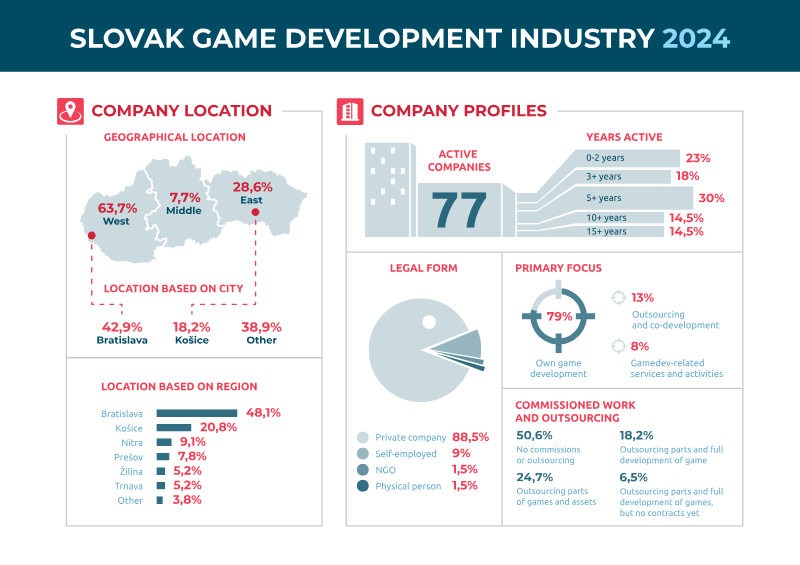
The 2024 Slovak Game Industry report provides a comprehensive overview of the nation’s game development sector, detailing its economic performance, workforce composition, and operational landscape as of December 31, 2024. The industry is characterized by a mix of established firms and newer entrants, with a primary focus on own-game development, which accounts for nearly 43% of activities, followed by outsourcing and co-development services. Geographically, the industry is concentrated in Bratislava and Košice, reflecting the urban centralization of technical talent and infrastructure.
Financially, the sector generated a total turnover of approximately 67.8 million euros in 2024, with a high degree of market concentration; the top 10% of companies account for over 83% of this revenue. The workforce consists of 982 employees with a median age of 30 to 35. While the industry remains male-dominated, women represent nearly 20% of the workforce, primarily in visual arts and marketing roles. Foreign talent is a significant component of the ecosystem, comprising 11.6% of the total headcount, with employees largely sourced from Poland, Ukraine, and Czechia. Remote work is highly prevalent, with 91% of companies offering some form of home office or fully remote arrangements.
Development trends show a strong preference for PC platforms, which serve as the primary target for both released and in-development titles. Self-funding remains the dominant financial model for projects, utilized by 80.5% of companies, while public funding and international publishers play secondary roles. Despite the industry's growth, stakeholders identify a need for improved state support, specifically requesting tax incentives, increased R&D funding, and more effective mechanisms for hiring foreign professionals. The report highlights a sector that is technically mature but actively seeking structural improvements to enhance its international competitiveness and sustainability.
- The Slovak game industry generated 67.8 million euros in total turnover in 2024, with high market concentration where the top 10% of companies account for over 83% of total revenue.
- The sector employs 982 professionals with a median age of 30–35, and while male-dominated, women comprise nearly 20% of the workforce, primarily in visual arts and marketing.
- Self-funding is the primary financial model for 80.5% of companies, indicating a reliance on internal capital over public funding or international publishing deals.
- Development activity is heavily focused on PC platforms and concentrated geographically in Bratislava and Košice, with 43% of industry output dedicated to own-game development.
- Remote work is standard practice in the sector, with 91% of companies offering either hybrid or fully remote work arrangements.
Slovak Game Developers AssociationJan 2024
Report78 pages
Netherlands Games Monitor 2024
AUTHORS SPECIAL THANKS TO Manuel Kerssemakers (Abbey Christel van Grinsven APPLIED Games) Arjan Terpstra Bowie Derwort (Game Tailors) Laurens Rutten (CoolGames Matthijs Dierckx Michaël Bas (&ranj) & Dutch Games Association) Roger ter Heide (Improvive) Tuur Hendrikx (Sonic Picnic) RESEARCH CHAPTER 1 ...
- The Dutch games industry employed 4,291 people by the end of 2023, a decline of 269 persons compared to 2021, with employment decreasing by 3% per year between 2021 and 2023, though revenue increased by an average annual rate of 10.5% to €763 million.
- The percentage of female workers in the Dutch games industry is rising, reaching 23.2% currently, aligning with broader European and North American industry averages.
- Applied games studios are adopting generative AI faster than entertainment studios, using or testing it for localization, dialogue, training content, and audio, with clients open to custom AI-enabled solutions, while entertainment studios are more hesitant due to potential player backlash.
- The Greater Amsterdam urban region remains the primary hub for the Dutch games industry, offering nearly 1,800 jobs by the end of 2023, and notably continued to grow employment between 2021 and 2023 despite an overall industry decline.
- There are 41 game education programs in the Netherlands, similar to 2022, primarily focusing on programming or game art, with a majority of courses having around 40% of students stating they will never use AI for finished assets.
+2
Dutch Games AssociationJan 2024
Report4 pages
Company Profiles: Slovakia 2024
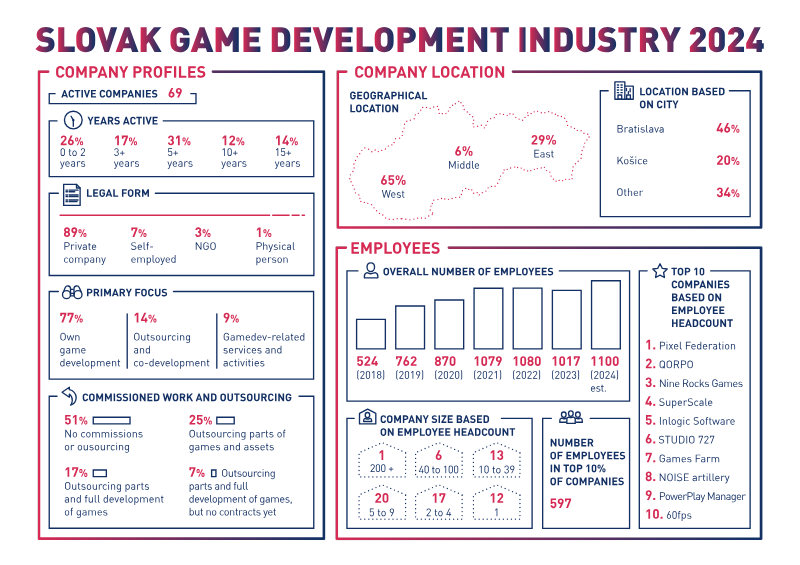
The Slovak game development industry in 2024 is characterized by a stable ecosystem of 69 active companies, primarily concentrated in the western region of the country, particularly Bratislava. The sector is dominated by private companies, with 77% focusing on original game development rather than outsourcing. While the industry experienced a slight contraction in headcount during 2023, it is projected to rebound to approximately 1,100 employees by the end of 2024. The workforce is relatively young, with a median age of 31, and women represent 21% of the total labor force, primarily occupying roles in graphic arts and marketing.
Financial data indicates a mature but concentrated market. The overall industry turnover for 2023 reached over 70 million EUR, a figure expected to remain stable through 2024. However, wealth is highly centralized, with the top 10% of companies—led by major players like Pixel Federation and Nine Rocks Games—accounting for 83.5% of total revenue. Funding remains largely internal, as 65.2% of projects are self-funded, though public funding supports roughly one-third of the industry.
Technologically, PC remains the primary development platform, utilized by 72.5% of developers, followed by mobile and console platforms. Despite the industry's creative success, developers face significant hurdles in recruitment, particularly for programming and game design roles. To foster future growth, industry stakeholders express a strong desire for increased state support, specifically in the form of R&D funding, tax incentives, and improved educational infrastructure to streamline the employment of both domestic and foreign talent.
- The Slovak game industry is highly concentrated, with the top 10% of companies—including Pixel Federation and Nine Rocks Games—generating 83.5% of the sector's 70 million EUR annual turnover.
- The industry consists of 69 active companies, 77% of which focus on original game development rather than outsourcing services.
- After a slight contraction in 2023, the workforce is projected to reach approximately 1,100 employees by the end of 2024, with a median age of 31 and 21% female representation.
- Financial independence is the industry standard, as 65.2% of projects are self-funded, while public funding supports approximately one-third of the market.
- PC remains the dominant development platform, utilized by 72.5% of Slovak studios, followed by mobile and console platforms.
+1
Swiss Game Developers AssociationJan 2024

Report13 pages
Behind the Screens: The Salary Stats in Gamedev
This research, conducted by 80 Level in January 2024, examines the global compensation landscape and financial well-being of professionals within the video game development industry. Based on a survey of over 1,000 respondents from the 80 Level Research panel and reader base, the study analyzes how geography, years of experience, and specific job roles influence annual income and purchasing power.
The findings reveal a highly stratified industry where nearly 40% of developers earn less than $40,000 annually, while only 11% exceed the $150,000 mark. Geographic location serves as a primary driver of these disparities; for instance, 36% of U.S.-based professionals earn over $150,000, whereas 54% of surveyed developers in India earn under $9,999. In Europe, the majority of professionals in the UK, Germany, and Sweden fall within the $30,000 to $79,999 range. The data also highlights a significant "cost of living" gap, noting that while 16.6% of the workforce can afford all discretionary purchases, 24.4% earn enough for a car but remain unable to afford a residence.
Experience levels further dictate earning potential, with 74% of interns earning under $9,999, while 24% of Directors and Leads exceed $150,000. The analysis of specific roles shows that Creative Directors and Software Developers generally occupy higher salary segments compared to Artists and Game Designers. Notably, the study identifies a segment of "struggling" C-level executives (19%), likely representing founders of small indie studios who face financial instability despite their titles. The research concludes that while the industry offers high-earning potential at senior levels in Western hubs, a substantial portion of the global workforce operates under significant financial constraints.
- The game development industry is highly stratified, with nearly 40% of professionals earning under $40,000 annually and only 11% earning more than $150,000.
- Geography is a primary driver of income disparity, evidenced by 36% of U.S.-based professionals earning over $150,000 compared to 54% of developers in India earning under $9,999.
- Financial instability is prevalent, as 24.4% of the workforce can afford a car but cannot afford a residence, while only 16.6% can afford all discretionary purchases.
- Experience correlates strongly with compensation, as 74% of interns earn under $9,999, whereas 24% of Directors and Leads earn over $150,000.
- Creative Directors and Software Developers generally command higher salaries than Artists and Game Designers.
+1
80 LevelJan 2024
Report76 pages
Game Developer Index: Sweden 2024
The analysis evaluates the health and trajectory of Sweden’s video‑game sector during 2023‑24, mapping its economic performance, creative output, ecosystem structure and emerging challenges. By quantifying sales, employment, investment and cultural impact, it argues that the industry remains a growth engine for the Swedish economy while confronting structural constraints that could limit future expansion.
Domestic net sales rose 6 % to SEK 34.6 billion (≈ EUR 3 billion, USD 3.2 billion) and total global revenue reached SEK 90.4 billion, a 4.5 % increase. The number of registered firms grew by 108 to 1,010, and Swedish‑owned companies expanded overseas to 218 subsidiaries in 54 countries, employing 15,792 staff abroad, of whom 29.5 % are women. Major titles such as Helldivers 2 (12 million copies in three months) and Satisfactory (6 million copies and a console launch) reinforced Sweden’s market presence, while Steam and Twitch data showed Swedish games accounting for over 700 million streamed hours in 2023 and nearly 500 million from January‑October 2024.
The ecosystem is heavily concentrated in Stockholm, home to 439 studios and 5,816 employees, with secondary hubs in Skåne‑Blekinge, Västra Götaland, Västerbotten‑Norrbotten and Östergötland. Educational provision spans bachelor, master and vocational programmes, serving roughly 700 students across multiple institutions. Inclusion initiatives have broadened participation, exemplified by a game‑developer camp for about 100 gender‑diverse teens and a network of scholarships and mentorships. Nevertheless, early‑stage capital has weakened, talent pipelines remain thin—with only 644 new hires in 2023 and rising work‑permit refusals—and public‑health screen‑time guidance remains ambiguous.
Capital flows revived in 2023‑24, highlighted by Embracer’s SEK 4.9 billion sale of Gearbox to Take‑Two and EQT’s SEK 28.7 billion acquisition of
- Sweden’s video-game sector grew to SEK 90.4 billion in total global revenue in 2023-24, a 4.5% increase, while domestic net sales rose 6% to SEK 34.6 billion.
- The industry’s footprint expanded to 1,010 registered firms, with Swedish-owned companies now operating 218 subsidiaries across 54 countries and employing 15,792 staff abroad.
- Major commercial successes like 'Helldivers 2', which sold 12 million copies in three months, and 'Satisfactory', which reached 6 million copies, drove significant market presence and over 700 million streamed hours in 2023.
- Capital activity remains robust, evidenced by major transactions including EQT’s SEK 28.7 billion acquisition and Embracer’s SEK 4.9 billion sale of Gearbox to Take-Two.
- Stockholm remains the primary industry hub with 439 studios and 5,816 employees, though the ecosystem faces structural challenges including a thin talent pipeline, with only 644 new hires in 2023, and rising work-permit refusals.
Swedish Games IndustryJan 2024
Report64 pages
The Game Industry of Finland Report 2024
The 2024 overview of Finland’s game sector presents a comprehensive assessment of an industry that remains a global technology leader while confronting a tightening financing environment. Employment reached roughly 4,300 individuals, equivalent to about 3,800 full‑time positions, underscoring the sector’s significance within the national economy. However, a pronounced drop in private risk capital and publisher backing has pushed many studios toward B2B subcontracting, co‑development agreements, and an expanding reliance on European Union and national public R&D programmes, especially after recent reductions in regional funding streams.
Talent depth continues to drive innovation, with Finnish teams at the forefront of AI‑assisted development, proprietary engines, and cloud‑gaming solutions. Persistent shortages of senior developers and specialists in Unreal Engine, together with increasing regulatory complexity and geopolitical uncertainty, pose constraints on future growth. New public R&D instruments and targeted regional SME support aim to mitigate these pressures and sustain the ecosystem’s dynamism.
Geographically, the industry is anchored by a network of regional hubs, notably Jyväskylä’s EXPA, which serves as a northern innovation cluster. The ecosystem is highly diversified, ranging from global powerhouses such as Supercell—employing over 800 staff and delivering seven worldwide hit titles—to agile indie studios like Snowhound, which hosts more than 120 employees from over twenty nationalities, and niche ventures such as Soihtu DTx, which secured a $4.2 million seed round for a clinically validated mental‑health game. Across the board, firms are expanding into cross‑platform and co‑development projects, exemplified by collaborations between Ubisoft RedLynx and Zaibatsu Interactive, reflecting a broader trend toward collaborative, multi‑disciplinary production.
- Finland’s game industry currently employs approximately 4,300 individuals, representing about 3,800 full-time positions.
- A significant decline in private risk capital and publisher funding has forced studios to pivot toward B2B subcontracting, co-development agreements, and increased reliance on EU and national public R&D programs.
- The ecosystem remains anchored by major players like Supercell, which employs over 800 staff and has produced seven global hit titles, alongside diverse ventures like the mental-health game developer Soihtu DTx, which recently secured a $4.2 million seed round.
- Finnish studios are increasingly adopting collaborative production models, evidenced by cross-platform partnerships such as the collaboration between Ubisoft RedLynx and Zaibatsu Interactive.
- Despite innovation in AI-assisted development and cloud gaming, the industry faces growth constraints due to a persistent shortage of senior developers and specialists proficient in Unreal Engine.
+1
Neogames FinlandJan 2024

Report42 pages
ゲーム開発者の就業とキャリア形成 2024
The 2024 Game Developer Survey for Japan provides a comprehensive snapshot of compensation trends among the nation’s game development workforce, focusing on individuals with formal vocational‑school or university education. By capturing responses from a broad cross‑section of developers, the study aims to assess whether recent industry growth translates into tangible financial benefits for skilled professionals.
Findings reveal that more than 80 % of educated respondents reported a salary increase over the preceding year, a pattern that holds consistently for full‑time employees, with roughly the same proportion experiencing any rise in earnings. This upward trajectory suggests that Japanese studios are increasingly rewarding qualified talent, reflecting both heightened competition for skilled labor and the sector’s expanding revenue streams. The data also underscore the importance of formal education as a predictor of wage growth, indicating that employers value academic credentials when allocating compensation adjustments.
Overall, the survey indicates a robust and positive compensation environment for Japan’s game development sector in 2024, highlighting sustained investment in human capital. The prevalence of salary gains among highly educated, full‑time developers points to a healthy labor market that may enhance talent retention and support continued industry innovation.
- Over 80% of game developers with formal vocational or university education in Japan received a salary increase in 2024.
- The trend of rising earnings is consistent among full-time employees, with approximately 80% reporting wage growth over the past year.
- Formal academic credentials serve as a significant predictor of wage growth, as employers prioritize these qualifications when determining compensation adjustments.
- The widespread salary growth reflects heightened competition for skilled labor and the overall expansion of revenue streams within the Japanese gaming sector.
- The 2024 data indicates a robust labor market characterized by sustained investment in human capital and improved talent retention strategies.
+1
CESA – Computer Entertainment Supplier's AssociationJan 2024

Report20 pages
The Austrian Game Industry 2024
The Austrian game sector is portrayed as a youthful, fast‑growing cluster of predominantly small and micro enterprises whose economic relevance has expanded dramatically over the past six years. A 2023‑2024 survey commissioned by the Austrian Professional Association of Management Consultancy, Accounting and IT and executed by the Institute of Industrial Research gathered responses from roughly 150 active developers, with detailed data supplied by 78 firms on production output and by 23 firms on serious‑game activities. The study combines firm‑level questionnaires with macro‑economic modelling to assess direct, indirect and induced effects on the national economy.
Revenue generated by domestic developers reached €92.8 million in 2023, a nominal increase of more than 285 % compared with 2017, and still represents a 180 % rise after price‑level adjustment. Employment rose from 474 jobs in 2017 to 1 080 in 2024, a 128 % increase, and the sector’s multiplier effect creates roughly 2 260 jobs across Austria. Projections that assume a slowdown to one‑third of recent growth still forecast revenues of €149 million and a workforce of over 1 500 by 2029. In the preceding three years, the surveyed firms produced 405 games, while serious‑game developers now number 20‑30 companies employing 130‑150 staff, chiefly to raise awareness of social issues such as climate change.
The workforce is highly qualified: almost 80 % hold tertiary degrees, with the 25‑34 age group dominating. Educational provision is concentrated in three regional hubs—Salzburg, Upper Austria and Carinthia—where 25 university programmes supply the bulk of IT talent. Financing remains largely internal, with self‑funding cited by 92 % of firms; public subsidies rank second but are considered insufficient, reflected in the finding that 77 % of developers rate Austria’s location policy as poor or very poor. Nonetheless, only 5 % contemplate relocation, and the majority anticipate continued employment growth over the next three years.
- The Austrian game industry generated €92.8 million in revenue in 2023, marking a 285% nominal increase since 2017.
- Direct employment in the sector grew 128% over seven years, rising from 474 jobs in 2017 to 1,080 in 2024, with a total economic multiplier effect supporting 2,260 jobs.
- Projections for 2029 estimate industry revenue will reach €149 million and the workforce will exceed 1,500 employees, even assuming a significant slowdown in growth.
- The industry is characterized by small and micro enterprises that rely heavily on internal financing, with 92% of firms self-funding their operations.
- Despite 77% of developers rating Austria’s location policy as poor or very poor, only 5% of firms are considering relocation.
+1
Austrian Professional Association of Management ConsultancyJan 2024
Report4 pages
Czech Gaming Industry Report 2024
The Czech Gaming Developers Association compiled an annual industry overview to map the sector’s economic performance, workforce composition and structural trends for 2023 and early 2024. By aggregating self‑reported financial and employment data from member studios, the analysis aims to illustrate growth trajectories, geographic concentration and the evolving profile of talent within the Czech game development ecosystem.
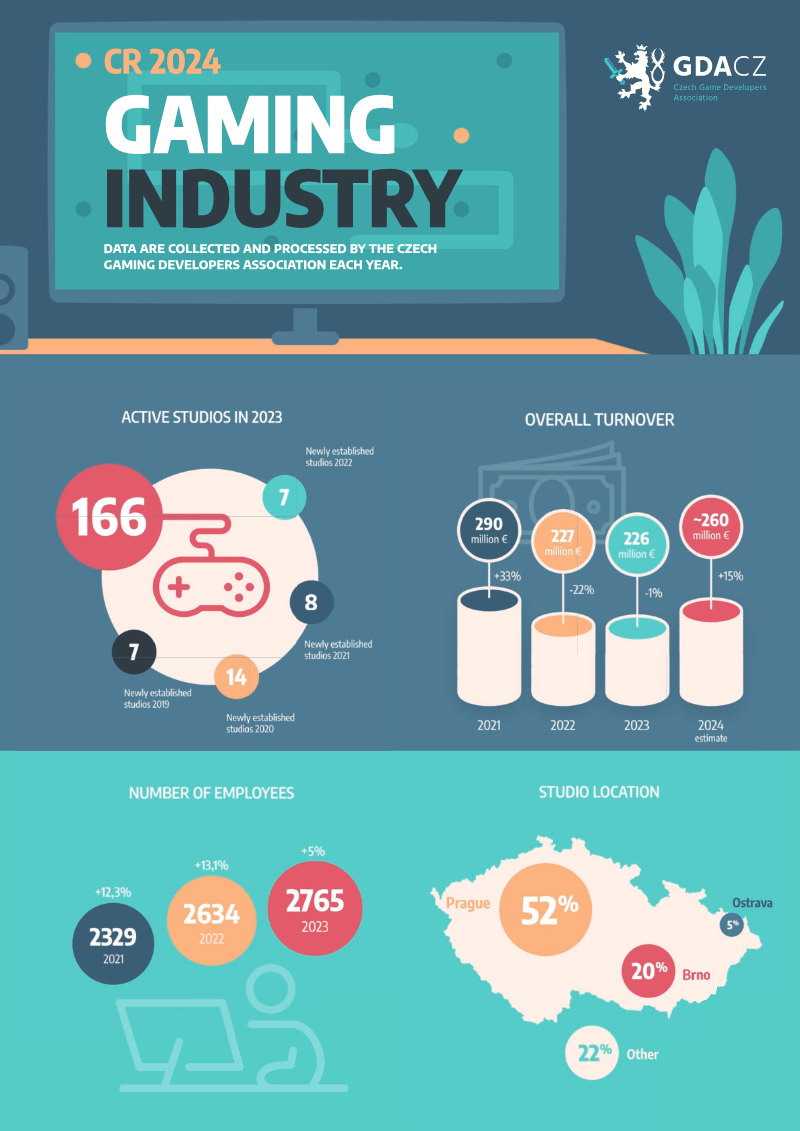
Overall turnover reached €226 million in 2023, marking a 33 % increase over the previous year, while the number of active studios rose modestly, with newly established entities numbering 166 in 2023 compared with 260 in 2022. Employment expanded to roughly 4,165 staff, a 12.3 % rise, with the majority concentrated in Prague (52 %), followed by Ostrava (13 %) and Brno (20 %). The sector released 29 new titles in 2023, supplemented by 10 early‑access projects and 10 DLCs, for a total of 39 releases.
Ownership structures remain dominated by private limited companies, accounting for the bulk of legal entities, while joint‑stock and foreign‑branch configurations each represent about 5 % of the market. Job creation accelerated, with over 430 new positions announced across the year, a 20‑23 % increase relative to prior periods. The workforce is increasingly international: 34 % of employees are foreign nationals, predominantly from EU member states, while 66 % are Czech. Educational backgrounds are diverse, with roughly half holding higher‑education degrees and a similar share possessing vocational or technical qualifications. The report’s methodology relies on annual surveys administered by the association, covering all registered Czech game development firms and providing a comprehensive snapshot of the industry’s health and direction.
- The Czech gaming industry reached a total turnover of €226 million in 2023, representing a 33% year-over-year growth.
- Total employment in the sector grew by 12.3% to 4,165 staff, with over 430 new positions created throughout 2023.
- The industry released 39 total projects in 2023, consisting of 29 new titles, 10 early-access projects, and 10 DLCs.
- The workforce is increasingly international, with foreign nationals—primarily from EU member states—comprising 34% of all employees.
- Geographic concentration remains high, with 52% of the workforce based in Prague, followed by 20% in Brno and 13% in Ostrava.
GDACZ – Czech Game Developers AssociationJan 2024

Report41 pages
L'Industrie du Jeu Vidéo au Canada
The 2024 Canadian video‑game sector is presented as a mature, high‑value industry that contributes $5.1 billion to national GDP and sustains 34 010 full‑time‑equivalent positions, with an average compensation of $102 000. The analysis underscores a pronounced geographic concentration, as 83 % of the 821 operating studios are located in Ontario, British Columbia and Québec, reflecting the continued clustering of talent and infrastructure in these provinces.
Compared with 2021, the total number of firms declined by 9 %, a contraction driven largely by the disappearance of micro‑enterprises, while larger studios either remained stable or expanded. Ownership patterns have shifted markedly, with foreign‑owned companies now accounting for 88 % of total employment, indicating deepening international integration and reliance on external capital.
Industry spending reached $4.8 billion in 2024, an 11 % increase over the 2021 level, and labour costs now represent 72 % of total expenditures, up from roughly 66 % three years earlier. This rising labour share highlights the sector’s intensifying dependence on skilled human capital.
The study classifies studios into eight size categories—from solo developers to firms with more than 200 employees—using survey‑derived averages to estimate spending, revenue and wage structures across each segment. By scaling these averages to the number of firms in each tier, the analysis provides a nuanced picture of economic activity across the full spectrum of the industry.
Overall, the findings portray a Canadian video‑game ecosystem that is consolidating around a few large, often foreign‑owned players, expanding its overall financial outlays, and increasingly reliant on a highly paid workforce, all within a geographically limited core that dominates national output.
- The Canadian video game industry contributes $5.1 billion to the national GDP and employs 34,010 full-time equivalent workers with an average annual compensation of $102,000.
- Industry spending reached $4.8 billion in 2024, an 11% increase since 2021, with labour costs now accounting for 72% of total expenditures.
- The sector is increasingly dominated by foreign-owned companies, which now account for 88% of total industry employment.
- While the total number of studios declined by 9% since 2021 due to the contraction of micro-enterprises, larger studios have remained stable or expanded.
- The industry is highly concentrated geographically, with 83% of the 821 operating studios located in Ontario, British Columbia, and Québec.
+1
ESAC – Entertainment Software Association of CanadaJan 2024