
Report166 pages
Pesquisa Nacional da Indústria de Games 2023
The 2023 national survey of Brazil’s game‑development ecosystem maps the sector as it stood in 2022, revealing a vibrant but highly fragmented industry dominated by micro‑ and small studios. With 1,042 active studios and a representative sample of 309 developers, 214 freelancers and 80 support organisations, the market expanded despite a 5.1 % contraction in the global games market, delivering a 3 % domestic growth that lifted the industry to US $182.9 bn in 2022 and projecting US $206.4 bn by 2025. Brazil ranks fifth worldwide in online population, hosting roughly 103 million gamers; revenue generation is led by mobile (49 %), followed by PC (26 %) and consoles (25 %), while gender parity approaches equality with women accounting for 46.2 % of players.
Export orientation is emerging, as 76 % of developers target the domestic market but substantial shares also aim at the United States (58 %), Latin America (57 %) and Western Europe (55 %). Prospects for the next three years show Canada and Latin America each featuring in 47 % of sales roadmaps, with China appearing in 44 % of plans, indicating a gradual diversification of export destinations. The sector is supported by 17 regional industry associations and coordinated nationally by Abragames, Brazil Games and ApexBrasil, which provide market representation, business‑matching missions and participation in overseas fairs.
Artificial intelligence dominates technology priorities, cited by more than half of respondents as a short‑ and long‑term focus, while XR/VR/AR follows closely, driven by 5G and new engines such as Unreal Engine 5. Interest in blockchain and
- Brazil’s game industry grew 3% in 2022 despite a 5.1% global market contraction, reaching a valuation of US$182.9 billion with projections to hit US$206.4 billion by 2025.
- The Brazilian market is highly fragmented, consisting of 1,042 active studios that are primarily micro or small in size.
- Mobile gaming leads revenue generation at 49%, followed by PC at 26% and consoles at 25%, supported by a massive domestic player base of approximately 103 million people.
- Developers are increasingly export-oriented, with 58% targeting the U.S., 57% targeting Latin America, and 55% targeting Western Europe, while future roadmaps show growing interest in China (44%).
- Artificial intelligence is the primary technology priority for over 50% of developers, followed by XR/VR/AR applications enabled by 5G and Unreal Engine 5.
+1
AbragamesJan 2023

Report36 pages
State of the Game Development Industry 2023: Workplace Health & HR Culture, Mental Trends
The global game development industry entered a period of profound instability throughout 2023, characterized by widespread layoffs affecting 28% of the workforce and a pervasive crisis of employee loyalty. This volatility is reflected in a negative Employee Net Promoter Score of -19%, signaling deep-seated dissatisfaction across the sector. While economic recalibration and management failures are the primary drivers of this distress, only 3% of job losses are currently attributed to AI automation. Instead, the workplace is increasingly defined by "quiet hiring" practices, where 37% of employees take on expanded responsibilities without additional compensation, often coupled with unpaid overtime and insufficient severance packages.
Despite these hardships, remote and hybrid work models have become the industry standard, with 80% of professionals operating outside traditional office environments. Job seekers now prioritize salary, remote flexibility, and skill development above all else. However, a significant disconnect exists between employer expectations and worker reality. While 88% of firms prioritize industry expertise and portfolios over formal education, they simultaneously struggle to fill high-level specialist roles. This talent gap is exacerbated by a competitive market where 50% of professionals find suitable opportunities scarce, particularly entry-level candidates and marginalized groups who face heightened barriers to entry.
The most critical factor for improving retention and workplace culture is managerial mindfulness, specifically ethical leadership and empathy. Despite its statistical importance to employee satisfaction, only 13% of companies provide leadership training in these areas. As 70% of professionals report general dissatisfaction and 34% of companies have scaled back hiring, the industry faces a structural imbalance. Success in the current landscape requires a shift away from traditional recruitment and toward fostering supportive environments that address the mental health and professional growth of a demoralized workforce.
- The game industry experienced significant instability in 2023, with 28% of the workforce affected by layoffs and an Employee Net Promoter Score of -19% indicating widespread dissatisfaction.
- Economic recalibration and management failures are the primary drivers of industry distress, while AI automation currently accounts for only 3% of total job losses.
- Workplace culture is suffering from 'quiet hiring' practices, where 37% of employees are absorbing expanded responsibilities without corresponding increases in compensation.
- Remote and hybrid work models have become the industry standard, with 80% of professionals now operating outside of traditional office environments.
- A structural talent gap persists as 50% of professionals report a scarcity of suitable opportunities, despite 88% of firms prioritizing portfolios and expertise over formal education.
+1
80 LevelJan 2023
Report4 pages
Slovak Game Development Industry 2023
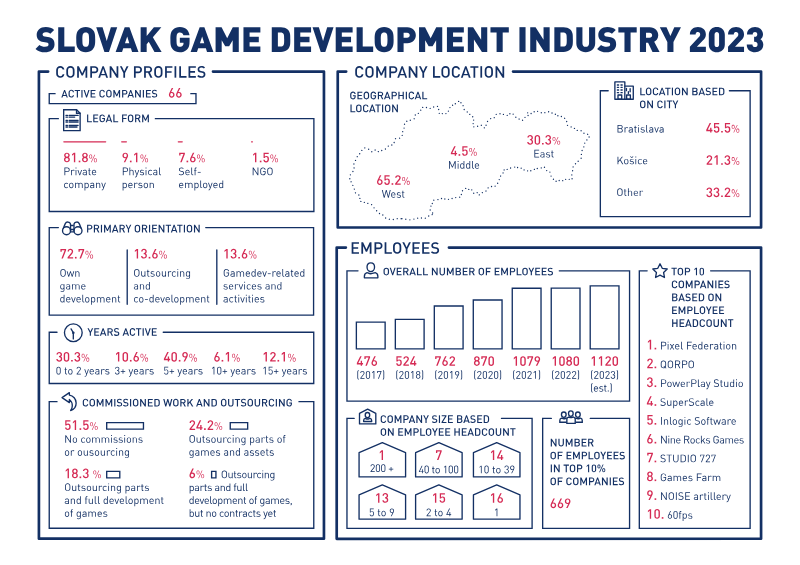
The Slovak game development industry in 2023 is characterized by a stable ecosystem of 66 active companies, primarily concentrated in the western region of the country. The sector is dominated by private entities, with 72.7% focusing on core game development and the remainder providing outsourcing or specialized services. While the industry features a mix of experience levels, over 40% of companies have been active for more than five years. The workforce has seen consistent growth, rising from 476 employees in 2017 to an estimated 1,120 in 2023. However, the industry exhibits significant centralization, with the top 10% of companies employing approximately 60% of the total workforce and generating 84.6% of the annual turnover.
Financial data indicates a mature but plateauing market, with an overall turnover of €77.1 million in 2022 and a nearly identical estimate of €76.9 million for 2023. Pixel Federation, SuperScale, and Inlogic Software lead the market in both headcount and revenue. Development is largely self-funded, though 37.9% of companies utilize public funding. PC remains the primary target platform for development, followed by mobile and consoles. Notably, half of all projects remain unpublished, while those that reach the market are predominantly self-published via digital storefronts like Steam, Google Play, and the App Store.
The labor market reveals a workforce with a median age of 30, where women represent 19% of the total headcount, primarily occupying roles in graphic arts and community management. Recruitment remains a challenge for specialized roles, particularly for programmers and game designers. To address talent shortages, nearly half of Slovak firms employ international staff, largely from Czechia and Ukraine. Operational trends show a decisive shift toward flexible work arrangements, with over 89% of companies utilizing remote or hybrid office models. Industry stakeholders express a strong desire for increased state support, specifically through tax incentives and improved education for the digital arts.
- The Slovak game industry is highly centralized, with the top 10% of companies accounting for 60% of the 1,120-person workforce and 84.6% of the total annual turnover.
- Industry revenue has plateaued, with turnover reaching €77.1 million in 2022 and an estimated €76.9 million in 2023.
- Pixel Federation, SuperScale, and Inlogic Software are the dominant market leaders in both headcount and revenue.
- The workforce has grown significantly since 2017, rising from 476 employees to 1,120 by 2023, though recruitment for specialized roles like programmers and designers remains difficult.
- While 89% of companies utilize remote or hybrid work models, firms are increasingly reliant on international talent, with nearly half employing staff from countries like Czechia and Ukraine.
+1
Slovak Game Developers AssociationJan 2023
Report3 pages
UK Games Jobs Summary: November 2022
The United Kingdom games industry experienced a notable contraction in recruitment activity during November 2022, continuing a downward trend observed throughout the second half of the year. Open vacancies decreased by several hundred positions compared to the previous month, leaving the market with over 500 fewer available roles than in June 2022. This decline aligns with broader global and domestic technology sector layoffs. While major development hubs such as London, Guildford, Leamington Spa, Cambridge, Edinburgh, and Manchester remain the primary centers for recruitment, these locations have seen a significant reduction in active job postings.
The downturn has impacted various industry segments and disciplines unevenly. Mobile studios recorded the highest proportional reduction in open roles, often attributed to the fulfillment or removal of positions following major corporate mergers. Despite the general decline in volume, the market shows resilience in specific areas; two less prominent geographic regions bucked the national trend by increasing their job offerings. Furthermore, while senior and experienced roles remain prevalent, there was a recorded increase in advertised junior positions, suggesting a continued interest in developing entry-level talent despite broader economic headwinds.
Data indicates that Software Engineers, Producers, and Senior Environment Artists are among the most sought-after titles. Programming, Art, and Design remain the dominant hiring categories, though most disciplines have seen a net loss in postings. The age of available jobs suggests a mix of immediate needs and long-term vacancies, with over 600 new jobs added in the month preceding the summary. This analysis is based on a comprehensive database of UK game studios, which expanded by eight new companies during this period, providing a representative snapshot of the hiring landscape across AAA, AA, mobile, indie, and service-based sectors.
- UK games industry recruitment contracted significantly in November 2022, resulting in over 500 fewer open vacancies compared to June 2022.
- Mobile studios experienced the highest proportional reduction in job postings, largely driven by the completion or cancellation of roles following corporate mergers.
- Despite the broader market decline, the industry added over 600 new job postings during the month, and the total number of tracked studios grew by eight companies.
- While hiring volume dropped across major hubs like London, Guildford, and Manchester, two smaller geographic regions bucked the national trend by increasing their job offerings.
- Market demand remains concentrated in Programming, Art, and Design, with Software Engineers, Producers, and Senior Environment Artists identified as the most sought-after roles.
+1
Games Jobs LiveNov 2022
Report3 pages
Video Games Development Industry in Romania – 2022 (Summary & Key Insights)
Video Games Development Industry in Romania – 2022 (Summary & Key Insights)
1. Industry at a Glance
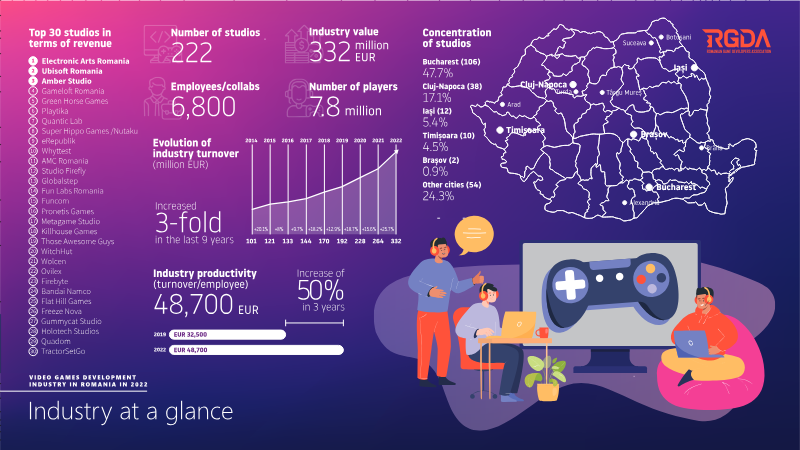
| Metric | Figure (2022) | Comments | |--------|---------------|----------| | Total industry value | ≈ €222‑332 million (range reported) | The spread reflects different sources/segments (e.g., studio revenue, B2B services). | | Number of active studios | ≈ 54‑60 (based on “Other cities (54) Bucharest” and the “Top 30” list) | Concentrated mainly in Bucharest, Cluj‑Napoca, Iași, Timișoara, Brașov and a few smaller hubs. | | Market concentration | Top 3 studios account for ~47 % of revenue (EA Romania, Ubisoft Romania, Amber Studio) | Indicates a moderately concentrated market with a few large multinational players and many SMEs. | | Growth trend (2021‑2022) | +15 % – +25 % for several mid‑size studios (e.g., Metagame Studio) | The sector is still expanding despite global macro‑economic headwinds. | | Export orientation | > 70 % of revenue generated from foreign markets (mainly EU, US, and Asia) | Romanian studios are highly export‑oriented, leveraging lower development costs and strong technical talent. |
2. Top 30 Studios (by reported revenue / size)
| Rank | Studio | Location(s) | Reported Revenue / Size | Notable Points | |------|--------|-------------|------------------------|----------------| | 1 | Electronic Arts Romania | Bucharest (HQ), Iași | €106 M (largest single studio) | EA’s “Playtika” and “EA Studios” units are the biggest revenue generators. | | 2 | Ubisoft Romania | Bucharest, Cluj‑Napoca, Iași | 47.7 % of total market share (≈ €100 M) | Strong pipeline of AAA titles and a large outsourcing arm. | | 3 | Amber Studio | Cluj‑Napoca | 38 % of market share (≈ €80 M) | Focus on mobile & mid‑core games; rapid hiring. | | 4 | Gameloft Romania | Turda, Târgu Mureș | €6.8 M (6,800 k) | Mobile‑first, strong presence in EU & LATAM. | | 5 | Green Horse Games | Arad | €? (data missing) | Indie‑focused, growing export sales. | | 6 | Playtika | Iași | €12 M (approx.) | Social
- The Romanian video game industry generated between €222 million and €332 million in 2022, driven by a highly export-oriented model where over 70% of revenue comes from foreign markets.
- Market concentration is high, with the top three players—Electronic Arts Romania, Ubisoft Romania, and Amber Studio—accounting for approximately 47% of total industry revenue.
- Electronic Arts Romania is the largest single entity in the sector, reporting €106 million in revenue, followed by Ubisoft Romania and Amber Studio, which represent significant market shares of 47.7% and 38% respectively.
- Despite global economic headwinds, the sector maintained a growth trend of 15% to 25% for several mid-size studios during the 2021–2022 period.
- The industry comprises approximately 54 to 60 active studios, with operations primarily clustered in major hubs including Bucharest, Cluj-Napoca, Iași, Timișoara, and Brașov.
+2
RGDA – Romanian Game Developers AssociationJan 2022

Report17 pages
Annual Barometer of the Video Game Industry in France 2021
The 2021 Annual Barometer of the Video Game Industry in France provides a comprehensive analysis of the sector’s economic health, employment trends, and production landscape. Conducted between May and June 2021 through an online survey of 1,200 qualified entities, the research captures a representative snapshot of the French video game ecosystem, which is primarily composed of development studios, publishers, and service providers. The study highlights the industry's resilience and growth despite the challenges posed by the global health crisis.
Key findings indicate that the French video game sector remains highly productive, with approximately 1,350 games in development during 2021, 92% of which are original creations. The industry is characterized by a strong focus on independent production, with 77% of studios identifying as indie developers. Financially, while the sector shows promise—with 20% of studios reporting annual revenues exceeding €1 million—the landscape remains fragile, as 36.5% of studios reported a deficit in 2020, the highest level since 2014. Despite this, the industry maintains a positive outlook, with 89% of respondents expressing confidence in their company’s future and 94% remaining optimistic about the broader French video game market.
Employment remains a cornerstone of the industry, which continues to prioritize permanent contracts, with 80% of salaried positions held as CDI. The workforce is increasingly diverse, with female representation reaching 22%. Furthermore, the sector benefits from robust institutional support, as 41% of companies utilize regional funding and many rely on the national video game tax credit. France is currently ranked as the second most attractive country for video game development globally, trailing only the United States, reflecting the sector's strong international standing and continued potential for expansion.
- France is the second most attractive country globally for video game development, supported by a strong reliance on national tax credits and regional funding utilized by 41% of companies.
- The industry is highly productive with approximately 1,350 games in development during 2021, 92% of which are original intellectual properties.
- Despite high levels of optimism regarding the market, 36.5% of studios reported a financial deficit in 2020, marking the highest rate of insolvency since 2014.
- The French ecosystem is dominated by independent production, with 77% of studios identifying as indie developers.
- Employment stability is a priority for the sector, as 80% of salaried positions are held under permanent (CDI) contracts.
+1
Syndicat National du Jeu VidéoJan 2021

Report38 pages
Romanian Game Development Industry Report: 2020
The Romanian game‑development sector has emerged as a rapidly expanding component of the national digital economy, delivering €218.5 million in revenue in 2020—a 19.1 % year‑on‑year increase that pushed total earnings beyond the €200 million threshold. This growth builds on a foundation laid in the late‑1990s by early publishers such as AMC and Fun Labs and accelerated by a wave of indie activity that has diversified the market across hyper‑casual, mid‑core and AAA support segments.
Policy measures have been pivotal: a tax‑exempt status for developers introduced in 2004, a state‑aid scheme for large IT investments in 2012, and the “Startup Nation” programme of 2016 have collectively fostered an IT sector employing over 113 000 people and contributing roughly 6.8 % of GDP in 2020. The exemption, however, applies only to technical staff, leaving creative roles under‑supported and prompting the Romanian Game Developers Association to propose dedicated incentives.
The ecosystem now includes hyper‑casual studios that have amassed more than 10 million downloads, mid‑core and AAA support firms such as EA Romania, Ubisoft Romania and Gameloft that together employ around 750 developers and work on franchises like FIFA and Assassin’s Creed, and independent studios such as Ovilex, whose simulators have exceeded 500 million installs.
Case studies illustrate the sector’s breadth: Whyttest operates a cross‑border QA‑outsourcing service with senior and junior testers in Bucharest and Belgrade, while XSA, an indie start‑up focused on Android/iOS car games, reaches over one million players each month. The analysis draws on multiple European industry sources, including ISFE‑EGDF, EGDF, Goldstein Research, and regional surveys, providing a comprehensive view of Romania’s game‑development landscape during the 2020 period.
- The Romanian game development industry generated €218.5 million in revenue in 2020, marking a 19.1% year-on-year growth rate.
- The broader IT sector, bolstered by state-aid schemes and tax exemptions, employed over 113,000 people and contributed approximately 6.8% of Romania's GDP in 2020.
- Major AAA support studios including EA Romania, Ubisoft, and Gameloft employ roughly 750 developers in the country, contributing to global franchises like FIFA and Assassin’s Creed.
- Independent studios have achieved significant scale, with firms like Ovilex recording over 500 million installs for their simulator titles.
- Current tax-exempt status for developers is limited to technical staff, leading the Romanian Game Developers Association to lobby for new incentives to support creative roles.
+2
RGDA – Romanian Game Developers AssociationJan 2021

Whitepaper2 pages
Good Conduct Guidelines for the Danish Games Industry
The Good Conduct Guidelines for the Danish Games Industry, published in November 2019, establish a standardized framework for fostering a safe, inclusive, and professional work environment across the Danish game development sector. The primary objective is to protect the personal integrity of industry professionals by promoting a culture of mutual respect, diversity, and accountability. These guidelines serve as a foundational reference for businesses to integrate into employee handbooks or internal policy discussions, ensuring that workplace practices align with both ethical standards and Danish labor legislation.
The guidelines mandate that all industry participants uphold principles of dignity and fairness, with a specific emphasis on eliminating systemic crunch, excessive overtime, and all forms of harassment or discrimination. The policy adopts a zero-tolerance stance toward abusive behavior, noting that harassment is defined by its impact rather than the intent of the perpetrator. Furthermore, the framework places a heightened responsibility on management to act as ethical role models, proactively prevent unsafe conditions, and ensure that employees can report grievances without fear of retaliation.
To support enforcement, the guidelines outline clear procedures for addressing workplace misconduct. Employees are encouraged to engage with internal representatives, such as HR or management, while also being reminded of their rights to seek external support through labor unions, occupational health providers, or the Danish Working Environment Authority. By formalizing these expectations, the industry aims to standardize professional conduct and ensure that all developers and staff operate within a healthy, sustainable, and welcoming environment.
- The Good Conduct Guidelines, published in November 2019, establish a standardized framework for professional behavior and workplace safety across the Danish game development sector.
- The policy mandates the elimination of systemic crunch and excessive overtime to ensure a sustainable working environment for all industry staff.
- Harassment is defined by its objective impact on the victim rather than the intent of the perpetrator, and the industry maintains a zero-tolerance stance toward all forms of abusive behavior.
- Management holds a heightened responsibility to act as ethical role models, proactively prevent unsafe conditions, and guarantee that employees can report grievances without fear of retaliation.
- The guidelines align internal workplace practices with Danish labor legislation to promote a culture of mutual respect, diversity, and accountability.
+1
Danish Games IndustryNov 2019

Report41 pages
Romanian Game Development Industry Report 2019
The 2019 Romanian Game Development Industry Report establishes that Romania’s gaming sector is rapidly maturing, delivering a notable economic contribution and expanding its global footprint. In 2018 the industry generated $188.5 million, marking a 19.2 % increase over the previous year, and employed more than 6,000 professionals across roughly 103 active entities, the majority of which are concentrated in Bucharest, Cluj‑Napoca and Timișoara. Seventy‑seven percent of these firms focus exclusively on game development, while a substantial share provides ancillary services such as quality assurance, publishing and testing for international publishers.
The ecosystem is highly diversified, ranging from small indie teams producing niche titles to multinational subsidiaries that co‑develop major franchises. Mobile and hyper‑casual games dominate commercial success, exemplified by Deep Byte’s titles surpassing ten million downloads and KillHouse’s “Door Kickers” achieving half‑a‑million sales. Romanian studios also contribute to console and PC projects, with Ubisoft Romania and EA’s testing division supporting flagship series. Emerging specializations in virtual reality and narrative‑driven experiences further broaden the sector’s capabilities.
Education remains in an early stage; only a few university programs address game design, limiting the pipeline of formally trained talent. Nonetheless, the industry benefits from a strong pool of creative and cross‑disciplinary professionals, fostering a growing record of internationally recognised releases. The analysis draws on data from SuperData, Newzoo, Goldstein Research and Dealroom, underscoring Romania’s position as an increasingly influential player in the global game development landscape.
- The Romanian game development industry generated $188.5 million in 2018, representing a 19.2% year-over-year growth.
- The sector employs over 6,000 professionals across approximately 103 active entities, primarily concentrated in Bucharest, Cluj-Napoca, and Timișoara.
- 77% of industry firms focus exclusively on game development, while the remainder provide ancillary services like quality assurance, testing, and publishing for international clients.
- Mobile and hyper-casual games drive significant commercial success, highlighted by Deep Byte titles exceeding ten million downloads and KillHouse’s 'Door Kickers' reaching 500,000 sales.
- Major multinational players, including Ubisoft Romania and EA, utilize local studios to support the development and testing of flagship console and PC franchises.
+1
RGDA – Romanian Game Developers AssociationJan 2019
Report46 pages
Koulutusta Suomessa
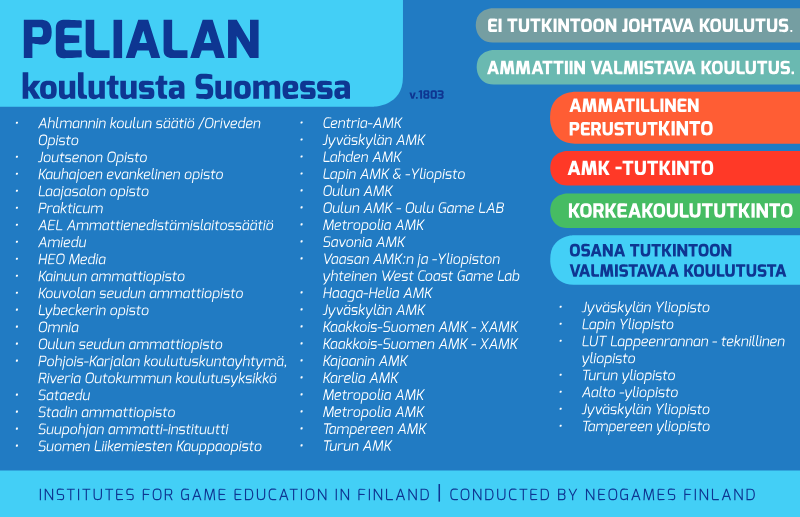
• Ahlmannin koulun säätiö /Oriveden • Opisto • • Joutsenon Opisto • • Kauhajoen evankelinen opisto • • Laajasalon opisto • • Prakticum • • AEL Ammattienedistämislaitossäätiö • • Amiedu • • HEO Media • • Kouvolan seudun ammattiopisto • • Lybeckerin opisto ...
- Finland offers a wide range of game industry education, from vocational training to university degrees, including programs focused on game programming, design, art, and business.
- Vocational education (AMMATILLINEN PERUSTUTKINTO) includes programs like Datonomi, Media-alan perustutkinto (Animation and Game Industry), and Peliohjelmoija, with durations typically ranging from 2 to 3 years.
- Universities of Applied Sciences (AMK) offer Bachelor's degrees (AMK-TUTKINTO) in fields such as Information Processing (Tietojenkäsittely) and Culture and Arts (Game Design), generally lasting 3.5 to 4 years.
- Several institutions offer non-degree game-related training, such as 'Kohti Pelialaa' at Joutsenon Opisto (9 months, 31 ECTS), 'Spelproduktion' at Prakticum (1 year, 60 ECTS), and 'Pelisuunnittelu' at HEO Media (9 months, 60 ECTS).
- Specialized programs exist, like Oulu Game LAB (Oulun AMK), West Coast Game Lab (Vaasan AMK & Yliopisto), and Metropolia AMK's 3D-animation and visualization with a focus on game graphics.
+1
Neogames FinlandJan 2018
Report51 pages
The Games Monitor 2018
We are honored to present The Games Monitor 2018 edition with the latest facts, figures, trends and developments in the Dutch games industry. The Games Monitor was first published in 2012 and was followed by new research in 2015. Both reports generated a lot of interest into the Dutch games industry’s facts and figures, which is why we are pleased to be able to provide you with an update for 2018.
- The Dutch games industry saw a net job growth of over 60% concentrated in Utrecht, Eindhoven, and Amsterdam between 2015 and 2018.
- The total number of entertainment game companies increased by over 50 since 2015, continuing a previous trend, while the number of applied game developers stabilized at 114 companies.
- Applied games have a strong foothold in the Dutch industry, with healthcare and education remaining the largest market segments for applied game companies, and 62% of studios working on five or more projects in 2018.
- Dutch game companies are most positive about growth for mobile games, consoles/PC, and Augmented Reality (AR), but less so for Virtual Reality (VR) due to expensive hardware and lack of user-friendliness.
- Key challenges for both applied and entertainment game studios include finding enough players/sales, acquiring sufficient funds, and securing suitable personnel, with a noted lack of investors in the Netherlands.
+2
Dutch Games AssociationJan 2018
Report36 pages
Dutch Games Monitor: The Netherlands 2015
In 2012 the first edition of the Dutch Games Monitor was presented. Whilst maybe not the first research focusing on the Dutch games industry, it was the first where an extensive survey and a series of interviews provided a broad insight into the state of the industry. In the past few years interest in games and data about the games industry has increased. Many people were interested in an updated version of the Games Monitor .
- The Dutch games industry saw its number of professionals grow from 2730 in 2011 to 3030 in 2015, an annual job growth of 2.6%, which is above the national average of -0.4% for the same period.
- Over half of Dutch game companies are less than 5 years old, and the average company size is 7 employees, indicating a young industry dominated by small studios.
- Access to funding, availability of qualified staff, and sales are the top three challenges for Dutch game companies, with over 40% reporting issues in obtaining funds.
- Applied games are a significant domain, with expected growth in healthcare and education. However, 42% of applied game companies' turnover is fully realized domestically, while 58% have international clients.
- The mobile market is dominated by Free to Play games, the PC marketplace by mid-sized games, and the console market by high-production-value games. Forty-four percent of respondents developed for the PC platform Steam in 2015, but its popularity makes success increasingly difficult.
+2
Dutch Games AssociationJan 2015
Report16 pages
Essential Facts 2014: Canada
The 2014 overview of Canada’s video‑game sector presents a comprehensive picture of an industry that ranks among the world’s largest by per‑capita employment and is a cornerstone of the nation’s digital economy. Drawing on custom research commissioned by the Entertainment Software Association of Canada (ESAC)—including NPD surveys of 3,359 adults and 526 teens in 2014, a 2012 survey of 2,969 adults, 527 teens and 687 children, and quantitative data from 90 Canadian companies—the analysis covers national trends, regional breakdowns, workforce characteristics, public perception and consumer behaviour.
Employment figures reveal 16,500 individuals directly working in game development, equivalent to 27,000 full‑time jobs, with a 5 % increase in staff between 2011 and 2013 and two‑fifths of firms forecasting a 25 % expansion within two years. The sector generated $2.3 billion in GDP contribution and $1.6 billion in direct spending, a 12.5 % rise from 2011. More than half of Canadian companies identify as independent developers, and 53 % of the 329 firms operate as such. Salaries average $72,500 annually, with a median employee age of 31,
- Canada’s video game sector directly employs 16,500 people, representing 27,000 full-time equivalent jobs.
- The industry contributed $2.3 billion to Canada’s GDP and generated $1.6 billion in direct spending, marking a 12.5% increase since 2011.
- Employment in the sector grew by 5% between 2011 and 2013, with 40% of firms projecting a 25% staff expansion within two years.
- Independent developers comprise 53% of the 329 identified Canadian game companies.
- The average annual salary for industry employees is $72,500, and the median age of the workforce is 31.
+1
ESAC – Entertainment Software Association of CanadaJan 2014
Report60 pages
Canada's Video Game Industry in 2013: Final Report
Canada’s Video Game Industry in 2013 – Final Report (Summary)
1. Industry Perception of Tax Credits
Overall valuation: Canadian video‑game tax credits received an average rating of 4.4 / 5, indicating that firms consider them a highly valuable policy tool. Key benefits identified: Project opportunities: Highest impact score (4.0 / 5). Employee retention, revenue growth, and industry visibility also scored strongly, reflecting that tax incentives help companies keep talent, expand sales, and raise the sector’s profile. Cost‑effectiveness: Respondents reported that the administrative burden is low relative to the financial value they obtain from the credits. Growth outlook: The survey revealed a very optimistic near‑term outlook: 40 % of firms expect revenue growth of more than 25 % in the coming year, underscoring confidence that the tax environment is a catalyst for expansion.
2. Economic‑Impact Analysis
| Component | Methodology | Key Findings | |---------------|----------------|------------------| | Direct impacts | • Calculated from reported industry revenues and wages.<br>• Applied an operating‑surplus‑to‑labour‑income ratio of 15.17 % (derived from the broader software‑publishing sector) to estimate profits and value‑added. | • Direct employment, labour income, and GDP contributions were quantified based on actual firm‑level data. | | Indirect impacts | • Integrated the survey data with Statistics Canada Input‑Output (I‑O) tables.<br>• Modeled supply‑chain spillovers, capturing purchases from other Canadian industries and adjusting for import leakages (goods/services sourced abroad). | • Showed how video‑game firms stimulate activity in supporting sectors (e.g., hardware, professional services, marketing). | | Induced impacts | • Used a custom multiplier built on Canada’s marginal propensity to consume (MPC) and marginal propensity to import (MPI).<br>• Estimated household re‑spending of earnings generated in the direct and indirect stages. | • Quantified the additional employment, income, and GDP generated when workers and suppliers spend their wages locally. |
Overall economic contribution (direct + indirect + induced): The combined effect demonstrates that the video‑game sector’s footprint extends well beyond the firms themselves, creating significant ancillary jobs and income throughout the Canadian economy. The methodology ensures that import leakages are subtracted, providing a realistic picture of net domestic impact.
3. Implications
1. Policy Validation – The high satisfaction scores and strong growth expectations confirm that the tax‑credit regime is achieving its intended objectives: fostering project development, retaining talent, and boosting sector visibility. 2. Economic Multiplier Effect – The I‑O‑based analysis shows that every dollar of direct video‑game revenue generates additional economic activity across multiple industries, reinforcing the argument for continued or expanded fiscal support. 3. Strategic Recommendations (derived from the findings): Maintain or enhance tax‑credit levels to sustain the momentum in project creation and revenue growth. Streamline administrative processes further to keep the cost‑benefit ratio favorable.
- Canadian video-game firms rate tax credits as highly effective, awarding them an average satisfaction score of 4.4/5.
- The tax-credit regime is a primary driver of industry expansion, with 40% of firms projecting revenue growth exceeding 25% in the coming year.
- Tax incentives are most effective at creating project opportunities, which received an impact score of 4.0/5, followed by strong benefits for employee retention and industry visibility.
- The administrative burden of accessing tax credits is considered low relative to the financial value received, maintaining a favorable cost-benefit ratio for firms.
- Economic impact analysis confirms that the industry generates significant ancillary activity through supply-chain spillovers and household re-spending, calculated using a methodology that accounts for import leakages.
+1
ESAC – Entertainment Software Association of CanadaJul 2013

Report19 pages
Faits Essentiels 2011 sur le Secteur Canadien des Jeux Vidéo et Informatiques
The study evaluates the Canadian entertainment‑software industry in 2011, outlining its structure, economic contribution, and consumer profile to illustrate why the sector ranks third worldwide in revenue and first in jobs per capita. Quantitative data show roughly 16 000 workers employed by about 350 firms, generating an estimated direct impact of C$1.7 billion and delivering an 11 % growth rate over the previous two years, with a projected 17 % increase in the next two. Traditional console development still dominates, employing 68 % of the workforce, while mobile, social and casual games together account for just under 12 % of resources, reflecting a rapid diversification of platforms.
Regional analysis reveals Quebec as the sector’s hub, housing 8 236 employees, 70 % of large firms and C$733 million in spend, and posting a 13 % annual growth rate. Ontario follows with 2 600 employees, 96 firms and a higher growth trajectory (20 % historic, 21 % forecast) driven by numerous micro‑ and small‑size companies. British Columbia’s 3 882 employees and C$393 million in spend show modest growth, while Saskatchewan is omitted due to lack of survey responses. Company‑size distribution indicates that 59 % of employees work for large enterprises (151+ staff), with the remainder spread across medium, small and micro firms.
Consumer insights, derived from an NPD Group survey of 2 579 adults, 398 teens and 547 children (margin of error ± 1.6 %), indicate that 48 % of Canadians identify as gamers, with a median age of 33 and a gender split of 62 % male to 38 % female. Thirty percent play daily,
- Canada’s video game industry generated C$1.7 billion in direct economic impact in 2011, ranking third globally in revenue and first in jobs per capita.
- The sector employed approximately 16,000 workers across 350 firms, with an 11% growth rate over the previous two years and a projected 17% increase for the following two.
- Quebec serves as the industry hub with 8,236 employees and C$733 million in spending, while Ontario exhibits the fastest growth trajectory at 20–21%.
- Large enterprises (151+ staff) dominate the labor market, accounting for 59% of total industry employment.
- Console development remains the primary focus, employing 68% of the workforce, while mobile, social, and casual platforms represent 12% of resources.
+1
ESAC – Entertainment Software Association of CanadaJan 2011