
Report74 pages
2024 Global Mobile Games Marketing Trends & Insights
The global mobile gaming industry is currently defined by extreme market concentration and a fundamental shift in monetization and marketing strategies. With the top 50 publishers generating 70% of total revenue, the sector is moving toward hybrid-casual models that blend ad-based revenue with in-app purchases to offset rising user acquisition costs. Strategic priorities for 2025 include the expansion of Direct-to-Consumer platforms to preserve margins and a resurgence in HTML5 web games. This evolution is occurring alongside a surge in marketing volume; in 2024, the industry saw over 250,000 advertisers and 46.2 million creative assets, representing a 60% year-over-year increase in advertising activity despite a declining rate of new market entrants.
Geographically, the landscape is marked by rapid growth in Southeast Asia and Latin America, while the United States remains a dominant but maturing market. High-production, cross-platform free-to-play titles, particularly from Chinese developers, are raising consumer expectations and challenging traditional premium pricing models. To navigate privacy-related data limitations, marketers are increasingly adopting creative-level attribution and generative AI for both content production and data analysis. Short-form video has become the primary driver of engagement, accounting for up to 81% of impressions in genres like Puzzle and Simulation, often utilizing AI-generated imagery and demographic-specific hooks to capture niche audiences.
Tactical trends reveal a widespread reliance on intellectual property and the integration of casual mini-game mechanics to market hardcore RPG and Strategy titles. Successful campaigns frequently leverage localized content and specialized creative formats, such as "stomp" transitions for social media or long-form puzzles to attract RPG players. This data, synthesized from over 1.6 billion ad records across 80 countries, underscores a transition toward high-volume, AI-enhanced marketing where deep user segmentation and creative variety are essential for maintaining player lifetime value in an increasingly competitive global environment.
- The top 50 publishers now control 70% of total global mobile gaming revenue, driving a market-wide shift toward hybrid-casual models that combine ad-based revenue with in-app purchases.
- Advertising activity surged by 60% year-over-year in 2024, with 250,000 advertisers deploying 46.2 million creative assets despite a decline in new market entrants.
- Short-form video has become the dominant engagement driver, accounting for up to 81% of impressions in the Puzzle and Simulation genres.
- Marketers are increasingly bypassing platform limitations by adopting creative-level attribution and leveraging generative AI for both content production and data analysis.
- Growth is accelerating in Southeast Asia and Latin America, while high-production, cross-platform free-to-play titles from Chinese developers are successfully challenging traditional premium pricing models.
+2
SocialPetaDec 2024

Report24 pages
Insights into Marketing Trends in Southeast Asian Mobile Games in 2024
The Southeast Asian mobile gaming market in 2024 is characterized by high advertiser activity and a strategic shift toward video-centric marketing. Data collected between January and August 2024 reveals a monthly average of over 20,000 active advertisers in the region, representing a 9.5% year-over-year increase. While the proportion of new advertisers remained stable at approximately 3.7%, a significant surge occurred in June, where new game advertisers reached 8.5% of the total market.
Geographically, Indonesia leads the region in the volume of monthly advertisers with 12.3K, surpassing major markets like Japan and South Korea. However, Thailand remains the most intensive in terms of content volume, serving as the only country in the region to exceed 100 monthly creatives per advertiser. From a platform perspective, Android dominates the landscape, accounting for over 70% of advertisers in markets like Indonesia, though iOS users see a higher proportion of image-based creatives.
Genre analysis indicates that while casual games maintain the largest share of advertisers at 28.4%, Role-Playing Games (RPGs) are the most aggressive marketers. RPGs account for 16% of total creatives, a figure significantly higher than the global average. Strategy games (SLGs) lead in format innovation, with 76.5% of their ads utilizing video. Across all genres, video is the dominant medium, making up nearly 70% of all creatives, with a growing trend toward using local influencers, live-action footage, and "mini-game" playables to drive engagement.
The findings are based on sampling from SocialPeta’s database of 1.6 billion ad creatives across 70 global channels. The methodology combines statistical forecasting with desk research to track advertising intelligence across Indonesia, Thailand, Singapore, Malaysia, Vietnam, the Philippines, and Cambodia. Findings suggest that successful regional campaigns increasingly rely on localized content, such as Thai celebrity endorsements and TikTok-inspired audio synchronization, to navigate the fierce competition in the Southeast Asian media-buying landscape.
- Video-centric marketing is the dominant strategy in Southeast Asia, accounting for nearly 70% of all ad creatives across all mobile game genres.
- Indonesia is the region's largest market by advertiser volume with 12.3K monthly advertisers, while Thailand leads in content intensity with over 100 creatives per advertiser.
- The Southeast Asian mobile gaming market saw a 9.5% year-over-year increase in active advertisers, averaging over 20,000 per month between January and August 2024.
- Casual games hold the largest market share at 28.4% of advertisers, but RPGs are the most aggressive marketers, contributing 16% of total creatives.
- Strategy games (SLGs) are the leaders in format innovation, with 76.5% of their advertisements utilizing video.
+1
SocialPetaOct 2024
Report36 pages
Gaming Industry Report: Q3 2024
• 2024 market size: $188bn (+2.1% YoY) Total gamers in 2024 by region (millions): • Public markets: leading public gaming ETFs up 22- • 36% YTD (vs S&P 500 = 21%) Middle East & Africa Venture funding in Q3‘ 24: $517m across 92 deals 559 (funding +1% QoQ, number of deals -14% QoQ) (16%) • Epic sidesteps Apple in the EU, sues Google Europe (454 3,422m • Discord launches Activities ...
- The gaming market size in 2024 is $188 billion, showing a 2.1% year-over-year growth. Asia-Pacific accounts for the largest share of gamers with 1,809 million (53%), followed by Europe with 454 million (13%).
- Venture funding in Q3 2024 reached $517 million across 92 deals, marking a 1% increase in funding quarter-over-quarter but a 14% decrease in the number of deals. Total private market funding for 2024 is $3,739 million, with a 15% QoQ increase in Q3.
- Public market gaming ETFs are significantly outperforming the S&P 500, with leading ETFs up 22-36% year-to-date compared to the S&P 500's 21%.
- Unity has fully removed its Runtime Fee, reverting to a seat-based subscription model with increased revenue and funding ceilings for Unity Personal (up to $200k) and price increases for Unity Pro (+8%) and Unity Enterprise (+25%).
- Epic Games is actively challenging platform policies, launching its own iOS app store in the EU with a maximum 12% commission and suing Google and Samsung over anti-competitive practices related to app distribution on Android.
+5
KonvoyOct 2024

Report15 pages
Mobile Games Annual Investment Report
The mobile gaming investment landscape in 2023 was characterized by a strong concentration of capital within early-stage ventures, with a significant emphasis on blockchain integration and infrastructure. Venture capital activity was led by prominent firms such as Andreessen Horowitz, which deployed 63 million dollars across eight investments, including a notable 33 million dollar seed round for Proof of Play. This trend highlights a strategic pivot toward developers who combine traditional mobile gameplay with decentralized technologies and infrastructure solutions.
Investment patterns reveal a diverse range of sub-sectors receiving capital, including social gaming, AI-driven development, and fantasy sports. For instance, Lumikai focused heavily on the Indian market and social platforms, leading a 22 million dollar round for Eloelo. Meanwhile, firms like BITKRAFT Ventures and Animoca Brands continued to bridge the gap between mobile and web3, funding projects like Redemption Games and Upland. While early-stage seed and Series A rounds dominated the volume of transactions, late-stage funding remained selective, as evidenced by Animoca Brands’ 11.9 million dollar raise.
Geographically and operationally, the sector shows a global distribution of capital, targeting both established publishers and niche studios. Total round values for top investors ranged from approximately 15 million to over 60 million dollars, signaling a cautious but steady flow of capital into the mobile ecosystem. The data suggests that while the broader gaming market faced economic headwinds, investors remained committed to high-growth areas such as blockchain-enabled rewards platforms, mid-core mobile development, and innovative monetization models through digital ownership.
- Venture capital in 2023 prioritized early-stage mobile gaming ventures, specifically those integrating blockchain technology and decentralized infrastructure.
- Andreessen Horowitz led investment activity by deploying 63 million dollars across eight deals, including a 33 million dollar seed round for Proof of Play.
- Investment focus remained diverse, spanning social gaming, AI-driven development, and fantasy sports, exemplified by Lumikai’s 22 million dollar investment in Eloelo.
- Firms such as BITKRAFT Ventures and Animoca Brands actively funded projects like Redemption Games and Upland to bridge the gap between traditional mobile gaming and Web3.
- While early-stage seed and Series A rounds dominated transaction volume, late-stage funding remained highly selective, highlighted by Animoca Brands’ 11.9 million dollar raise.
+1
DDMJun 2024
Report35 pages
Gaming Spotlight H1 2024
Mobile gaming solidifies its position as the leading segment of the global video‑game market, with revenue projected to reach $83 billion in 2024, reflecting a 6 percent year‑over‑year increase. In contrast, home‑console spending is expected to decline by 1 percent to $42 billion, while handheld revenues are slated to fall 2 percent to just under $2.5 billion. The upward trajectory of mobile is driven primarily by rapid expansion in emerging regions such as India and Indonesia, where user acquisition and spending are accelerating faster than in mature markets. Within mobile, fast‑growing sub‑genres—particularly simulators and multiplayer online battle arenas—accounted for $2.34 billion, representing 5.8 percent of total mobile revenue, and achieved a modest 0.4‑point rise in download share during the latest reporting period.
In the United States, monetisation patterns among mobile players continue to favour rewarded‑video advertisements. These ads recorded the highest net‑sentiment score of +20 points and were the most frequently encountered format in the third quarter of 2023. Other ad formats, including playable, native, banner/display, and standard video, lagged behind both in visibility and user sentiment, indicating a clear preference hierarchy that shapes publisher revenue strategies.
Overall, the data underscore a market increasingly centred on mobile platforms, propelled by growth in developing economies and reinforced by user‑friendly ad experiences. Console and handheld segments face modest contractions, suggesting that future investment and innovation will likely concentrate on mobile‑first titles, emerging‑region outreach, and optimisation of rewarded‑video ad ecosystems to sustain growth.
- Mobile gaming remains the dominant market segment with projected 2024 revenues of $83 billion, representing a 6 percent year-over-year increase.
- Home-console and handheld gaming segments are experiencing a decline, with projected revenues of $42 billion (down 1 percent) and $2.5 billion (down 2 percent) respectively.
- Growth in the mobile sector is primarily driven by rapid user acquisition and spending expansion in emerging markets, specifically India and Indonesia.
- Mobile simulators and multiplayer online battle arenas generated $2.34 billion in revenue, accounting for 5.8 percent of total mobile earnings and a 0.4-point increase in download share.
- Rewarded-video advertisements are the most effective monetization format in the U.S. market, achieving the highest net-sentiment score of +20 points during Q3 2023.
+2
Sensor TowerJun 2024

Report71 pages
Insights into Global Mobile Game Marketing & Ad Spend Trends for H1 2024
The global mobile gaming landscape in the first half of 2024 is defined by a strategic pivot toward hybrid-casual and subscription-based models as developers seek stable revenue and higher user lifetime value. This transition is supported by the rapid expansion of mini-games on super-apps, currently engaging approximately 650 million players, and the integration of 5G and AI-driven personalization. Marketing success now hinges on the synergy between App Store Optimization and paid search, alongside the use of predictive modeling to mitigate rising acquisition costs. Rewarded playtime has emerged as a critical monetization tool, yielding eCPMs 2.7 times higher than standard formats.
Market activity surged during this period, with monthly active advertisers increasing 33.7% year-over-year to exceed 55,000. Despite this influx, the intensity of individual campaigns moderated, with the average monthly creatives per advertiser falling to 105. Video remains the primary medium, accounting for 77% of ad formats, though AI-generated imagery is gaining significant traction. While Western Europe maintains the highest advertiser density, the Hong Kong, Macau, and Taiwan regions represent the most competitive environments. Genre-wise, casual and puzzle games dominate advertiser participation on Android, but RPGs have surpassed strategy titles in total creative volume through the aggressive use of AI-generated content.
Regional performance highlights distinct growth corridors, such as Brazil’s emergence as a hub for casino games and the Middle East’s demand for localized simulation and strategy titles. Successful campaigns frequently utilize "mini-game" video ads and deliberate-failure narratives to drive conversions. High-performing titles like Legend of Mushroom and Solo Leveling: Arise demonstrate the efficacy of high-volume creative output and IP-driven TikTok marketing. Ultimately, the industry is moving toward a bifurcated strategy where Asia-Pacific markets focus on intensive pre-registration windows while Western markets prioritize long-term promotional stability.
- Monthly active advertisers in mobile gaming grew 33.7% year-over-year in H1 2024, surpassing 55,000 total advertisers.
- Rewarded playtime has become a primary monetization driver, generating eCPMs 2.7 times higher than standard ad formats.
- Video remains the dominant ad medium at 77% of total formats, though average monthly creatives per advertiser dropped to 105 as AI-generated imagery gains traction.
- Mini-games on super-apps have reached 650 million players, serving as a core component of the industry's shift toward hybrid-casual and subscription-based models.
- RPG titles have overtaken strategy games in total creative volume, largely driven by the aggressive integration of AI-generated content.
+2
SocialPetaJun 2024

Report45 pages
Digital Market Index: Q2 2024
Global consumer spending reached a record $36.2 billion in the second quarter of 2024, representing an 11.7% year-over-year increase. This growth was primarily propelled by non-gaming applications, which now constitute 46% of total market expenditure. While iOS strengthened its revenue leadership with 13% growth, global download trends remained bifurcated; mature markets like the United States and India experienced stabilization or decline, whereas emerging regions such as Indonesia and Nigeria demonstrated significant expansion. Within the mobile gaming sector, the Strategy genre underwent a major shift, surpassing RPGs as the top-grossing category for the first time since 2017, largely due to the performance of titles like Last War and the successful launch of Squad Busters.
The digital advertising landscape saw United States expenditure exceed $27 billion, with social media channels capturing 76% of that total. TikTok maintained its market dominance, breaking records with over $1.3 billion in quarterly consumer spend while reclaiming the top position for global downloads. Advertising strategies became increasingly aggressive, as evidenced by Tencent’s massive YouTube-centric campaign for Squad Busters. In the retail media space, Walmart maintained a commanding lead with 11.7 billion impressions, though specialized retailers like Best Buy dominated specific niches, such as consumer electronics.
Strategic diversification and co-branded partnerships defined the retail media environment during this period. While Walmart and Target maintained broad influence, brands like L'Oreal successfully scaled advertising efforts across multiple major retailers simultaneously. High-performing collaborations, such as those between Chewy and Purina or Walmart’s partnerships with Kraft Heinz and PepsiCo, underscore a shift toward integrated, multi-platform marketing strategies. These trends indicate a maturing digital economy where non-gaming utility and sophisticated retail media placements are becoming the primary engines of financial growth.
- Global consumer spending reached $36.2 billion in Q2 2024, an 11.7% year-over-year increase driven largely by non-gaming applications, which now account for 46% of total expenditure.
- Strategy games surpassed RPGs as the top-grossing mobile gaming genre for the first time since 2017, bolstered by the performance of titles like Last War and Squad Busters.
- U.S. digital advertising expenditure exceeded $27 billion in Q2 2024, with social media platforms capturing 76% of that total spend.
- TikTok reclaimed the top position for global downloads and set a record with over $1.3 billion in quarterly consumer spending.
- Global download trends are bifurcated, with mature markets like the U.S. and India seeing stabilization or decline, while emerging regions like Indonesia and Nigeria show significant expansion.
Sensor TowerJun 2024
Report40 pages
2024 Casual Gaming Apps Report
The global casual gaming market entered a period of recovery between April 2023 and April 2024, characterized by rebounding consumer spend despite a slowdown in total downloads. This shift is defined by a strategic migration from hyper-casual titles toward more complex hybrid-casual and 3D match models. User acquisition remains highly bifurcated by platform; iOS costs average $4.83 per install compared to just $0.65 on Android, though iOS continues to deliver a superior Day 7 return on ad spend. North America remains the most expensive and lucrative geographic region, while simulation games have emerged as the most cost-effective genre for acquisition.
Casual games function as a critical ecosystem driver, generating 91% of their own installs and significantly influencing mid-core titles. Puzzle subgenres, particularly Match3 and Mahjong Solitaire, now command 37% of casual installs, while the 3D Match category has seen explosive growth, increasing its US iOS market share fivefold in a single year. To sustain this growth, market leaders are increasingly relying on sophisticated LiveOps and social mechanics. Successful strategies include collaborative partner events, social win streaks, and "digging" minigames, all of which leverage group competition to drive engagement and baseline revenue.
Monetization strategies have evolved toward player choice and direct-to-consumer models. Progressive offers and "pick-one" bundles are now standard in 70% of top-performing US casual games, providing structured value through tiered rewards. Furthermore, developers are aggressively adopting engagement-linked offers and external web stores. By linking premium rewards to gameplay tasks and moving transactions to proprietary web platforms, developers are successfully bypassing traditional app store fees while fostering long-term player loyalty through exclusive digital storefronts and daily login incentives.
- The casual gaming market is shifting from hyper-casual titles toward hybrid-casual and 3D match models, with 3D Match category market share on US iOS increasing fivefold between April 2023 and April 2024.
- Developers are increasingly bypassing app store fees by adopting proprietary web stores and engagement-linked offers, a strategy now utilized by 70% of top-performing US casual games.
- User acquisition costs are highly bifurcated, with iOS installs averaging $4.83 compared to $0.65 on Android, though iOS maintains a superior Day 7 return on ad spend.
- Puzzle subgenres, specifically Match3 and Mahjong Solitaire, currently dominate the market by commanding 37% of all casual gaming installs.
- Simulation games have emerged as the most cost-effective genre for user acquisition, while casual games overall generate 91% of their own installs.
+3
LiftoffApr 2024
Report4 pages
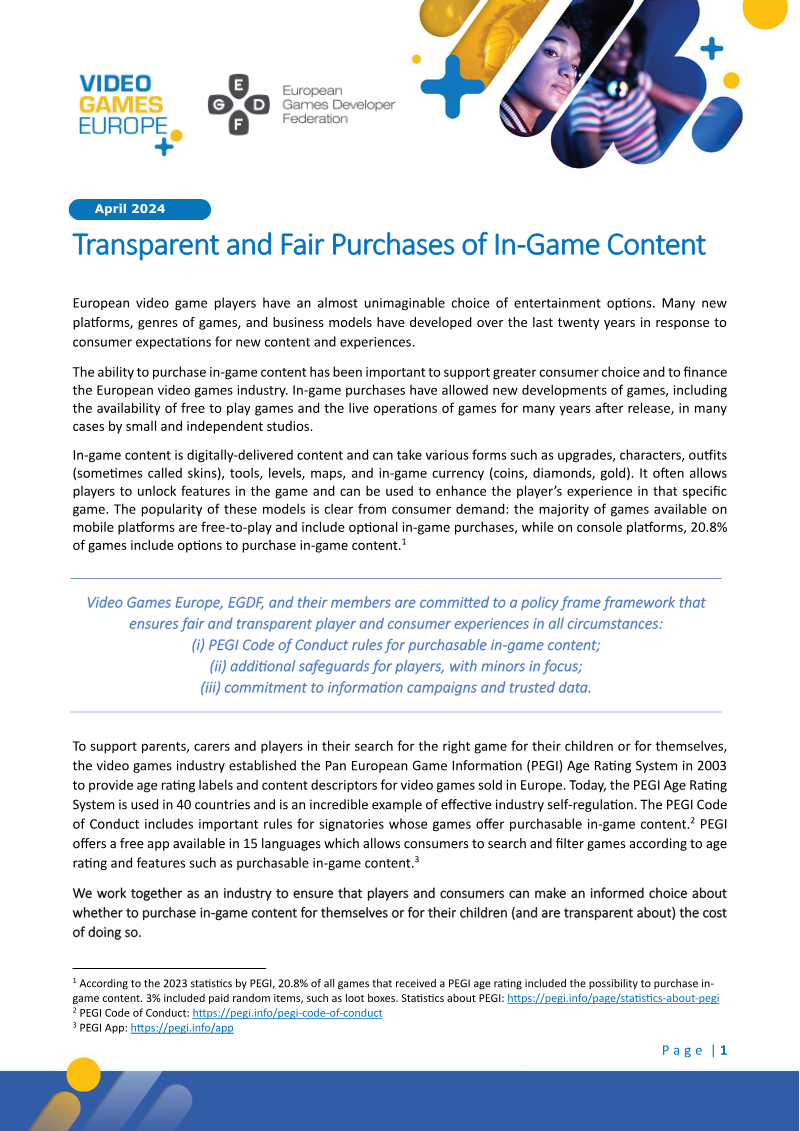
Transparent and Fair Purchases of In-Game Content
The initiative seeks to ensure that European players can make informed, transparent decisions when purchasing in‑game content, while safeguarding minors from unintended spending. It builds on the PEGI Age Rating System, now operating in forty countries, and introduces a three‑part policy framework: the PEGI Code of Conduct for purchasable content, additional safeguards focused on younger players, and coordinated information campaigns supported by trusted data.
Statistical evidence shows that 20.8 % of all games receiving a PEGI rating include in‑game purchase options, with 3 % offering paid random items such as loot boxes. An annual Ipsos survey commissioned by Video Games Europe from 2018 to 2024, covering the five largest European consumer‑spend markets, reveals that parental supervision remains high—95 % of Swedish parents monitor spending—and that 76 % of parents report their children do not make in‑game purchases, a figure stable since 2020. Average spend among permitted purchasers fell 21 % in the Netherlands since 2023, and only 11 % of players aged 11‑64 have bought in‑game currency across the surveyed regions.
The PEGI Code of Conduct obliges signatories to display a dedicated icon at the point of purchase, provide receipts, and clearly state the real‑world cost of any virtual currency. For paid random items, it mandates visible notices, confirms that such purchases are optional, and requires transparent probability disclosures in line with data‑protection laws. Additional safeguards include parental tools that default to zero spending for child accounts, separation of transaction interfaces from gameplay, and refund mechanisms for unauthorized purchases. Policies also prohibit the use of in‑game assets for illegal gambling or unauthorised trading, with enforcement powers vested in the PEGI Enforcement Committee.
Information campaigns, such as the Pan‑European “Seize the Controls” effort, aim to raise awareness of these tools and safeguards in national languages, leveraging partnerships with Safer Internet Centres and other stakeholders. The industry welcomes further support from EU institutions and member states to amplify outreach and reinforce responsible spending practices across the European gaming ecosystem.
- The PEGI Code of Conduct mandates that signatories display purchase icons, provide receipts, and disclose real-world costs for virtual currency, while requiring transparent probability disclosures for paid random items like loot boxes.
- Only 20.8% of PEGI-rated games include in-game purchase options, with just 3% of all rated games offering paid random items.
- Parental supervision remains robust, with 76% of parents reporting their children do not make in-game purchases, a figure that has remained stable since 2020.
- Industry safeguards now include parental tools that default child accounts to zero spending, the separation of transaction interfaces from gameplay, and established refund mechanisms for unauthorized purchases.
- Data from 2018–2024 indicates that only 11% of players aged 11–64 have purchased in-game currency across the five largest European markets.
+1
Video Games EuropeApr 2024

Report31 pages
AI Apps Market Insights 2024
The 2024 AI Apps Market Insights report provides a comprehensive analysis of the global mobile artificial intelligence sector, focusing on download and revenue trends across the App Store and Google Play. Covering the period from January to August 2024, the study examines market distribution, sub-genre performance, and user engagement metrics. Data is derived from Sensor Tower’s proprietary intelligence platforms, excluding advertising revenue and third-party Android store sales.
Global adoption of AI applications has accelerated significantly, with downloads reaching 2.2 billion in the first eight months of 2024 and projected to hit 3.3 billion by year-end. In-app purchase revenue is expected to grow 51% year-over-year to $3.3 billion. While India leads in total downloads with a 21% market share, North America and Europe remain the primary financial drivers, accounting for 68% of total global revenue.
The market is segmented into several high-performing categories, with AI Art Generators emerging as the most profitable sub-genre, capturing 53% of total industry revenue. AI Chatbots follow at 29%, having already surpassed their total 2023 revenue by 1.5 times. A notable trend is the rise of companion AI apps like Character AI and Talkie AI, which boast high user retention; Character AI users average over 1.5 hours of daily use, with a heavy concentration among the 18-24 age demographic.
ChatGPT maintains a dominant position as the leading AI application, reaching a record $45 million in monthly revenue in August 2024 following the launch of GPT-4o. With over 190 million monthly active users and $270 million in cumulative revenue, it serves as the industry benchmark. Beyond general assistants, AI technology is increasingly integrated into specialized fields including education, dating, and music, signaling a broader diversification of the mobile AI ecosystem.
- Global AI app downloads are projected to reach 3.3 billion by the end of 2024, with in-app purchase revenue expected to grow 51% year-over-year to $3.3 billion.
- AI Art Generators dominate the market as the most profitable sub-genre, capturing 53% of total industry revenue, followed by AI Chatbots at 29%.
- ChatGPT remains the industry benchmark with 190 million monthly active users and a record $45 million in monthly revenue as of August 2024.
- North America and Europe generate 68% of total global revenue, while India leads in volume with a 21% share of total downloads.
- AI Chatbot revenue has grown rapidly, already surpassing its total 2023 performance by 1.5 times within the first eight months of 2024.
+1
Sensor TowerMar 2024

Report35 pages
Store Intelligence Data Digest: Q4 2023
Global mobile app performance in the final quarter of 2023 reflected a complex landscape of shifting platform dynamics and regional market evolution. Total worldwide downloads reached 33.4 billion, representing a 6% year-over-year decline primarily attributed to an 8% drop in Google Play installs. Conversely, iOS downloads grew by 1.3%, a trend particularly visible in India. Despite a 13% decline in Google Play installs, India remained the world’s largest mobile market with 6.1 billion downloads, while its growing middle class drove increased iOS adoption. Emerging markets like Nigeria showed the strongest absolute growth on Google Play, while Japan demonstrated exceptional monetization efficiency, leading the world with a revenue-per-download ratio of $23.61 in the manga category.
The competitive landscape was defined by a tension between aggressive user acquisition and long-term retention. TikTok reclaimed its position as the most downloaded app globally, fueled by an 80% surge in China, while the shopping platform Temu dominated Western markets. However, high-growth apps like Temu struggled with user stickiness, maintaining daily engagement rates below 20%. In contrast, established platforms like WhatsApp and Google Chrome proved the most resilient, with WhatsApp achieving a 91% daily engagement rate among its monthly active users. Meta and Google maintained their corporate dominance, bolstered by the launch of Threads and a 38% year-over-year increase in YouTube Kids downloads.
In the gaming sector, Garena Free Fire and Roblox led global downloads with 56 million installs each, while Ludo King remained a powerhouse in the Asian market. The U.S. market saw continued success for Monopoly Go and a significant expansion of Netflix’s gaming portfolio, highlighted by the launch of GTA San Andreas. These trends underscore a maturing global industry where market leaders must balance massive scale in emerging regions with the high-value monetization and retention found in established digital economies.
- Global mobile app downloads fell 6% year-over-year in Q4 2023 to 33.4 billion, driven by an 8% decline in Google Play installs despite a 1.3% increase in iOS downloads.
- India remains the world's largest mobile market with 6.1 billion downloads, though Google Play installs in the region declined by 13% while iOS adoption grew.
- TikTok reclaimed the top spot for global downloads following an 80% surge in China, while Temu dominated Western markets but struggled with user stickiness, maintaining daily engagement rates below 20%.
- Established platforms maintain superior retention, with WhatsApp achieving a 91% daily engagement rate among its monthly active users.
- Japan leads the world in monetization efficiency, recording a revenue-per-download ratio of $23.61 within the manga category.
+1
Sensor TowerMar 2024
Report72 pages
Africa Games Industry Report
The African video games industry represents a rapidly expanding mobile-first frontier, characterized by a player population that surged from 77 million in 2015 to 186 million in 2021. With annual revenues projected to surpass $1 billion by 2024, the continent is positioning itself to replicate the success of other emerging markets like Brazil and India. Growth is currently concentrated in regional hubs across South Africa, Nigeria, Ghana, and Kenya, where a young demographic is increasingly integrating local cultural themes into digital entertainment. This evolution is supported by a complex value chain where mobile gaming accounts for the vast majority of engagement, mirroring global trends where mobile platforms generate over $92 billion in annual revenue.
Despite this potential, the ecosystem remains in a nascent stage, with 63% of studios operating for five years or less and 59% of developers never having secured external investment. While high-profile deals such as Carry1st’s $27 million funding round and GBarena’s $15 million acquisition of Galactech signal growing investor confidence, the broader market is still dominated by hobbyists. Only 36% of developers currently earn a living from their work, and over half of those rely exclusively on domestic revenue. Technical development is heavily centralized around the Unity engine, which is utilized by 64% of the market, reflecting the industry's focus on accessible mobile content.
Significant structural barriers continue to impede the transition from a hobbyist community to a professionalized global competitor. Infrastructure deficits are the primary concern, with 60% of industry participants citing poor power supply and high internet costs as critical obstacles. Furthermore, government support is nearly non-existent, currently reaching only 3% of the sector. To achieve sustainable maturity, the industry requires a coordinated effort to stabilize infrastructure, formalize talent pipelines, and attract informed investors who understand the unique dynamics of the African market. Addressing these catalysts is essential for transforming local creative potential into a robust, revenue-generating economic sector.
- The African gaming market is a high-growth mobile-first sector, with the player base expanding from 77 million in 2015 to 186 million in 2021 and annual revenues projected to exceed $1 billion by 2024.
- Infrastructure instability remains the primary barrier to professionalization, with 60% of industry participants identifying poor power supply and high internet costs as critical obstacles to growth.
- The industry is currently in a nascent, hobbyist-dominated state where 59% of developers have never secured external investment and only 36% earn a full-time living from their work.
- Development is heavily centralized around the Unity engine, which is used by 64% of the market to produce mobile-focused content, mirroring global trends in mobile gaming.
- While the market is largely fragmented, high-profile activity such as Carry1st’s $27 million funding round and GBarena’s $15 million acquisition of Galactech indicates emerging investor confidence.
+1
Games Industry AfricaMar 2024
Report44 pages
Q1 2024 Digital Market Index
In the first quarter of 2024, the mobile gaming market showed a clear shift away from hyper‑casual titles, which experienced a year‑over‑year decline of more than ten percent across all major platforms. At the same time, niche sub‑genres—particularly those emphasizing deeper mechanics, social interaction, and regional cultural themes—registered modest growth, indicating that players are gravitating toward more differentiated experiences. Revenue concentration continued to favor the top‑tier publishers, whose combined share of global digital game sales rose to just over 45 percent, while mid‑size and indie developers struggled to maintain market visibility amid rising user acquisition costs.
Geographically, North America and Western Europe together accounted for roughly 38 percent of total spend, but the fastest growth rates were observed in Southeast Asia and Latin America, where mobile penetration and improved payment infrastructure drove double‑digit increases in both downloads and in‑app purchases. The overall market size reached $23.7 billion in Q1, representing a 4.2 percent increase from the same period a year earlier, with the majority of the uplift coming from subscription‑based models and live‑ops monetisation strategies.
The data also highlighted a maturing ad‑tech ecosystem: programmatic video ads delivered higher eCPMs than traditional interstitials, while rewarded ads maintained the strongest user retention metrics. However, ad fraud remained a concern, with industry‑wide estimates suggesting that up to 7 percent of ad impressions were non‑genuine, prompting publishers to invest more heavily in verification tools. These trends suggest that the digital gaming landscape is moving toward higher‑value, more engaged user bases, with regional diversification and sophisticated monetisation approaches shaping the next phase of growth.
- The global digital gaming market reached $23.7 billion in Q1 2024, a 4.2% year-over-year increase driven primarily by subscription models and live-ops monetization.
- Top-tier publishers consolidated their market position, capturing over 45% of global digital game sales as mid-size and indie developers faced increased pressure from rising user acquisition costs.
- Mobile gaming trends shifted away from hyper-casual titles, which saw a decline of over 10% year-over-year, in favor of niche sub-genres offering deeper mechanics and social interaction.
- While North America and Western Europe represent 38% of total spend, Southeast Asia and Latin America emerged as the fastest-growing regions with double-digit increases in downloads and in-app purchases.
- Ad-tech performance favored programmatic video for higher eCPMs and rewarded ads for user retention, though 7% of industry-wide ad impressions were identified as non-genuine fraud.
+1
Sensor TowerMar 2024

Report53 pages
Mobile App Trends 2024: Japan Edition
The Japanese mobile app market maintains its status as a global powerhouse, generating $17.9 billion in consumer spending and 2.5 billion downloads in 2023. Despite a marginal decline in annual installs, the market demonstrated a strong recovery in the first quarter of 2024, characterized by a 3.5% rise in spending and a 3% increase in downloads. This growth is underpinned by high user engagement and a notable 30% ATT opt-in rate within the gaming sector, signaling a resilient ecosystem for data-driven marketing and monetization.
Mobile gaming remains the primary revenue driver, with RPGs accounting for nearly half of all consumer spend and achieving a high average revenue per monthly active user of $5.09. However, the landscape is evolving toward deeper immersion, as evidenced by simulation games reaching average session lengths of over 40 minutes. Simultaneously, the finance and e-commerce sectors are experiencing rapid expansion. Finance apps saw a 53.5% spending surge in early 2024, while e-commerce lifetime value in Japan reached $9.67 by the end of the first month, nearly doubling global medians.
Strategic shifts in user acquisition are evident across all segments, with a marked transition toward paid channels. The paid-to-organic install ratio for gaming reached 2.31 in early 2024, while finance and e-commerce also saw significant increases in paid acquisition efforts. This trend is complemented by the emergence of Connected TV as a critical performance channel. With ad spend projected to reach 170 billion yen by 2025, advertisers are increasingly reallocating budgets from social media to CTV to leverage its high viewership and its proven ability to assist in driving mobile app installs through sophisticated measurement and AI-driven creative optimization.
- The Japanese mobile market generated $17.9 billion in consumer spending in 2023, with Q1 2024 showing a 3.5% increase in spending and a 3% rise in downloads.
- Mobile gaming remains the primary revenue driver, with RPGs capturing nearly 50% of consumer spend and simulation games achieving session lengths exceeding 40 minutes.
- Finance apps experienced a 53.5% surge in spending in early 2024, while e-commerce apps reached a first-month lifetime value of $9.67, nearly double the global median.
- Connected TV is emerging as a critical performance channel, with ad spend projected to reach 170 billion yen by 2025 as advertisers shift budgets away from social media.
- User acquisition strategies have shifted heavily toward paid channels, evidenced by a 2.31 paid-to-organic install ratio in the gaming sector during early 2024.
+1
Sensor TowerMar 2024

Report33 pages
Marketing Insights into Global Casual & Puzzle Games for Q1 2024
The global mobile gaming landscape in the first quarter of 2024 is characterized by a significant expansion in the advertiser base, which grew nearly 29% year-over-year to approximately 51,300 monthly active participants. Despite this increase in competition, the volume of unique creatives per advertiser decreased by 18%, signaling a strategic shift toward quality over quantity. Casual and puzzle games remain the primary drivers of this ecosystem, collectively representing half of all active advertisers. Casual games alone account for nearly 40% of total ad creatives, with the most intense market activity concentrated in Europe and the United States. In these regions, success is increasingly dependent on high-quality, short-form video content and rapid creative iteration to combat player fatigue.
Performance data indicates that iterative content updates and rigorous A/B testing are essential for scaling titles in a saturated market. Successful case studies demonstrate that optimizing level depth and refining monetization strategies can yield substantial financial gains, as seen in the 32% increase in average revenue per user for Camo Snipper and the continued dominance of Royal Match as a top-five global grossing title. Furthermore, the rapid international expansion of instant games from Chinese developers highlights a growing trend toward cross-border competition. To penetrate diverse markets such as Japan, South Korea, and Southeast Asia, developers are increasingly relying on localized ad creatives and influencer marketing to bridge cultural gaps.
The scope of these findings encompasses a broad geographic range, including Southeast Asia, the Middle East, South America, and East Asian territories. By analyzing these regional clusters, it becomes clear that while the casual and puzzle segments are globally ubiquitous, effective execution requires a nuanced understanding of local preferences. The current market environment demands a sophisticated balance between broad-reach advertising and localized engagement strategies to maintain growth and profitability in the face of rising advertiser density.
- The global mobile gaming advertiser base grew 29% year-over-year in Q1 2024 to 51,300 participants, while the volume of unique creatives per advertiser dropped by 18% as firms shifted toward quality over quantity.
- Casual and puzzle games dominate the market, accounting for 50% of all active advertisers, with casual games alone responsible for nearly 40% of total ad creatives.
- Success in saturated markets like the US and Europe requires high-quality short-form video content and rapid creative iteration to mitigate player fatigue.
- Rigorous A/B testing and content optimization drive financial performance, evidenced by a 32% increase in average revenue per user for Camo Snipper and the continued top-five grossing status of Royal Match.
- Chinese developers are driving cross-border competition through instant games, utilizing localized ad creatives and influencer marketing to penetrate markets in Japan, South Korea, and Southeast Asia.
+2
SocialPetaMar 2024

Report14 pages
The True Cost of Building a Mobile Game Backend
This analysis examines the financial and operational costs associated with developing in-house backend technology for mobile games. The primary thesis suggests that while third-party game engines have become industry standards, backend infrastructure is currently undergoing a similar shift as the technical demands of live-service games outpace the practicality of internal development.
The findings are based on a survey of 125 C-level executives and tech leads at US-based mobile game studios with at least 50 employees, conducted in April 2024. Data indicates that the average leading US studio employs 52 developers for 36 months to build and maintain an internal backend. With an average annual salary of $138,864 per developer, the direct financial investment for a custom backend is estimated at approximately $21.6 million. The research notes that strategy and shooter genres are most likely to require these complex systems, while hypercasual games are increasingly adopting them to support "hybridcasual" live-ops models.
Beyond direct costs, the analysis identifies significant "hidden" human and operational tolls. Approximately 50% of surveyed studios reported that diverting gameplay programmers to backend tasks slowed overall game development. Furthermore, one-third of respondents experienced higher employee turnover and increased "crunch" periods, while 20% reported direct revenue loss. The study concludes that the decision to build internal tech often results in negative knock-on effects across departments, suggesting that third-party solutions offer a more sustainable path for scaling live-service titles without sacrificing personnel well-being or development velocity.
- Building an in-house mobile game backend costs an average of $21.6 million, requiring 52 developers working over a 36-month period.
- Diverting gameplay programmers to backend infrastructure tasks slows overall development velocity for 50% of surveyed studios.
- Internal backend development contributes to negative organizational outcomes, including increased employee turnover, higher rates of crunch, and direct revenue loss for 20% of studios.
- The technical demands of live-service games are driving a shift toward third-party backend solutions, mirroring the industry-wide adoption of third-party game engines.
- While strategy and shooter genres have the highest requirement for complex backend systems, the rise of 'hybridcasual' models is expanding this need to the hypercasual sector.
+2
MetaplayMar 2024

Report29 pages
Turning Organic Success into Long-Term Revenue: A Framework for F2P Mobile Games
This industry guide provides a strategic framework for mobile game developers to transition from initial organic traction to sustainable, long-term revenue growth. The central thesis argues that while organic "sparks" are invaluable, lasting success requires a rigorous, two-step approach: first, optimizing the game’s internal economy for maximum Lifetime Value (LTV), and second, deploying data-driven paid User Acquisition (UA) campaigns.
The first phase focuses on monetization through ad mediation and in-app purchases (IAP). Key findings suggest that implementing a hybrid ad mediation setup—combining real-time bidding with manual waterfalls—can yield a 10% to 20% uplift in Average Revenue Per Daily Active User (ARPDAU) immediately. The analysis emphasizes the importance of rewarded ads over intrusive interstitials and highlights that personalized, segmented IAP offers can increase player spending by up to 23%. It also advocates for regional pricing, noting that price cuts in lower-purchasing-power markets can boost ARPDAU by as much as 30%.
The second phase details a methodology for scaling through paid UA, emphasizing the necessity of accurate data post-IDFA. The guide recommends a three-step framework of assessment, preparation, and optimization. It advises that while platforms like Meta and TikTok are accessible for smaller budgets, larger networks typically require a minimum monthly spend of $20,000 to exit the "learning phase" effectively. Furthermore, it stresses the role of App Store Optimization (ASO), citing a case where a simple icon change resulted in a 90% install uplift.
The scope of the analysis covers the global free-to-play (F2P) mobile gaming market, applicable to various genres and studio sizes. The methodology relies on industry benchmarks, case studies, and data from SuperScale’s proprietary analytics engine, SuperInsights. The overarching conclusion is that developers must treat monetization and UA as iterative, scientific processes, using predictive modeling to forecast Return on Ad Spend (ROAS) up to a year in advance to ensure business-level profitability.
- Developers should treat monetization and user acquisition as iterative, scientific processes, using predictive modeling to forecast ROAS up to one year in advance to ensure profitability.
- Implementing a hybrid ad mediation setup that combines real-time bidding with manual waterfalls can yield an immediate 10% to 20% uplift in ARPDAU.
- Personalized, segmented in-app purchase offers can increase player spending by up to 23%, while regional pricing adjustments in lower-purchasing-power markets can boost ARPDAU by as much as 30%.
- Paid user acquisition campaigns on larger networks typically require a minimum monthly spend of $20,000 to effectively exit the platform's initial learning phase.
- App Store Optimization is a high-impact lever for growth, as evidenced by a case study where a simple icon change resulted in a 90% uplift in installs.
+2
SuperScaleMar 2024

Report49 pages
State of Play: Spring Edition
Mobile gaming has solidified its position as the industry’s primary driver, currently engaging 1.9 billion players and tracking toward $118 billion in annual revenue by 2027. This growth is occurring alongside a fundamental restructuring of digital commerce. Regulatory shifts, such as the European Union’s Digital Markets Act and recent judicial rulings, are dismantling the traditional walled gardens of major app stores. By forcing the adoption of alternative billing systems and out-of-app commerce, these changes allow developers to bypass standard commission fees and engage in direct-to-consumer marketing, fundamentally altering the economics of mobile distribution.
The industry is simultaneously transitioning toward a cross-platform ecosystem where seamless play and unified payment systems across mobile, PC, and console are becoming standard. Consumer behavior supports this shift, as 87% of multiplayer gamers now engage in cross-platform play. Younger demographics, specifically Gen Alpha and Gen Z, exhibit a 52% payer conversion rate, significantly outperforming older cohorts. To capture this value, developers are increasingly forming strategic alliances with telecommunications providers to integrate 5G infrastructure and mobile wallets, ensuring frictionless transactions in a "cross-pay" environment.
Despite a significant cooling in investment during 2023—characterized by a 75% drop in Web3 funding and a 43% decline in merger and acquisition activity—the sector is recalibrating toward a sustainable "new normal." The workforce is becoming more formalized, with nearly three-quarters of designers holding university degrees. Market analysts anticipate a recovery throughout 2024, marked by a 20% increase in deal flow and the entry of major media entities like Netflix and Disney. This stabilization is supported by a shift in venture capital toward alternative models that prioritize marketing and operational support over traditional equity-only investments.
- Mobile gaming is the industry's primary growth engine, with 1.9 billion players and projected annual revenue of $118 billion by 2027.
- Regulatory changes like the EU's Digital Markets Act are dismantling app store walled gardens, enabling developers to bypass standard commission fees through alternative billing and direct-to-consumer commerce.
- Cross-platform play is now a standard expectation, with 87% of multiplayer gamers participating and developers increasingly integrating 5G and mobile wallets to facilitate unified 'cross-pay' ecosystems.
- Younger demographics (Gen Alpha and Gen Z) are driving monetization, exhibiting a 52% payer conversion rate that significantly outperforms older player cohorts.
- After a 2023 downturn featuring a 75% drop in Web3 funding and a 43% decline in M&A activity, the market is projected to recover in 2024 with a 20% increase in deal flow.
+1
XsollaMar 2024
Report40 pages
State of the Market 2023: An Annual Analysis of App Market and Advertising Activities
The 2023 market analysis evaluates global mobile advertising performance, concentrating on the two dominant operating systems, iOS and Android, and the leading social platforms that drive ad spend. Facebook and Instagram continue to command the largest share of the social advertising ecosystem, reinforcing their status as primary channels for marketers seeking broad reach and engagement across diverse audiences.
Video advertising emerged as the pre‑eminent format throughout the year, registering a 16 % increase on iOS and a markedly higher 37 % rise on Android. This divergence underscores Android’s accelerating momentum in video consumption and ad adoption, while iOS maintains steady growth. Interactive ad formats also showed modest gains, with a 2.7 % uplift on iOS, indicating a gradual shift toward more engaging user experiences, though the expansion remains limited compared with video.
Overall, the findings suggest that mobile video continues to dominate revenue generation, with Android delivering the strongest growth trajectory. The incremental rise in interactive formats points to emerging opportunities for richer creative solutions, yet video’s dominance will likely shape strategic allocations for the coming year. These trends highlight the importance of platform‑specific optimization and the need for advertisers to balance high‑impact video placements with exploratory interactive formats to maximize reach and performance across the mobile landscape.
- Video advertising is the primary revenue driver, experiencing a 37% growth on Android and a 16% increase on iOS during 2023.
- Facebook and Instagram remain the dominant platforms for social advertising, serving as the primary channels for broad audience reach and engagement.
- Android is outpacing iOS in video ad adoption, demonstrating a significantly stronger growth trajectory for video-based marketing strategies.
- Interactive ad formats saw a modest 2.7% growth on iOS, signaling a slow but emerging shift toward more engaging, non-video user experiences.
- Advertisers should prioritize platform-specific optimization by balancing high-impact video placements with exploratory interactive formats to maximize performance.
+1
AppticaMar 2024
Report38 pages
Landscape Shifts in IP Gaming: An Analysis of How the Competitive Landscape of IP in Gaming Has Shifted in 2023
The global gaming landscape in 2023 was defined by the overwhelming commercial dominance of established intellectual properties, which accounted for every top launch on PC and console. Licensed mobile titles generated $16 billion in gross revenue, driven largely by the unprecedented success of Monopoly GO!, which reached $1 billion in revenue in under seven months. This performance propelled Hasbro and Scopely to the top of the corporate and publisher rankings, respectively. While video game and anime IPs continue to command the largest market share—particularly in Asia where they account for 70% of downloads—board game IPs experienced a significant revenue surge within the United States.
Strategic integration of IP serves as a critical driver for both monetization and marketing efficiency. Role-playing games remain the most lucrative genre for licensed content due to the effectiveness of gacha-based monetization, while cross-platform collaborations and limited-time events continue to expand audience reach. Furthermore, established franchises demonstrate superior cost-efficiency compared to original titles, achieving high sales volumes with significantly lower marketing expenditures. This suggests that leveraging recognized brands provides a vital competitive advantage in an increasingly crowded marketplace.
Despite the high visibility of major hits, the mobile IP market remains largely unsaturated, with licensed titles currently accounting for less than 20% of total revenue across most genres. While RPGs and social casino mechanics have proven successful, casual categories such as puzzle and simulation games represent significant untapped opportunities for future integration. Growth in the sector is increasingly dependent on high-profile new launches rather than the expansion of legacy titles, indicating that the strategic selection and execution of new IP partnerships will dictate the next phase of industry expansion.
- Established intellectual properties dominated the 2023 market, accounting for every top-performing launch on both PC and console platforms.
- Licensed mobile titles generated $16 billion in gross revenue in 2023, with Monopoly GO! reaching $1 billion in under seven months to drive Hasbro and Scopely to the top of industry rankings.
- Video game and anime IPs dominate the Asian market with a 70% share of downloads, while board game IPs saw a notable revenue surge in the United States.
- Established franchises offer superior cost-efficiency over original titles, achieving higher sales volumes while requiring significantly lower marketing expenditures.
- The mobile IP market remains largely untapped, as licensed titles currently account for less than 20% of total revenue across most genres.
+1
Sensor TowerJan 2024