Spore
Game
Documents about Spore
Whitepaper17 pages
Pattern Recognition: Gameplay as Negotiating Procedural Form
Pattern Recognition: Gameplay as Negotiating Procedural Form argues that pattern recognition, grounded in Gestalt psychology, is central to how players engage with games, and that this engagement is generated through procedural programming rather than simply perceived in fixed designs.
- The paper argues that pattern recognition, grounded in Gestalt psychology, is central to player engagement and that players actively produce patterns (not just perceive them), citing Metzger's claim that Gestalt principles govern both perception and production.
- Its most distinctive contribution is the concept of "pattern immersion," a sub-linguistic, Gestalt-based engagement developed through direct play that aligns with Csikszentmihalyi's notion of Flow, set against "narrative immersion," which relies on authored story and cultural convention.
- The author contends that designers often apply Gestalt principles as a top-down layer over predefined structures, underutilizing their capacity to generate emergent gameplay.
DiGRAJan 2011

Whitepaper10 pages
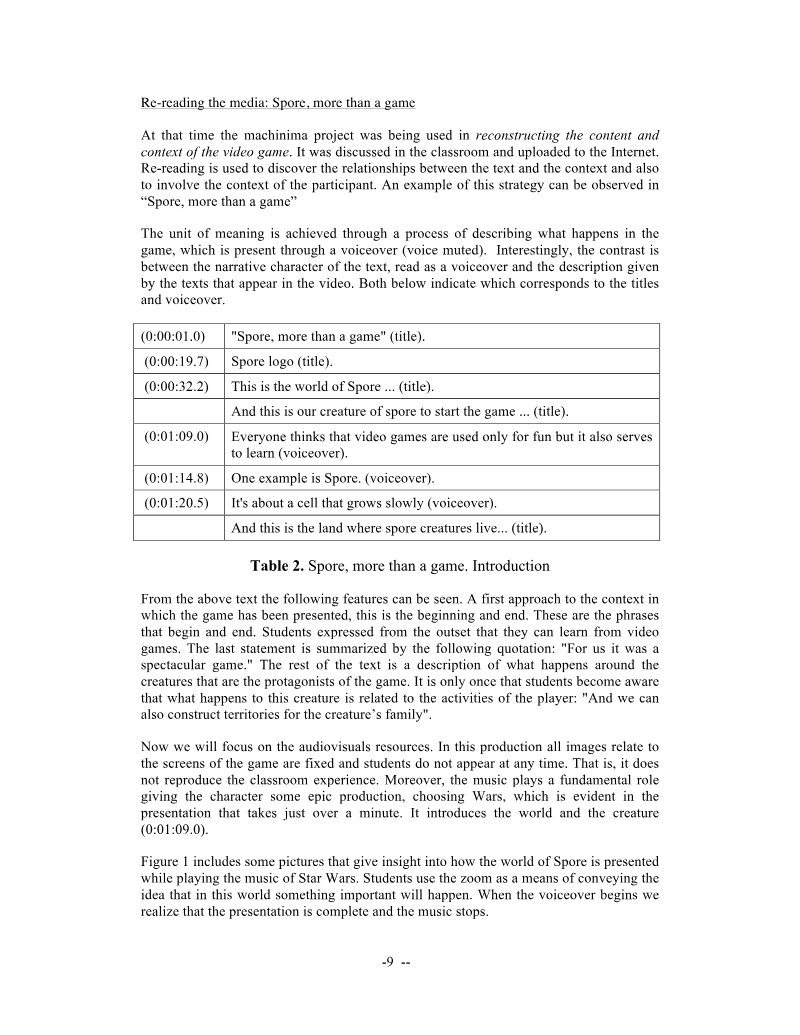
Doing It Themselves! A Mixed-Method Study into the Motivations of Players to 'Create' in the Context of Gaming
This study investigates what motivates players to create content within digital games, focusing on two titles promoted as accessible creative experiences: Spore (PC and Mac) and LittleBigPlanet (PS3).
- Players who create content in games tend to be highly engaged: over 81% of survey respondents had used a level editor, and roughly one in five had contributed to game development in some form.
- Challenge was the highest-scoring motivation among respondents, followed by Arousal and a newly introduced Create construct, which correlated strongly with both Challenge and Arousal.
- Players are broadly omnivorous in genre preferences, with first-person shooters, action-adventures, and racing games ranking highest among respondents.
DiGRAJan 2011

Whitepaper15 pages
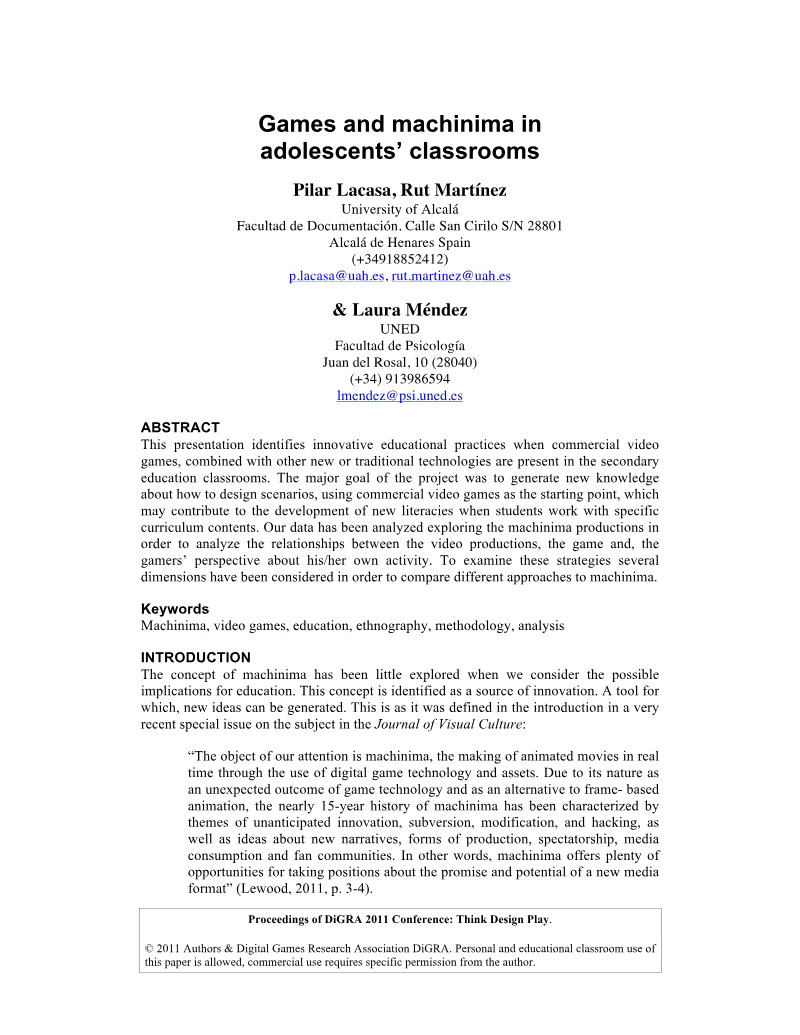
Games and Machinima in Adolescents' Classrooms
This study examines how commercial video games and machinima, films produced inside game engines, can be used in Spanish secondary classrooms to develop new literacies within the curriculum.
- The study ran during the 2008–2009 school year with roughly 300 students aged 11 to 16 and 17 teachers in Spanish secondary classrooms, using commercial video games and machinima (films produced inside game engines).
- The authors report no measured learning outcomes; their claim that the approach is effective rests mainly on their own experiential observations as practitioners rather than quantitative evidence.
- The methodology alternates dialogue, play, and reflection in workshops, culminating in student-made machinima, with the stated aim of generating knowledge for designing game-based learning scenarios.
DiGRAJan 2011