Detroit: Become Human
4 documents in the library are about Detroit: Become Human, from writers such as Alinea Analytics, Game Developers Conference and Game World Observer, the newest from 2026. Each has a summary and key insights with the page they come from.

Detroit: Become Human is an interactive narrative adventure game developed by Quantic Dream and released in 2018. Set in a near-future Detroit where androids serve humans, the story follows three android protagonists—Kara, Connor, and Markus—who shape the city’s fate through their choices. Gameplay combines exploration, dialogue interactions, and quick-time events, with branching storylines and multiple endings. The narrative explores themes of artificial intelligence, freedom, and morality.
- Released
- May 25, 2018
- Developer
- Quantic Dream
- Publisher
- Sony Interactive Entertainment
- Genres
- Adventure
- Platforms
- PlayStation 4, PC (Microsoft Windows)
- Links
- Wikipedia
Game data from IGDB.com
Key figures
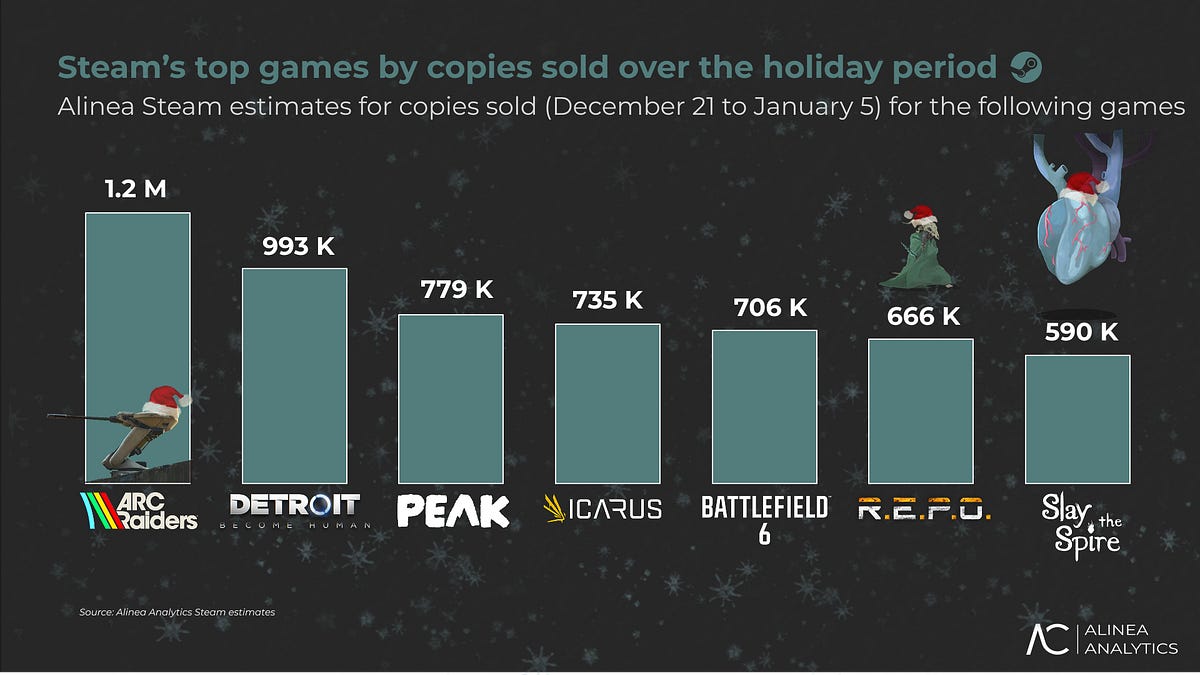
Detroit: Become Human shifted 993,000 copies during the holiday period, driven by a record-low price of $4 that helped the title surpass $150 million in total Steam revenue.
Alinea Analytics, 2026 · The Steam Games That Sold the Most Copies Over the Holidays
In March 2022, reports surfaced that Chinese tech giant NetEase was in negotiations to acquire 100% of Quantic Dream, the developer of Detroit: Become Human.
Game World Observer, 2022 · Chinese Tech Giant NetEase to Reportedly Acquire 100% of Quantic Dream
Documents about Detroit: Become Human
The Steam Games That Sold the Most Copies Over the Holidays
Steam experienced a record-breaking December in 2025, generating $1.6 billion in gross revenue from over 100 million players.
- Steam generated $1.6 billion in gross revenue during December 2025, marking a 22.7% increase over December 2024 and surpassing the previous record set in December 2020.
- ARC Raiders led Steam sales between December 21 and January 4 with 1.2 million copies sold, contributing to the title reaching 12 million total copies sold and 7 million on Steam.
- Detroit: Become Human shifted 993,000 copies during the holiday period, driven by a record-low price of $4 that helped the title surpass $150 million in total Steam revenue.

60 Best Interactive Story Games in 2026
The interactive story genre has evolved into a sophisticated landscape where player agency and narrative depth serve as the primary drivers of engagement.
- Interactive story games drive long-term retention and high replayability by centering gameplay on branching storylines, moral dilemmas, and character-driven development.
- Player agency is the primary engagement driver, with success defined by the ability to influence character relationships and narrative outcomes through choice-based mechanics.
- Top-performing titles like Detroit: Become Human, Disco Elysium, and Life Is Strange demonstrate that integrating meaningful choices with immersive world-building is essential for market success.

Chinese Tech Giant NetEase to Reportedly Acquire 100% of Quantic Dream
This overview examines shifting investment strategies within the global gaming industry, specifically focusing on NetEase’s evolving relationship with its partner studios.
- In March 2022, reports surfaced that Chinese tech giant NetEase was in negotiations to acquire 100% of Quantic Dream, the developer of Detroit: Become Human.
- NetEase previously acquired a minority stake in Quantic Dream in 2019 to support the development and distribution of global online games.
- Quantic Dream had been seeking a buyer since its three-year partnership with Sony Interactive Entertainment concluded in 2018.

The Lighting Technology of Detroit: Become Human
Achieving visual consistency in Detroit: Become Human required a fundamental transition to a physically based rendering pipeline grounded in photometric units and linear space shading.
- The engine utilizes a physically based rendering pipeline grounded in photometric units and linear space shading to ensure consistent material and lighting interactions.
- To maintain performance within a strict 280MB memory budget, the engine employs a hybrid system featuring a high-performance shadow atlas with static caching and dynamic resolution.
- Global illumination is managed via an adaptive sparse octree of light probes, which store second-order spherical harmonics in volume texture atlases to support both static and dynamic objects.