Colossal Cave Adventure
Game
3 documents in the library are about Colossal Cave Adventure, from writers such as DiGRA. Each has a summary and key insights with the page they come from.
Connections
Each row is a game or company named alongside Colossal Cave Adventure, each column a document, oldest first. A mark means that document names it. Select a row to see those documents.
Documents about Colossal Cave Adventure
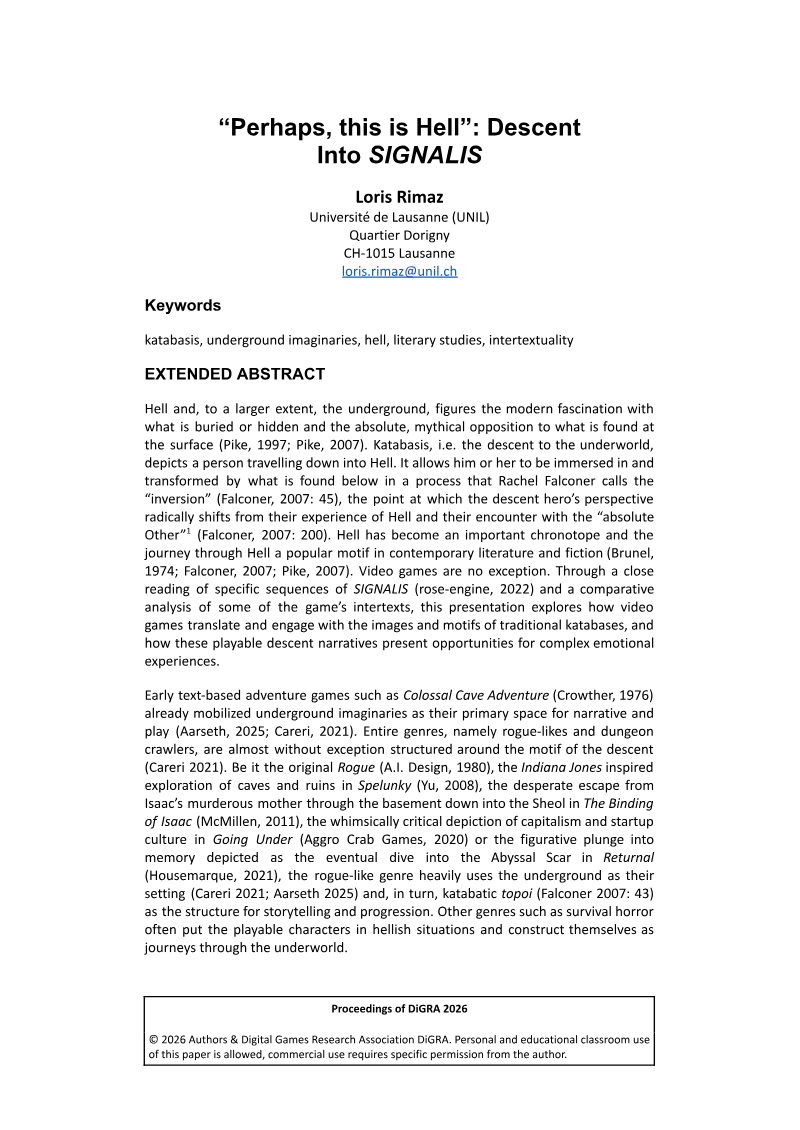
"Perhaps, This Is Hell": Descent Into SIGNALIS
This paper examines how video games engage with katabasis, the mythic descent into the underworld, using a close reading of SIGNALIS (rose-engine, 2022) and comparative analysis of its intertexts.
- The paper argues that playable descent narratives translate traditional katabatic (underworld-descent) images and motifs into interactive form, enabling complex emotional experiences.
- Its primary case study is SIGNALIS (rose-engine, 2022), read as both a literal and metaphorical katabasis through its vertical structure, threshold moments that compel protagonist Elster downward, and the explicit line "PERHAPS, THIS IS HELL."
- The author contends that in SIGNALIS, Hell is not a destination but the distorted world itself: a self-generated cycle of guilt, decay, and memory loss.



Designing Open Dialogue Systems for LLM-Based NPCs
This paper argues for an approach to non-player characters in which players converse with NPCs through free-form typed dialogue, with a large language model generating responses under the control of pre-written "directing prompts" that constrain the NPC's behavior.
- The paper proposes free-form typed dialogue with NPCs, where an LLM generates responses under pre-written "directing prompts" that constrain behavior, positioning this against historical text-parser and menu-based dialogue systems.
- Its central thesis is that LLM reasoning, including step-by-step and causal reasoning, lets game state change through qualitative semantic judgments rather than numerical win conditions.
- Rather than seeking deterministic outputs, the authors treat both player input and model output as non-deterministic and achieve predictability through system-level instructions that shape every response.
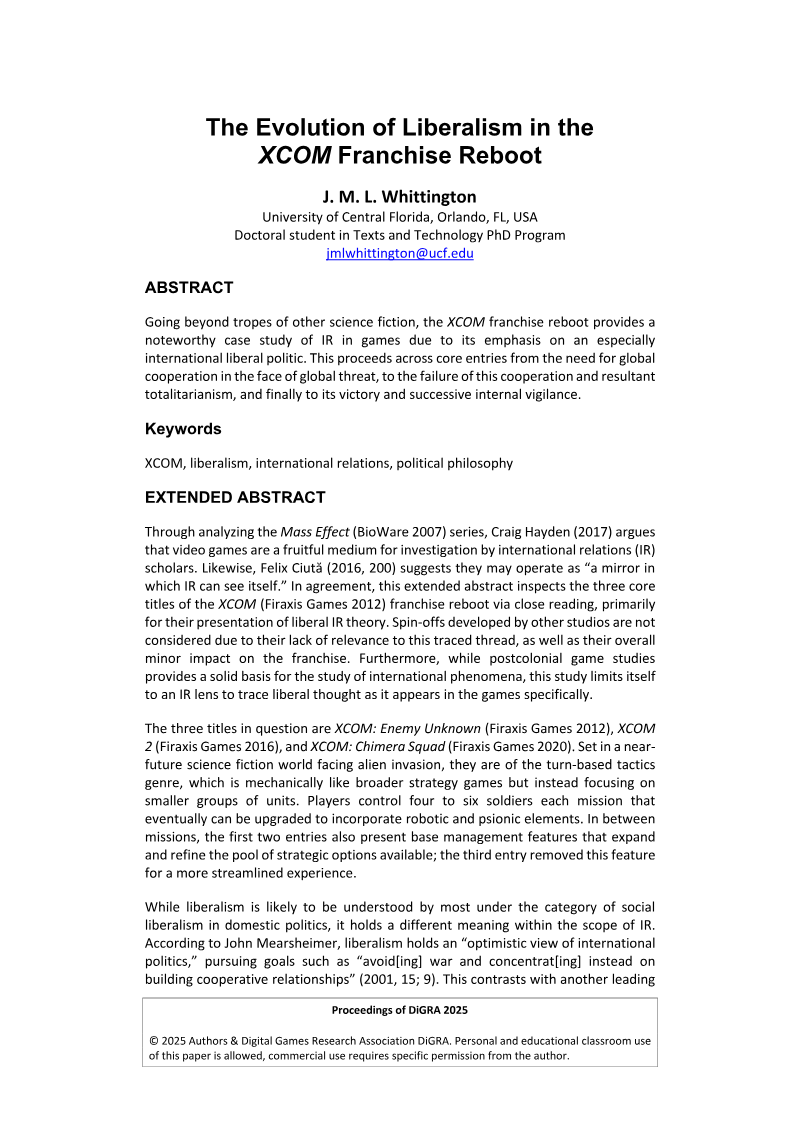
The Evolution of Liberalism in the XCOM Franchise Reboot
This paper examines the XCOM franchise reboot, comprising XCOM: Enemy Unknown (2012), XCOM 2 (2016), and XCOM: Chimera Squad (2020), as a case study in how games engage international relations theory, with particular attention to liberal internationalism.
- The paper argues the XCOM reboot trilogy (Enemy Unknown 2012, XCOM 2 2016, Chimera Squad 2020) traces a liberal arc: global cooperation against an external threat, collapse into authoritarian rule, liberation, and then domestic vigilance for a pluralist society.
- Using John Mearsheimer's distinction between liberal optimism and realist pessimism as its theoretical frame, the study contends the franchise departs from the realist logic its turn-based strategy mechanics might suggest.
- Enemy Unknown depicts sixteen major powers uniting under a council against an alien invasion, substituting generalized global threats such as climate change for the colonial anxieties common in alien-invasion fiction.