Adventure Time
Game
3 documents in the library are about Adventure Time, from writers such as ETC Press, Extra Credits and G|A|M|E – The Italian Journal of Game Studies. Each has a summary and key insights with the page they come from.
Connections
Each row is a game or company named alongside Adventure Time, each column a document, oldest first. A mark means that document names it. Select a row to see those documents.
Documents about Adventure Time
The Study of the Players' Pixel Aesthetics in Design-Driven Practices
This paper examines how pixel art aesthetics shape player experience and the design of physical gameroom environments, drawing on interior design, game psychology, and game studies.
- Pixel art aesthetics, especially in MapleStory, Super Mario Bros, Mega Man, and Crazy Arcade, are argued to shape players' emotional engagement, with game aesthetics significantly influencing players' willingness to engage with games and recommend them to others (Mai et al., 2025).
- The study frames game design through a mechanics-dynamics-aesthetics framework, positing that mechanics produce dynamics and dynamics produce players' aesthetic experiences.
- MapleStory is described as having over 100 million players worldwide and remaining popular for over 20 years thanks to its 2D side-scrolling pixel art and cutesy aesthetic, with self-determination theory (autonomy, competence, relatedness) cited as key to its engagement.
How the Joke has Changed | Comedy in Games 2026 | Extra Credits Gaming
Comedy in video games has evolved significantly over the last decade, shifting from a reliance on scripted writing and voice acting to a model where gameplay mechanics and player interaction serve as the primary drivers of humor.
- Comedy in games relies on the structural manipulation of player expectations, where developers create tension through established rules and resolve it through surprising or subverted outcomes.
- Effective game comedy often involves a strategic balance of player agency, where designers must decide when to grant control and when to remove it to ensure the player's input enhances rather than disrupts the intended humor.
- Modern comedy games have shifted from relying solely on written dialogue to utilizing gameplay-driven mechanics, such as physics-based simulations in titles like Octodad and Surgeon Simulator that intentionally defy real-world gravity and logic.
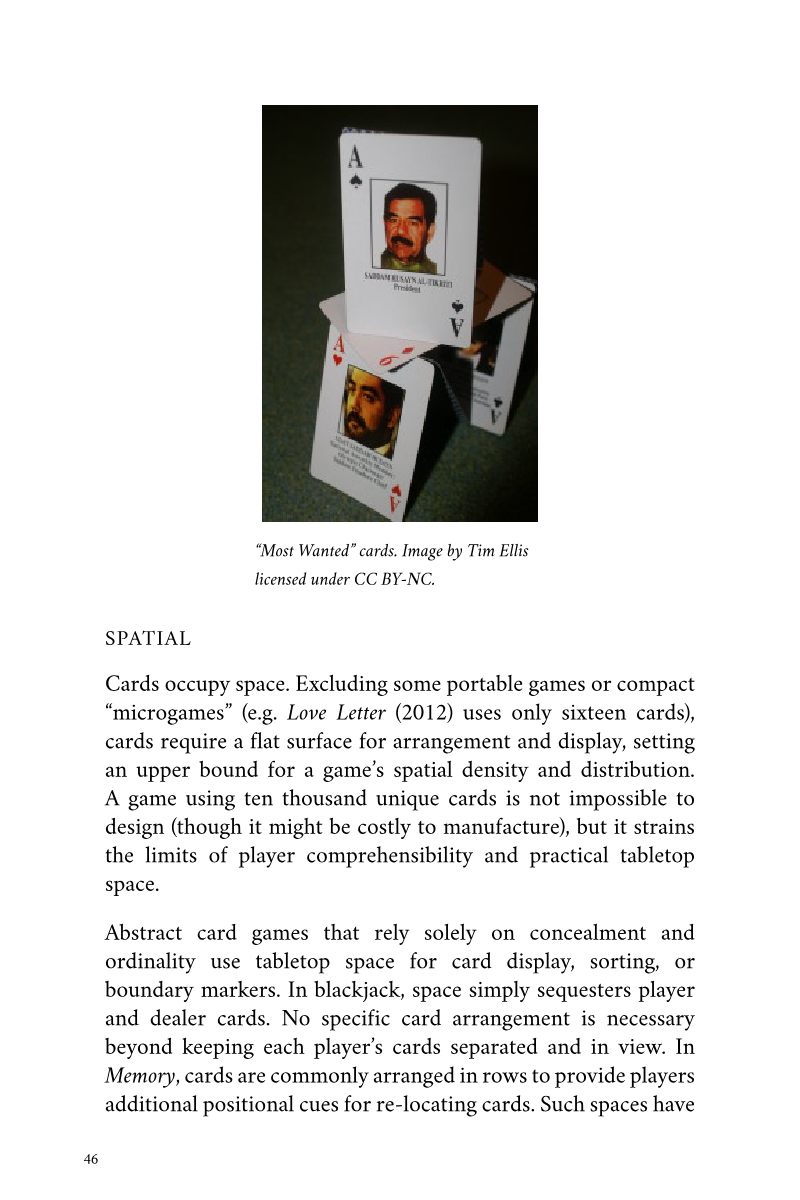
The Playing Card Platform
In "The Playing Card Platform," Nathan Altice argues that playing cards function as a platform whose physical form shapes game design in the way hardware shapes software.
- Nathan Altice argues that playing cards act as a platform whose physical form shapes game design much as hardware shapes software, identifying five defining characteristics: planar, uniform, ordinal, spatial, and textural.
- The rectangular card's two concealable faces enable secrecy-based games like poker that board games cannot easily support, while uniformity underpins fair play and mass commercial reproduction.
- Magic: The Gathering extended the traditional deck's ordinal logic through colors, custom ranks, combinatorial complexity, and collectible scarcity, and its 1993 tapping mechanic, which repurposed a 90-degree rotation as a resource tracker, spawned numerous variants.