1 free read left. Create a free account for unlimited reading + AI research.
Create free account
Working with Independent Developers: Lessons Learned Over the Years PG Connects Digital #2
Key insights
6 takeaways- 01Only approximately one percent of independent game projects successfully recoup their initial investments, highlighting the extreme difficulty of achieving commercial viability.
- 02Developers must prioritize rigorous project planning, specifically through the creation of comprehensive game design documents, to avoid failure caused by unrealistic expectations.
- 03Independent studios must retain active ownership of their creative direction and ensure their projects are fully realized before seeking external support to maintain long-term sustainability.
- 04The developer-publisher relationship is most effective as a partnership where the publisher acts as a facilitator for reach rather than a substitute for a project's foundational vision.
- 05Publishers provide essential capital for influencer campaigns and targeted advertising, but these investments cannot compensate for a project that lacks a clear, well-documented plan.
- 06Success requires a shift away from legacy marketing tactics like traditional media and physical trade shows toward direct community engagement and platform-specific visibility.
Ask AI about this video
Transcript
so without further ado just as there's a few extra people have joined us already we're gonna welcome Anton Raven of 1c Publishing to stage who is going to talk about working with independent developers and lessons learned over the years so it should be a valuable one I see Anton joining us now I hope all being well there he is hey Anton how are you good morning good morning I'm doing very well right well thank you so much for joining us I'm sure at the moment there is a riotous applause going on at home offices all across the country and world welcoming you to the stage but yeah without further ado your self and say thank you so much for joining us and yeah over to you good morning everyone
let me just share my keynote here okay so my name is Anton and and I was very very fortunate to work with some amazing independent developers in my career and on some amazing projects like stalker Metro Kingdom come on sisters legacy I'm fury Witcher and many many others to be very honest and currently I do publishing and I do investment in PC and console titles at home in my home office I have my shelf of Fame which I'm very very proud of so that's the photo of that so I started working with independent developers back in 2005 and the term indie - did not really exist back then however the independent developers very much existed and just to give you a reference in terms of
timeline this was the device we've been using for communication back then and yeah well independent developers very much existed like GSC game world with the famous stalker I guess the India developer is an independent developer I define this for myself as an as a developer that works on its own IP and the computers were very backwards back then obviously so but perhaps independent developers go way back further into the past than the early 2000s with each software valve in with health life and many many other amazing titles that were obviously independently developed so I guess there are the indie
developers of the past and there are the developers of the present as well and I think that they are pretty different and we can talk a lot about how different they are but I would point out it's two very very differences and I think this differences would be first of all the skill set right the modern developers are different in terms of their skill set compared to the developers of the past their professional level and their vision is also different they could be better in some cases but in most cases that they are not as advanced as independent developers of the past simply because they can afford being this way they got first of all access to the world's best
tools something that a very very small community had access to back in the days now everyone has access to this for free and obviously it makes things a lot easier and the second thing I would name as a really big game changer is obviously the outsourcing industry and the standardization of assets in the modern days you can build a very large game a very complex game with actually a very small team and your indie developer can be really anything and anywhere in the world could be a team of two people in Norway or a large team of developers in Colombia in China in Iran anywhere in the world absolutely and the first lesson that I have learned in practice and I would like to share
with you is that really it doesn't matter and tiny hidden indie jams exist I found some in the past myself and if you are a publisher or in the agency or something you're looking for a great small indie teams and small indie projects you absolutely can find them and if you are an indie developer yourself but you feel that you are unable to build a large team do not despair you can definitely become an indie Jam as a small team you can achieve same or better commercial results them a huge team and this is I think a very simple idea but it's not so easy to actually believe this but I have experienced in practice I have worked with teams of very small teams of a couple of people that have
achieved very good financial results and I have also worked with large developers consisting of a lot of industry veterans that have completely failed and were unable to succeed yes having experienced having more qualified people within your team does raise your chances for success however you can also be successful as a small team and both options have strengths and weaknesses this is the first lesson I would like to share for today and obviously the video game distribution has changed incredibly over the last 15 years it has also changed over the last five years dramatically I think you can write books about how much it has
changed and how things has to be done differently now compared to what has been done in the past but nobody is writing those books at least to the best of my knowledge because I think everyone is just too busy adopting to those changes and the way this distribution system has changed lads to developers being able to publish their own titles and some of them started to believe that they can achieve everything on their own distribution marketing everything at all and in some cases this was true and some independent developers were able to succeed but I think statistically only 1% of indie games are commercially successful meaning that they make back the money invested into development so I
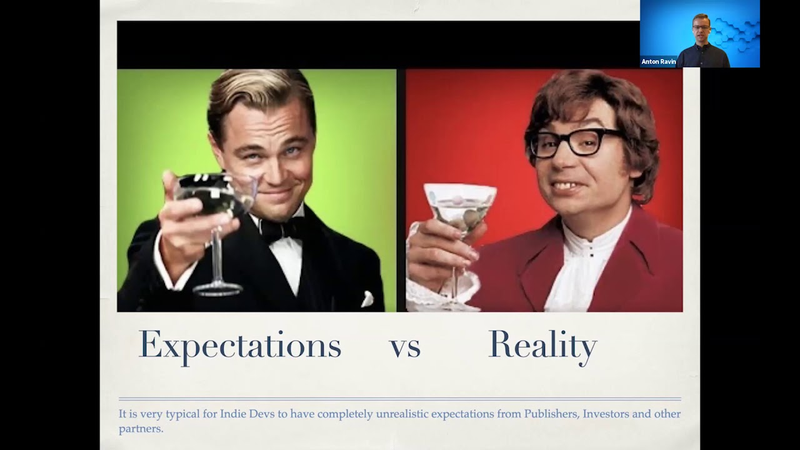
guess in most cases this is not the case and because developers especially the new indie developers the less experienced developers have unrealistic expectations of themselves to succeed as a consequence they also have very often unrealistic expectations of the external partners publishers investors marketing agencies PR agencies so yeah this expectations often do not match and unfortunately this leads to disappointment this leads to Tibet commercial results so the second lesson I would like to share is something that I have learned the hard way is that while you have to stay optimistic you have to talk to your
partner's about the worst case scenario and this is tremendously difficult this is a lot of extra work it's definitely far easier to sweet-talk your potential partners into working with you however I think that this is very important to to work on amending the expectations and working with expectations of your partner this helps raising the quality of the project and not ultimately helps you to achieve better commercial results so obviously nobody wants to hear about the problems nobody wants to hear about difficulties and challenges and why by taking this tactics by being very honest by being brutally honest sometimes by by talking
about the worst case scenario by trying to mediate risks you probably are not going to become very close friends with your business partners however it's just business and nothing personal so long term it's going to pay off because if you want to build long-term business partnerships successful long-term business partnerships I recommend doing this instead of sweet-talking and instead of keeping everyone's expectations unrealistically high I have made a lot of friends in the video games industry and unfortunately also some of the corporations that I was managing didn't end up well didn't end up poor it did end up with a disappointment mutual disappointment and I'm afraid this was due to the fact that I was not working
hard enough to amend the expectations of the other party and I regret it so hopefully you can learn from this I wish someone would have told me this 15 years ago okay so because a lot of indie developers are not very experienced they tend to also not pay attention to things that matter a lot and you will not believe how many times I was pitched projects independent projects that did not have a GED at all or did not have properly structured develop thought through GDD or the GED would lack very vital details basically in most cases as I was investigating
this mance that the developer herself or himself did not know what kind of game exactly we wanted to me this is an incredibly typical story especially for the last experienced indie developers and don't get me wrong I I completely understand agile I completely understand experimenting however I strongly believe that in order to be able to change a plan you must have one first so you can amend your plans later but you must have a plan to amend the first and yeah incredible mass with documentation planning absence of production plans or completely unrealistic production plans from my experience very often lead to poor design for design choices and ultimately a very poor product in the
end or a product that is performing below expectations so this is a very important I think to to share with you the the third lesson that I have for today is that in case you are considering a project that does not have amply developed documentation that is lacking a GED or is lacking production plan professionally develop production plan you should be very cautious and for you indie developers I think that it is incredibly important for you to to give extra care time and patience to preparing your GED to preparing your documentation do ample prototyping and
really answer all the questions you want answered before you start pitching your project externally to external partners such as investors or publishers some developers think that external partners like Co developers and publishers are going to direct them are going to help them and some some companies can do this however none of them are going to be able to help you unless you already have a very strong basis they're not going to write your GED for you they can help you improve however you have to get to where you can get on your own on your own first so this is I think incredibly important and again you will not believe the the amount of indie developers that are just not following this and
basically are not preparing their projects properly before they start developing them full time so take scrupulous attention to detail and really take your time get ready if you are an indie developer and you are a new developer you do not know how to do this professionally I think there are some guidelines online you can learn from whoever is willing to teach you and the more time you will spend with this the better your final results would be and again if you are an investor you're looking at an indie project you're looking for this indie jam just just pay attention to those projects that have properly developed documentation and properly develop GED
they are the ones that probably are going to result in better product so these are the the lessons I hope they will help you in some way to some of you I guess they would seem trivial but they were all learned a hard way by me in practice over the years and some of them I had to learn multiple times before I really understood how it works but obviously you are far more clever than I am and you'll be able to learn simply by looking at my slides I would like to say that I think that indie developers you are all incredibly talented and I simply admire your braveness to enter this incredibly competitive complicated and tough market and I hope that I was able to help and I wish you all best luck now
we can move on to questions I'm not sure the system works if I have to press something here no well here I am they should be coming through um there's a Q&A window at the moment we've only got up we've only got one but let's start with that one and the rest of you audience if you've got any questions to them to put forward here you know it's a really unique opportunity to speak to a publisher who's very experienced in that process the first question who's actually mentions triple-a titles but considering we're talking about working with Indies I think we should um because I've got a second question coming in our from a certain Chris James I've heard of him well we'll start on that first one though we just talked about testing now they've asked when is the best time to start testing when it comes to a triple-a title if obviously you're talking about the relationship between publishers and Indies so feel free to go
down to the indie route if you would but from a publisher perspective you know I guess it different publishers approach it differently but do you have any advice on particularly in terms of the context if you well you've been talking Joe I I think that the definitely the answer would depend on what this person meant by testing if you mean testing the gameplay mechanics or testing the prototype were doing QA or testing on audience or what kind of testing right it also very strongly depends on what kind of product this is is this an online product is this a free-to-play problem triple-a it says right but is it a single player triple e for console or a multiplayer free-to-play triple right so I think that if if you mean testing which I guess what you have meant
testing with life audience then I would say as as soon as you can as soon as you have something playable it doesn't have to be final in terms of quality or visuals but you can at least test your basic mechanics on the audience pretty early on if you want to test individual elements you can get them tested as they become developed so or perhaps the intention of the question was something else but it would have to be defined better well yeah sure the person asks that question you're welcome to elaborate in the Q&A sort of text window I'm actually gonna move down the bottom because I've just spotted Dan glass odds question which is really interesting when looking to a publisher game indie developers often debating between self-publishing or going through a publisher could you explain some of the I guess some more of the incorrect expectations indie developers have of publishers investors so yeah that's
really fascinating you've already touched on it right I guess there's this kind of traditional perspective of the publisher and then there's the reality of how they can be incredibly helpful results and you know different publishers present different things but yeah you know any other kind of misconceptions or incorrect assumptions by indie developers you Phila worth addressing mm-hmm well III think that also the question contains partially the answer is there are two extremes either goin yourself or with the publisher and these are kind of like on two different polls these are two poll decisions pulls apart so to speak so when you finally decide bravely decides to share your revenue the publisher and go with a publisher you would expect that you would be in some kind of very advantageous position suddenly but it may have been the case
20 years ago or 15 years ago even to some extent however right now actually everyone is competing in the same space in the same field on their more or less same conditions so I think that the expectation is if you go with a publisher they're going to enable you to be successful and they will not be able to enable you to be successful in case something wrong with your product or something wrong with your positioning or something fundamentally wrong with something else and since this is your property as an indie developer I assume you own the indie title you have to really be involved in every step of the publishing process as well and help the publisher and you have to work together because the only thing the publisher can really do despite what they would tell you what they would promise they can raise your chances for success well some publishers
can Ottoman do that but some publishers can raise your chances for success but they are not going to be able to guarantee success and I think that the expectation is if you are sharing your revenue with the publisher then the publisher will just make you successful suddenly by some magical means if you do not yourself see your path to success then publisher is probably not going to be able to help you much in Ewing fantastic really interesting stuff um one of the questions has come up and oh yeah I think some more have come in I was about to say please ask some more dear audience but as I spoke another one has popped up but first of all yeah there was the one as an indie what's the worst advice you've received I guess as a publisher maybe there's a piece of advice given to English you you know I also I've also worked for for indie
development cumberly and myself so I I have either worked with indie developers or for indie developers but the worst advice a difficult question like I guess I just filtered it out over over time but well I think that it used to be and and I think it's still very popular to go to physical trade shows I invest in having a boof and and doing press meetings I don't know at Gamescom and GDC what developers love doing this obviously and we've been doing a lot of this as a publishers while hosting our developers all over the world at events I think that the effectiveness of this especially for uni games we're not the Triple A games talking about the indie games the effectiveness of this versus the investment you have to make
is actually pretty low right now and and it's also gradually been going down so if someone is advising go get a booth you will get your press meetings outside some bad advice it's not really practically helpful inside there um the next one and I guess this kind of gets to a real classic issue of the relationship between indie well between developer and publisher but indie developer in this context and kind of you know creative freedom creative control and yeah the question I read it directly when working with publishers and investors how much should the developer allow them to influence their project where is the limit right I guess there's be expert help coming from a publisher and then losing control do you have any insights on that and I know this question could probably be subjective now is discussion but it is it is extremely extremely subjective I have a strong opinion on this I have a strong opinion my opinion that is that
and in the developer must have a very strong vision of the title they want to create and they shouldn't allow anyone to influence this vision we as we work with either developers at one see for example we do not ask for any changes once there is solid vision with the independent developer we're not asking them to make any changes unless for legal reasons sometimes yeah you know the creative freedom sometimes leads developers too far they are breaking the law yes you know not bright well the questions are really rolling in now which is fantastic let's ask the one as a games journalist I don't know whether I should there I should just keep my mouth closed for this one just media coverage play an important part in the
plans for the release of game for Indies and they've mentioned particularly you know Indies that may not have a large contact book themselves like you know that I've been doing at fifteen years and the importance and role of media has changed certainly we have been fascinated here insights on that from the publisher perspective well I think that a lot of you have noticed how less and less effective this has become over the years especially now so in the past it was a absolute paramount important to be featured now I would say social media and the point-of-sale such as steamer GOG are far more important he can't get if you get featured there it's far more effective for your sales and for your brand recognition compared to media coverage media coverage however can help you
early on if you have ample amount of time six twelve months before your first release you can accumulate the core audience for your product right it helps you accumulate your core audience and then the score audience is going to helpful at the point of sale in the social media by supporting you by writing good reviews and stuff like this or maybe if you are doing a crowdfunding campaign it's going to help you form that audience that would do crowdfunding but when you already have a product shipping I think the media coverage is not so important at least like compared to what it was 15 years ago you can't compare that like 15 years ago it was super important it was it was really a game changer if somebody gave you a good review and good magazine you made it
now it's really like a lot of successful titles for example on Steam got very poor media coverage before they become successful and they've only started being covered once they have become successful with community right well at least you know at least some of what I do is fake you still relevant we we've just to get back yeah it had a brief answer this one how much encouragement the wind is required to promote their project properly allocate budget and resources to media push so you know I'm sure it changes from Indies windy but you know how proactive as a publisher do you have to be in that pushing leondis are encouraging them in that way never really had had a problem with this never
felt that you need Avella pers have to be strongly encouraged to do this perhaps because since I do video game publishing we are take care we're taking care of these costs yeah like if if the Indies would have to be taking these costs and you know you know produce cash to to enable those youtubers produce cash to enable those advertising's and stuff like this I guess some of them would have to be convinced but I don't know I am from my experience I never had a problem convincing that advertising is an important actor in success sure fantastic right well on that now and with almost perfect timing and we've come to the end of our slot so yeah and I'll just say thank you so much for joining us for sharing all that information and I'm sure you know just tremendously practically helpful to the
audience and so yeah thank you and I'd normally say warm round of applause at this moment and I can't get out that habit but I'm sure it's there from our audience and then yeah I'll let you let you go and hand over to our next speaker so thanks so much anthem thank you very much everyone have a great day you
Summary
The independent game development landscape is characterized by a high barrier to commercial viability, where only approximately one percent of projects successfully recoup their initial investments. Despite the democratization of development tools and the availability of outsourcing, many small teams falter due to inadequate project planning and unrealistic expectations. To navigate this volatile environment, developers must prioritize the creation of comprehensive game design documents and maintain a transparent, honest dialogue with business partners regarding potential risks and worst-case scenarios.
Success in the modern industry requires a shift away from legacy marketing tactics, such as traditional media coverage and physical trade shows, which have seen a marked decline in efficacy. Instead, commercial momentum is now primarily generated through direct community engagement, strategic social media presence, and platform-specific visibility. While publishers provide essential capital for influencer campaigns and targeted advertising—investments that are often necessary to achieve market penetration—they cannot serve as a substitute for a project’s foundational vision.
Ultimately, the relationship between developers and publishers is most effective when it functions as a partnership rather than a reliance. Developers must retain active ownership of their creative direction and ensure their projects are fully realized before seeking external support. Publishers act as facilitators that amplify a game’s reach, but they cannot manufacture success for a project that lacks a clear, well-documented plan. By balancing creative autonomy with rigorous business discipline, independent studios can better position themselves to overcome the industry's inherent challenges and improve their long-term prospects for sustainability.
















Comments