1 free read left. Create a free account for unlimited reading + AI research.
Create free account
Why You Should Care About CDA 230 - Platform Responsibility & Free Speech - Extra Credits
Key insights
6 takeaways- 01Section 230 of the 1996 Communications Decency Act provides the legal foundation for the internet by shielding platforms from liability for third-party content while allowing them to moderate content in good faith.
- 02The C1 shield protects platforms from being held legally responsible for user-generated content, while the C2 provision grants them the legal right to remove objectionable material without facing censorship claims.
- 03Legislative protections under Section 230 are not absolute, as they exclude intellectual property violations, sex trafficking, and instances where a platform actively encourages illegal activity.
- 04Political pressure from both sides of the aisle threatens these protections, with critics on the left citing concerns over hate speech and conservative figures alleging politically motivated censorship.
- 05A reduction in C2 moderation powers would limit a developer's ability to curb toxic behavior, creating a disproportionate burden on smaller studios that lack the resources to manage widespread harassment.
- 06Proposed reforms to Section 230 could force game developers to disable essential social features like chat, voice, and customization to avoid the risk of litigation.
Ask AI about this video
Transcript
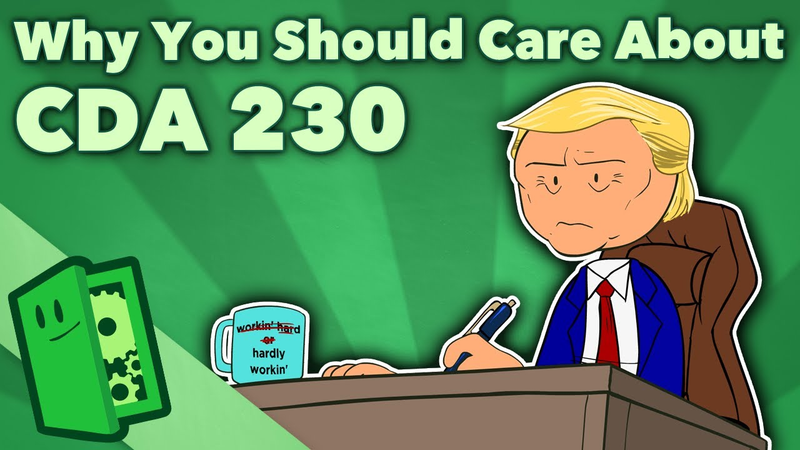
You may have recently heard proposals by US politicians calling for reform on something called Section 230 of the Communications Decency Act. In case you didn't know, Section 230 is commonly referred to as the 26 words that created the internet. So, what does it mean when President Trump signed an executive order in May calling for Section 230 platform immunity to be clarified? And how might these reforms affect the games industry? To once again help us jump through this legal jargon jungle, we've called on our lawyer friends Joe, Rebecca, Andrew, and Aaron at Fenwick and West. And if you've seen some of their other episodes, you already know that standard verbal fine print applies. These are just their opinions presented in animated video essay form, not legal advice, and you should always consult a real-life lawyer if you need help. We've put links to their bios in the description, along with some other useful articles for further reading on this topic. But okay, way back in ye olden times of 1996, only
26% of Congress members even had an email address, much less surfed the net. While some politicians were proposing regulating the internet like TV and radio, Senator Ron Wyden and Congressman Chris Cox recognized that the internet was special. Unlike TV, internet users could publish their own content and interact in real time. Wyden and Cox were worried that government regulations would unleash a swarm of government sensors that would harm the baby internet and ruin what made it special. So, they drafted an amendment which would eventually become the Communications Decency Act as we know it today. CDA 230 has two major parts, 230c1 and c2. C1 provides that with some important exceptions, providers such as YouTube, Gmail, online video games, and even your ISP, and users like you and your friends, generally can't be held liable for what other people publish online. This means that if someone posts something defamatory or inappropriate on Twitter, Twitter won't be held responsible. But it also means that if
you retweet it, you won't be held responsible either. So, you can kind of think of this C1 as a shield. Incoming lawsuit deflected. The other section, C2, provides that so long as a platform acts in good faith, they may, but don't have to, remove content that they find objectionable. And you can kind of think of C2 as a banhammer. Platforms can wax slime with C2 safely, knowing that the posters can't sue them for censorship. Now, Section 230's shield isn't all-powerful. For example, it doesn't provide immunity for platforms whose users violate intellectual property law, such as copyright. More recently, Congress amended Section 230 to make platforms responsible if they facilitate prostitution or sex trafficking. Though whether or not those laws were executed well is its own can of worms we won't get into here. Additionally, one court ruled that when a platform actively induces its users to post illegal content, it also loses its CDA shield. And lastly, the CDA doesn't apply when a platform speaks for itself, editing
users content to fit the platform's viewpoint. So, now that you're familiar with the basic outlines of Section 230, you might be asking, why all the recent attacks? Well, wouldn't you know it, both liberals and conservatives have something to dislike about Section 230. Some liberal commentators think that the big platforms have become complacent with their C1 shield immunity and have allowed hate speech, harassment, stalking, lies, and other horrible things to run rampant. Checking my Twitter feed here, yep, that seems anecdotally correct. Guh. On the other side, some conservative politicians, including President Trump, claim that big online companies are using their C2 ban hammers in bad faith to selectively censor their views. Though granted, the data doesn't really bear out on that, but these days, when has that ever stopped anyone? So, Trump signed an executive order in May of 2020 that directs both the Federal Trade Commission and the Federal Communications Commission to get involved in combating online censorship. Meanwhile, tons of legislative proposals
are floating around to fix 230 ranging from giving Attorney Generals the power to pierce Section 230 shield immunity to creating new government commissions to craft a mandatory internet best practices to taking the shield away entirely unless a platform proves to the US government that its banhammer is politically neutral. Lots of hard air quotes in this episode for obvious reasons. The problem is that many of these proposals engage in the same kind of large-scale content-based speech policing that Wyden and Cox were worried about way back in the '90s. Oh, and having the government sanction what is politically neutral? Can't imagine how that would ever go wrong. But let's bring this back to games. As you may know, the games industry has been grappling for a long time with toxicity as anyone with a passing familiarity with Gamergate can tell you. But all of the proposals that we've seen so far would severely hurt the games industry. A weakened 230 shield could chill game speech by making companies nervous about getting sued for something a player
posts and in response could lead to them disabling comments, chats, and even customizable outfits and usernames. Less talk, less liability, right? Heck, game companies might even decide to reduce all interaction to can't chat. Well played, I guess. On the flip side, game companies rely on their Section 230 banhammer to act against their most toxic players without fear of a lawsuit. And whether or not specific companies are currently using it effectively enough, without this strong banhammer, the worst trolls would go unvanquished and further ruin everyone else's time with the game. Not to mention this could be particularly devastating for smaller developers where a few bad actors can have a massive impact. A small bit of good news is that all of these proposals are still new. They'll need to go through both houses of Congress to become laws, which will take time and is unlikely with the current garbage fire of, you know, most everything. And if any pass, they will almost certainly be challenged as unconstitutional. Now, as for Trump's executive order, it's important to remember that the president
does not enact or even write laws. An executive command might feel scary, but it has no real effect on game companies right now. Nevertheless, pay attention. Even Democratic nominee Joe Biden has gone on record saying he wants to revoke Section 230, albeit to fight misinformation. So, this isn't a debate that's going to disappear anytime soon. Section 230 is central for game developers, both large and small, for building the online community they want for their players, and for protecting their games' unique qualities from those that might ruin the experience. Each community is different, and each has its own rules, and that's okay. That's not a bug of the internet, it's a feature. And if you are a developer, remember that for now anyway, you have the CDA shield and banhammer in your armory. So, please use them responsibly. See you next week, everyone. Legendary patron roll call: Ahmed Ziad Turk, Alicia Bramble, Casey Muscha, Dominic Valenciana, Gunnar Clovis, Kyle Murgatroyd, and Orioles won. Thank you so much.
Summary
Section 230 of the Communications Decency Act (CDA) serves as a foundational legal framework for the modern internet, providing essential protections that allow platforms to host user-generated content without assuming liability for that content. Enacted in 1996, the legislation consists of two primary components: the C1 shield, which grants immunity to platforms and users regarding third-party posts, and the C2 provision, which empowers platforms to moderate or remove objectionable content in good faith without facing legal repercussions for censorship. These protections are not absolute, as they exclude intellectual property violations, sex trafficking, and instances where a platform actively induces illegal activity or speaks for itself.
Recent political discourse has targeted these protections, with both liberal and conservative factions expressing dissatisfaction. Critics on the left argue that the C1 shield allows for the proliferation of hate speech and harassment, while some conservative figures, including former President Trump, have alleged that platforms use the C2 banhammer to engage in politically motivated censorship. These concerns have led to various legislative proposals and executive actions aimed at reforming or revoking these protections, often by introducing government oversight regarding content moderation and political neutrality.
For the games industry, these potential reforms pose significant risks. A weakened CDA 230 could force developers to restrict player interaction—such as disabling chat, voice, or customization features—to mitigate the threat of litigation. Furthermore, the loss of the C2 banhammer would hinder a developer's ability to moderate toxic behavior, disproportionately impacting smaller studios. While current executive orders lack the authority to change existing law, the ongoing debate suggests that the future of platform immunity remains a critical issue for developers, as the ability to curate community standards is essential to the functionality and health of online gaming environments.
















Comments