1 free read left. Create a free account for unlimited reading + AI research.
Create free account
Anime IP in Games | Crunchyroll's Plans for Gaming
Key insights
6 takeaways- 01Western expansion for anime-based games requires moving beyond brand recognition to provide deep game mechanics, robust end-game content, and a high cadence of live operations.
- 02Japanese publishers frequently struggle in Western markets by treating these regions as an afterthought rather than tailoring localization and strategic focus to local expectations.
- 03Developing original IP with an anime aesthetic is an increasingly viable growth strategy that avoids the rigid creative constraints imposed by existing anime IP holders.
- 04Role-playing games (RPGs) are the most effective genre for the Western anime audience, as they better leverage narrative depth and character-driven experiences compared to casual genres.
- 05The core Western audience for anime games is predominantly male and extends into the late 30s, requiring content that prioritizes narrative engagement over casual gameplay.
- 06Predictive success in the West can be improved by analyzing engagement data from streaming platforms and utilizing performance metrics from other Asian markets.
Ask AI about this video
Transcript
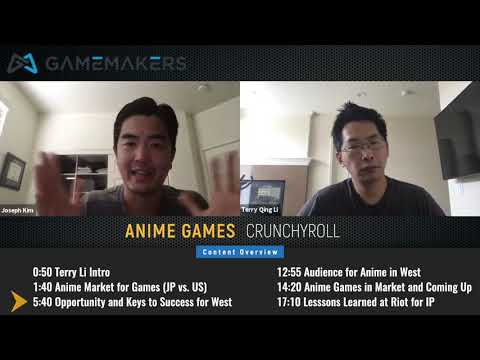
hey everybody today we are joined by terry lee head of 360 and games at crunchyroll anyone who knows anything about anime here in the us should be familiar with crunchyroll which is primarily known for their popular anime streaming service but today we're going to talk to terry about number one the market for anime-based games two the opportunity for anime games in markets outside of japan so opportunity and challenges for the western markets three who's the audience for anime ip and finally what are big upcoming anime ip games coming out soon and specifically with respect to crunchyroll but before kind of diving in terry can you talk to us a little bit about your background and what you do at country roll for and for example what what is 360 what does that mean sure um that's a good question so 360 for crunchyroll is basically um all the business lines
that surround the streaming video business um as you probably know crunchyroll started primarily as a streaming video subscription service and over time as part of the vision to bring a holistic anime experience to our fandom we started getting into e-commerce merchandise events and most recently games so all that falls under the broader three what we call 360 umbrella and then uh prior to three six prior to running 360 control um i was uh running kind of publishing at riot games and then prior to that i was uh running international for crunchyroll so long space a long time in anime and game space maybe we could just start with um by talking about the overall anime market four games now certainly when we look at the size of the market especially in japan we see that a lot of top grossing titles there are anime titles so fig grand order dragon ball seven deadly sins one piece yu-gi-oh and a lot more
but here in the u.s market we're always seeing like you know dragon ball dokkan battle and let's say the top 10 15 grossing but we haven't seen a lot more so can you talk to us about the japanese market or the u.s market and maybe some thoughts in terms of why some of the the bigger ip titles have not been as successful in the us market yeah definitely um i think there's a there's a bunch of factors here um i think uh you know firstly i would say that traditionally speaking the u.s market has been more of an afterthought for a lot of japanese publishing developers right they when they look at anime rights and when they look at anime games exploitation is primarily going to be japan and then broader asia china is a huge market really really publishes a lot of these games but into the west unless there's traditionally a japanese publisher that takes it over here namely like bandai who takes a lot of you know top games including dragon ball here the rest of the field has largely been up to
small developers publishers or a us publisher going and grabbing a game and taking it into the west so i think from a strategic standpoint it has hasn't always been on par and then once those games have come to the market um in the west a lot of times there isn't enough consideration around the audience suitability or adaptation right so a good game in japan relies on a few things one of course is ip recognition and overall awareness of that genre and that anime escape the second is familiarity with the game format um a lot of the mechanics of the game um including the way that you know drop rates gotcha rates work and overall feeling of the game um and i do think there's a there's still a pretty big difference between how western players view their game experience and how east eastern mainly japan and chinese players view their game experience and then if you layer in on top of that the fact that most ips are not as well known anime in general is not as broadly
part of a societal norm in the west as it is in japan you're talking about a reduction in audience and potentially a mismatch in terms of audit expectations so that's why i think most games that come over don't necessarily work on the level that they work in japan even if a grand order is a good example right where we're talking about a one billion dollar franchise but vast majority of that is asia and vast majority of that is so japan and in terms of like the success of some of the titles uh with respect to like the popularity of the anime does that roughly match would you say that like what you're seeing from a video consumption perspective like is dragon ball because dragon ball dokkan battle is popular here that the game is popular i'm just trying to compare like the video and the anime popularity to the game success certainly i think ip recognition is huge right i mean um i think it's hard to look at say the literal popularity of the ip at this moment in time because then you can sort of say like hey dragon ball and say you know some some
of the other more recent titles are as relevant but the reality is uh dragon ball as an ip has been in the us for for decades right and and more so um than just being popular on streaming it's been on television right it's been dubbed into the english language it's a world of known type um you know very few anime ips have hit that kind of threshold right maybe sailor moon maybe um cowboy bebop that have all aired in the u.s but dragon ball is also really really long running right and so that entire franchise and the recognition certainly helps carry a tremendous weight for um audio expectations in the west so how are you guys from a crunchyroll perspective because you guys have relationships you guys have a lot of you know access to anime how are you viewing the opportunity for enemies anime based games here in like the us or western markets and outside of japan how are you guys thinking about that yeah i mean i think really we got into the space because we recognized that
there wasn't enough of these games that were coming through and we wanted to sort of figure out how to leverage both our relationships in japan and our current kind of um reach and engagement to the western base to figure out how to bring more games to right like we sort of went into it knowing that it's not really like a bullet right it's gonna be pretty hard and it's primarily a way to add more value to our fans so right now our current approach is look at what games have been successful um in japan and identifying the the developers and the publishers that may be willing to make tweaks or make live ops adjustments to orient that game more towards a western fandom and then working with them to publish the games here and that being said i think that's still difficult because you know most developers don't like to maintain multiple versions of a game right if you have to change like the balance of the game or change the even the drop rates that could be that could require two separate databases and
live operations teams so we are looking into more around taking the the japanese game and just doing a completely us port instead of launching the japanese version here and when you think about like let's say you're taking or so i guess there's one part which is taking an existing japanese anime ip game and kind of converting and porting it for the us audience and then just as a standalone title like a a for the west title that's an anime-based game what would you say if you're thinking about the critical success factors or what are the key things that you need to get right in order for that game to be successful in the west how would you think about that yeah um i think that's a great question um you know we we've often uh had this conversation with a lot about japanese partners and figuring out you know what ips work well and not um i think one is um the depth of the game mechanic needs to be well thought out um there's there's actually quite a few anime games in japan that are very
beautiful um in terms of how they are crafted and their art styles but the game isn't that deep right and so you're essentially relying on ip recognition and that's not gonna work here right and so you can you can potentially push through the initial fold by getting a lot of users in but the game is not deep um if there's no long term uh replayability especially in the endgame state then people are not gonna stay so end game is something that we really kind of uh hone in on with our partners the second piece a lot is the cadence of liveops right um and understanding that like if you're if you're an anime game player in the west um chances are that you you have you're probably an anime fan and a lot of the fandom here because it's still seen as relatively niche relative to some of the other broader segments a lot of players are pretty pretty avid they're pretty avid fans right and so they consume the content and they consume the actual game content pretty rapidly and so if you're going by a slower cadence of like you know one one new update a month or one you update every other month like
it doesn't really jive as well here because people get consume all that content and they get bored and they drop off right and so that's really um prevalent in the way that you see a lot of games that go from japan to the us there's a pretty big drop off in um dau's anime using retention right even though it's the same mechanics and it's not because somehow the game is bad but it's just it's relative to the other games in that competitive market right so um that's a lot of what we talk about with our partners yeah so it sounds like there might be a couple of things at play here so first is to your point like the anime audience has this expectation in terms of content consumption so you to your point you need a higher cadence of content but maybe also because they're anime fans do you also think that they also would have an expectation for more narrative more story more focus on characters and things like that are there like specific narrative and gameplay types of
impacts that you you think are there because of that audience um i mean i think that's certainly true um i do think to that end you know most decent japanese anime games i've seen do make a pretty good effort around crafting a structural narrative partly because they also have to because they have to get sign off from the original ip holders right um and you know and we've experienced this thoroughly around like when we're trying to work on a a game and we really want to work on another ip you know sometimes ironically it's actually easier to try to fold that ip in as a collaboration instead of making a game around the ip because when it's a collaboration the ips ip holder knows that it's non-canon and they care less about exactly what you do that you know they have some rough guidelines but if you're trying to make a game of the iep all of a sudden they care a lot about like what are you actually making my characters do what is the actual um nature of the storyline how is it going to impact the rest of the universe
so there is a good degree of control there i see and then would you say that just also the the kind of second audience kind of factor to keep in mind would be just the japanese audience versus the us audience and i i think certainly at the high level it seems like japanese have a stronger preference for rpgs and more gotcha collection us tends to favor more more i guess micro based games more fps and things like that do you see any other like kind of like high level differences between the audiences that you would try to factor in when you're taking like a japanese game and bringing it to the west in general um there's a lot more um potential for casual based games in in the anime space and they do ring true in the japan market right um there's a lot more effort to make a broader set of game genres off of anime space but i think
to the point you're making like because of the nature of the anime industry in the west at least at this point in time um the games that ultimately become successful here uh have to cater to a pretty like avid fan base so they actually err on the side of being more rpg driven in order to capture the user base here right um and also because there there is an abundance of all these other um games that are non-anime-based for all these other categories it is it becomes very difficult for example to launch an anime-based um match 3 or card game here just because the competitive landscape here for those genres is pretty well established and there's no narrative component right and so to your point like if you want to rely on you know nostalgia and recognition and the desire to participate in the narrative rpgs are generally the easiest genre to go into and i think that's why we see a lot more of that all right and then maybe kind of shifting gears a little bit in terms of the audience and so i think that as far as the enemy audience is concerned you know you guys as
crunchyroll should have a lot of understanding of who that audience is could you talk to us about you know what does that demographic look like is it young males is it a broader audience who are the fans of anime from a crunchyroll perspective yeah i mean i think that part uh probably doesn't really come as a surprise but um it's gonna be um more male than female like i would say it's it's probably majority male um especially the ones that play the games right but even uh within that the viewership space it is skewed a little bit towards more more towards mayo but the age range is actually fairly broad i mean certainly it excuse younger but it's broader than most people would think right we we we go upwards to like the late 30s um in terms of people who are still fans of consistently watching anime and as you can also probably imagine the subscriber base versus the free viewer base the scriber-based skills a little bit older they tend to be more people who are more established but they have an income they can actually afford a subscription
got it um so yeah so that's kind of like the centric format and for us we're global but most of our audience data is centered around um english-speaking world right and we're we're working towards you know expanding you know the rest of latin american european basis but those uh areas are still growth mode for us okay and then can you speak to kind of maybe some of your thoughts in terms of the existing big anime games out there like kind of your thoughts on them and then from a crunchyroll perspective what are you guys planning to launch soon yeah i mean um i mean you know that like you know dragon ball is doing really well and i think that actually captures a lot of the things that um we were talking about earlier about why um i think they have really high production they have a lot of good game game mechanics and like the core loop is actually pretty um strong it's well built um and they consider the concept of having a pretty long um long tail kind of deep
uh end game state um and so beyond that i mean i think um there's there's few other games that have that big of a reach um you know you can reach back to like pokemon but that's really based on the ip and the novelty of that format you know what we've been looking at these days is um looking at the top 10 charts of of japan and seeing which of those games um have actually also done well in the rest of asia outside of japan right so that's a first proxy for us to say like can it do well in a space that where this ip is not immediately recognizable right and and then it gives you a signal that the game quality itself is good um and then the second piece that we look at is we actually have started um honing in on ips that are more anime look and not based on a specific ip because we think there's more room to grow there and what we've discovered with all of our experiences here at crunchyroll is that people love that genre because of the
potential for the narrative and the art style that comes with it right people are willing to pick up a new ip people are going to pick up a new story line and so a lot of times it's actually easier to work on a game that is not based off of an anime originally but the art style is just very reminiscent and then eventually we actually convert that to anime so that's sort of where our core focus is right now got it okay and do you have anything that you can announce or is that kind of tbd you guys are gearing up for some stuff but i can't announce anything just just yet well what i can say is we've got a couple original titles that are coming through towards later half of this year um they're they're more um working with smaller studios that we find to be um very up and coming what i can say is that we have a major temple game coming through it's one of a top 10 japanese games today that are we're looking to to bring to the us and the western market probably towards the end of this year or beginning of next year unfortunately i can't disclose it just
yet because it hasn't been public but it is basically something that the entire control team has been focusing on okay maybe i could ask you just one last bonus question which is a little bit of a fuzzy question but so you came from riot certainly ryan has is a company that is known for having incredible characters and game ip and kind of coming to crunchyroll and looking at enemy ip can you talk about maybe some of the lessons learned from riot and kind of lessons learned at crunchyroll thinking about ip like how how do you increase the value of these ips or how do you make them valuable to players or make make them work in in games again kind of a fuzzy question but wondering if you could speak to that just given that you're coming from you know you're in a role both at riot and here at crunchyroll where you have to think about ip very very carefully yeah you know it's it's interesting that the the two companies um they both
have a very strong kind of sentiment around ip quality um but they approach it in different directions and i actually think it creates very two very different like rule sets and universe sets right um you know at riot a big part of the opportunity was figuring out what additional ways to kind of expand the brand ip beyond just a game right especially as i was working with the china market there was a lot of desire from our partners there to really figure out how to do more with ip into other media avenues right but what's interesting is that the fandom built around that ip uh was largely due to the engagement with these characters and with with the art styles right like for a while um there wasn't as much background narrative on the characters now certainly wright went through a huge effort to build a universe around the entire character set and you know all the regions and era but at the end of the day they had a little bit more i i consider that they had a little bit more flexibility and creativity in
figuring how to you know looking at how fans engaged with a particular character or particular set of regions it gave them a sense of like what they could do to further carry that kind of engagement by crafting a narrative that really um pushed that kind of envelope right whereas i think at crunchyroll you know where i draw the lesson is that helps us think about create original iep in a much more holistic way right like we don't have to just rely on what's coming out of an existing anime right which has a lot of rules and constraints like if we if we think about a game we think about our original projections which anime control is doing there's a lot more that cues that we can take from our fans and how they currently engage with various uh ips characters narrative storylines and draw inspiration on that to create a more um holistic ip experience for our fan base so i think long story short the biggest lesson i i've taken away is
your fans can become a big part and your your user base can become a big part of um seeing ideas inspiration and and good will towards how you even structure and create the ongoing iep got it right yeah and i know riots definitely that's one of their strengths right listening to their playbacks and uh okay cool i mean those are all the questions that i have do you have any like final message for anyone in our audience if there's somebody looking maybe you guys are looking for specific roles to fill or you know if you want us to watch out for our next big game please let us know definitely a few things right i mean i think definitely keep keep up to date with the the crunchyroll games um kind of social posts we do have some huge announcements coming up um so that we're super excited i super wanted to be able to share this but i couldn't clear it with our partners in japan because they wanted like a day in day kind of announcement uh but yes we're also rapidly growing so you know a big part of what i've learned is that the gaming community especially the anime gaming
community is small and they're very cohesive so anytime people have good ideas suggestions we're always open to listening and chatting got it and maybe the final final question do you in particular have a favorite anime that you would recommend the audience to to watch uh i definitely do i mean i don't know how broad the the bass is so i really like hajime no ipo um it's a boxing anime primarily because i also like boxing and uh it's it's not a super long series um the first iteration was around 70ish episodes it's super good and uh it's super inspirational if you like sports or if you like like inspirational stories it's a really feel good anime with a lot of boxing sports action all right well i think that's it thank you very much for your time terry and yeah appreciate appreciate all the all the responses to the questions thanks great thanks joe [Applause] [Music]
[Music]
Summary
The anime-based gaming market presents a significant opportunity for expansion in Western territories, though it faces distinct challenges regarding audience expectations and localization strategies. While Japan remains the primary market for top-grossing anime titles, Western success is often hindered by a lack of strategic focus from Japanese publishers, who frequently treat the West as an afterthought. Successful adaptation requires more than just brand recognition; it necessitates deep game mechanics, robust end-game content, and a high cadence of live operations to satisfy an avid, content-hungry Western fan base.
The core audience for these games is predominantly male, though the demographic is broader than often assumed, extending into the late 30s. Because anime is not as deeply embedded in Western societal norms as it is in Japan, developers must prioritize narrative depth and character-driven experiences to retain players. Role-playing games (RPGs) currently serve as the most effective genre for this audience, as they leverage nostalgia and narrative engagement better than casual genres, which face intense competition in the West.
Strategic approaches to this market involve two primary paths: porting successful Japanese titles with Western-specific adjustments or developing original intellectual property (IP) that utilizes an anime aesthetic. The latter is increasingly viewed as a viable growth strategy, as it allows for greater creative freedom and avoids the rigid constraints imposed by original IP holders. By analyzing engagement data from streaming platforms and testing titles in other Asian markets, publishers can better predict a game's potential for success in the West. Future industry growth is expected to rely on a more holistic approach to IP management, where fan feedback and community engagement inform the development of both games and original narratives.