1 free read left. Create a free account for unlimited reading + AI research.
Create free account
Epic Games Lawsuit vs. Apple Court Hearing | Lawyers Explain! (Fortnite Mobile Killed)
Key insights
6 takeaways- 01The Epic Games litigation challenges the industry-standard 30% commission structure and restrictive payment policies enforced by Apple and Google on mobile app ecosystems.
- 02A judicial intervention prevented Apple from terminating Epic’s developer accounts and restricting access to the Unreal Engine, citing disproportionate harm to third-party developers.
- 03Epic Games aims to dismantle the closed-loop nature of mobile platforms by legally classifying app stores as essential facilities, though this remains a high-burden antitrust argument.
- 04Analysts expect the case to conclude in a settlement rather than a total legal victory, driven by mounting pressure from global regulators and developer coalitions.
- 05The legal conflict has catalyzed a broader coalition of industry stakeholders, including Spotify and Match Group, to collectively oppose existing monopolistic platform practices.
- 06The industry is expected to transition away from uniform commission structures toward more flexible, value-based pricing models and open platform governance.
Ask AI about this video
Transcript
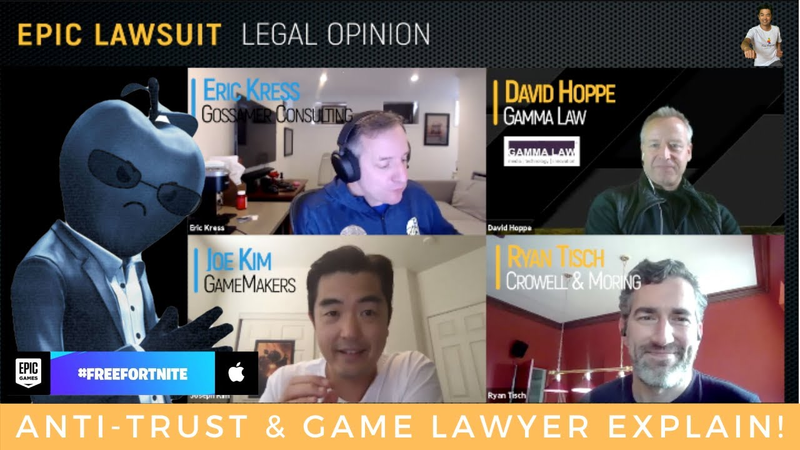
welcome everybody the focus of our discussion today as everyone is probably already well aware is the legal suit by epic against apple and google now just about every single person in our industry has a strong and in my opinion largely misguided legal opinion about the situation even though they literally have zero legal background so today we are joined by two actual lawyers to talk legal legal implications and potential of epic's legal suit first we have anti-trust and ips specialist ryan tish a partner at washington dc based kroll and we have video games industry lawyer david hoppe a partner at gamma law right here in san francisco so welcome guys thank you thanks for having us and before we begin maybe we could just get a super quick introduction from both of you guys on your legal background just to establish
your expertise in weighing in on today's topic uh maybe starting with you ryan that'd be great uh as you said my name is ryan tisch i'm a partner at the law firm of corolla mooring in washington dc i'm an antitrust specialist which means i usually do mergers and acquisitions and and uh uh and government uh regulatory approvals of deals but i also counsel tons of clients on the kinds of of any trust questions that are raised in the twin lawsuits brought by epic including when to figure out when a company has an impermissible amount of market power whether they're a monopolist or uh whether they've reached an illegal agreement with another company to avoid competing with them so this uh this pair of losses is just a total bonanza for someone like me uh who loves thinking about how competition actually works in the real world and affects the products we all use david all right so david hoppe uh founder managing partner of gamma law in san francisco we are a video games
esports focused law practice and uh have been in this space for some 15 16 years possibly more and have worked with publishers from the size of capcom down to all sorts of smaller developers and publishers and others in the space awesome so maybe just diving right in i thought we could first start by talking about the lawsuits in the legal situations themselves so first of all it does seem like there's a big misunderstanding by a lot of folks in the industry which has to do with the interpretation of what the lawsuits are actually even about so lots of people still believe epic is suing to reduce app store platform fees but in fact epic has asked for an injunction halting anti-competitive behavior so maybe we could start there could you guys explain to many of us uh not aware of the specific legalese what does this actually mean what is an injunction and legally what is epic actually trying to do
well joseph i think a lot of people are getting it wrong in terms of what what is the lawsuit about but maybe they're not getting it so wrong in the end i think epic's goal has got to be to try to bring down the vig that that the tech companies take out of the in-app uh purchases that they get their users to make but what they're really asking the court for is to ask apple to stop making them allow only purchases in app that are made using the payment tools and allowing the 30 commission that apple and google take currently it's so it's a long way around but what they're really saying to the court is these guys have uh either twin monopolies or they are kind of dual monopolists in a 50 50 kind of market for operating systems um and court you got to come in here and tell these guys to let us uh uh sell things to our users using other ways of paying and whether the long game is to to actually get that competition in there or whether the long game is uh to pressure both companies to kind of come back to the table
and get to uh what looks like a more reasonable fee structure i think time is going to have to tell i don't know how david feels about it yeah no absolutely and that is joe maybe your next question but what is the real objective here on the part of of epic and you know i'm interested ryan in your opinion on this but uh from my perspective at least reading the pleadings not being an antitrust specialist but um it strikes me that the law seems to be it strikes me that epic would need to get the judge to to reach a bit beyond existing law in order to to get what their what they're requesting in the complaint so is that the real objective or is their objective to you know force some negotiations here you know several months into this or maybe some other uh a goal no one knows of course but it's interesting to to consider what what the various outcomes might be i think i think you're reading that absolutely right i mean i think it it
will require some reaching for for this plaintiff to get as far as they want to get in the lawsuit but as as most lawyers know lawsuits are crazy living things that that change at every moment and twist and turn and so there's every chance that there's a fully realized kind of commercial strategy that's under this that is not about driving all the way through an antitrust litigation which by the way can take um you know years and years to get to a decision by a judge so at least publicly tim sweeney and epic have talked about open competition and they've tried to i mean they they've launched a at least on android side a mobile app store but given the legal situation given that it might be a reach maybe to your point maybe the ultimate objective is to just not it may not go that far it may just be to reduce the fees is what you guys are speculating uh well it's interesting you know in the most recent you know of course we did hear
actually from the court uh on tuesday i guess was when the uh the decision was released on the temporary restraining order you know as she made the point the judge made the point well listen it may well be that the 30 percent commission taken by the platform owners needs to be reduced but i'm pretty sure that whatever that number winds up to be it's not zero percent [Laughter] is it was there was was there any significance about them going after or um in their suit they basically uh in for epic they weren't going after themselves to get uh to open up the um sorry open up the ecosystem for themselves but open up for everybody because they could have just gone in and said we think it's unfair for our business is there like any significance about trying to make it more broad and and trying to change the entire ecosystem is that like a strategy or is that just it's a it's a good question right i mean what it's done is to draw in lots of
other companies who have come and said we think this is right that we have a problem with this as well and don't forget epic has had a history of picking fights with companies that have tried to close their platforms including microsoft which um there are significant differences between opening up ios and opening up a kind of an augmented reality future um platform that's not really a commercial juggernaut today but they did end up getting microsoft to back down once in a sort of similar kind of confrontation and for the last year they've been quite lovey-dovey over time so i i think uh in part it's also a public relations sort of a thing that epic wants gamers and other people to see them as crusaders for the opening up of the ios platform but david to your point what the judge said about the price not being zero that that leaves a big question unanswered which is who's going to pay to build these marvelous ecosystems the io you know ios and android that let us all have these products that the price can't be zero so you can only crusade so
far when it goes to um to saying how much the developers of of these big ecosystems should get paid right and there's been a lot of talk in terms of like epic versus apple but i guess the the the other horse in this race is is google and so there hasn't been a lot of discussion about epic versus google are the lawsuits pretty much the same is the situation the same except that the the battle between epic and apple is just more visible and apple's taking harsher kind of uh retaliatory tactics is that the current situation i think that's a really interesting question joe i mean in some ways it seems to me and interested in ryan's opinion this but some some ways it seems to me google is a better defendant for epic i mean google actually has i mean they don't have monopoly power i don't think under under the traditional measurement of that in terms of percentage of market share but at least they have a majority of the market share in the united states which apple does not but at the same time the google store is a bit more
complicated because they do allow other app stores on the platform it's just they take various steps to make it difficult for users to uh to make purchases through those app stores right but yeah it's it's you know why did why was apple chosen as the bad guy and this actually is a bit of a trend isn't it in the various other investigations and lawsuits that are pending now with respect to platform fees not really sure about that except the uh the fortnight character is you know the tarp tycoon right it's probably easier to mock apple and maybe easier to villain in a way that google's not i mean this is something that i've been ranting about for the last few months it's because apple is terrible like very terrible to their partners and no one talks about it because they get blacklisted and you know the gestapo apple people won't like feature your game or whatever even the podcast got in a little trouble for talking trash about arcade you know so it's like they have they have they they are they have deep pockets and they have a lot of reach and so you no one ever wants to talk
trash about them and so they're they're they're not a benevolent platform and i think i think that's part of the reason why i think uh people are getting a little more aggro against them versus google you know and the ie issue and all the stuff that they're doing is is terrible for the ecosystem you know yeah i think there might be an emotional difference between the two and david you're you're rightly putting your finger on one respect in which uh google and android you know are the the preferred defendant given their reach their ubiquity and certainly outside the united states where they're in fact in many countries much bigger than ios but actually i think apple apple itself is technically um the juicier target for for epic in part because of the side loading thing that you mentioned uh david which everyone sort of laughs at when you say it because when was the last time you tried to actually sideload something around google play i mean it's just a total nightmare but you'll notice if you look at the two lawsuits the big difference in the in the accounts the antitrust counts against the two defendants is that they're suing apple for what's
known as uh um the monopolization of essentially a what's called an essential facility something that you need access to to access a market they can't say that about google because you can sideload things and sort of work around them however impractical that is and i would expect in the real lawsuit against google they'll be saying in practical effect there's an essential facility there because there's no way around it but it's very unusual for antitrust plaintiffs to claim um that they need access to an essential facility because the doctrine the you know the precedent the law is so hard to prove just way out there uh remarkable that they threw that count in i think and and remarkable that they only threw it in against apple apple is a totally walled garden where android pretends not to be right well this actually lends us right up to the next question so apple took a few more steps after this uh this lawsuit was filed first thing they they threatened to uh terminate um
they did terminate epics game accounts uh and so that no games that come from epic are available on the store anywhere so their developer account is gone but what they also threatened was their engine account right in which removing their engine account would basically render all the games that use unreal including ironically pubg which was heavily featured when when uh when uh the game came down uh when and so so anyway so this was like some their response and talk about being a total jerks right you know the fact that apple is even doing this seems odd to me in general like this response is is draconian at best because they're not only punishing epic but they're punishing all the developers that use epic's engines um so could you just talk about that from the perspective of the the of the judge because she basically overruled this this lawsuit and i'm using all this terminology wrong i know but um but if you were using it right you
wouldn't need us yeah exactly so can you just walk us through exactly how that happened and and again for me like what was the strategy was was apple really trying to make this happen i mean do could they actually get this done um as a reaction to this or was it more posturing and more like a more strategy legal strategy right ryan ryan will will correct me here but it just it just strikes me that that never had a chance of succeeding meaning apple's um claim which i think came so first of all you know in the morning of the 13th when they realized what had happened and that fortnite had uh uploaded this alternative payment option of course first they replied with the with the message that you better take that down or fortnight's coming out of the app store right and then like what 14 hours later they sent a second email to epic that said you better conform to the terms of the developer agreements or the unreal engine will also be taken down right so it's interesting obviously there was
discussion at apple throughout the day but at the you know what did they hope to achieve by that because it seems to me in some ways it plays right into the claims of epic that this is a monopoly monopolistic organization that's retaliating and behaving in an anti-competitive manner yeah i thought the judge really caught on to that too i'm not going to correct you because you're 100 right david but the the judge the the difference between the temporary restraining order request in terms of reinstating the games in the in the app store and the temporary uh restraining order with respect to uh the unreal engine the difference in her mind she she didn't grant the former and granted the latter was the harm imposed on third parties all of those developers who have stuff they're working on with the unreal engine who are all harmed by that i thought she was really uh also struck by the fact that there are different contracts that govern epic's use of one and the other and that while epic is breaching
their contract with respect to the conditions for the app store for the in-app payments they weren't breaching the unreal engine agreements and that bugged the judge she didn't like that i always say tro's temporary restraining orders are real hard to get um uh so that that seems to have been a miscalculation but if you think about how tightly woven together these companies are there's just lots of little nerves they can pluck and it seems that apple decided they were going to turn the pressure all the way up yeah go ahead as a non-legal opinion on this and i've already stated this before is that this is exactly why apple is the demon in this in this in this lawsuit or that's why the focus is on apple so much is because they are acting bad actors in the space right they they are basically saying we don't care about any of the hundred of games that are built on the unreal engine including pubg which is the direct competitor and we will be willing to
sacrifice all that revenue because we're upset with what they've done uh you know with what they're trying to do at epec you know so i for me it's just kind of a it kind of is just it's just part of the narrative of of how apple is not acting on on good faith with the publishers and the developers out there can i ask and joe you can edit this out if this is too technical but i think it's really interesting you know when two parties have multiple agreements it's very common to have what they call a cross-default provision which says you know if you breach agreement a with us then we we don't want to work with you anymore in agreement b or agreement c right and it's interesting that there appears not to be and i haven't gone back but apparently there is not a cross default provision in the apple developer agreements which means that apple is forced to continue to do business in this case you know by the judge basically with epic in other under other developer agreements despite you know having a legitimate breach claim under one of those
agreements right so given all of that and just kind of speculating a little bit do we think that so this this the actions against unreal engine you know i've talked to lawyers before and it's like well there's kind of like this legal strategy we're gonna posture this and we're gonna do this we're not we're not gonna get it but we're gonna do this so do you think that was to like from apple's perspective to have such a strong retaliatory action so that it scares off anyone else from trying to jump in and kind of partner up with epic you guys think that that may have been the strategy there as david points out it's very common to have uh uh pieces of contracts that link them together so you can do that nobody wants to be performing a contract with somebody that they think has acted in bad faith or breached uh another one and so you know in part you would say every company has the right to sort of contract with whomever they want and if they suddenly don't trust a major partner they they will usually have put in place
provisions that allow them to make that decision i don't obviously we can't read those agreements um but from what the judge says it sounds like they didn't do that in this case but i think it gets to the end game here um you know there's a new season out in fortnight think about all the revenue that's being missed minute by minute out there as as an entire uh half the users of fortnite in the united states are not making in-app purchases and who's better positioned to withstand that kind of revenue loss i always say nothing solves a conflict better than somebody losing huge amounts of money for as long as the conflict is going on but to eric's point one of these companies can withstand that a lot better than the other one and i i kind of wonder um you know how much pain uh apple can inflict on epic uh how much pain epic can take uh over time um yeah but the thing is that the epic yeah the majority of epic revenue though is not from mobile it's like i think like 10 to 12 13 or something like that so they i don't think they could add up to something over time i mean it's meaningful by almost every
measure but i'm saying it's not about their business right yes and they're with their business yes i don't you know whatever the psychic pain of uh assorted eighth graders everywhere is probably a much bigger factor than the uh the actual cash in the short term let's talk scenarios here is is it just like win where epic actually is successful and then they can introduce do we see this kind of scenario as a realistic potential outcome where they can actually launch their own app store uh they lose and then they're just not on mobile anymore or settle where maybe epic behind the scenes gets a lower you know like a reduced platform fee or are there other scenarios that could potentially kind of fall out of this current situation what do you guys think well maybe um i'll start um you know maybe as we as we dig into that a bit let's consider the calendar here and what's going to happen so a month from now we have uh we have another hearing which is the hearing on the preliminary
which is just a more kind of serious developed version of the arguments we heard earlier this week on the temporary restraining order and then at some point we'll probably have a motion to dismiss right uh ryan i suppose we'll have a motion to dismiss by um by uh by apple and that's probably where we'll get into the real substance of the antitrust arguments and you know is anything likely to happen in terms of settlements or meaningful negotiations be between now and then you know i would think not i agree yeah those are those first kind of gating parts of a lawsuit and everybody writes their complaint and starts their lawsuit thinking about those next milestones that that the additional clarity you'll get from the judge and what she actually thinks of these arguments is going to set the actual stage for any kind of settlement or resolution that comes after that um do i think that it's possible epic will go all the way through with this lawsuit and get a a verdict in in in their own favor and uh by force of
the court upset the apple the the apple cart uh with respect to in-app purchases i i don't expect that i think that takes a really really long time but as i sat and thought about what are the other possible end stages here you know it's it's hard to pick one in one sense if you're apple you could give a few points back to epic as part of a settlement and epic can sort of say um never mind we resolved our issues but how satisfying is it for epic to what get down to 25 it doesn't seem like that's what they're aiming at there are other companies who uh have apps that that have got different deals with um with both of those companies including amazon as i understand it so you know epic can join them but what's that going to do for their kind of this public crusade about setting free the the operating systems yeah tim sweeney that's not what he wants right so i don't know yeah it doesn't seem very tim sweeney no no i don't i i think i mean just listening
to him talk on the podcast and and and reading the lawsuits like he really wants them to open a platform for other transaction systems for everybody and so so if that's what he's after so what what what is the likely outcome or is there a likely outcome i mean could they negotiate a lower fee for everybody i mean yeah sorry i i don't have a legal opinion i have my own you know uninformed opinion but it just seems impossible um but at the same time so there's kind of like this conspiracy theory around the apparently the law firms that represented like qualcomm versus apple in this now settled patent dispute case are the same law firms representing epic and apple so to what degree does do you guys think that that's kind of teeing up for a settlement or does that not matter what do you guys think well speaking from an antichrist perspective and david you're you're uh out in the industry and you'll you'll have a maybe a more informed view of this i just think those are the
people that that people call for these mega disputes they're big names they know what they're doing and they uh they will know how to resolve the the issue and the way that's most favorable for their clients but there's certainly no strangers to sitting down and negotiating over big complicated webs of contracts and agreements in an industry like this got it yeah we just add i know that the firm that's uh that's working with apple of course is also representing them in at least one of the pending antitrust actions which is a developer and a trust action but there's also a consumer and a trust action there's this ques there's a lot going on against apple right now of course there's a congressional investigation there's the european union investigation uh david you mentioned some aspects of the timing but what from a timing perspective based on the different scenarios what what should we be thinking about like you know if they would settle quickly or if this thing drags out what what's like the the longer term time frame that we're talking about well so you know there will be a lot of
action relatively speaking in the next let's say six or eight months but assuming that there hasn't been a settlement then we're in for a very long period where nothing much is going to happen uh right ryan absolutely boy if it's very hard to give the the odds of this but i think some part of this is not unlikely to get past a motion to dismiss um and just to to break that down for people who don't have the great fortune of sitting around thinking about any trust litigation all day a motion to dismiss is the very first part where you go in front of the judge and the judge decides have you said something here that if you proved it would be enough for me to to order relief that there's an actual legal claim that you're that you are uh claiming here they look at at the law that sort of underpins all the claims that epic is making against apple and google and decide whether or not um there's even a possibility the lawsuit should go forward and if you get past the motion to dismiss uh which is not unlikely in a big complicated lawsuit like this
with very smart people who have written a complaint that should get passed a motion to dismiss you get into what's called discovery where people have to open up their files tell each other what's going on and the fighting over that can take years and years and years in part because they will also be getting every kind of expert involved in this um and to to prepare an expert to give an opinion about this you know the the uh the science end of this the economics of it takes uh forever i mean it takes a really long time and it's very expensive so i i agree with david that there's like an inflection point in the next few months at which something may happen sometimes uh parties don't get themselves fully dug in at that point and once discovery starts that gets so painful for them that things may change but for two very well-funded litigants like this i would expect that if the battle lines are drawn after emotion emotionally dismissed this could go on for quite some time but in your experience what kind of like how many years are we talking are we talking like three years like one of my partners gave an oral argument on a threshold legal question in a
a lawsuit that was brought against our client that they gave that argument this week in a lawsuit that was brought against our client and i think 2013. that has just been multiple multiple rounds of uh of different factual questions getting called in front of the court and resolved and then other phases of the case going forward things getting put up on appeal and brought back um i think everything the public thinks about the way the courts work they work that way for a reason but they do work that way they'll take a long long time is it is it possible that we could see other plaintiffs come after apple so please people like uh the ones that come to mind are match.com uh tinder spotify the spotify case yeah that was my second question but like could we see a a group of the willing to come out and just basically get on top you know follow epic's lead and and go after apple would would that does that even help the case or i mean just does it add more weight to it or i don't know does that does that
make sense it's a great question you know of course we saw microsoft which uh seemed to me quite surprising step up you know and file that pleading in in support of the preventing the unreal engine from from being taken down um obviously microsoft has potentially their own they have a lot to lose if uh effect epic prevails in this case and it makes me wonder why exactly did they do that and of course they only weighed in on the one narrow question about taking down the unreal engine right they didn't weigh in on the overall antitrust claim but having kind of aligned themselves with epic at this point uh you know it makes me wonder if they really don't think that uh epic has a realistic chance of winning on the anna trust claim so they don't see anything really to lose i see um maybe i don't know but they're all bent out of shape because they wouldn't allow xcloud on apple's devices right this happened a few weeks ago and so you know this is like just the battle of the big right these huge companies
just going after each other right um it is and eric to your point previously yeah i mean jumping in at this point unless you've got a sort of different set of facts that you're trying to pursue it doesn't really add much to the weight of the lawsuit it would be one thing if epic were some tiny little company that couldn't afford to carry on and you needed a coalition of the willing i think some of these public statements by the matches and others of the world they add some some moral credence or some sort of weight in the mind of consumers that this is a good lawsuit that should go forward but you know i would be advising my clients to kind of watch and and see what happens they're always sort of grateful when somebody else wants to take on an anti-trust lawsuit because it's a huge huge uh burden to take on yourself very expensive and so so this is my second question and i think uh dave and i have talked about this in the past is that the legal precedent now this is where i want you guys to correct me because i've been saying this probably very erroneously over the years but the legal precedent for this is very weak like the fact that
the chance of them opening up their platform and allowing other people other transaction systems and there's pretty slim to none is what i've been understanding however the case against spotify or spotify against apple is far more stronger in the sense that they are competing directly against apple with a service that is uh almost identical and they are they are paying a 30 fee for that privilege and so am i correct in that assumption is that that that argument in that case is a lot more winnable with the precedence and the laws that are on the books today is that accurate i i would have thought and that's why i was going to say a moment ago when you're talking about other plaintiffs potentially joining that certainly would add an important element i think to this overall uh claim that apple is a monopolist and unfairly using its its power if you had uh you know a company that actually you know is offering a service that competes with apple on their own platform and is seeing their rankings uh allegedly
uh pushed down you know uh unfairly and you know a variety of other harms as a result of that yeah i would say almost all antitrust claims are really pretty hard for plaintiffs to make in the united states which is a a uh an antitrust regime that presumes that competition will take care of itself for the most part um eric i think you're actually getting exactly right it's very hard to make out a case like this uh i think it is easier to make out a case when you're the competitor getting harmed because there's just a um an intuitive kind of oh yeah you shouldn't be allowed to do that um and that's a claim that we call often it's a claim we call tying which is to say i've got power in one market i'm going to make you use another product of mine because you need the first one and i'm going to crowd you out using my power in the first market to attain new power in the second market it is way harder to get out of a lawsuit like that for a defendant it's like that was like the microsoft like the explorer thing right wasn't that sibling exactly yeah and you can see the the the fear i think courts really kind of
recoil from these in a way because it's so hard for them to understand the science behind them to dig into what's inside an operating system and like one of the big questions in italian cases are the two products really separate products are they really two parts of the same product you don't sue someone for tying right shoes to left shoes although they're physically different things uh you know and i i think apple has has will probably make a lot of arguments against these tying claims that there's something integrated about the two of them that makes them work better or something together a much stronger case for a spotify to say no no you have a music store and you're trying to keep my music store out um right right we'll see what happens right all right so all right putting your feet to the fire here if you were to guess what is going to happen i think you've kind of already said it but if you what's your big prediction of where this ends up with epic versus apple um you know short term and long term and we'll start with ryan okay uh i mean
i predict they duke it out for a while i think they're going to want to see what the judge thinks about these arguments straight up whether the thing's got legs or not assuming that parts of it do which i think you've got really smart lawyers filing this lawsuit i don't think they would have filed something that's uh hasn't got a prayer in that sense that the people are going to start to look for either ways to resolve it or you know some way to win over a long period of time if you had to if i had to be a betting man i would say there's a settlement in sort of six to 12 months time that that addresses some of epic's concerns but doesn't leave apple without a way to monetize every in-app purchase because otherwise they're just gonna have to go to some other revenue model to uh to recoup the ongoing investment in ios what do you think david i think i would approach it from the perspective of the fact that apple is under an unprecedented amount of pressure from various fronts now about the existing system about the existing commission rate and let's remember you know when the app store was was announced by steve jobs in 2008 when
it launched uh it was an amazingly economical way for developers to offer their games and other apps at 30 percent you know given that the apps were typically 99 cents that barely covered the the credit card processing fees right and obviously you know much has changed since 2008 and and that seems to be you know a big part of the reason why suddenly we're seeing this convergence of all these um claims uh against uh against apple and secondarily against google so my guess is that um all this pressure from you know from washington from the eu from these uh class action lawsuits and now from the this epic lawsuit is going to force apple and google to come up with a more let's say sophisticated um pricing structure that doesn't um instead of this kind of stake in the ground thirty percent right and uh and one that more kind of reflects the value they're adding
and and market realities in in 2020 and my guess is that what will happen then is the epic lawsuit epics not going to get everything they that they want uh however there will be some you know there there will be some concessions in terms of the of the commissions and and my guess is that the epic would likely would likely withdraw its claims at that point and real question how much will that benefit other uh other companies if if as david is is positing uh is correct and i think he may well be if this is going to be a sort of a paradigm shift for the os companies that forces them to come up with some other model others may well really benefit from that but wouldn't it be better for them in some ways to try to negotiate one-off bespoke uh kind of deals way they have with the very few of their app developers um and and try to sort of ride this as long as they can i wonder
whether the regulatory pressure sort of converges as david is theorizing that it that it will to try to drive a solution that benefits more than just epic you gotta think that epic probably realizes that to get all that they want is probably unrealistic so they probably have some kind of settlement scenario in mind that's not just reduced the fee because tim sweeney has always been you know pretty clear that it's not about the fee it's not about the fee so i'm just wondering you have to think that before epic engage in this they've got something in mind that's not fully interoperability fully like competing at the store level and i just wonder what that is but i don't know if you guys have any space like any good litigant they won't tell you what it is right at the outset you got to go through some of the litigation and play some of the chess to figure out what it is they're after but i think my big question is think of the children like what weeks and weeks and weeks of this i fear our teens are going to uh to explode in flames if they're really going to be kept away from the the new season you know the good but no
the good news is that you'll start buying consoles yeah you're playing on mobile that's good for the business that's right yes he's got no problem with people paying the consoles that's right i have a question for you ryan really quickly um not quite off topic but um so if you were to have done this lawsuit uh with epic would you have done it any differently would you have like this not only not only the lawsuit itself but the strategy behind it you know like putting your they basically put their game back on the google store and then circumvented both stores they get pulled down immediately and then they have a lawsuit ready and then they have this commercial the mocking you know one of the most iconic commercials ever made of apple which probably pissed off everybody in the c-suite there i mean i guess what would you would you have done it any differently i mean well it's really interesting because judge rogers the the judge hearing that the case who issued the decision in the in the tro proceedings sort of posits a
different way to to pursue this she sort of said why are you forcing everybody's hand when you could just sue leave things the way they were keep paying um and let the courts figure it out and i all i can imagine is that there's such a sense of urgency about this that they felt that going in with all guns blazing was the best way to get apple and google's attention and get something done you got it if you read the complaint it's really wonderfully written it's fairly easy for even like women to understand um and they put in all the kinds of counts that you would put in i think you what they've got to be dealing with is as you said joe a very clear end game that the client has set out for them and for those of us on the outside who haven't heard that it's hard to say whether the the strategy that they've put out their matches um what the client wants to have happen but you gotta imagine it does because these are some of the best antitrust lawyers working out there so i know i think this is um it's a good strategy but it requires a client with nerves of steel big pockets and a willingness to like really go to the mat which most most of my clients most of anybody's
clients don't have the appetite for in the end got it and i think i would just add i mean i think it's really impressive what um that the production you could say that uh that epic has um presented here you know with the lawsuit uh and and of course that was noted in judge rogers um you know order uh earlier this week i mean it potentially can backfire right it can look like you're sort of um trivializing a lawsuit uh filing uh you're sort of maybe unfairly trying to mobilize you know public opinion um but at the same time i really have to respect you know the lead up to this uh to this dispute um the planning obviously that went into it and the um the the amount of uh thinking uh and and deliberation that must have um must have preceded all this all right yeah and i think i think at least it's seems to have emboldened a lot of other companies to start taking shots at apple right like even facebook
is like hey this is monopolistic behavior even though they mandated credits on their social game pop exactly they annihilated a whole industry at facebook their hands are not clean you know but yeah and sometimes you smell blood and the sharks come around it's very it'll be very interesting sometimes when you're counseling a defendant like this all you can tell them is don't settle that because uh you know if you think you're gonna get away with what i said a few minutes ago which is a resolution to just epic's problem the second anyone gets a whiff that you're willing to budge even a little bit you're going to end up in negotiations with everybody else so i you know this it looks like the confrontation has finally come hey huh okay well i think that's all the questions that we have guys i really want to thank you so much for your time ryan and david if you have any final message for our audience any legal advice or any other final thoughts please let us know oh i think i would just say that in the life of every monopolist
people don't start out monopolist they build something special and unique and they become monopolist because they're really good at what they do it'll be a fascinating case to see what happens uh to a truly mature set of businesses that have really big user bases and i as i said i think there's a lot of 13 year olds just waiting to see what judge rogers does yeah that's right and one of them actually uh sits in this room that i'm sitting in right now and uh and is uh constantly haranguing me about um v bucks etc uh so um he plays on consoles so this doesn't directly uh impact our family life but um anyway uh yeah fascinating dispute and um you know it's uh it certainly you know broadened the the the the audience for antitrust litigation uh perhaps than one could ever have imagined here so uh many many many people will be watching uh with the interest to see how this develops i think thank you guys so much for uh of
your time and your legalese and your brevity and your brevity among of all the brevity is great thanks for having us all right [Music] me
Summary
The legal challenge initiated by Epic Games against Apple and Google represents a fundamental assault on the prevailing 30% commission structure and restrictive payment policies governing mobile app ecosystems. By framing these platform requirements as anti-competitive behavior rather than a mere fee dispute, the litigation seeks to force a structural transformation of digital marketplaces. While the primary objective is to dismantle the closed-loop nature of these platforms, the legal burden of proof remains substantial, as courts are traditionally hesitant to mandate zero-percent fee structures or dismantle established business models that have defined the industry for over a decade.
The conflict escalated significantly when Apple attempted to terminate Epic’s developer accounts and restrict access to the Unreal Engine. A judicial intervention successfully protected the engine, acknowledging that such retaliatory measures caused disproportionate harm to third-party developers who rely on the technology. This tactical miscalculation by Apple highlighted the lack of robust cross-default provisions to justify such broad punitive actions. Despite this, the broader antitrust claims regarding the classification of app stores as essential facilities remain a significant legal reach that will likely require years of discovery and litigation to resolve.
Ultimately, while a total victory for Epic Games is considered unlikely, the case serves as a catalyst for a broader industry shift. The litigation has emboldened other major stakeholders, such as Spotify and Match Group, to align their efforts against monopolistic practices. Analysts anticipate that the mounting pressure from global regulatory bodies and a coalition of developers will likely culminate in a settlement. This outcome would move the industry toward a more sophisticated, value-based pricing model, effectively ending the era of uniform commission structures and forcing a more open approach to mobile platform governance.