Transcript
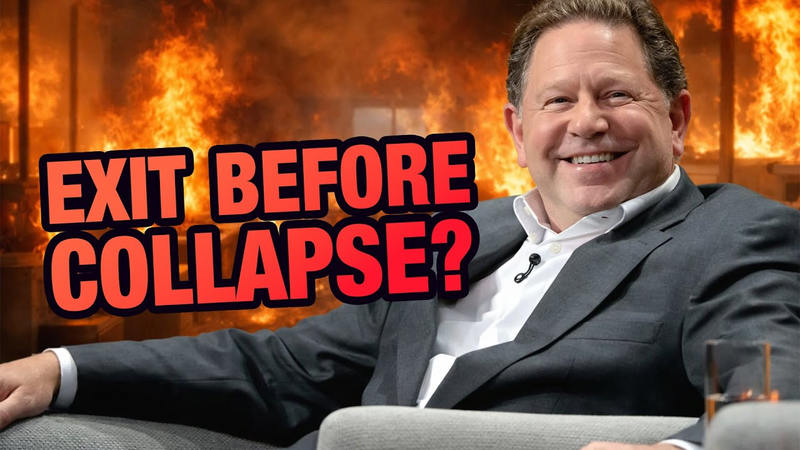
Let's get to the headlines. So, uh, let's do a little, um, little drama. So, the drama in the game industry is actually starting to rival what I in I hear on the news with like Open AI and Elon Musk with all their legal battles. So, we have our own version of this with Bobby Kodick and and Bracer actually gets pulled into this one. So Chris, I know you must be like so excited to talk about this one, so I'll let you do it.
There was some information that came out that was kind of interesting. Anyway, the Swedish pension fund AP7 claims that Cotch rushed the $69 billion sale to Activision to Microsoft in order to protect his $400 million payout and avoid the sexual harassment accountability. Bobby says that indeed he was not trying to do that. it was because he was seeing the writing on the wall and that he wanted to get out before things you fell off the cliff, right? And so he said that Black Ops 7
sales are down 60% year-over-year, you know, justifying the $95 share price to Microsoft. Console market collapsed in November. He brought that up. You know, Xbox is down 70% year-over-year. PlayStation 5 is down 40. He said that, you know, the battlefield effect is actually proof that, you know, the FTC was completely wrong about Microsoft's gaining huge monopoly power through the acquisition. And then obviously Activision basically said that following the a Black Ops performance, he's not they're not going to do backto-back releases. So anyway, he's just trying to defend his decision in order to, you know, fight off these claims that the transaction was hasty, I suppose.
Where do you think he got the 60% decline in Call of Duty? I mean, isn't it hard to get that math because of the subscription?
I doubt it's 60, but it's pretty significant, though. You know, like it's probably in the 40 to 50 range if I were to guess.
But he got it from some source. He wouldn't just like throw this out there,
I think.
Yeah. The thing that I thought you were going to go after because of your love of Embracer was was this part. And so Bobby says that the lawsuit was secretly meant to help Embrace your group. So this is what he said in the lawsuit. This Delaware lawsuit was apparently aimed to help pave the way for Embracer to increase its foothold in the California market at the expense of Activision, making it more difficult for Activision to recruit talent and expand through M&A activity of the sort that Activision relied on to grow historically. Embracer then comes back and denies this and says, quote, "Perhaps difficult to accept for Mr. Kotek, but we did not and do not need any help from a Swedish pension fund in competing with Activision." That's pretty funny. I was like, "Oo, kudos on your comeback there."
Yeah, that was a good comeback. But but to be clear, dude, Embracer could never actually compete with Activision. So, there's that.
Exactly. [laughter] Exactly.
Look, I wanted to include this because I wanted to make the point that the Swedish investment firm is absolutely correct, right? All these things are
intertwined. protecting Bobby's legacy, protection of his $400 million buyout, and maximizing shareholder value were all aligned at that time frame because we talked about this at the time when this deal was happening. I do think that this deal was probably the worst deal for the history of vid of gaming like for the gaming industry per se, but I think I still think it was a brilliant move by Bobby and the board to unload this asset in perfect timing because there were a lot of headwinds that were coming for this company with between Blizzard, between Call of Duty and a lot of that stuff. So the Swedes should be thanking their lucky stars that this deal was gapally happened because it was actually right before the implosion was likely to occur within Activision
as a plaintiff in this case and to give you more context [laughter] AP7 is the public Swedish pension fund. So I have a lot of money invested in this case just to give you context 100 billion under management at least. And so I want to bring us back to Bobby's decision to sell the company. If you
remember before Bobby's decision to sell the company, there was the sexual misconduct case at Activision. And this was like a very serious misconduct. And if you remember the details of the case, there was extremely gruesome example where one of the employees died by suicide after male employees circulated pictures of her genitalia. That is grotesque. It is it is grotesque and is unacceptable. Not only that, there was evidence that Bobby shielded other executives and he did not promptly inform the board and they end up settling with, I believe, the California Fair Labor Commission for $54 million. That is a fireable offense. That is absolutely a fireable offense. And that is also why sometimes CEOs move to do things like this. They can sweep it under the rug. They can basically exit cleanly. And so the goal of a board is to manage and maximize shareholder value, right? The CEO reports to the board. And so the thing that's really important for AP7 to show, and I'm surprised you haven't picked up on this, Eric, or at least you haven't criticized it, they need to show that at least Bobby tried to shop this asset around.
And the reason I'm doubtful of that is because the chairman of the board is Brian G. Kelly, which is Bobb's partner in crime going back to the founding of Activision. The board needs to be independent. And if you go back to Eugene FMA, and Eugene FMA, for those who are unfamiliar, is one of Eric's favorite economists. He is the man behind the efficient market hypothesis. Separation of ownership and control is, I would argue, his second Nobel Prize-winning paper. And he argues that basically these boards have become rubber stamps. They're weak monitors of CEO behavior. CEOs don't always act in the interest of maximizing shareholder value. And so I think AP7 absolutely has the right to say, "Let's go through the discovery process and let's see who else this asset was pitched to." I mean, there must have been a million biders for this. First of all, let me correct the record. The settlement that they came to stated that the court that no court or independent investigation substantiated the allegations of systematic or widespread sexual harassment at Activision Blizzard. The specific instance that you're talking
about. Yes, that clearly was true.
It was Bobby's behavior that matters here. It's Bobby.
But it wasn't Bobby. Bobby was not even shielded it, but he shielded it and did not report it to the board.
Okay. No, that is incorrect. Okay. And they also like California actually withdrew all these serious claims about this because of the investigation that was conducted, right? It was just not part of the culture of Activision. It was individual circumstances that ultimately were proven in
That's not the claim though. The claim is Bobby's involvement in this and whether Bobby was completely It's like Bobby being responsible for what happened to Blizzard, right, with those three or four guys that got in trouble, right? It's all the evidence on the ground from what talking to a lot of people that were familiar with this stuff back then. It was not systematic.
But that's not the claim when it's relevant to the shareholder case. The shareholder case is whether or not Bobby should have reported this to the board and whether or not he should have reported it promptly. Obviously, it eventually got to the board and so did he report it promptly? And I think this is a good piece of evidence that if
you're someone looking to again, as you mentioned, Eric, protect your legacy, you'd want to exit quickly after something like this. So you can clearly see that this might have been an incentive for him to perhaps not shop the asset as aggressively as he should have.
That point I I would agree like he wanted to get out of this mess and protect his legacy. I've actually made that argument many many times. I'm just trying to tell you that it was not like this systematic thing at Activision while it is was I think systematic at Ubisoft from every all the evidence that I've heard from people. Correct. So so I there's a difference is what I'm trying to say. The second thing is in terms of shopping this around at the time like there was just no one that was going to pay this kind of money for Activision period like there was there were no other buyers to to look for right and
savvi savvy I mean first of all whether they should have at least tried they need to show evidence they at least tried
dude even didn't do it because they didn't want to blow the deal with savvi because they knew that they couldn't get another buyer right the bankers are smart enough to know whether or not like there are other buyers that are interested in these assets because They
talked to them constantly and so rather than trying to sour the deal with Savvy, they EA didn't shop the deal either. Goldman didn't shop the deal for EA either.
And I think that's wrong too.
No, I I think you're I think you're wrong because I don't think you understand the dynamics of how M&A works for bu deals that are worth like $60 billion, right?
So they they should have formed an independent commission, which we know they did. But the idea is that they at least need to show they attempted this. That's the that's the whole point of this discovery process. That's incorrect. The minute you do that, you actually could sour the deal with Savvy, right? And they knew what they had on the table. And I would I would imagine that Activision had the same issue. And so, you know, maybe I'll talk to the banker at Goldman and see what he has to say because I'm sure he has some like really like insights as to what the back end dealing of this stuff was. But I I don't think you and I are actually on the different [laughter] page on this to be honest. Except the fact that like yeah, don't you don't shop deals right like this. And these Swedes should shut the up and count their blessings that they actually got out at this value
because if if this happened, here's my point. If this happened with Call of Duty this year, this stock would be in half, right?
Yeah.
Will you at least concede that like having Brian Kelly as chairman of the board is impropri like that's impropri. It needs to be an independent board.
Dude, the EA board is completely not independent. The EA board is all
completely aligned with a kiss ass board these days. like this is all you need% I agree with that
corporate and governance deserves deserves to be independent and be protecting shareholder interest and we need stronger controls for that and stronger monitors
again I am not disagreeing with you what I'm saying is that in this particular case I think all the stars were aligned this is my opinion right
and I look forward to trial and discovery
there [snorts] will be no trial there'll be no dis no about the sweets they certainly don't give a about AP7 right
Chris let me let me just ask you on This like was this filed a long time ago and it's just taking forever? Like why? Why now? Why now?
I don't know. Yeah. Why now? It's like
ages ago.
It was filed a long time ago. It's just been working its way through the courts. [music]
[music]
Auto-generated captions from YouTube — names and numbers may be misheard.


















Comments