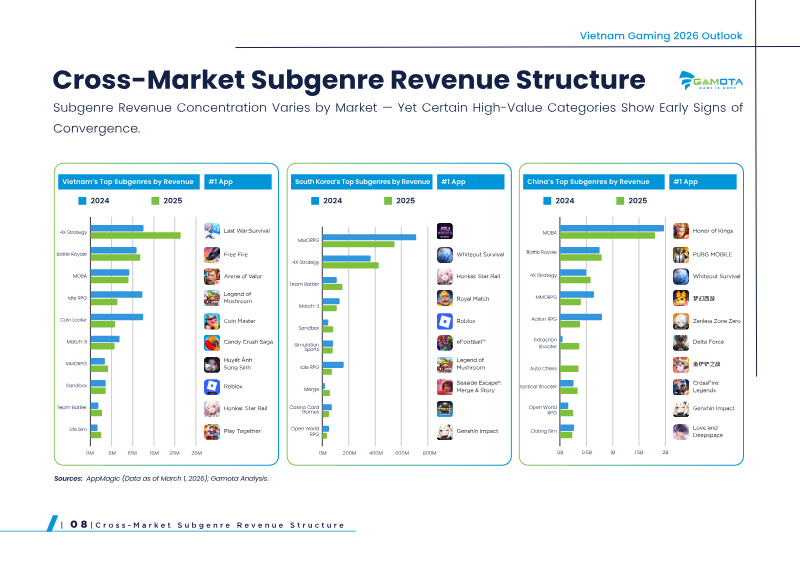
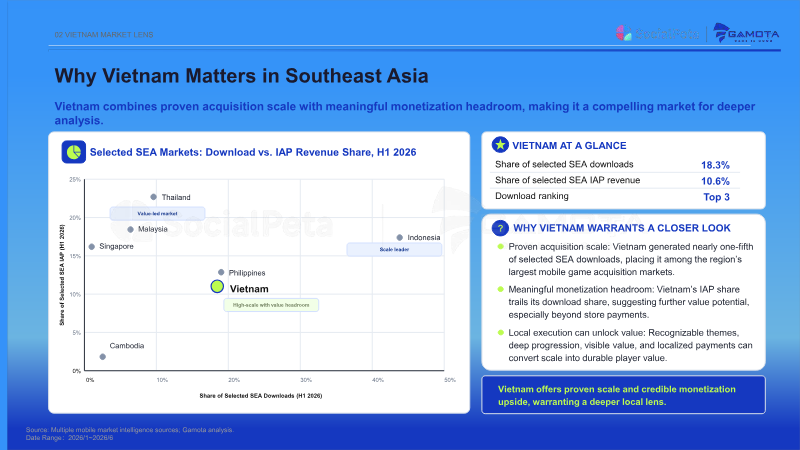
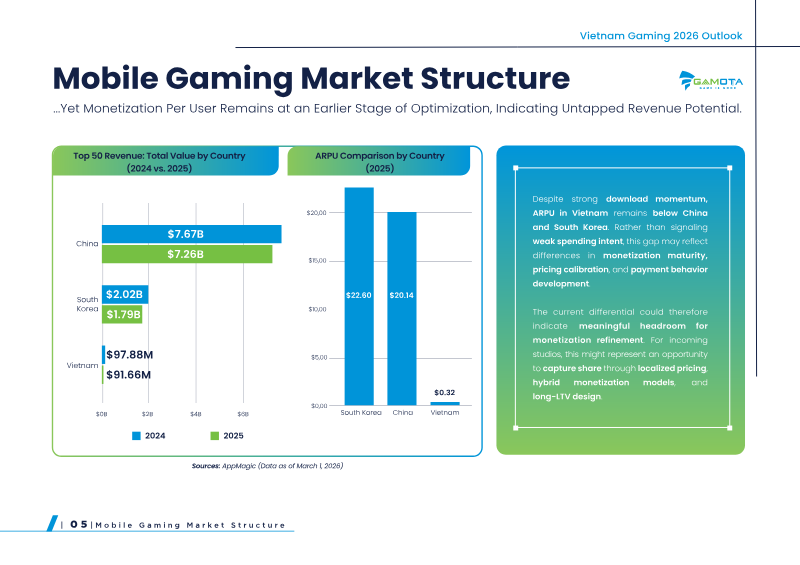
The market shows strong momentum in player scale, with download volume outpacing regional peers like South Korea. Monetization per user is less mature than in China or South Korea.
High Growth. Vietnam is in a high-growth user acquisition phase, with significant untapped revenue potential.
The Vietnam Gaming 2026 Outlook provides a comprehensive analysis of the mobile and PC gaming sectors in Vietnam, projecting sustained market expansion through 2026. The analysis identifies Vietnam as a high-growth market currently in an active user acquisition phase, characterized by significant download volume that outpaces regional peers like South Korea. While the market demonstrates strong momentum in player scale, monetization per user remains at an earlier stage of maturity compared to China and South Korea, indicating substantial untapped revenue potential for studios capable of implementing localized pricing and long-term value design.
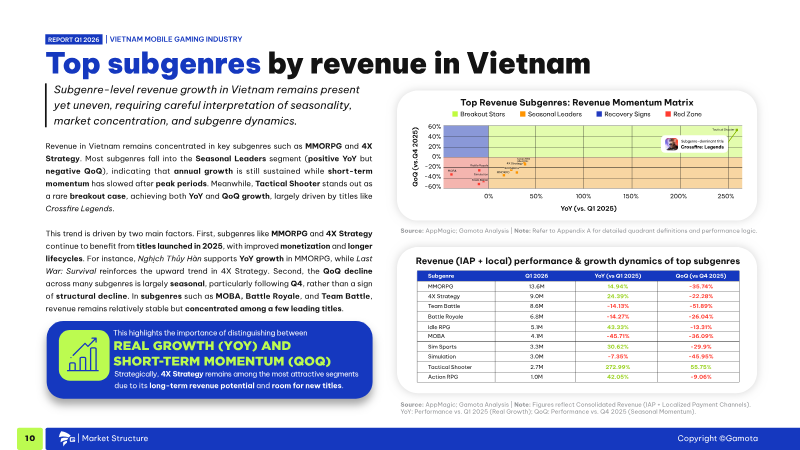
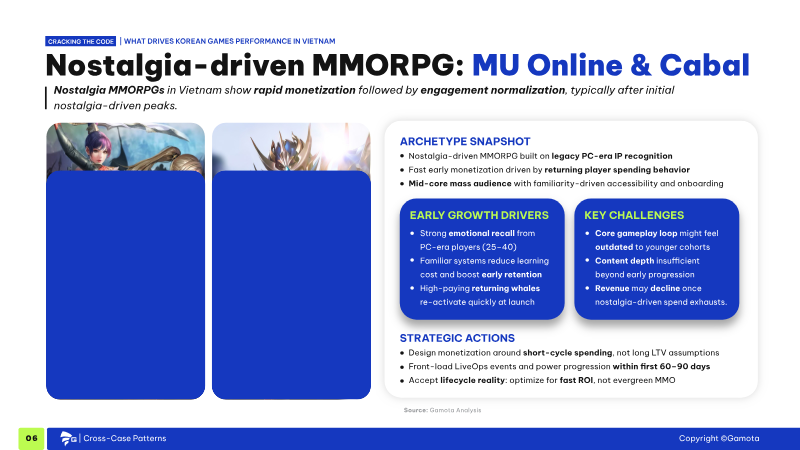
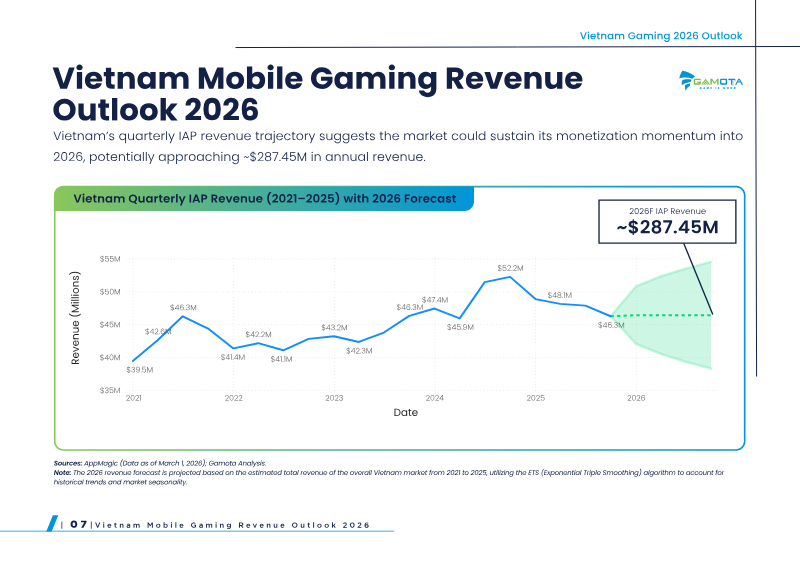
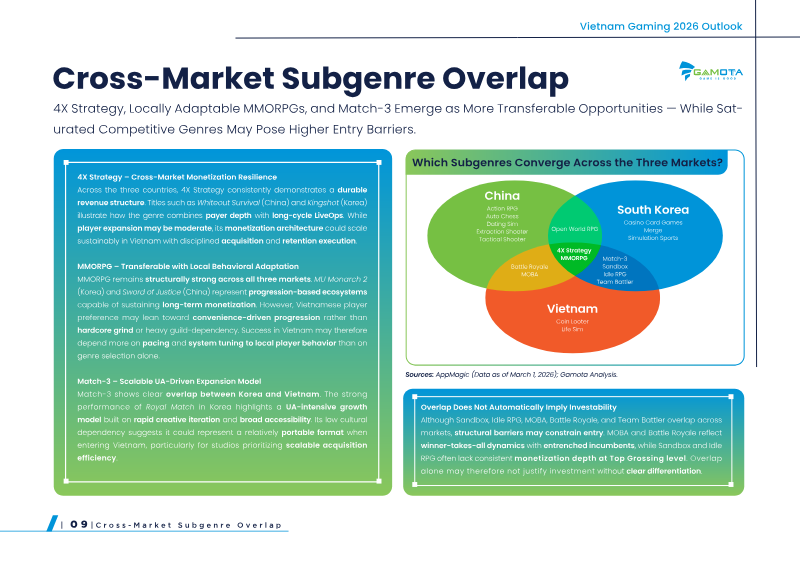
Quantitative projections, derived using the Exponential Triple Smoothing (ETS) algorithm based on historical data from 2021 to 2025, suggest that the Vietnamese mobile market will reach approximately 1.34 billion downloads and generate roughly $287.45 million in annual in-app purchase revenue by 2026. The research highlights that while certain subgenres such as 4X Strategy, MMORPGs, and Match-3 show cross-market portability, success in Vietnam is not guaranteed by genre overlap alone. Instead, it requires structural adaptation to local player behaviors, such as a preference for convenience-driven progression over hardcore, grind-heavy mechanics.
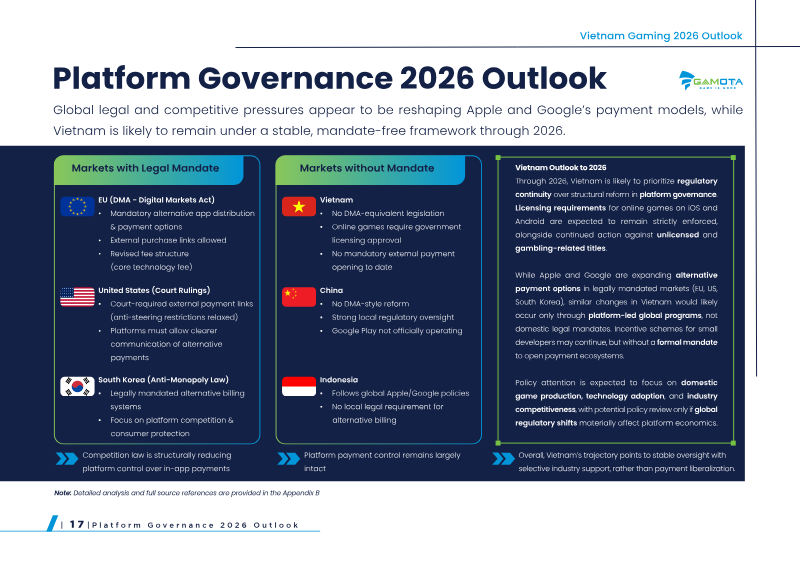
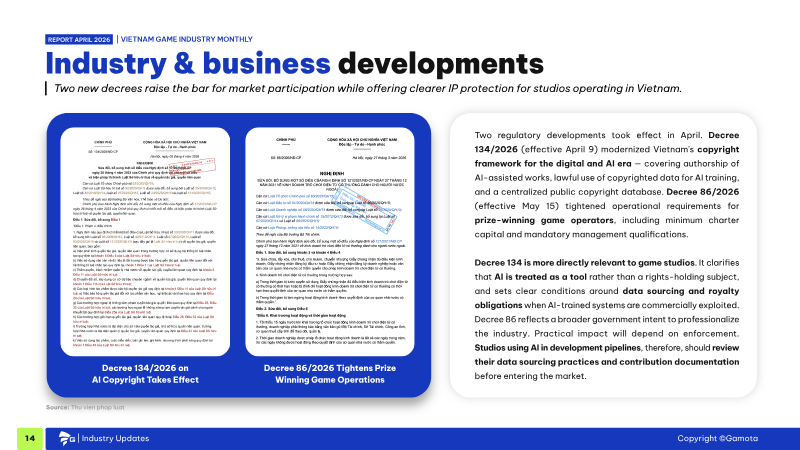
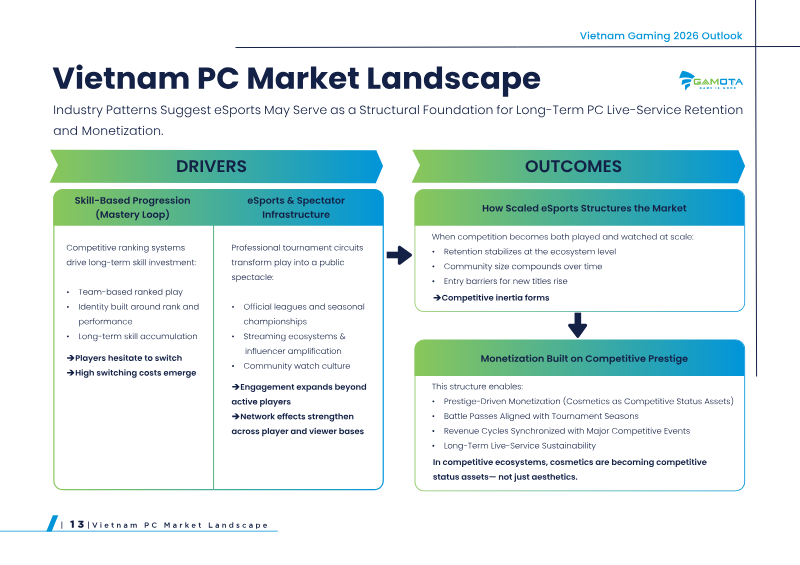
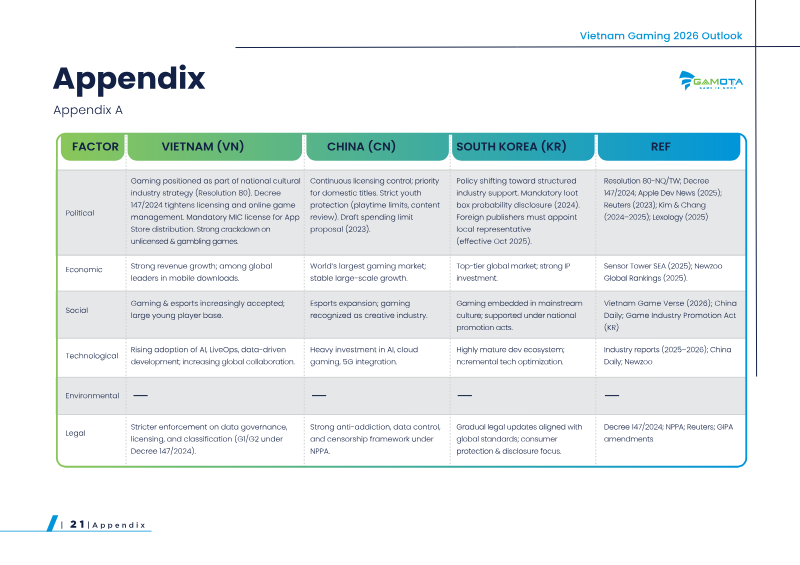
The PC market landscape remains stable but is heavily influenced by entrenched incumbents and strong network effects. New entrants face high barriers to entry, with long-term retention and monetization increasingly tied to eSports infrastructure and competitive prestige. Furthermore, the regulatory environment is shifting toward a phase of controlled expansion. While the government continues to support domestic industry growth, it is simultaneously enforcing stricter licensing, content oversight, and age classification requirements. Unlike markets such as the European Union or South Korea, Vietnam maintains a stable, non-liberalized platform governance framework, with no current mandates for alternative payment systems. The findings emphasize that future success for publishers in Vietnam will depend on navigating this structured compliance environment while differentiating products through cross-platform accessibility and localized live-service strategies.

SocialPeta · 2026
Gamota · 2026


Gamota · 2026

Gamota · 2026

Gamota · 2026

Gamota · 2026
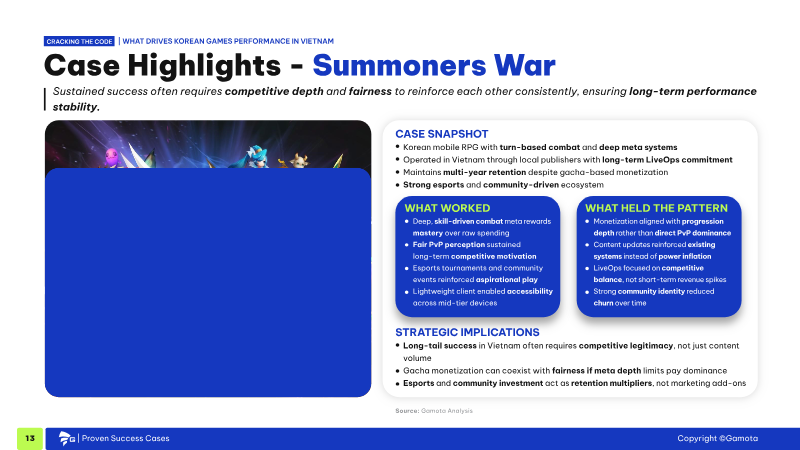

Gamota · 2026
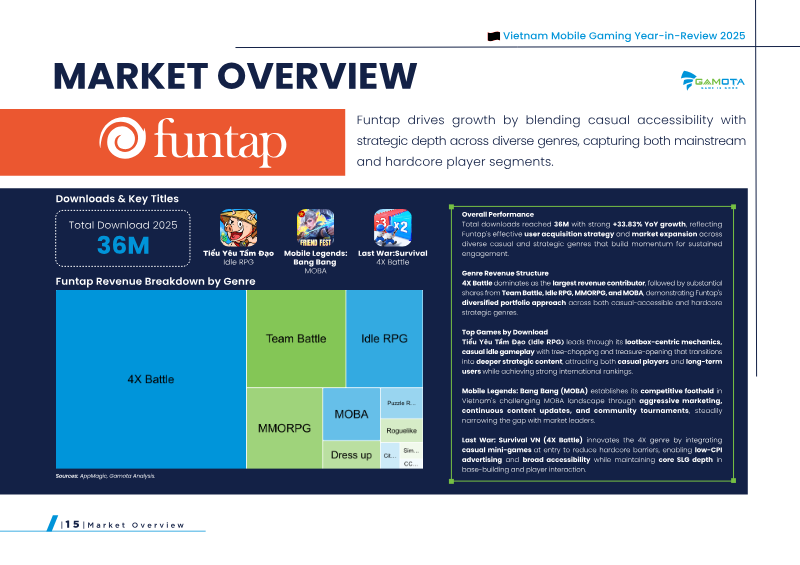
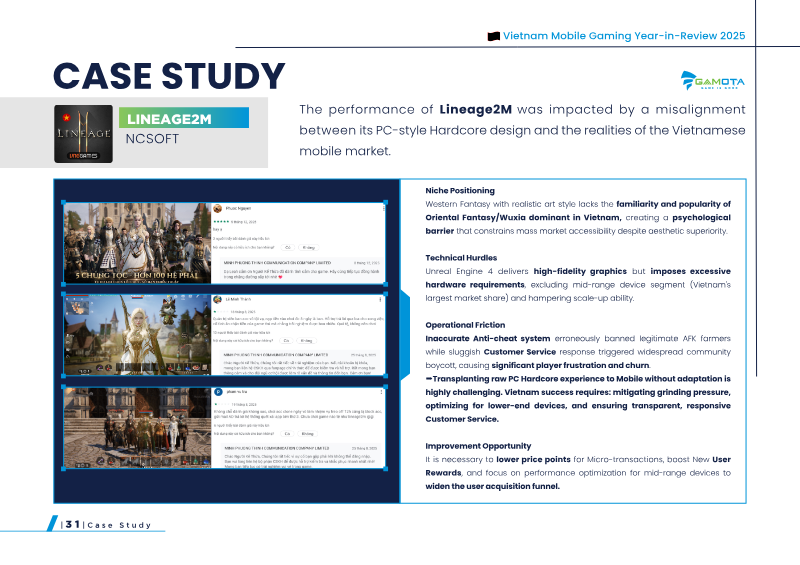

Gamota · 2026

Two & a Half Gamers · 2026



Newzoo · 2026
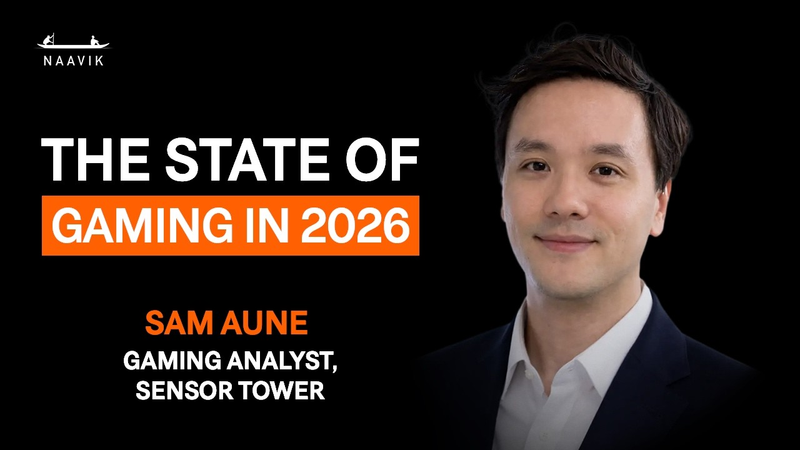
Naavik · 2026

Two & a Half Gamers · 2026
InvestGame · 2026
InvestGame · 2026
Aream & Co · 2026
Epyllion · 2026

Deconstructor of Fun · 2025
Newzoo · 2025

The Game Business · 2025

The Game Business · 2025
Comments