1 free read left. Create a free account for unlimited reading + AI research.
Create free accountWhitepaper DiGRA
1 free read left. Create a free account for unlimited reading + AI research.
Create free accountWhitepaperDiGRA
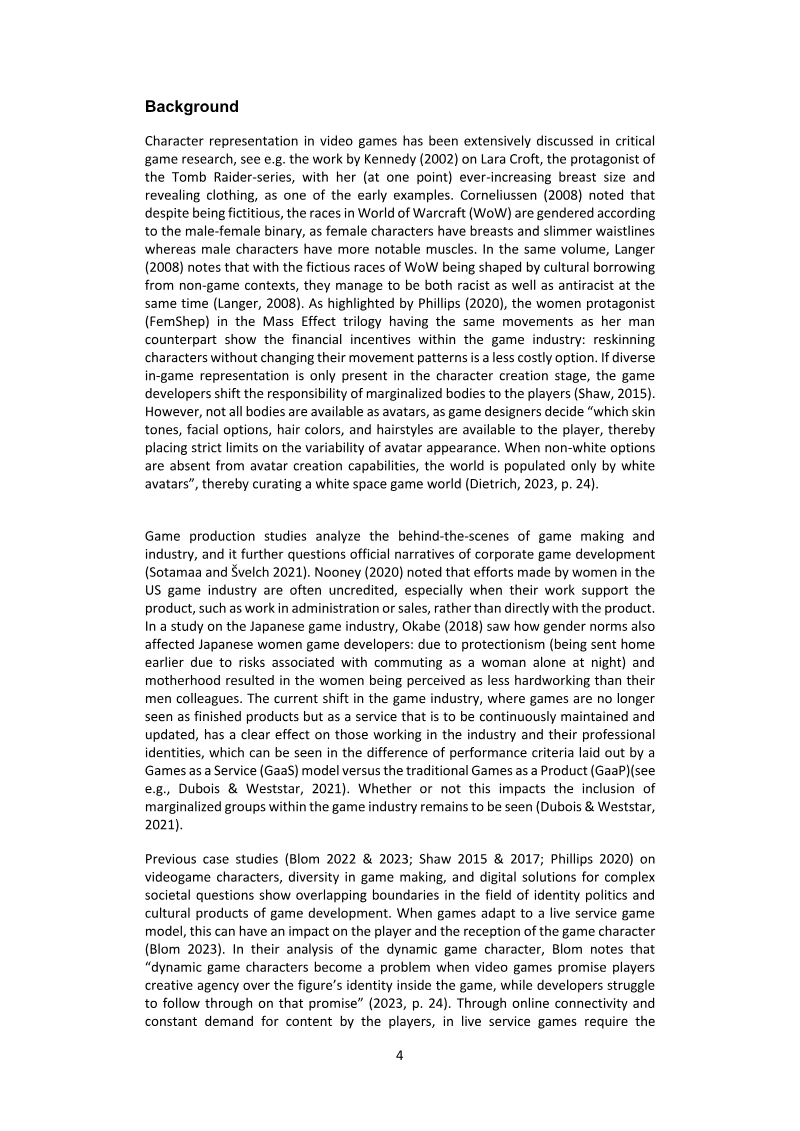
The paper cites research documenting sexist, stereotypical, and narrow identity representation in games. It also cites limited job access and toxic work environments for women.
This paper, presented at DiGRA 2025, reports preliminary findings from the first phase of a research initiative examining how games and the game industry can become more diverse, equitable, and inclusive. Drawing on a review of prior research documenting sexist, stereotypical, and narrow identity representation in games, along with persistent barriers such as limited job access and toxic work environments for women, the authors argue that progress in the industry remains slow. The initiative adopts an action research approach, engaging feminist game design researchers, students, and industry stakeholders to identify concrete ways forward, with a particular focus on the Nordic games industry in Sweden.
The methodology centers on two open panel lectures featuring three feminist game design researchers each, and a half-day game jam in which students without formal game design expertise created games envisioning more inclusive play. From these activities, the authors synthesize five themes: rethinking inclusion and who counts as a stakeholder, shifting focus from games to play, the experiential and sometimes darker dimensions of play and the power imbalances shaping them, embracing failure when addressing wicked problems, and building reflective design skills and pedagogy. The findings are qualitative and drawn from discussion rather than a large-scale survey, so they are best understood as exploratory.
The study is limited in geographic and sample scope, but the authors expect its insights on equity, representation, and production practices to inform broader international conversations. A planned colloquium in fall 2025 is intended to extend the work into collaborative workshops among researchers, designers, and industry stakeholders.

DiGRA · 2026

DiGRA · 2026



DiGRA · 2026



DiGRA · 2026



DiGRA · 2026



DiGRA · 2026



DiGRA · 2026



DiGRA · 2026

DiGRA · 2026



DiGRA · 2026



DiGRA · 2026

DiGRA · 2026
DiGRA · 2026