1 free read left. Create a free account for unlimited reading + AI research.
Create free account
Uncovering DuoFun’s approach to mid-market IAPs
Key insights
6 takeaways- 01DuoFun Studios is pivoting its monetization strategy away from high-spending 'whales' to target a mid-market cohort of players willing to spend between $20 and $60.
- 02The studio aims to mitigate high churn and 'regret spending' by replacing predatory mechanics like 'rage-pulling' with transparent value propositions for in-app purchases.
- 03DuoFun’s model prioritizes long-term retention and community engagement to build a sustainable revenue base that reduces reliance on aggressive, high-cost user acquisition.
- 04Internal data identified a binary spending pattern where players typically either play for free or spend large sums for competitive advantages, a trend the studio is attempting to bridge.
- 05The studio utilizes iterative soft launches to adjust progression curves and leveling caps, ensuring that moderate purchases provide tangible, consistent value to the player.
- 06While early metrics show improved retention and engagement compared to traditional titles, the studio acknowledges that the long-term financial viability of this model remains experimental.
Ask AI about this video
Transcript
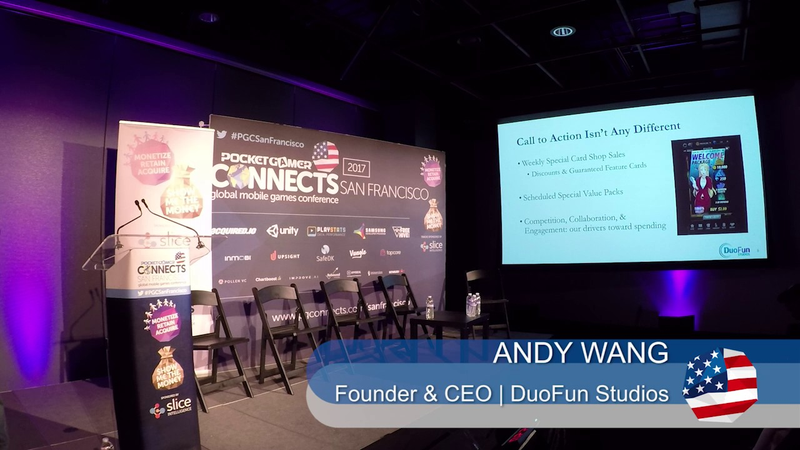
[Music] perfect hi folks I'm Andy Wang I'm with DuPont studios today we're going to be here to talk about mid market monetization or what I call the median spenders my backgrounds in a combination of high tech as well as I was also a first generation eSports player and I run to myth core mobile user groups I don't know the largest or certainly very sizable one is a what we call a well group you have to spend two thousand dollars in a game before to join so that's not very relevant to mid market monetization but the other one is a generic mobile user group you know we usually go from game to game and all the mainstream games and we see most of us dilip all the top guilds and these kind of RPGs that we go to we run a lot of surveys in these mobile user groups or we ask them how much did you spend on this game when did you make that purchase and things like that so it's
thinking about some of the data that we talk about when we use to formulate some of our hypotheses that we have on mid market monetization come from the trends that we observe in these groups in the last two or three years so a little bit about dual funds we were founded January 2016 is we're based in Irvine California we started here in San Francisco but San Francisco too expensive so we decided to move down as a turbine most of us about half our guys came from Blizzard so that king that made more sense for us to move down to Irvine we make real-time team-based multiplayer games so not just we want people to play with friends we want people to play against other people but most importantly we want them to play in a team-based fashion where you win together where you lose together everybody on our game site has worked on a commercially successful game before we identified a couple different areas that we think is lacking in the team-based real time area we put a lot of emphasis on building up our technology so we have to think all week all ribs it's our real time or reusable integrated back-end
service server that we use from one game to another we have one green up spend product ready we have another one that's been pre-production and we've been testing out some of our hypotheses on mid-market gaming from there so why do we even want to focus on the median spenders in the first place well we've been I'm sorry one more thing is just shoutout to some of our great advisors that we have these hourly investors as well as people that gives a lot of feedback on where to go they cover all ranges from the super big down to just indie gaming and they know without them we would be a lot more scattered than we are already are so why do we even want to target mid market well we looked at early on at least in the previous games that all of our guys worked on it's always totally the hunt for Wells it's always trying to get those big spenders and that's always going to be part of the strategy but when we start looking at that we sees well everybody else wants the well everybody else wants that big spender too and it's no secret it's I mean this is it's novice to that user
acquisition keeps going up up up up up more and when we look at sustainability of a game we wanted to make sure we outpace that race and we're not at risk to higher and higher user acquisition cost well what the 30 point is you do want the big spenders and as more and more people want the big spenders what happens is you will be usually thinking see choose two paths we see well you can be very niche so you can be a dating sim you can be something like that and you can get you can get wells that way but the more mainstream way is you're forced to win with higher production value and a larger feature cost so longer development cycles more perfect development cycles in order to actually win that because you're going to be sinking a lot of money in uni kind of creative products or tech products the higher your cost gets but let's risk you can take so once your budget gets has more and more zeros in in that sum you certainly need to stick with proven proven things traditional things traditional gameplay things that worked
in another blockbuster game and when you do more and more of that you become just a game that's very similar to other titles that are out there I think matically spiritually what have you and now you're part of the problem because your only path to ROI is really through the wells that like the traditional games and this brings you back of the gloop that now you spent all this time building a game high production value which means two very costly to build and now you got to go after those Wells and you've become the reason part of that reason why the cost goes higher and higher and well that's bad that's the rat race that we didn't want that we didn't want to fight in so we want to be able to avoid hire and hire you a cost we wanted to run our development cycles at a shorter clip compared to having to build a long time mostly importantly from us because we are all gamers we wanted to make sure we started making different kind of games that weren't just one clone after another so um people there's two hypotheses that we tested the chief puzzle officer we first thing that we squandered tests was would you spend
$20.00 well this is not little more market data but would you spend $20.00 to be new people were spending 2000 the reason we wanted to test this hypothesis was because I think I think a year and a half or two years ago a monster strike was the first time we have 300 people in our users are definitely at the survey and we saw a good healthy chunk of what we call median spenders 20 to 50 dollars or so and from then on from one game after another unison League Valkyrie Kinect long for us recently we started seeing a very binary distribution there was their own proud no problem with being free-to-play willing to grind the time and then it was either drop team $300 the first day or not at all and the reason we started seeing this disparity our hypothesis when we talk in our user monthly meetups was we got a lot of people say why would I spend $20 if I know that there's people dropping a thousand two thousand you know I used to support the developers but you know people say that but support the developers is intrinsically rooted only if they get an advantage in an outcome
and you still want to support the develop developers only if you're getting something so and apparently that getting something is a far far bigger component than supporting the developers that's just the truth out there so what we what we have are people say during our meetups was well guys like you know I would love to play with you but I won't spend $20.00 because that just makes me like the status sucker you know to the guy who spent like $1,000 or $2,000 so we saw a short decrease in the we didn't necessarily see an increase in the number of people that spent more than $200 on the first day but we did see a short decrease in the people that were in the middle and it's just a value equation so on the other hand we asked what would we would you spend $20.00 if the maximum spend was $20 at that point your premium game now that's just how much exactly that your game cost well that's not very good either because premium games have there's been capped and that's not exactly what we want to try to do here so where is that magic number $60 $200 now we know what the user is
saved but the other thing is that what they saying what they do is also very different so we went we did 7 different different cohorts of a user acquisition during our during the soft launch a chief of lobster where we essentially tested the effective cap through masking it in the backend you know in terms of these just different leveling curves different progression curves at the time when we raise the level caps the amount of experience needed to raise cards and things of that nature we set each each one on the so that more savvy players can see what the value they were getting for their 20 bucks and we started seeing that can't get deep in the details in this in a 20-minute session but what we started see was that there's definitely a correlation there was a correlation between what people felt was the value that they were going to get from the money now so we know we know extreme examples we know on one and if you know this is what we call the clash royale if you know that there were the two thousand dollar spenders the $1,000 spenders you're very be incentivized to
be able to spend pockets of $20.00 Boyd R it really doesn't matter if you what worked like a year ago was you know if you give them these monthly packs that seems so good that you can't pass up that works really well at the time but now people are I think penguins are getting a lot more sophisticated where they're weighing that versus well what exactly am I getting so what if I'm getting two and you see this in war simulations a lot so what if I'm getting a beginner pack that has a 7,000 percent value that cost me four ninety-nine if the real outcome is that it didn't make any material difference between me versus the guys who are spending much more so we know that it extreme and we are losing the minion spenders now we also know on the other end if we go premium game route than what with the amount of people that spend and buy the game is exactly the people that spent the cap we have that but we already know that that isn't the true earnest potential of our game so trying to accumulate enough data try the experiment we don't the perfect answer but finding that
midpoint inflection point in the middle is where we think as a studio going forward that we can find the where we can find the healthy medium spenders that we that will get us into a healthy mid market tier mid market if you look at economics you know if you don't look at gaming and just look at mid market democratization mid market as a segment would be the fourth largest GDP country in the world so you could the gem of finding enough guys to spend medium amounts in your game economically is always there but it doesn't mean certainly doesn't work if you're going for a value based spend in the current free free-to-play paradigm and that's what we're trying to tackle the call to action to get people to spend even if you have an effective cap in your game on how you spend isn't really any different than traditional mix you still want to give them incentives people still need effects illogical driver suspense so in arguing we still give you the welcome pack it's just that we still despite the same things like you know
trashing our military sims giving you seven thousand percent value we still do that in our game we still give you the deal that you can't say no we still do the intermittent times random specials that come come at you and go away after a limited time all we do is we make it very apparent in the game we try to help players calculate the cost of what they're going to get and we try to make it much more apparent that this this 299 is is a lot more it gets you you know what one-third way to your level card I thought the actual numbers but the idea is to give you enough and give the users enough info that they know what they're getting with this $2.99 no longer are we just doing $2.99 so cheap buying now it's $2.99 this has this this will this has a direct value of x so now we're trying with our in our latest cohorts we try to put that you know put that messaging inside of our welcome packs I mean we we try to do different things I don't have this to here we have things like enough to you know mass level three cards you know we have things like you
know get to max level you know 48 hours faster or something like that we're trying to spell out the results of the users so that they know and we are tinkering right now with if we should or should not you know I've actually put an effective cap spent something's up in Japan are doing this where they're actually caps and monthly spend that you can have in the game where we focus on the North American market so we're more iffy about doing that you know we still want to have traditional big spenders but we also at the same time we're trying to figure out where that happy medium balance is so because we are a real-time games because our studio focus on real-time multiplayer games we still use competition collaboration engagement to drive you know we still do things like putting in the your guild chat when someone draws a five-star car we still have things people are building together and so we still want to drive but what we're trying to do and we're hoping to achieve is that we can get a lot of
twenty to sixty dollars reoccurring spenders we would be a lot happier to do that because in our in our only way that we do not having to do Facebook targeting for guys with the latest iPhone 7 having spent money and again the last 14 days likes the pay joking of war or something like that not having to do that and be able to use alternative targeting and by now having a pretty substantial list just to do you know look like targeting those kind of guys cost us a lot less to buy and if we can get them to spend for a lot less cost means we can we can set we can be satisfied with a lot less LTV so let's what maybe it uh I think I'm also signed up to do the talking and in a couple months of pocket game ran in Europe and maybe at that point I'll tell you is a completely fail social experiment but for now we are approaching that because we think as a new CD studio studio we don't have the backing to be able to play in that you know big us-led market so we got to find a different way we may
very well you know what our game chief US officer now that we collect the data we want we may very well partner together with a publisher and if they're one that wants that I think they have a competitive Vantage in the big spending game sure but as a new studio so far operating on a solo path and who knows we might partner up with on the publishing side for disking one next one we're trying to figure out a new way to survive and that's why we can this whole idea to target mid market okay now does it work you know that's you know that that's what we care about that's what you probably care about so in the first cohort that we have we've had a lot of actual users and folks on our different some other gaming website that we won't talk about here is that they where we for the longest time we can see that once we make our reputation out there as a game that yes you spent yes you absolutely spent but it is not a well dominate game we can see that our retention and our engagement has been compared to traditional games of success much much higher you know where we're doing very good on our job you know day
one day seven days stage day 30 as well as our engagement rate how long people play our games we stayed a number of different sites that have ranking charge we stayed up there for quite a while despite just being in soft launch status for four through multiple multiple iterations that we have so what we're consciously optimistic in the direction that we're going in but at the end of the day I cannot at this point tell you that this has translated into a profitable real dollar proposition for us it could we haven't hit critical threshold into where we think we're a normal well based paying game would have hit anyway so I think we're on the trajectory but as always tell my King if it doesn't count until actually have it so we are moving in that trajectory and I hope into three must be able to report the next Pocket Gamer conference that we have you know we have cross chasm in the possibility all right any questions yes I'm a massive fan of this kind of
model because of what you've seemed to me to be doing is broadening your funnel essentially I mean rather than focusing on the same targets that everybody else is it seems to me that you're focusing on trying to engender the values but what's in the back of my mind is surely what you also will end up doing when we can we don't know the data yet but would you suspect that by getting this mid-market engaged more deeply so they made themselves become larger spenders and you would otherwise expended yes it's absolutely absolute now a Germany kind of insider comes shows that it might be possible yet or is it too early see what we sing right now is when I look at my well user group the number it used to be if the game of fun yeah well then we drop money right away to get that early edge but now the most criteria is this game going to be around a month this game going to be around and three Muslim populations going to die out I think what we like to say is that well have been burned a lot with their
short-term spending habits so it makes them kind of shady to say this but we went after MIT market gaming as a means to a healthier ecosystem so that so that the guys so that wells who are now they don't mean wealth online not playing your day I'm getting day one don't care they catch up right away you know when they want to come and and as you said as you alluded to if you know the chances of people making VP purchases are so high that if we can target people willing to make the spend between twenty to sixty dollars then as we start moving into things are not more power related cosmetics you know different types of things we part we being based in Irvine close to LA we've had a lot of talks with you know sports figures where we talk about no different intrinsic prizes like spent a day with you know certain NFL stars and no things like that and those are the things that we think we can get high spend without impacting the health of the ecosystem but we've more or less targeted the healthiness and integrity of the player base ecosystem as the number one means to be able to
achieve well I think that's going to be something that affects lots of people I immerse me I'm trying not to use too well ever again and this today has not been helpful for that so that dislike I'm not a fan of the work whale because I think white whale is a very specific term that relates to a behavior we see in gambling are the reason we see that behavior in gambling is because if you're a gambler you know the gambling game that you already lost yep and that we use that term in in games our risk because we are creating content that people don't necessarily already love yep they have to learn to love and there's a process and journey for them to get onto that that bit is why I was focusing so much on this idea of for me it's not about mid-market necessarily or well or true founders I prefer to say it's about understanding the player journey yeah and not everybody is going to get to the final end stage where they're dropping thousands bullets right so one thing I will share a song are well we do use the word will help you learn how to
characterize us from from our big spender user group one thing was the first iteration of that back three years ago I wish I can tell you everything back then it was only $1000 to get any without there was a lower spend a factor I wish I can tell you everybody in that group we're rich disposable income a lots of money it's not the case a lot of the membership in that group came for what we call one kind wealth or regret Wells you know so after they spent they greatly regret that they have spent in that money and it was it was a really I mean I think for a period three months our group was more focused on helping you know get them get refunds from Apple and Google by explain like you know how this affected their lives and blah blah blah blah so there's we have strength in numbers we actually got a lot of refunds in that by you know by just basically writing in and spam spam spam so but so what we we talk to us on a lot of guys and we were looking for we ourselves and the people that we want associated in that group were people that spend an entertainment knowing that it is entertainment half we disband their entertainment now a lot of us have what
we call like hero complex where you know when we play war simulations we like to be able to help and lead and collaborate an entire alliance to victory so those and we don't do that as a sin we don't do that a shameful we just view that that's the first that's what we seek in our entertainment and and what we're so what I look at it I in my mind as a game maker I'm making separation between healthy big-spending and unhealthy big-spending and we're trying to do a fun we're trying to make the gangs that gravitate towards the healthy big-spending so we don't try to do things with let's say gotcha you know expansion packs that are we use those mechanisms but we make sure that they're more modern-day they have failed states they have they have triggers where you know you'll have your mileage you know guaranteed by story after certain amount of polls so that people don't fall into what we call rageful which additionally have been one of the highest drivers we talk to a publisher a year ago that said but rage pole is one of the main sources of income you know to to where it comes from and what we say to that is that doesn't sound like a
publisher that we're going to work together with you know in terms of our games so I think in keeping this time getting is it's about healthy won't get building in your game yep which is perfect way to it thanks very much I'm silly thank you [Applause] [Music]
Summary
DuoFun Studios is shifting its monetization strategy away from the industry-standard reliance on high-spending "whales" toward a model centered on moderate, recurring spenders. The studio’s primary thesis is that the current mobile gaming landscape—defined by escalating user acquisition costs and a "race to the bottom" regarding production values—is unsustainable for smaller studios. By targeting a "mid-market" cohort willing to spend between $20 and $60, the studio aims to foster a healthier, more sustainable player ecosystem that prioritizes long-term retention and community engagement over the volatile, high-risk revenue generated by extreme spenders.
The studio’s methodology relies on data gathered from mobile user groups and internal soft-launch cohorts. By analyzing player behavior, the team identified a binary spending pattern where users either play for free or drop large sums to gain a competitive advantage, often leading to "regret spending" and high churn. To counter this, DuoFun utilizes a "retention-first" approach, employing transparent value propositions for in-app purchases and social-driven gameplay mechanics. The studio tests these hypotheses through iterative soft launches, adjusting progression curves and leveling caps to ensure that moderate purchases provide clear, tangible value to the player, thereby encouraging consistent, healthy spending habits.
While the studio reports promising early metrics regarding player retention and engagement compared to traditional titles, it acknowledges that the model is still in the experimental phase. The long-term financial viability of this approach remains to be proven against the traditional blockbuster model. Ultimately, the studio seeks to move away from predatory monetization tactics like "rage-pulling" in favor of modern, player-friendly systems that treat gaming as a form of entertainment rather than a high-stakes gambling environment. This strategy is intended to lower the barrier to entry for new players while building a loyal, recurring revenue base that does not rely on the aggressive, high-cost user acquisition strategies currently dominating the mobile market.












Comments