1 free read left. Create a free account for unlimited reading + AI research.
Create free account
The growing challenges of monetising and retaining players
Key insights
7 takeaways- 01Sophisticated haptic libraries allow mobile developers to mimic console-quality tactile feedback, such as mechanical resistance or tension, to create immersive 'wow factors'.
- 02While individual in-app purchase amounts remain stable, the combination of longer session lengths and higher engagement leads to an overall increase in revenue per install.
- 03Haptic integration in mobile games correlates with a 20% increase in 14-day retention and a 4% to 13% rise in first-time payer conversion rates.
- 04Players are more likely to keep haptic feedback enabled than audio because it provides sensory rewards without the social or environmental drawbacks associated with sound.
- 05Haptic technology can be applied to video advertisements to improve user click-through and share rates.
- 06While Android allows for custom haptic profiles, iOS provides standardized patterns that support consistent cross-platform haptic experiences.
- 07Implementation is technically low-friction, requiring minimal development time through existing plugins for platforms like Unity.
Ask AI about this video
Transcript
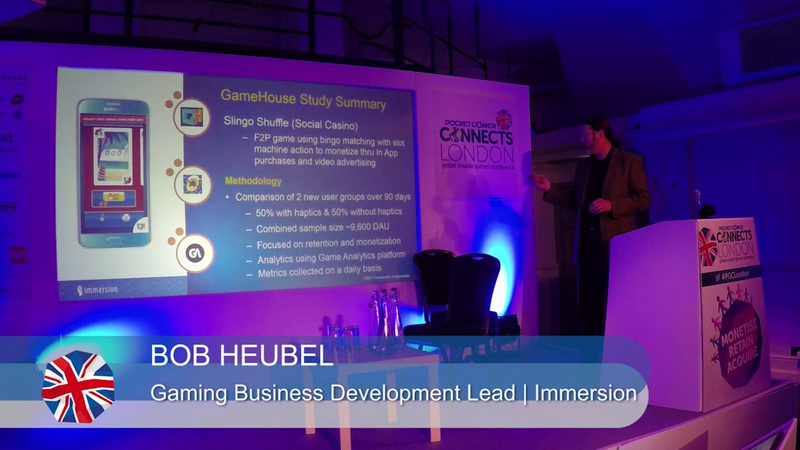
a bob cable from immersion and I'm going to talk about some monetization and retention techniques using tactics which has been different than what you would think of when you want to monetize and make some retention upgrades and the first thing that you have to do how many people here know what happen except the start with all right so a good number all right for those of you that don't what I'm going to do is pass work around a couple of tablets here that have Angry Birds everybody knows Thank You Birds right so in a pass one on this side and my coworker there actually my boss Matt tell us he's going to pass around the other tablet on the other side and while I'm talking here about monetization retention just go through and play the game and you're going to feel haptics on the gameplay all right and I'm going to
talk about two studies here and the results from the studies based on putting in feeling into your mobile app so where do we get this room so immersion is a haptic company we've been licensing haptic technology into Xbox Playstation the racing wheels where you have full force feedback way back since 1993 and we don't just do gaming we do automotive we do medical Sims anywhere that you want to put a seal into the computer human interface that's what we do alright so the studies that were we're going to be talking about are not just your standard vibe this isn't just turning the motor on and turning it off what we have here from the studies are predefined effects from the library so immersion knows it's not the easiest thing to take up any kind of developer
time trying to create milliseconds little time fragments of vibration so what we do is we made a library certain very specific feelings that you find in the developers that want to put vibration into games so we work with folks like Sega rockstar Rovio and we know what kind of vibration patterns they want in the game somewhere explosions somewhere very subtle racing effect or nitro FX going on a lot of weapon effects where you want to feel a pistol it feels different than a shotgun laser rifle anything like that so it's not just your standard vibe it's pre-made effects that went into the games into this study we call this textin technology and what we've done for the studies and work we continue to do is the library freak the vibration patterns are free we basically make our money on the hardware side of the business licensing to a Logitech so Microsoft out there but what we're looking for is more data so the data that you see here if you're a game
developer and you want to experience it for yourself we give a free license for the library in exchange for the data that are in reports like this all right so enough about that the first study is from orbital games it was an a/b test where half of the users they had the game with the haptics built into the gameplay and the other half did not and we did a comparison over 90 days the sample size is fairly small so 1200 da you and the focus of the study was specifically on retention and user satisfaction here and we're collecting the medic matrix on a daily basis the game itself is a social casino game so solitaire slots where they're using metaphor cards but it set up as a slot machine mechanism so you get to feel things like the spinning reels of the slot machine falling into place as well as the vibration effects
for the reward so the impact of the study we saw that there was more retention and by that we mean that more people return to the game more often and for the engagement users with a hassocks played more round and they got deeper into the game so they went into more levels of the game and the enjoyment factor of it they were willing to spend game currency to increase the odds of winning what were very tactile rewards so you had to get so far into the game to unlock some of these casual sensations so let's look at the numbers a little bit here so when we're talking about more round started we saw about a three percent increase in the round but the 14-day retention was up twenty percent over the non haptic versions and as far as paying and these are first time payers they were thirteen percent more likely to pay in the hassock
version and it's not that some were playing with haptics and all of a sudden they had haptics on and they started going that way this is a very side-by-side comparison half users didn't know anything about haptics they didn't have any experience of feeling in their game and what we were comparing was a whole other group that had the feeling in the game the second study that we had was similar but it was with game house this game was called Slingo shuffle it's a social casino game and it's free to play like the other game free to play and it had a bingo mechanism in it so it wasn't a solitaire kind of game but it was more bingo you call out a number sort of thing but it did have the same sort of slot machine actions going along to monetize on it and again we did the same thing where you had fifty percent with the haptics and fifty percent without the haptics and this study was about 9,600 daily active users and we were
using game analytics anybody here using game analytics for their analytics so standard kind of game analytics that we were using to collect on a daily basis and what we found here same thing with the retention and engagement and the enjoyment going up numbers are similar but let's look at so here the monetization drivers that we had they had more first-time buyers for install four percent and the in-app purchases they they went up more as well by six percent now these are small studies so we've got little footnotes here to say that wouldn't necessarily be significantly significant if we're removing the top 2% of the gamers in there but still fairly good for four percent six percent increase there now note here the in-app purchases the amount of money actually went down so they in-app purchases but because you
had more people that were playing the game longer over the session time it actually accounted for more installed per revenue install revenue 60 what four point six percent it went from 25 cents per user to 27 cents per user in a very small type of game and what we also see we were testing to see sound versus haptic so how many people turn off the audio in their game where they're playing it a lot of people end up turning off this audio however audio is considered very significant for the gameplay it doesn't necessarily generate more revenue but what we find is a lot of people turn it off this isn't the same with a hassock side of it people tend to leave the feeling of the game on more than they do the audio you see here about a three percent increase for turning haptics off versus the audio on it and would anybody know why people
tend to turn everything off outside of just not wanting to bother somebody we found it's generally because they're trying to save their battery right and you think about audio / haptics which one's going to use more power is going to be the haptics are going to be the the sound on it actually the haptic side of it uses about the same as audio if you take something like a Samsung Galaxy class device that has a linear resonant actuator in there it really doesn't consume that much power it's about 1% of the overall power drain in the system but still people want to save every little bit they can but we found in this study specifically that while tracking the audio and the hassock more people tend to turn off the audio than the haptic alright so from these two studies we see basically the same sort of thing we're
getting people that are playing longer they're playing more often which equates to better retention and players tend to spend more money through the in-app purchases specifically and they're more engaged with the haptics and they are for the audio side of it and again this is using the touch tense type of vibration it's not just your standard buds on and off where are the demos at the moment how far they've gotten up here so they're they're not in too far down on the rose but you should really try out the experience that's coming down there for angry birds that you get the feeling of what we're talking about for haptic most of you out there I'm sure have had the chance to play in a console or play on the BR where you have the haptic sensations for the gameplay the rumble pads that are out there with a big and small motor and the rubber pads have been around for years what we have learned is that you can take that same sensation and it's a very nice
transition into mobile it's very easy to do takes about two days to put it in but what we didn't know which was never tested on the console side is that you can actually monetize off of this it's a natural fit going from the console space over to mobile and so we still need more data and that's what I'm practicing here is that however more testing is needed we need larger da you groups and what we're doing for the library as it stands now for probably the next year maybe maybe two depending on how long it takes to get the data is we're giving the library out free you can use it in your development platform and we want to collect the data and get more reports like this and show that it's not just in this category of social gaming for for continent for casino but it can apply across all the genres whether it's rock stars Grand Theft Auto that has hassocks in there or it's Sega's Sonic titles that have the haptics in there or the Angry Birds we need more genres to
really prove out that this feeling of the game can help you retain users and also generate more revenue from the users that you're getting and that's all I have here but I also want to let you know that beyond this method of monetizing how many people are doing ads in a game you're doing any video ads so there is also a method for putting haptics into the video ads right now our partners are opera so you've got opera and also teed that are using this in in their methods so if you use basically add colony which is the opera MediaWorks they have a method for taking any kind of video ad that you have and sticking haptic profiles in there so that when the video plays back you can key up every event that you want in there to associate
feeling with so if it's a car commercial you can feel the revving of the engines if it's a can of pop that's opening you could feel the pop if its your game and you've got the effects in the game that's fine that's great you're going to monetize that way but even if you don't go through the effort of adding some effects into your game we find that viewers that are looking at a video clip of any kind of ad they pay more attention to it like the click-through rates are higher and the share rates are higher so if you guys are interested in the ad side of it you can also look me up send me an email and i can give you more details about that because that is another way you can monetize through your app and do we have time for questions all right oh my god absolutely so if your if
your device is just vibrating the whole time that's horrible and working with all the developers that I have over the years it's interesting to see how many developers very good at programming so you can put the code in very quickly sometimes when I'm giving a lecture on how to put the haptics into the gameplay before I'm done with my session somebody's already programmed it into their game it's very simple that way but choosing the moment where to put the haptics in and what that feeling should be that takes more time and that's where immersion is an expert so what we typically do with a the game developers will play their game and we'll say event ABCD like for angry birds are pulling back the bird to catapult it out that's a natural spot to have it or the collision when everything is collapsing it's good to feel things there but not on everything so for example in Angry
Birds if you felt it you're not feeling the collapsing of all the blocks but you are feeling when the bad piggies explode right you feel the catapult shot going you shall have bad piggies exploding there are some special animations of the special characters like an angry birds friends that say one of them blows up like a balloon and you have little hum that happens as it expands and goes flying off the explosions are some exploding Birds where you get the exploding portion of that but take an example of a racing game you can have a car where you can feel the car the whole time right the revving an inch and everything going on with it and that would be too much you don't want to feel that the whole time but if you step back and say okay well I want to feel the shifting the shifting that I do with it or I want to feel only when i get a nitro blast on the car goes flying down the road those are the elements that you want to have as what we call Wow factors otherwise nothing is going to be special
about it and it's the same way with console they don't necessarily have Rumble all over the place they have it when you're taking damage they have it when you're firing a weapon in a racing game for well like need for speed you're going to feel if you go off-road you're going to feel the bumpiness of that you're going to feel some gear changes collisions so if you take the same sort of events that you would do in console and you apply them to the mobile game it makes sense what's different from the console side to the mobile side is that there are many more casual games in the mobile space so say you've got kinect free figure out well what would I feel with interconnect free so like a king game right like can crush anything like this if you're making the connection you can just have a simple UI interaction the interaction where you're feeling the tick tick tick as it goes down or completion of a set of blocks but that goes off or a reward for finishing the
session in the Angry Birds sessions there the each one of the levels at the end you get a star or you get three stars however me stars you happen to get for that level and you can add a little effect for a little pop pop pop for each one of the stars coming out just as a special little reward you wouldn't necessarily have that in a console game so that makes sense like yes excuse me very good question so this the touch sense of library is specifically for android right now and it's for any android system out there there's plugin for unity that are very easy but also native code so if you want to do it that way which is all fine to iOS is a bit more lockdown you can't do as much with a vibration expands in there have however since iphone 7 they also have a few pre-made vibration patterns i have
about seven of them they're not very subtle or they're not mince really to be subtle but you can use those for things like collisions and explosions you might want to look into that if you want to do as same experience on both platforms of iOS and Android although you can do a lot more on the Android side it's a little more open if you want something a little more consistent for your users you might want to apply it to both me [Music]
Summary
The integration of haptic technology into mobile gaming serves as a potent strategy for enhancing player retention and monetization. By moving beyond simple vibration patterns to utilize sophisticated, pre-defined haptic libraries, developers can create immersive, tactile feedback that mimics the high-fidelity experiences found in console gaming. This approach transforms standard mobile interactions into "wow factors," such as feeling the tension of a catapult in a puzzle game or the mechanical feedback of a slot machine, which deepens user engagement and encourages longer play sessions.
Empirical studies conducted on social casino games demonstrate that haptic-enabled titles consistently outperform non-haptic versions. Data from two specific studies involving 1,200 and 9,600 daily active users, respectively, revealed that haptic integration led to a 20% increase in 14-day retention and a 4% to 13% rise in first-time payer conversion rates. Furthermore, while in-app purchase amounts per transaction remained stable, the increased session length and engagement levels resulted in a measurable rise in revenue per install. Notably, players are more likely to keep haptic features enabled than audio, as haptics provide a sensory reward without the social or environmental drawbacks of sound.
The implementation of this technology is technically accessible, often requiring minimal development time through existing plugins for platforms like Unity. While Android offers a more open environment for custom haptic profiles, iOS provides limited, standardized patterns that can still be leveraged for consistent cross-platform experiences. Beyond gameplay, haptic feedback can be extended to video advertisements to improve click-through and share rates. As the industry seeks new ways to combat player churn, haptics represent a low-friction, high-impact tool for increasing the perceived value and enjoyment of mobile applications across diverse genres.













Comments