1 free read left. Create a free account for unlimited reading + AI research.
Create free account
The Games Business During and After the COVID-19 Crisis PG Connects Digital #2
Key insights
6 takeaways- 01While major AAA titles faced development delays and infrastructure strain, smaller developers gained increased visibility due to the temporary pause of large-scale marketing budgets.
- 02User activity patterns during the pandemic varied by region, with mobile-first markets like South Korea and Japan seeing higher engagement compared to the more balanced distribution across PC and console platforms in Western territories.
- 03The COVID-19 pandemic is projected to drive an additional two to three percent in annual revenue growth for the mobile gaming sector.
- 04Monetization of the pandemic-driven influx of new users remains a challenge, as these players prioritize free content and are often unfamiliar with in-app purchase models, causing download spikes to outpace revenue growth.
- 05To combat the anticipated post-lockdown decline in casual player traffic, developers should implement flexible engagement strategies and integrate less demanding gameplay elements to improve long-term retention.
- 06The games industry is historically more influenced by internal market forces, such as hardware cycles and business model shifts, than by broader macroeconomic recessions.
Ask AI about this video
Transcript
now we're gonna have Louise from um dia she's gonna come on and talk to us about the games business during and after coab in nineteen so I always loved the fact when we get people away is coming on we get to get a little bit of an insight from people who look at the data so Louise hi can you hear me okay great awesome I'm really good thank you and so yeah today I'm going to be talking about covert 19 and the games business was a bit of a focus on mobile of course so I'm gonna go ahead and share my screen so just a little bit about me and um dia which is the company I work for so um dia is a date for a research arm of an former tech where more than 400 analysts and we track the global media and Technology markets in former tech
also has a really large media and events business which includes GDC Gamasutra XL DC and black hat so in terms of our games research specifically we've been tracking the games market for over 20 years so since the 90s we provide industry players with tactical data and insight and a really granular understanding of the games landscape in terms of market sizing so I specialize in mobile games and also PC before I became an analyst I worked in online business development at Square Enix here in London and prior to that I was a researcher studying informal learning in on my games so I've got quite a lot to get through so I'm just gonna get started so first a brief look at the position in the role of the games industry during the corona virus pandemic so what we've seen more broadly in recent times is that the games segment is very robust when it comes to socio-economic shudders and it normally
manages to emerge relatively unscathed from these kinds of events and there are a number of reasons for this so games are engaging and abundance there are countless games out there to choose from they are very cost effective in terms of price per hour consumption and this really makes them a logical medium for consumers to return to either when they're bored or if they have a lot of time on their hands games also very easy to access and this is especially true now given the rise of mobile gaming so virtually everywhere a smartphone and this keeps the barrier to entry very low games can be accessed literally wherever you are there's also a lot of variety in games not unlike a TV and cinema so games provide a huge number of experiences for people from all demographics to enjoy more games are now adding social layers which is something which is particularly important during this time I think and the addition of these social layers means that games can't address people's needs to stay connected when they are geographically dispersed as many people are now and this also makes them a lot
more appealing to so called non gamers which is a theme that's going to cut quite a bit in this presentation finally games can now be incredibly low-cost so free-to-play titles represent the majority of the market on mobile and although we haven't really seen this kind of disruption on other platforms or at least not to this extent this again lowers the entry barrier so it games are always within reach but because of this situation we've been facing over the past few months the manner in which games companies function may already have changed quite fundamentally so major companies have been and I'm sure will continue to be expected to provide multiple channels of support to the games landscape and this is in addition to dealing with their own internal challenges and their support applies to you consumers so things like smooth maintenance of services under this newly heavy load and also free content to maximise on the increased number of people that are now looking
for something to play it also applies to enterprise so we've seen things like tech sharing schemes and subsidies to support the most effective creators what I think is a really good example of a consumer facing initiative was Microsoft making minecraft education temporarily free and also the Polish government has made use of Minecraft so they provided a free public server to allow children to interact during lockdown so really what we're seeing here is games being used as vehicles for remote support by all manner of other segments from governments to Education bodies so obviously many aspects of game development and publishing can continue to exist even during lockdown like we're going through at the moment but scale and interdependence II are issues that can cause delays especially for Triple A titles so numerous facets of the business can pivot towards network to remote work remote working setups and many of the challenges that
they face in these scenarios actually come from things like the extra burdens put on existing infrastructure so for instance even dev teams that have really good solid home working setups may run into significant problems if their home broadband isn't up to scratch for example but on the plus side for smaller developers a lot of big companies have been putting their formal marketing plans on hold and this has made room for these companies to gain visibility by making some of their content temporarily free and now I'm going to look at a few kind of broader trends that we've seen in the mobile games market in the last few months there has been a broad reduction in the games related acquisitions and funding rounds in the first quarter of this year and this was largely fueled by a declining activity in China but the corona virus pandemic has definitely had somewhat of a role in this but despite this in the actual
mobile game segment remain quite strong and it represented the majority of deals that we saw and this really underlines the state of the global games market as mobile first now we've seen $0.10 further decelerating its games industry investment so in 2019 $0.10 engaged in only nine games related deals and this trend has continued into the first half of this year and again this is something that has been exacerbated by conditions surrounding the pandemic so $0.10 has actually refocused its acquisition of funding activity on industrial internet markets things like 5g e aí and also cloud and these areas that have been highlighted for growth by the Chinese government so compared with its domestic competitors like Alibaba and Baidu $0.10 is actually falling behind in the cloud and AI markets and so I think we can expect to see $0.10 activities in these sectors are
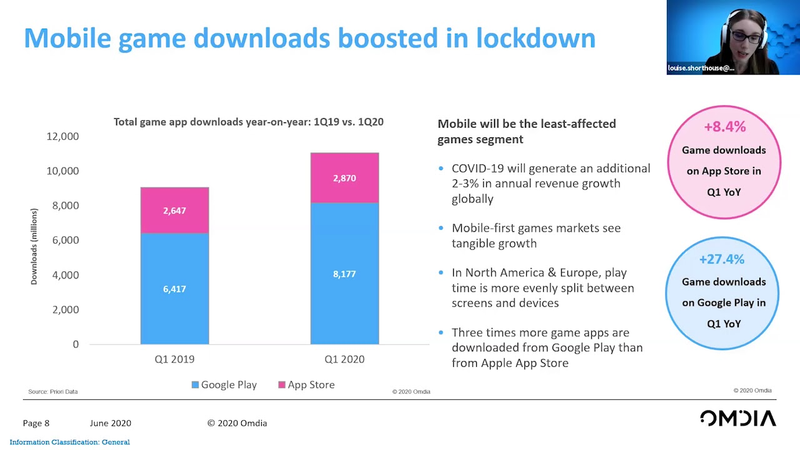
intensifying whilst its activity in the games market remains more muted something else we're seeing is an increased focus on internal expansion rather than acquisition activity and by dance is a really good example of this and it really it prevents and it presents a lower risk in an unstable economic environment like we're currently in so we're expecting the cove in nineteen out break to generate an additional two to three percent in annual revenue growth for the mobile games market this balance is greater growth in markets like China with the more modest increases that we see in western territories so mobile will be the least affected game segment this chart actually shows q1 and it's worth noting that in q1 the virus had a very limited impact in many mobile first markets places like South Korea Japan and also India so in territories where mobile is the primary platform of choice for games consumption user activity will
increase even more but in markets like North America and Europe where playtime is more evenly split between screens and devices we're seeing a greater share of this extra recreational time being spent on fixed side platforms so a lot of these players are actually turning to PC and console and this has been evidenced by steams consecutive records concurrent play accounts and also industry decisions by Sony and Microsoft to limit download speeds on their consoles in China specifically publishers of some of the biggest games increase the frequency of their updates in the first quarter and this resulted in several peaks of user activity for top games like honor of kings and peacekeeper elite we also saw $0.10 enhance social features for its poker game and this prompted a huge upsurge in popularity and it actually turned out that they needed to introduce extra servers to cope with this
increased in demand so as with PC online games in China Mobile should also prepare for a potentially sharp user decline after the pandemic proceeds and I think many publishers will start to introduce less demanding gameplay elements in order to retain these new users that they've acquired through the pandemic so um do data shows that in-app ads account for around 40% of mobile games revenue with end user spend taking a majority share so innovation around ad formats things like rewarded video interactive and playable ads and even augmented reality ads will continue to grow in significance and also popularity over the next few years the covert 19 pandemic has seen a lot of brands freeze or even cut their advertising budgets and this will of course have a knock-on effect on in-game advertising revenue advertisers are also
really vulnerable to AD and brought fraud which threatened to erode advertiser trust in things like measurement and view ability but during lockdown many publishers are of course trying to expose more people to their titles so they will likely continue to spend on app installs install campaigns particularly because this is a really key revenue stream of in-game advertising so ultimately advertising will remain has remained and will continue to remain important throughout the crisis because many consumers will still be looking for free content to consume and now I'm going to a Content trend so I'm gonna focus on a few key titles and genres in April Animal Crossing pocket camp saw its best month for global downloads since its launch three years ago in 2017 and it peaked at over five million so this was primarily driven by two factors the first one being the lockdown measures
and the second one being the release of the switch title new horizons in March so there was a lot of hype circulating on social media in the lead-up to the launch of the switch game and this led many people to download the mobile title while they were waiting for the launch of the switch game also people who didn't own a switch or maybe they didn't have the means or the desire to buy one could kind of tap into this global frenzy through downloading pocket camp and playing the mobile title also an importantly coronavirus related global switch shortages may also have led players to instead try out the mobile game there was a significant increase in New Horizons TV advertisements in March and this combined with widespread school closures in key territories like North America and also Western Europe will have also contributed to increased interest around the animal crossing IP and although downloads have increased
quite substantially the impact on revenue hasn't been quite as significant so net revenue only grew by 3 percent in April despite an almost 100% increase in downloads and this really reflects a broader trend around mobile games drawing curve at 19 so more and more users are coming to the platform because they're seeking free content but generally these users are not overly familiar with the space or the business or the monetization models and so they're reluctant to spend and I think pocket camp is actually quite aggressively monetized through in-app purchases and it also has an optional in-game subscription with two tiers that was introduced last year and this undoubtedly was also quite off-putting to users who are new to the platform kovin 19 obviously represents a huge threat to location-based augmented reality titles and what's noticeable in this trial immediately I think is Dragon
Quest walks considerable decline in that revenue but actually this can't be attributed to Cove in nineteen as the game is confined to Japan so in the first quarter of this year a large scale outbreak had yet to occur in Japan the impact of coronavirus was still very minimal there so this decay that we're seeing is therefore due to other factors so q1 tends to see a broad decline in revenue and engagement in Japan versus q4 which sees very high seasonal spend and also the game was only released in the fourth quarter of last year so it hasn't actually been around that long and and user activity immediately post-launch tends to reach a peak that can't easily be reclaimed in later months so augmented reality titles only account for around 3% on revenue in the global mobile games market so this is still a very small amount per kamongo
has thrived during lockdown it hit peak monthly active users for the year so far in March almost 17 million and towards the end of March Niantic announced changes to all of its location-based augmented reality games including Pokemon go but also Wizards unite and these changes would make the games a lot easier to play from home so the USA and Japan are the most substantial markets for Pokemon go with the combined territories accounting for around 65 percent of App Store net revenue in the first quarter of this year the virus only really started gaining traction in these countries much later in the quarter and as a result the measures taken to assist at home play unlikely to offset any notable decline that we see through the second quarter and this really underlines the importance of being flexible and responsive as a developer or a publisher because in introducing these measures Niantic has effectively avoided what could have been
a very heavy decline the board game app genre saw higher growth in downloads than any other mobile games category in April at 29% so globally people are turning to these apps as a way of connecting with friends and family during lockdown when it's not possible to play physical board games anymore and actually board game apps attracts a much broader demographic than many other genres like RPGs or strategy games including older users and also people again who don't necessarily identify as gamers or game players there were a couple of other categories that saw a lot of growth particularly on the Google Play Store in March so educational games saw a rise of almost 50 and a half percent in downloads and interestingly RPGs also saw an almost 16 percent increase in installs as well so
this is just a more focused look at one of the board games Scrabble which was originally published by EA and then it was recently acquired by scope Li and relaunched as Scrabble go with quite a new aesthetic so on the bottom right there you can see the different home screen so the one on the left is for the newly launched Scrabble go and the one on the right is for the original Scrabble so you can see already that they look quite different and feedback from some of the mature and more established players of the previous more kind of traditional Scrabble app has been very negative and there's been a bit of a backlash but at the same time new users are being acquired from younger generations and one of the effects of this pandemic is that traditional board games are becoming a much more important part of the kind of new digital age and as with the kind of broader game spectrum they provide a way to connect with people via a common interest so this an increased interest around ball game apps will flatten when
the pandemic recedes many non gamer users will ultimately leave the platform and return to physical games when they can but there will definitely be a lasting effect and a small percentage will remain engaged and this is something that we're expecting to see across the board so in this final segment I'm going to explore the impact of previous recessions on the industry and just identify some of the lessons I think we can take from these scenarios so gaming's lifespan as a commercial proposition is actually very brief compared to things like television and cinema which have been around for almost a century games are also at the forefront of technological change in terms of many things so device usage distribution virtual socializing for example and lots more and this restlessness and also complexity means that fundamental changes are occurring all the time almost continuously and
this makes it very difficult to isolate possible impacts of recessions during 2008 which is a period I'm gonna touch on briefly in the last couple of slides digital delivery and also connectivity were only really beginning to be explored and mobile was on the cusp of emerging as this kind of global superpower in gaming and even now things like VR AR and especially cloud intend to be really quite transformative to the games landscape and I'm sure that in several years time the picture of the industry will be quite different to what it is today so there have been pandemics during the lifespan of the games industry things like SARS Ebola swine flu but actually they've been quite well contained and their impact on developed regions was quite minimal so Cove in nineteen is really the first pandemic to have such a hugely widespread impact and this unprecedented
nature of its consequences make it very difficult to compare with past recessions or to look to past recessions as indicators of them what might be to come so the two scenarios I'm going to briefly cover in terms of their impact on the games market are the Great Recession in the USA in 2008 and also the Sendai earthquake recession in Japan in 2011 so here we have consumers spend on console content and services both leading up to and after the Great Recession in the u.s. in 2008 so this is just the plain view to give a clear idea of the broader picture and significantly there is the kind of psychological nature of console generations to consider here so Xbox 360 and ps3 launched in 2005 2006 and that's where we really start to see the beginnings of this steep incline in spending and then ps4 launched at the end of 2013 and that's really where we can see spend beginning to accelerate again so while
this sloping decline might look quite severe there are actually several more secular trends that are driving this downturn rather than the recession so the peak you can see in 2008 is actually exaggerated due to the popularity of games like Guitar Hero and we fit so peripheral led games that were temporarily really popular and had very high average sale prices they drove up average sale prices for the whole segment but their popularity quickly faded and also in 2010 this is around the time that mobile began to emerge as this really disruptive force in gaming and this is also around the time that we saw the shift from feature phones to smartphones so around this time the long-expected transition to digital from physical is also beginning to take hold but implementation was very slow and several large publishers were quite exposed from 2010 to 2015 and ultimately
it ended up taking kind of several years for digital to start maturing and for it to really drive a fresh peak of spend here we have mobile games downloads and consumer spend most leading up to and after the Sendai Earth earthquake recession of 2011 in Japan so again this is the plain view just to give a clearer idea of the broader picture you can see quite clearly that although downloads continue to climb and appear unaffected spenders very flat in 2012 which is the year following the earthquake which heavily suggests evidence of a recessionary impact so just to emphasize that there is strong evidence of flattening spend seen in 2012 but the trend is otherwise very robust 2012 is clearly very out of step with the general growth story that we see here but there are also some other factors to
bear in mind in terms of the wider picture so Japan was always hand held centric in terms of console and when you combine this with its advanced implementation of the device group for gaming these growth curves are really not that surprising also market maturity in 2016 meant that spend was still growing even though downloads had leveled out by that point of course now top games can persist at the tops of the top of the charts for many many years maintaining strong average revenues per user also the concentration of high spending individuals in Japan perhaps exacerbates the recessionary impact here so we've spent per user was lower but more evenly spread across the population and the effect perhaps would not have been quite so stock and so Japan has the highest spend per capita in the world at the time of the recession mobile was of
course still very young as the game's platform it wasn't well established business models were still being defined and users were still getting accustomed to mobile gaming and this made it more vulnerable to economic shudders I think and so the recessionary impact that's shown here will almost certainly not be replicated in future scenarios and of course Japan is a very unique market particularly in terms of mobile so these are some key takeaways that I think are the most important points from this deck primarily the fundamental games market forces are more likely to steer consumer habits than recession so growth and decline stories will vary considerably across territories strong growth in mobile first markets will be balanced by more modest growth in the West and the post-crisis recessionary decline will reflect this also low price entertainment products tend to be quite
resilient during recession and so we expect to see potential flattening of spend into the third and fourth quarters of this year and perhaps into 20 to 2021 overall but certainly not a heavy decline creators must capitalize on exposure to large audiences while dealing with internal challenges so despite the internal difficulties that I'm sure so many people are facing it's really crucial for companies to take advantage of the increased exposure afforded by this kind of event when there are so many people in lockdown try to circumvent a negative impact through being pre-emptive responsive and dynamic so the industry pivot to digital has made the segment even more robust and it's important to take advantage of this as we saw with Pokemon go prepare for increased traffic but not necessarily increased spend so a lot of the growth that we're seeing is partially due to an influx of non gamers who are seeking and
downloading free content but they can be unfamiliar with monetization models and therefore not willing to spend finally and most importantly to reiterate and look primarily to fundamental games market forces when predicting recessionary impacts so the game is market is not entirely recession proof I think we definitely saw that during the Sendai earthquake recession in Japan but internal factors do turn to hold Broadus way than recession and that's me thank you very much for listening thank you very much yeah I love the fact you keep saying the words fundamentally games exactly there's so much good stuff though in terms of looking at the date right particularly like that case where you showed about half of 2009 actually it was not necessarily a decline it was
actually the arrival of new you know distribution methods becoming kind of more dominant yes following a previous peak that was unrelated so I think that's fascinating to see that now we lit a time but I'm going to ask this question we now have an increased demand for mobile games but this a tendency may decrease significantly with the end of the lockdown is that honest do you is it true that hard times have yet to come for indie developers and if so how long do you think that will last can you just repeat the first there's been an increase in demand for mobile games which potentially could be down to the lockdown yes so afterwards there may be a declining in usage and then then that could potentially impact in particular indie games recession coming essentially for games well I think the games market is extremely resilient to recession
particularly as it tends to be made up of a lot of low cost as I mentioned kind of low cost entertainment items I suppose digital items I think although we are definitely going to see it a kind especially in terms of downloads because actually spend hasn't been hugely affected if we look at the broader picture it's more in terms of heightened engagement and also an increase in downloads so while that will come back down to earth I suppose we're definitely gonna see a kind of small percentage of these users remaining because they've discovered the platform they've discovered games that they enjoy and they want to stick around and I think games will probably have more staying power than other apps things like relating to kind of food delivery kind of that sort of stuff because I think people will download them when they need them and then you know have an escape quality to them and I think you
know particularly in times of hardship that is something that people reach to and and too often sadly it's alcohol so you know at least we're a relatively healthy outlet for that escape yes absolutely yes and I think that's kind of them supported by what I said about governments and Education bodies using games as ways to facilitate interaction between students or communities and things during that and thank goodness we've seen a change of attitude from the w-h-o who performed a bid we're talking about us being evil unlike ambling yeah better get me started and now it's actually really healthy because it's a great way to connect people so let's hope that we get more balanced kind of views Louise as always thank you for so much very much to share all those slice everybody as well of course yeah thank you so much thanks to his ticket
you
Summary
The games industry demonstrates significant resilience during socio-economic crises, largely due to the accessibility, cost-effectiveness, and social utility of gaming. During the COVID-19 pandemic, the sector functioned as a vital tool for remote connection, education, and entertainment, attracting a surge of non-gamers. While the industry is not entirely immune to economic downturns, historical data suggests that internal market forces—such as platform transitions, hardware cycles, and evolving business models—often exert more influence on revenue trends than macroeconomic recessions.
Mobile gaming remains the dominant segment, with the pandemic expected to drive an additional two to three percent in annual revenue growth. However, this growth is uneven; mobile-first markets like South Korea and Japan experienced higher user activity, while Western territories saw a more balanced distribution of playtime across PC and console platforms. Despite a massive influx of new users, monetization remains a challenge, as many newcomers are unfamiliar with in-app purchase models and primarily seek free content. Consequently, while download numbers have spiked, revenue growth has not always scaled proportionally.
Operational challenges during the pandemic included infrastructure strain and delays for AAA titles, though smaller developers found opportunities to gain visibility as major marketing budgets were paused. Looking forward, the industry should anticipate a post-lockdown decline in user traffic as casual players return to physical activities. To mitigate this, developers are advised to prioritize flexible, responsive engagement strategies and incorporate less demanding gameplay elements to retain newly acquired users. Ultimately, while the industry is well-positioned to weather economic instability, long-term success depends on navigating the transition from temporary pandemic-driven engagement to sustainable, long-term player retention.


















Comments