1 free read left. Create a free account for unlimited reading + AI research.
Create free accountArticle Breda University of Applied Sciences
1 free read left. Create a free account for unlimited reading + AI research.
Create free accountArticleBreda University of Applied Sciences
The work responds to a gap in existing research, which has rarely compared how different platforms of city-building games afford learning.
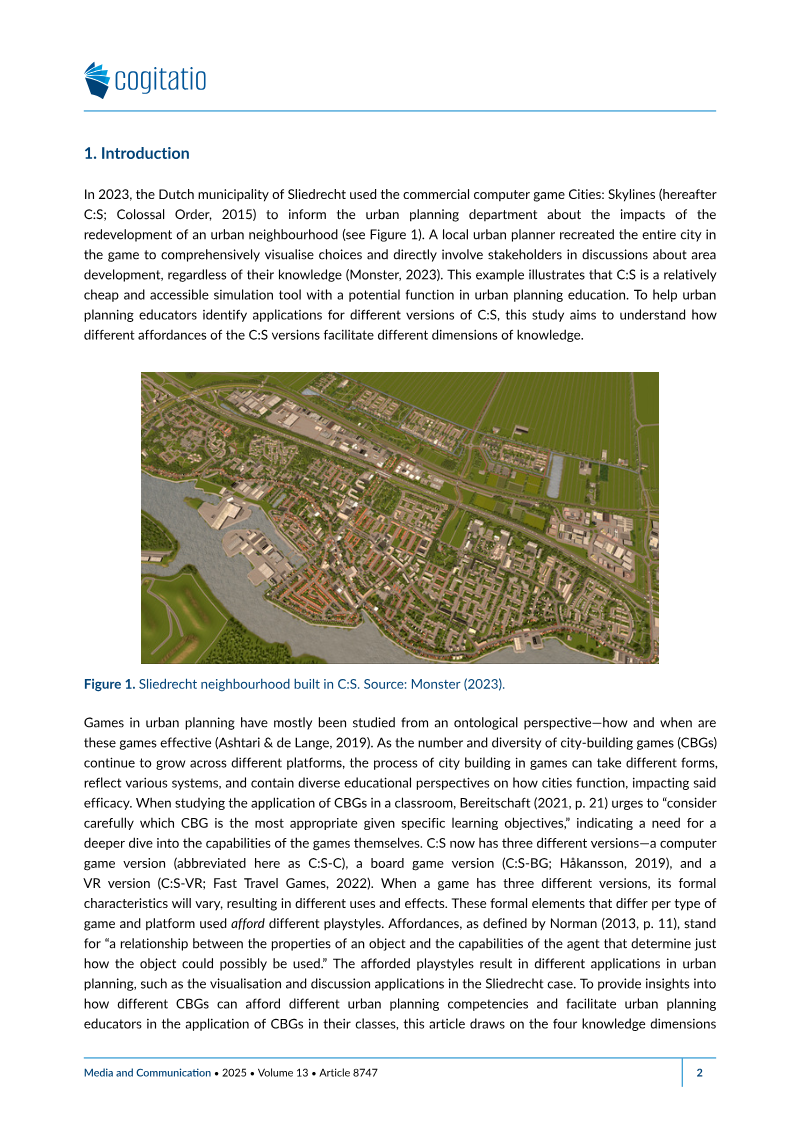
This study examines how three versions of the city-building game Cities: Skylines (the computer, board game, and virtual reality editions) support urban planning education, using affordance analysis grounded in Anderson and Krathwohl's four knowledge dimensions: factual, conceptual, procedural, and metacognitive. The work responds to a gap in existing research, which has rarely compared how different platforms of city-building games afford learning. It is motivated in part by the Sliedrecht case, in which the game was used for public visualization and stakeholder discussion.
The central finding is that each version supports a distinct profile of knowledge. The computer version best supports conceptual and procedural learning through a semi-realistic simulation of interrelated urban systems, such as zoning dependencies and the decay of public transport catchments, and its modding capability allows real-world buildings to be introduced. The VR version supports factual and metacognitive learning through a first-person perspective that conveys realistic height and distance. The board game abstracts urban relationships into gamified rules and permanent choices, which makes it especially effective for metacognitive reflection and collaborative, role-based discussion, though its theoretical value depends on whether the focus is city building or play itself.
The authors conclude that no single version is universally superior and that the appropriate choice depends on the domain being taught: transportation and logistics suit the computer edition, public policy and citizen participation suit the board game, and design-focused fields suit VR. The analysis is limited to the Cities: Skylines versions and rests on analytical rather than empirical grounds. The authors therefore recommend future testing with urban planning students, interviews with educators, and attention to contextual factors such as digital literacy and available classroom technology.
Each row is a game or company this document names, each column a document, oldest first. A mark means that document names it. Select a row to see those documents.

Breda University of Applied Sciences · 2026
Breda University of Applied Sciences · 2026
Breda University of Applied Sciences · 2026



Breda University of Applied Sciences · 2026
Breda University of Applied Sciences · 2026

Breda University of Applied Sciences · 2026



Breda University of Applied Sciences · 2026
Breda University of Applied Sciences · 2026

Breda University of Applied Sciences · 2026
Breda University of Applied Sciences · 2026
Breda University of Applied Sciences · 2026
Breda University of Applied Sciences · 2026
European Conference on Games Based Learning (ECGBL) · 2026