1 free read left. Create a free account for unlimited reading + AI research.
Create free accountWhitepaper European Conference on Games Based Learning (ECGBL)
1 free read left. Create a free account for unlimited reading + AI research.
Create free accountWhitepaperEuropean Conference on Games Based Learning (ECGBL)
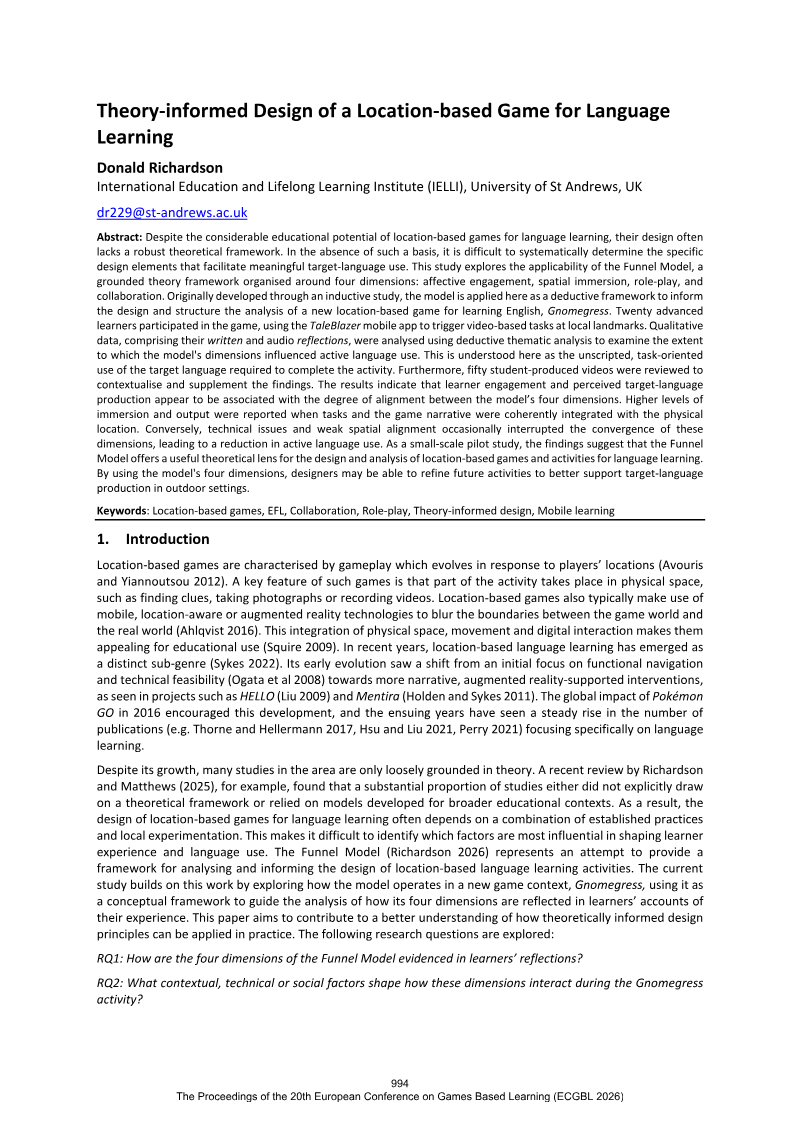
Twenty advanced university students played Gnomegress via the TaleBlazer app, completing video-based tasks at urban landmarks.
This study examines whether the Funnel Model, a grounded theory framework built around affective engagement, spatial immersion, role-play, and collaboration, can guide the design and analysis of a location-based game for English learning. The model was applied deductively to Gnomegress, a game set in Karlsruhe, Germany, in which twenty advanced university students used the TaleBlazer app to complete video-based tasks at urban landmarks. Their written and audio reflections were analysed thematically using the four dimensions as coding categories, supplemented by fifty student-produced gameplay videos. The findings suggest that learner engagement and perceived target-language production were associated with how well the four dimensions aligned, particularly when tasks and narrative were coherently tied to physical locations.
Students reported that the outdoor setting, the gnome storyline, and the persona of a fictional investigative organisation lowered anxiety about speaking in public and created functional reasons to communicate in English. Collaboration in small groups sustained target-language use in navigation and decision-making, though some groups slipped into German during less structured moments. Technical issues with the app and weak links between gnome locations and their surroundings occasionally weakened spatial immersion, and learners tended to prioritise narrative engagement over technical frustrations.
The authors frame these results as a small-scale pilot, noting limitations including a single cohort, a short development period, and the risk that the deductive framework shaped interpretation. The study concludes that the Funnel Model is most useful as an analytical and design-guiding lens rather than a predictive theory, and that further research across larger and more varied learner groups is needed.
European Conference on Games Based Learning (ECGBL) · 2026



European Conference on Games Based Learning (ECGBL) · 2026
European Conference on Games Based Learning (ECGBL) · 2026



European Conference on Games Based Learning (ECGBL) · 2026



European Conference on Games Based Learning (ECGBL) · 2026



European Conference on Games Based Learning (ECGBL) · 2026



European Conference on Games Based Learning (ECGBL) · 2026



European Conference on Games Based Learning (ECGBL) · 2026



European Conference on Games Based Learning (ECGBL) · 2026



European Conference on Games Based Learning (ECGBL) · 2026



European Conference on Games Based Learning (ECGBL) · 2026



European Conference on Games Based Learning (ECGBL) · 2026
European Conference on Games Based Learning (ECGBL) · 2023
DiGRA · 2023
European Conference on Games Based Learning (ECGBL) · 2026