1 free read left. Create a free account for unlimited reading + AI research.
Create free accountWhitepaper European Conference on Games Based Learning (ECGBL)
1 free read left. Create a free account for unlimited reading + AI research.
Create free accountWhitepaperEuropean Conference on Games Based Learning (ECGBL)
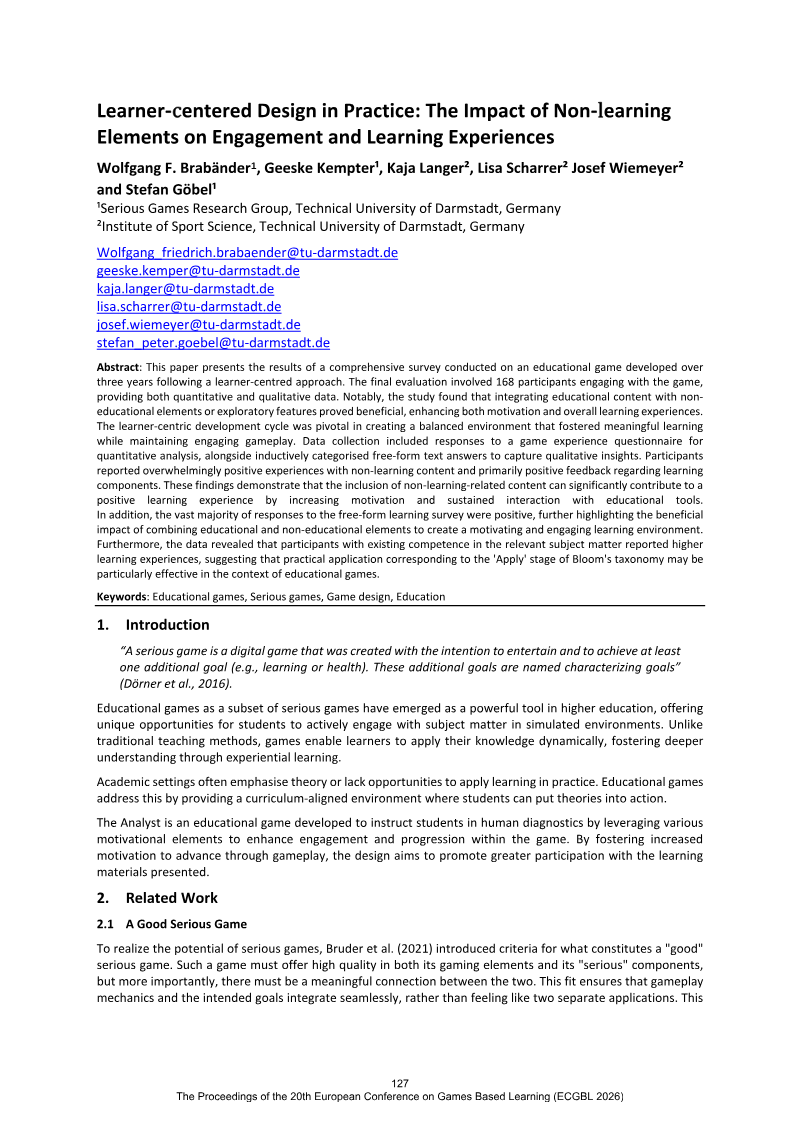
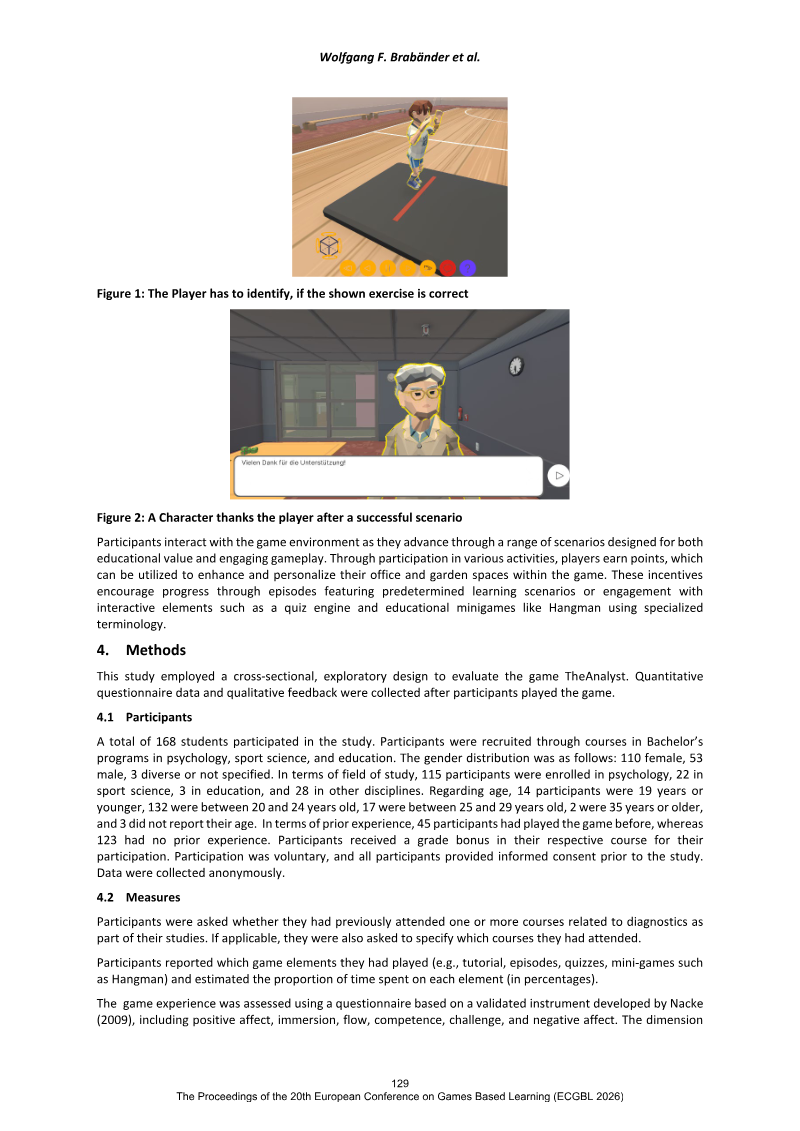
The Analyst teaches human diagnostics through simulated professional tasks, quizzes, and mini-games. Students played freely in a single cross-sectional session.
The study evaluates "The Analyst," an educational serious game for undergraduate students in human science disciplines such as psychology, sport science, and education, designed to teach human diagnostics through simulated professional tasks, quizzes, and mini-games. The researchers, based at Technical University of Darmstadt, examined how learner-centered design and the integration of non-educational gameplay elements affect engagement and perceived learning. The sample comprised 168 students who played the game freely for roughly 40 minutes in a single cross-sectional session, after which they completed a Game Experience Questionnaire adapted from Nacke (2009), learning-outcome items, and a free-text prompt that was analyzed inductively with an LLM-supported approach and manual refinement.
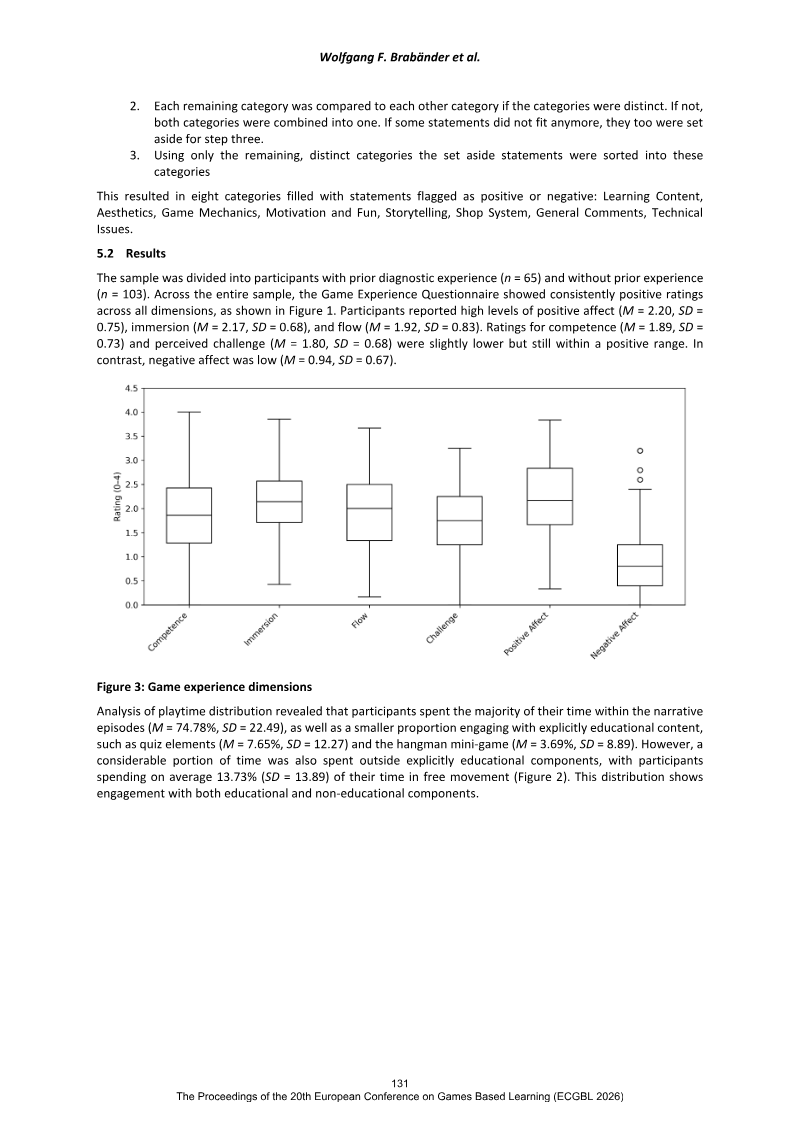
Results indicated consistently positive player experience, with high ratings for positive affect, immersion, and flow and low negative affect. Participants spent most of their time in narrative episodes (about 75%), with smaller shares on quizzes (about 8%), Hangman (about 4%), and free movement (about 14%), showing engagement with both educational and non-educational components. Perceived learning was moderate but positive, with active engagement rated most highly and overall learning gain rated lowest. Participants with prior diagnostic experience reported significantly greater knowledge increase and understanding, with small-to-medium effect sizes. Of 414 coded free-text statements, 241 were positive and 173 negative; positive feedback concentrated on game mechanics, storytelling, the shop system, and motivation, while negative feedback centered on technical issues and usability, particularly clunky controls and bugs.
The authors conclude that combining educational content with motivational and exploratory elements supports sustained engagement without undermining learning goals, while cautioning that the evidence concerns perceived rather than objectively measured learning. The cross-sectional, self-report design precludes causal claims, and the prototype's technical shortcomings may have affected results. The authors plan follow-up studies using objective performance measures and further refinement of the game.

European Conference on Games Based Learning (ECGBL) · 2026



European Conference on Games Based Learning (ECGBL) · 2026

European Conference on Games Based Learning (ECGBL) · 2026



European Conference on Games Based Learning (ECGBL) · 2026



European Conference on Games Based Learning (ECGBL) · 2026



European Conference on Games Based Learning (ECGBL) · 2026



European Conference on Games Based Learning (ECGBL) · 2026



European Conference on Games Based Learning (ECGBL) · 2026



European Conference on Games Based Learning (ECGBL) · 2026



European Conference on Games Based Learning (ECGBL) · 2026



European Conference on Games Based Learning (ECGBL) · 2026



European Conference on Games Based Learning (ECGBL) · 2026
European Conference on Games Based Learning (ECGBL) · 2025
European Conference on Games Based Learning (ECGBL) · 2025
European Conference on Games Based Learning (ECGBL) · 2024